Zimbabwe’s Hyperinflation: Fiscal Failure, Economic Collapse, and the Death of a Currency
Zimbabwe’s hundred-trillion-dollar note became the symbol of a catastrophe driven by unbudgeted political spending, agricultural collapse, shrinking output, and a central bank that financed deficits by printing ever more money. As price controls emptied stores and trust in the Zimbabwean dollar evaporated, citizens turned to foreign currencies and barter, ending hyperinflation only after abandoning the national currency. The crisis showed that money derives its value not from printed zeroes, but from productive capacity, credible institutions, and public trust.
By MyAudioBooks.ai ·
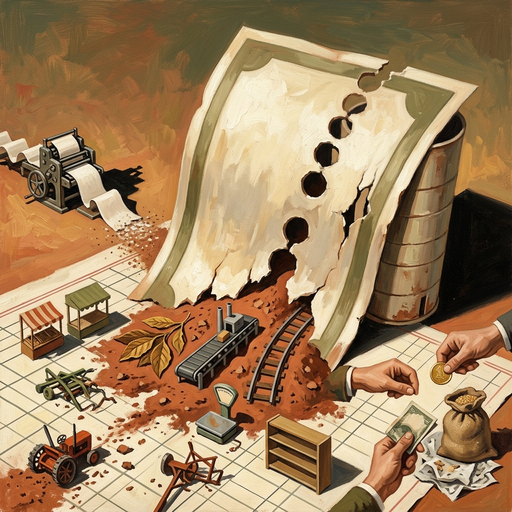
Zimbabwe's one-hundred-trillion-dollar banknote carries a numeral one followed by fourteen zeroes. It remains the largest face-value denomination any sovereign government has ever issued for legal circulation. A popular story claims that when this bill entered circulation, it was worth so little that it could not buy a single commuter bus ticket across the capital city of Harare. That claim frames a deeper structural mystery. A banknote is ultimately paper and ink, yet it represents an economy's underlying legal and productive order. How does that order unravel so completely that a government issues currency in the trillions, only for society to cast it aside entirely?
At My Audio Books dot A I, you can create your own audiobooks from prompts, turn your documents into audio, all with one subscription, and store your items in your own personal library.
At its independence in nineteen eighty, Zimbabwe inherited one of the most diversified and resilient economic structures on the African continent. Highly developed commercial agriculture yielded consistent food surpluses and lucrative cash crops, earning the country widespread recognition as the breadbasket of southern Africa. Robust manufacturing plants, extensive mining operations, and a reliable rail and road network supported a domestic currency that initially traded at a higher value than the United States dollar. The catastrophic collapse that occurred decades later did not take place in an economy that lacked physical wealth or institutional foundations. It unfolded across an established industrial and agricultural base through a compounding sequence of fiscal choices and policy failures.
Every sovereign government finances its public operations through three fundamental mechanisms: levying taxes, borrowing from capital markets, or issuing new currency. The balance among those levers determines national economic stability. In Zimbabwe, the Ministry of Finance established official budget allocations, while the Reserve Bank of Zimbabwe served as the central bank tasked with preserving monetary order. Under President Robert Mugabe, political commitments and state patronage increasingly diverged from the government's ability to raise tax revenue or access formal credit.
Understanding this trajectory requires a precise distinction between standard inflation and true hyperinflation. Inflation refers to a persistent rise in the broad price level, eroding the purchasing power of each individual monetary unit over time. Simply printing larger numbers on a piece of paper does not create new wealth; it merely dilutes the existing money stock. In professional economics, hyperinflation is formally defined as an environment where prices increase by more than fifty percent in a single month. At that threshold, prices compound so rapidly that they double every few weeks, completely dismantling the normal functioning of markets.
Zimbabwe officially crossed into hyperinflation in early two thousand seven, but the underlying vulnerability had accumulated across three distinct phases. The crisis began with massive, unbudgeted fiscal expenditures during the late nineteen nineties. It accelerated into severe agricultural disruption, production collapses, and uncontrolled money creation throughout two thousand eight. Finally, it culminated in early two thousand nine, when the domestic currency ceased to function as money. The central question is not simply why prices spiraled, but how political spending, plunging domestic output, and central bank money printing combined into an irreversible cycle.
The initial structural rupture in Zimbabwe's public finances emerged in late nineteen ninety-seven. Confronted by organized demonstrations from veterans of the country's liberation war, the Mugabe administration conceded to immense unbudgeted payouts. The government awarded lump-sum gratuities and lifelong monthly pensions to roughly fifty thousand claimants. This sudden commitment amounted to several percent of the entire national budget, yet the treasury had arranged no new tax measures and no foreign borrowing to cover the expense. On November fourteenth, nineteen ninety-seven, an event remembered in financial markets as Black Friday, foreign investors and local enterprises dumped the currency. The Zimbabwean dollar plunged by roughly seventy percent against the United States dollar in a single trading session.
A second severe fiscal strain followed almost immediately. In nineteen ninety-eight, Zimbabwe deployed thousands of troops to the Democratic Republic of the Congo to intervene in a regional conflict on behalf of President Laurent Kabila. Sustaining an expeditionary military force thousands of kilometers away required hundreds of millions of dollars in operational logistics, fuel, ammunition, and hardware. A substantial portion of this expenditure was conducted off the official parliamentary budget books. The campaign drained the state's scarce foreign exchange reserves and deepened structural deficits that the treasury could not close through normal revenues.
The definitive shock to the physical economy arrived in the year two thousand with the implementation of fast-track land reform. The government authorized the rapid, compulsory seizure and redistribution of thousands of large-scale commercial farms without compensation for land title. While presented politically as a correction of colonial-era land inequalities, the chaotic execution dismantled the backbone of commercial agriculture. Commercial farming had been Zimbabwe's primary source of foreign currency earnings, led by high-grade Virginia flue-cured tobacco and export horticulture, alongside staple grain production.
Commercial agriculture did not exist in isolation; it anchored Zimbabwe's broader industrial ecosystem. Large farms provided essential raw materials to domestic food processing facilities, edible oil producers, textile mills, and packaging manufacturers. In return, agricultural export revenues supplied the foreign currency necessary to import diesel fuel, electricity, agricultural fertilizers, spare parts, and industrial equipment. When commercial farm yields collapsed, the entire supply chain broke down. The International Monetary Fund documented that between two thousand and two thousand seven, Zimbabwe's real gross domestic product contracted by roughly forty percent. It fell by an additional fourteen percent in two thousand eight alone.
As economic output shrank, international relationships deteriorated. Western governments and multilateral institutions imposed targeted financial sanctions on prominent political figures and state-owned entities, while international lenders suspended concessionary credit due to accumulated loan arrears. The domestic consequences were devastating. Widespread food deficits, surging unemployment, crumbling hospitals, and severe malnutrition turned an institutional collapse into a humanitarian catastrophe.
With tax revenues collapsing, commercial credit cut off, and foreign exchange reserves exhausted, the state turned directly to the printing press. When a sovereign government monetizes its fiscal deficits, it creates new currency units, either physically or electronically, to pay public salaries, fund political programs, and meet domestic debts. Under the leadership of Reserve Bank governor Gideon Gono, the central bank abandoned ordinary monetary safeguards and became the primary financier of state expenditures.
The central bank engaged in unprecedented quasi-fiscal operations. These were state expenditures conducted directly by the monetary authority that bypassed the legislative budget process entirely. The bank subsidized fuel imports, purchased agricultural equipment for political patronage, financed loss-making state corporations, and bought foreign currency on the informal street market at massive premiums. By keeping these operations off the Ministry of Finance's formal ledger, the government concealed the true size of its public deficits. However, every unbacked allocation expanded the domestic money supply, flooding the banking system with liquidity.
Printing paper money cannot create real goods. As billions, and eventually trillions, of newly minted Zimbabwean dollars chased a rapidly shrinking supply of food, fuel, and manufactured products, prices adjusted upward to reflect real physical scarcity. In mid-two thousand seven, the government attempted to suppress inflation by administrative order, declaring strict price controls across retail shops. The authorities deployed police squads and price-monitoring inspectors to force store owners to slash retail prices by fifty percent or more, arresting thousands of shop managers and executives accused of profiteering.
The intervention produced immediate catastrophe. Store owners could not replenish their inventory when mandatory retail price ceilings fell below the wholesale cost of goods. Within days, formal retail shelves across the country stood completely empty. Basic commodities disappeared from legal storefronts and shifted entirely into an underground parallel market. On the street, transactions operated beyond state control, and prices rose higher than before to compensate traders for the severe legal risks of selling black-market goods.
As the general public recognized that the currency was being aggressively diluted, economic behavior adapted. Money functions as a unit of account, a medium of exchange, and a store of value. When people anticipate that the purchasing power of their wages will halve within days or hours, holding cash guarantees a total loss. The velocity of money—the frequency with which each note is exchanged—accelerated dramatically. Workers rushed to spend their earnings the moment they received them, buying any physical asset available before prices climbed. Businesses and citizens systematically abandoned the local currency, demanding foreign cash such as the South African rand and the United States dollar for everyday goods and services.
To keep pace with the accelerating velocity of prices, the central bank repeatedly redenominated the currency and printed notes with ever-larger face values. In August two thousand six, the bank removed three zeroes from the currency. In August two thousand eight, it removed ten zeroes. In February two thousand nine, it slashed twelve more. Across the entire crisis, authorities removed twenty-five zeroes from the nominal currency. Between these sweeping reissues, commercial cash shortages forced the central bank to print bearer cheques and temporary emergency notes with short expiration dates. In January two thousand nine, the Reserve Bank issued the one-hundred-trillion-dollar banknote.
While the physical note confirms the utter destruction of the paper currency's value, the popular claim that it could not buy a single commuter bus ticket requires critical scrutiny. When the one-hundred-trillion-dollar bill was issued on January sixteenth, two thousand nine, consumer prices and transit fares were fluctuating from hour to hour. Commuter omnibus operators had largely stopped accepting Zimbabwean dollars altogether, insisting on payment in South African rand, United States dollars, or small barter goods. In the isolated instances where operators still accepted local currency, the exchange value differed sharply depending on the time of day, the specific route, and the parallel market exchange rate. The bus-fare anecdote vividly captures the collapse of everyday commerce, but it remains an uncorroborated generalization rather than a fixed economic record without a verified date, route, and market price.
Calculating the actual pace of Zimbabwe's price explosion created immense technical obstacles for economists. Standard measurement relies on a consumer price index, which tracks the cost of a standardized basket of goods and services over time. When formal retail stores are empty and all trade moves to unregulated street markets, statistical agencies cannot compile accurate or meaningful data. The government ceased publishing official inflation numbers after July two thousand eight, when the reported annual inflation rate reached roughly two hundred thirty-one million percent. That was an extraordinary surge from the one hundred sixty-five thousand percent recorded just five months earlier in February.
Subsequent assessments diverged based on the underlying analytical method. The International Monetary Fund estimated that twelve-month consumer price inflation reached an apex of roughly five hundred billion percent in late two thousand eight. Economists Steve Hanke and Alex Kwok took a different approach, analyzing parallel-market exchange rates and purchasing power parity. They derived implied inflation directly from the daily depreciation of the Zimbabwean dollar against the United States dollar. Their model calculated that inflation peaked in mid-November two thousand eight at a daily rate of ninety-eight percent, which translates to an annualized rate of roughly eighty-nine point seven sextillion percent. That calculation established Zimbabwe's episode as the second most extreme hyperinflation in modern history, exceeded only by postwar Hungary in nineteen forty-six.
These different measurements do not contradict each other; they reflect different mathematical questions. Compounding a daily rate over three hundred sixty-five days generates an astronomical annualized figure that demonstrates the theoretical velocity of a twenty-four-hour peak. In contrast, trailing twelve-month figures record the actual cumulative price rise over a calendar year. Under either measurement, the substantive reality was identical. By late two thousand eight, the Zimbabwean dollar had completely failed as a reliable store of value and medium of exchange.
Hyperinflation in Zimbabwe did not conclude because the central bank regained its discipline or designed a more persuasive currency. It ended because the population rejected the domestic money entirely. By the closing months of two thousand eight, the economy had spontaneously dollarized from the bottom up. Wholesalers, corner markets, transport drivers, and ordinary citizens refused to accept local paper, conducting trade exclusively in foreign currencies or through direct commodity barter. Acknowledging that the domestic currency was effectively dead, the government formally legalized transactions in foreign exchange in early two thousand nine. It instituted a multicurrency system that named the South African rand as a reference currency, while the United States dollar became the dominant everyday medium of exchange.
Formal dollarization eradicated hyperinflation almost immediately. Because the Reserve Bank of Zimbabwe could not print United States dollars or South African rand, the state lost the physical ability to monetize its budget shortfalls or finance quasi-fiscal handouts through credit creation. The government was forced to accept a hard budget constraint: public spending could not exceed the tax revenue collected and the legitimate international loans secured. As the printing presses stopped, consumer price stability returned in hard-currency terms, and imported goods reappeared on formal retail shelves.
Nevertheless, dollarization introduced severe long-term economic complications. By giving up its domestic currency, Zimbabwe relinquished sovereign monetary policy. The central bank could no longer adjust domestic interest rates to manage business cycles or devalue currency to support export competitiveness. Crucially, it could no longer act as a lender of last resort to stabilize commercial banks during liquidity panics. The entire economic system became directly dependent on net inflows of physical foreign bank notes through export revenues, diaspora remittances, and external investment. When export earnings weakened or capital fled, acute cash shortages paralyzed the financial sector and restricted economic activity.
Furthermore, ending hyperinflation did not automatically repair the underlying productive infrastructure that a decade of crisis had shattered. Dormant industrial plants, decayed public power utilities, and disrupted agricultural property rights could not be cured simply by adopting a stable medium of exchange. Zimbabwe's historical ordeal demonstrated that real economic prosperity cannot be manufactured by political decrees or central bank presses. The value of money reflects the productive capacity, institutional credibility, and legal integrity of the society that stands behind it.
Money is ultimately a social covenant, sustained by tangible productive capacity, transparent governance, and public trust. When that covenant fractures, printing larger numbers on paper cannot replace the real goods and services an economy produces. As you consider dramatic economic claims today, reflect on the productive systems and institutional foundations that truly sustain the value of the currency in your own hands.