Yap’s Stone Money: How Oral Records Transferred Wealth Without Moving Stones
On Yap, enormous rai stones could change owners without moving—and, according to a recorded oral account, even a stone lost at sea retained its value. Their worth reflected the labor and danger of making them, their individual histories, and a community’s recognition of who owned them. Rai still serve ceremonial purposes today, offering a striking lesson for the age of digital payments: money depends less on moving objects than on trusted records of claims and obligations.
By MyAudioBooks.ai ·
Listen free: Yap’s Stone Money: How Oral Records Transferred Wealth Without Moving Stones
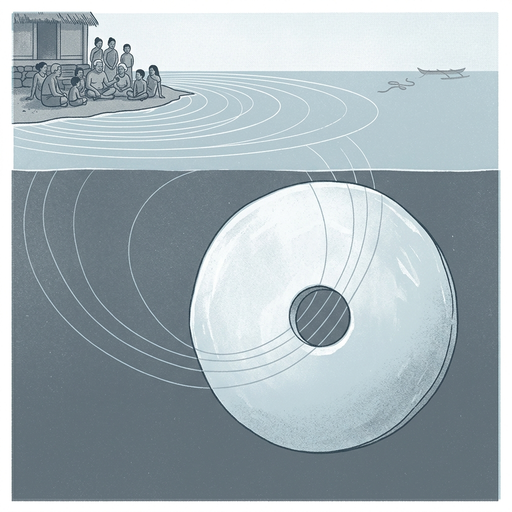
An ethnographically recorded account from the western Pacific tells of an expedition returning to the island of Yap with an enormous carved stone disk. On the journey home, a sudden storm hit the fleet. The heavy stone slipped from its bindings and plunged into the open sea. The sailors survived, returned to their village, and described what had happened, recounting the quality of the carving and the grueling labor spent quarrying it. The island's elders and chiefs weighed the testimony and accepted their word. They agreed that the physical loss of the stone beneath hundreds of feet of water did not destroy its value. For generations afterward, that unseen disk resting on the ocean floor continued to buy land, settle political alliances, and transfer wealth between families, exactly as if it were standing in the center of the village.
The episode exposes a paradox at the heart of economic life. It is easy to assume that money must be an object you can touch, carry, and hand to someone else to settle an exchange. Yet here, an unreachable stone performed the essential work of money without moving an inch. What truly gives money its power: the material object itself, the physical act of handing it over, or the shared social recognition of a claim?
At My Audio Books dot A I, you can create your own audiobooks from prompts, turn your documents into audio, all with one subscription, and store your items in your own personal library.
To understand how an invisible stone can hold purchasing power, we have to travel to Yap, a cluster of islands in the western Pacific that forms part of the Federated States of Micronesia. For centuries, Yapese society developed a monetary tradition centered on objects known locally as rai, though early Western observers often referred to them as fei.
Rai are not small pocket tokens. They are thick, circular disks carved from crystalline carbonate stone, each punctured through the center with a circular hole. In size, they range dramatically, from modest disks measuring about one foot across to monumental stones reaching ten or twelve feet in diameter and weighing several tons. The hole through the center was not designed to wear them as ornaments. Instead, it allowed workers to slide heavy wooden poles through the stone so teams of people could hoist, roll, and maneuver the disk across land and water.
These stones did not originate on Yap. The local geology is primarily metamorphic rock, which does not naturally produce the gleaming white or yellowish calcite that the islanders valued. Yapese voyagers had to travel roughly four hundred kilometers, or about two hundred fifty miles, across the open ocean to the limestone caves and quarries of Palau, focusing primarily on islands like Babeldaob and Koror.
When Western explorers first encountered these stones lined up along village pathways and outside traditional meeting houses, they often described them as giant coins. Yet rai are not coins in any conventional sense. They carry no stamped denominations, no government seals, and no fixed rates of conversion. A six-foot stone is not automatically worth six one-foot stones, nor can two stones be weighed against each other on a scale to calculate their relative purchasing power.
Furthermore, rai did not exist in isolation. Yapese economic life relied on a variety of valuables, including intricately woven mats and multiple types of shell money, particularly pearl oyster shells pierced and strung together. Different valuables fulfilled distinct social and practical obligations. While shells might handle more frequent transfers, the largest rai were reserved for major political settlements, compensation between villages, and monumental transfers of property.
This distinction points to a foundational economic truth: cash and money are not the same thing. Cash refers to physical tokens, like paper banknotes and metal coins, that pass from hand to hand to settle a purchase. Money, by contrast, is a much larger social technology. It is a system of rules, records, and shared agreements that allows a community to measure value, track obligations, and transfer wealth. Once we separate the social agreement from the physical token, the mystery of the stationary stone begins to unravel.
A central question in any monetary system is what makes a currency valuable in the first place. For rai, value was directly tied to the difficulty and danger of its creation.
Transporting several tons of stone across four hundred kilometers of open Pacific water in traditional outrigger canoes and wooden rafts was an immense technological and human feat. Before a single stone could be cut, Yapese navigators had to maintain delicate diplomatic and kinship relationships with Palauan leaders to secure quarrying rights. Once permission was granted, teams of laborers worked in dark, humid limestone caves, using fire, water, and adzes made of shell or basalt to carve rough disks from the rock.
The work was exhausting and perilous. Workers spent months, sometimes years, shaping and polishing the disks to achieve the desired symmetry, color, and smooth finish. Then came the most dangerous phase: loading stones weighing thousands of pounds onto bamboo rafts or lashing them between canoes to sail back home across unpredictable open seas. Many expeditions encountered severe storms. Historical records and oral genealogies preserve accounts of canoes overturning, stones sinking, and navigators losing their lives.
Because of this process, a stone's value was never a simple function of its physical dimensions. Size and stone quality mattered, but so did its biographical pedigree. A stone that cost the lives of skilled sailors or was brought back by a legendary navigator carried far greater social and monetary weight than a larger stone acquired without incident. The identity of the quarry, the craftsmanship of the carving, and the specific obligations incurred during the voyage were all woven into the stone's recognized identity.
Costliness in Yapese society was therefore both material and social. The community recognized the immense labor, political negotiation, and physical risk invested in each disk. When a rai arrived on the shores of Yap, it arrived not as an anonymous piece of rock, but as an enduring monument to human effort, diplomatic alliance, and seafaring skill.
Once a rai was brought to Yap, it was typically placed in a public location. Some were positioned outside the homes of high-ranking families, while others lined village dancing grounds or flanked the stone foundations of communal meeting houses. Many of these stones remained in the exact same spot for decades, or even generations. Yet during that time, their ownership could change repeatedly.
To understand how a stone can be spent without moving, we have to distinguish between physical possession, geographical location, recognized ownership, and social obligation. Physical possession means having your hands on an object. Location is simply the coordinates of where it sits on the earth. Recognized ownership, however, is a social fact. It describes whose claim to that object the community agrees to uphold.
In Yap, the transfer of a rai did not require rolling a three-ton disk across the island to a new owner's yard. Instead, an exchange took place through public announcement, ceremony, and the witness of community leaders. If a family used a large rai to purchase land or settle a significant debt, the parties involved, along with the village chiefs and elders, gathered to acknowledge the transfer. Everyone heard the terms, and everyone agreed that the stone standing beside the council platform now belonged to a different lineage.
The stone did not move an inch, but the recognized claim shifted completely.
This process functioned because Yapese society maintained an oral ledger. Without paper documents, computer servers, or written legal deeds, the community preserved its property records in shared memory. Every high-ranking family and village elder knew the history of the prominent stones in their district: who had brought each stone from Palau, which transfers had moved its title from one clan to another, and what social obligations remained attached to it.
This reliance on social recognition did not mean ownership was always frictionless or beyond dispute. Because records were kept in human memory and oral testimony, claims could be contested, reinterpreted, or challenged when political alliances shifted. In such moments, authority and social status mattered. The lineage that held the greater political standing and the backing of respected chiefs was far more likely to see its version of a stone's ownership confirmed. Recognized ownership was not an abstract mathematical balance; it was an active relationship embedded in village hierarchy, reciprocal duties, and political power.
This brings us back to the famous account of the stone lost at sea, an episode documented by American anthropologist William Henry Furness the third during his stay on Yap in nineteen hundred three.
According to the account passed down through local testimony, a crew had successfully quarried a magnificent, printless stone in Palau and secured it to a raft for the return voyage. Near Yap, a violent storm overtook the fleet. To save their own lives, the sailors had to cut the raft loose, watching the massive disk sink into the open water.
When the crew reached shore, they did not attempt to conceal what had happened. They approached their community, described the stone's dimensions and craftsmanship, and recounted the circumstances of the storm. The elders evaluated their testimony and confirmed the crew's integrity. The community concluded that the accidental sinking of the stone did not erase the labor that had carved it or the peril the crew had survived. Its existence as an asset was validated, and ownership of the sunken stone was formally established.
Decades later, when Furness inquired about the island's wealth, local residents pointed out to the sea and explained that one of the wealthiest families on the island owned a stone that nobody living had ever seen. That stone had been used in transactions to settle obligations and acquire goods just like the stones resting on dry land.
It is important to evaluate what this historical account actually represents. Modern researchers have no independent archaeological proof or specific geographic coordinates for this sunken disk. The story survives through oral history recorded by early twentieth-century ethnographers. But its historical truth does not depend on recovering the stone from the seafloor. What makes the account profound is that the Yapese people themselves considered it an entirely rational and practical arrangement.
The sunken stone illustrates the fundamental separation between an asset's physical accessibility and its social validity. The community did not need to touch the stone to verify its value, because the stone was never the source of the value in the first place. The value resided in the agreement of the community to treat the claim as valid. So long as the public memory persisted and the recognized authorities backed the claim, the purchasing power of the sunken stone remained intact.
Seeing rai operate in daily life dispels any notion that these stones were merely eccentric curiosities. They occupied a critical functional role in Yapese political economy.
Smaller stones did occasionally enter into transactions for essential goods, such as large catches of fish, agricultural products, or specialized timber for canoe building. But the true significance of rai appeared in broader social and political negotiations. Large stones were transferred to cement marriage alliances between prominent families, to compensate a village for assistance during warfare, to apologize for serious offenses, and to acquire rights to land.
In Western market exchanges, a payment typically ends the relationship. You pay cash for an item, take it home, and have no further obligation to the seller. In traditional Yapese society, the transfer of a rai operated on an entirely different logic. Giving a valuable stone often marked the beginning or the renewal of an enduring relationship. It established a reciprocal bond that might require political support, military loyalty, or ceremonial assistance for generations to come. The stone was both a settlement of past obligations and a living anchor for future ties.
Beginning in the late nineteenth century, this traditional monetary landscape faced profound external pressures through colonial encounters. Over several decades, Yap came under successive administrative control by Spain, the German Empire, the Empire of Japan, and eventually the United States following the Second World War.
European traders, most notably an Irish-American captain named David O'Keefe, recognized the islanders' desire for rai and introduced modern technology into the quarrying process. O'Keefe offered to transport Yapese laborers to Palau on steam-powered schooners and supply them with iron tools, explosives, and industrial ropes in exchange for copra and sea cucumbers.
This technological shift transformed stone production. Between eighteen seventy-two and nineteen hundred one, Yapese workers quarried thousands of stones using Western vessels and tools, producing disks far larger and in much greater quantities than had ever been possible with traditional rafts and shell adzes.
Yet the Yapese monetary system adapted in a revealing way. The community did not treat all stones equally. Islanders clearly distinguished between older stones quarried with stone tools and transported by traditional outrigger canoes, and the newer stones brought back on European ships. The older stones, having required far greater sacrifice and seafaring courage, retained vastly superior ceremonial and social value. The newer, machine-assisted stones, while still recognized, were considered less prestigious.
Eventually, changing labor markets, new commercial goods, and the disruption of long-distance sailing caused quarrying in Palau to cease altogether in the early twentieth century. Today, the official currency of the Federated States of Micronesia is the United States dollar, which is used for all routine commercial transactions, from buying groceries to paying taxes.
Yet rai have not disappeared into history. They remain deeply embedded in Yapese culture, serving as vital heirlooms, cultural property, and ceremonial markers. They are still transferred during significant traditional occasions, including customary marriage negotiations and village dispute settlements. Rather than being swept away, the stones coexist with the global banking system, performing cultural and political work that paper dollars cannot replicate.
When we examine the entire arc of Yap's stone money, we are forced to rethink what money actually is. Economists often describe money as a bundle of distinct functions: it acts as a medium of exchange, a unit of account, and a store of value. Rai performed these functions, but in a way that looks very different from modern banknotes.
Rai served as a store of value by preserving wealth across generations. They acted as a medium of exchange for high-level political, social, and land transfers. And they functioned as a measure of relative worth, allowing people to compare the significance of obligations and alliances, even though they lacked standardized numerical denominations.
In recent decades, economists and financial analysts have frequently compared Yap's rai to modern banking systems and digital currencies. The comparison is tempting. When you open a banking application and see a balance, you do not possess a stack of paper currency sitting in a private vault drawer with your name on it. Your balance is simply an entry on an electronic ledger. When you pay a merchant using a card or an electronic transfer, no physical cash travels through the air. A computer adjusts the numbers, debiting your account and crediting the merchant's.
In that specific sense, modern digital finance shares a profound conceptual root with the stones of Yap. Both systems separate the transfer of value from the physical movement of material objects. In both cases, wealth consists of a recognized claim within a community of users who trust the integrity of the record. The sunken stone on the Pacific seafloor is not functionally different from a row of digital bits stored in a server bank: neither has to be physically touched for its value to be transferred.
However, the comparison reveals its limits the moment we look at how the records are maintained. Modern banking depends on fungibility, which means that every dollar is identical to and interchangeable with every other dollar. It operates anonymously, allowing strangers who know nothing about each other to conduct transactions governed by standardized contracts and state-enforced laws.
Rai, by contrast, is completely non-fungible. Every stone possesses a unique identity, a specific history, and a known pedigree. Furthermore, the ledger that tracked rai was not an impersonal computer or a bureaucratic institution; it was a living social network of chiefs, elders, and kin groups. The value of a stone depended directly on who held it, where it was placed, and how the community interpreted its oral history.
Comparing rai to modern electronic ledgers can illuminate how claims are separated from objects, but it risks obscuring the kinship, ceremony, and political hierarchy that made the Yapese system work. Rai was never just an early version of an accounting software program. It was a comprehensive cultural architecture that bound communities together through shared obligations.
Historical questions remain open. Anthropologists and historians continue to debate precisely when rai production began. While popular accounts often claim the practice is two thousand years old, secure archaeological evidence confirms quarrying only over the past several centuries, leaving earlier timelines an area of ongoing study. Similarly, scholars continue to investigate how deeply nineteenth-century colonial contact reshaped the traditional meanings and volumes of the stones.
What remains clear is that the paradox of the stone at the bottom of the sea dissolves once we understand what money truly is. Money is not stone, gold, paper, or electronic data. Those are merely the physical materials and communication channels we use to anchor our agreements. Money is the shared recognition that lets an obligation be measured, recorded, and settled.
The next time a digital payment shifts your account balance without a single dollar changing hands, consider the lesson of the sunken stone of Yap. Wealth does not reside in the physical object you can hold, but in the community that keeps the record and the shared agreement that makes that record count.