Why Don't You Remember What You Read?
In a Washington University lab, students who reread a passage four times forgot 52% of it in a week; students who tested themselves three times forgot 14%. Roediger and Karpicke's experiments show why rereading and highlighting train recognition, not retrieval — and why repeated studying after learning added nothing while repeated testing added a large effect. The 2013 review of ten study techniques rates practice testing and distributed practice at the top, and the highlighter at the bottom. The fix is not a better pen. It is closing the book.
By MyAudioBooks.ai ·
Listen free: Why Don't You Remember What You Read?
One week after the study session, the students who had reread the passage the most forgot the most. In a laboratory at Washington University in St. Louis, volunteers learned short scientific prose passages and then split into groups: some studied the material four times, some studied it three times and tested themselves once, and some studied it once and tested themselves three times. When the researchers measured forgetting across the week, the four-times-studying group had lost fifty-two percent of what it once recalled. The group that had tested itself three times had lost fourteen percent.
Our verdict is that you do not have a bad memory; you have a bad study method, and it is bad in a specific, measurable way. Rereading and highlighting train the wrong skill, because recognition is not retrieval. They make the page feel familiar, and familiarity is precisely the feeling you will mistake for knowledge at eleven at night before the exam, the presentation, or the meeting. This book is about what the experiments actually measured — and why the method that feels best is so often the one that teaches least.
At My Audio Books dot A I, you can create your own audiobooks from prompts, turn your documents into audio, all with one subscription, and store your items in your own personal library.
The Crossover
The paper that should have ended the highlighter's reign appeared in Psychological Science in two thousand six, written by Henry Roediger and Jeffrey Karpicke. Their question was almost rude in its simplicity: is a test merely a measuring device, or is it itself a way of learning? In educational settings, they observed, tests are treated as instruments of assessment — something done to students after the learning is over. Their experiments asked what happens if you treat the test as part of the learning instead.
In the first experiment, students read a passage and then either studied it again or took a free-recall test on it, with no feedback. Then everyone sat a final test, some after five minutes, some after two days, some after one week. Read the results slowly, because the whole book lives inside them. After five minutes, the restudiers recalled eighty-one percent of the passage's idea units, and the self-testers seventy-five percent. Rereading won. After two days, the restudiers were down to fifty-three percent, and the self-testers held sixty-eight. After one week, the restudiers retained forty-two percent, and the self-testers fifty-six. The lines cross. The method that wins at five minutes loses at every interval that actually matters to your life.
Notice what this means for the way you judge your own studying. If you had checked these students at five minutes, you would have crowned rereading the superior technique — and that is exactly the check you perform on yourself when you finish a chapter, flip back through it, and feel the warm glow of recognizing every sentence. The experiment's five-minute condition is your evening. The one-week condition is your performance review, your board meeting, your licensing exam, your attempt to explain the book to a friend. We grade our methods at the interval where they look best and use them at the interval where they fail.
The authors' own summary deserves to be read as a complete sentence, because it collapses a century of schoolroom assumption into one line: "Testing is a powerful means of improving learning, not just assessing it." Not a means of measuring learning after the fact. A means of improving it, in the doing. Every time you close the book and force yourself to produce the idea, you are not auditing your memory. You are building it.
The Confidence Trap
Now the cruel part, because if the story ended with testing works better, you could simply swap techniques and be done. The deeper finding is that your own judgment is rigged against the swap. In the two thousand six experiments, repeated studying did something more dangerous than waste time: it inflated the students' confidence in their ability to remember the material, even as their delayed retention fell behind the self-testers. The method that produced worse learning produced better feelings about learning.
Two years later, in the journal Science, Karpicke and Roediger pushed the knife in further. Their abstract opens with the assumption most of us carry without noticing: "Learning is often considered complete when a student can produce the correct answer to a question." You got it right once, so you are done. Their experiment dismantled it. Students learned foreign-language vocabulary in the usual study-test cycle, and then, once an item had been answered correctly, it was quietly dropped from further studying, or from further testing, or from both. The result, in their words: "Repeated studying after learning had no effect on delayed recall, but repeated testing produced a large positive effect." None. Going back over what you already got right did nothing measurable for you a week later. Retrieving it again did a great deal.
And then the finding that should be taped above every desk: the students' "predictions of their performance were uncorrelated with actual performance." Uncorrelated. Not weakly related, not roughly indicative — the students' own forecasts of how well they would do carried no statistical relationship to how well they did. Even university students, the authors noted, seemed unaware of the effect they had just demonstrated on themselves.
Psychologists call the general problem metacognition — your thinking about your own thinking — and the specific failure here has a mechanism you can feel if you pay attention. Rereading makes the text fluent. Each pass is easier than the last, the sentences process faster, the ideas arrive with less effort, and your brain reads that ease as mastery. But the ease is coming from the page, not from you. The words are doing the work. Recognition is not retrieval, and the fluency of a reread page is evidence only that the page is still there. When the page is gone, so is the feeling. What remains is whatever you can produce — and producing is the one thing rereading never asks you to do.
The Report Card
If you want the whole field graded in one place, the document is a two thousand thirteen monograph in Psychological Science in the Public Interest, led by John Dunlosky with four colleagues. They took ten learning techniques and rated each for utility — not whether it can ever work under some laboratory condition, but whether it generalizes across learners, materials, and tasks well enough to recommend. It is the closest thing studying has to an official report card, and almost nobody who owns a highlighter has read it.
Two techniques came out at the top. In the authors' words, "Practice testing and distributed practice received high utility assessments" — distributed practice meaning spreading your study across time rather than massing it into one sitting. Three more received moderate ratings: elaborative interrogation, which is asking yourself why a fact is true; self-explanation, which is explaining the material to yourself as you go; and interleaved practice, which is mixing different topics or problem types within a session instead of blocking one at a time.
And five techniques were rated low utility: summarization, highlighting, the keyword mnemonic, imagery use for text learning, and rereading. Sit with the list for a moment, because it is essentially the standard study kit. The techniques most students actually use are the ones the review could not recommend. The authors note the bleak irony themselves: "Most students report rereading and highlighting" — the two most popular methods in the survey literature — and yet, across the evidence, these techniques do not consistently boost performance. The review's advice is blunt: other techniques should be used in their place, practice testing instead of rereading.
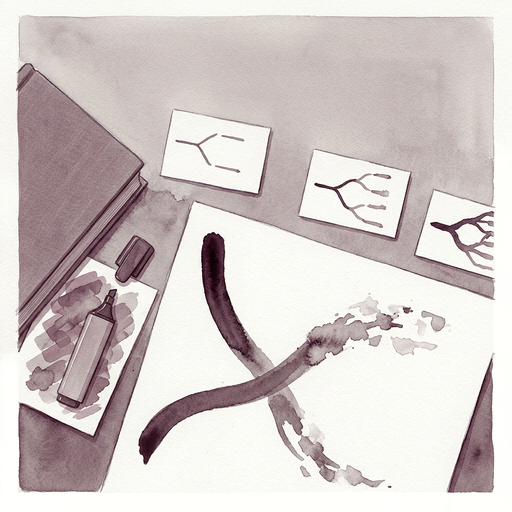
Why does highlighting land at the bottom? Not because ink is evil, but because of what the gesture trains. Sweeping a marker across a sentence is a recognition act: you are tagging the sentence as important while it sits in front of you. It asks nothing of you when the book is closed. It is entirely possible to highlight a whole chapter in a state of near-total mental absence — everyone has done it, the yellow growing as the comprehension shrinks. The highlight creates a second illusion on top of fluency: the illusion of having done something. The page looks processed, so you feel you processed it.
The moderate-rated techniques deserve their moment too, because they are the ones you can bolt onto retrieval for free. Elaborative interrogation is the habit of stopping at a claim and asking why it should be true; self-explanation is walking yourself through the reasoning instead of nodding at it. The review's caution about them is itself instructive: their benefits generalize across some variables, but they "have not been adequately evaluated in educational contexts." That is what an honest evidence rating looks like — promising, mechanism plausible, classroom proof still thin. It is also a useful contrast with the two top-rated techniques, whose evidence survived exactly that generalization test.
Rereading fails for a sibling reason. It is massed, passive, and page-dependent. It rehearses the situation of reading, not the situation of remembering. And here our read of the whole report card is worth stating plainly: the techniques at the top share one property, and the techniques at the bottom share its absence. The top techniques make you produce something — an answer, an explanation, a reason, a retrieval spread across days. The bottom techniques let you remain a spectator of your own studying. The report card is not really ten separate grades. It is one grade, awarded ten times, for the same distinction.
At My Audio Books dot A I, you can listen to this story and thousands of others that explore the hidden science and mechanics behind the headlines.
Retrieval, Repeated
The obvious defensive question at this point is whether the testing effect is just a trick of exposure. Perhaps the self-testers simply saw the material more, or differently. The experiments were built to strangle that explanation. In the two thousand six studies, the restudiers got the same number of encounters with the passage as the testers got encounters plus tests — the comparison was arranged so that additional studying was the only difference. The testers still won on every delayed test. And in the Science experiment, the design was even more brutal: after an item was learned, extra studying of it contributed nothing to delayed recall, while extra testing contributed a large effect. Same items, same students, same session. The active ingredient was not exposure. It was retrieval.
Why would pulling an idea out of your head strengthen it more than putting it back in front of your eyes? The working account in this literature is that memory is not a shelf you stock but a route you walk. A retrieval is an act of reconstruction: you have to find the idea using whatever cues you can assemble, and that effortful search — especially when it is difficult and succeeds anyway — leaves the route easier to travel next time. Restudying, by contrast, hands you the destination and spares you the journey. The struggle you feel when you try to recall something and it almost comes is not a sign that learning is failing. It is close to the mechanism itself.
The two thousand seven follow-up in the Journal of Memory and Language showed the dose-response directly. Across learning trials, students either kept the standard study-test rhythm or had conditions altered so that studying or testing dominated. Recall climbed across trials in all conditions, but the conditions diverged in what survived a week. The researchers' procedure even captured the shape of recall over ten full minutes, minute by minute, to make sure everyone had exhausted what they knew before the scoring. The pattern held: repeated retrieval was the active driver of durable learning, and the standard condition's advantage during the learning phase itself was no guarantee of what lasted.
There is one more implication here that the self-help versions usually miss. If retrieval is the mechanism, then the test does not have to look like a test. Nobody is asking you to sit with a proctor and a number two pencil. Closing the book and writing five sentences from memory is retrieval. Explaining the chapter out loud to an empty room is retrieval. Asking yourself, before you turn the page, what the last section actually claimed — and waiting for the answer — is retrieval. The form is irrelevant. The effortful production is everything.
The authors of the two thousand six paper end with an observation about the system, not the student. In university lecture courses, they note, tests are typically given just two or three times a semester and are generally perceived as a bother by faculty and students alike. Their belief is that testing is neglected in education precisely because everyone treats it as measurement. Read that again with your own routine in mind. If the instrument of learning is treated as a nuisance to be minimized, then of course the default becomes rereading: it is what is left when you have organized your whole study life around avoiding the one activity that works.
The Strongest Case for Rereading
Now the defense, at full strength, because the experiments themselves supply it and honesty requires it. Rereading won at five minutes. Eighty-one percent against seventy-five. If your actual use case is to hold material for a few minutes — to read a name and a number and walk across the room to use them — the short-term advantage of another pass is real, and the literature does not pretend otherwise. Restudying is not poison. It is a short-term tool with a long-term bill.
Highlighting has a better defense than its reputation suggests, too. The review's objection is to highlighting as a default, indiscriminate ritual. A reader who argues with the text, marks the two sentences that carry the argument, and writes a challenge in the margin is doing something much closer to elaborative interrogation than to yellow washing. The highlighter is not the problem; the passivity is. A pen can be a retrieval instrument if you use it to close the book and write, rather than to decorate open pages.
There are also honest limits to the testing evidence. Most of the classic experiments used free recall without feedback, which means a student can practice an error with great effort and consolidate that instead. The remedy is not to abandon retrieval but to check it: retrieve first, then compare against the source, then retrieve again. And the strongest results come from laboratory paradigms with prose passages and vocabulary lists, on university students, over intervals of days and weeks. The review's moderate ratings for some promising techniques exist precisely because classroom evidence is thinner than laboratory evidence. We think the honest summary is not that schools are one trick away from perfection, but that the direction of the effect is among the most replicated findings in learning science, while the size of the prize in any particular classroom still depends on how well the technique is implemented.
Finally, there is the emotional objection, and it deserves respect: many people hate tests for reasons that have nothing to do with memory. Tests were the instrument of judgment, and being told to study by testing can sound like being told to live inside the worst part of school. But notice the reframe the research forces. The retrieval that builds memory is private, ungraded, and allowed to fail. A blank page you cannot fill is not a verdict on you; it is a map of exactly what to retrieve again. The experiment's version of testing is the opposite of the school's version in the only way that matters emotionally: nobody is keeping score.
How to Read So You Remember
So here is the protocol, built from the documents rather than from a productivity aesthetic. Read the section once, properly, with the intention of explaining it. Then close the book. This is the moment your whole habit will resist, because closing the book feels like abandoning the material. It is actually the beginning of learning it. Write down, or say out loud, everything you can produce: the claim, the evidence, the example, the caveat. Do not peek. The effort is the point.
Then open the book and check. Mark what you missed and what you got wrong, because those are the items that need the next retrieval, not the ones you already produced. Retrieve first, verify second. That order is the entire trick, and it is the reverse of the usual one. Most of us verify first — reread — and never retrieve at all. We think the reason this feels so unnatural is that it front-loads the sensation of failure. Rereading is a comfortable way to avoid discovering what you do not know, right up until life discovers it for you.
Then space the retrievals. This is where distributed practice, the review's other high-utility technique, joins the argument. One retrieval tonight, another in two days, another in a week. Each one will feel harder than a reread would, and each one is doing more. You are not reviewing; you are rebuilding the route at increasing distances, which is precisely the condition under which the experiments found the largest advantages.
And when you are learning several things at once, mix them. Interleaved practice — alternating between topics or problem types rather than polishing one to a shine before moving on — feels scattershot and scores well in the review for the same underlying reason: it forces you to keep selecting and retrieving the right approach instead of repeating the same motion on rails. The comfort of blocked practice is the comfort of knowing what comes next. Learning, inconveniently, lives on the other side of that comfort.
For the reader who is not a student, the translation is direct. After a chapter, a report, a paper, a long article: close it, and produce the argument. If you cannot, you have not read it in the sense that matters — you have only watched it. Keep a notebook of retrievals rather than a notebook of transcriptions. Ask why a claim is true before you accept it. Explain it to someone, or to the empty room. The highlighter can stay in the drawer for all of this. The experiments do not ask you to buy anything. They ask you to do the one thing that feels like cheating and is actually the work: stop looking at the answer.
Recognition is not retrieval — that is why you forgot what you read, and it is also the way back. The page will always be happy to see you again. Your memory needs you to leave it, and then find your way back without it.
At My Audio Books dot A I, you can create fiction, non-fiction, and turn your documents into audio, all stored in one place with a single subscription — plus get instant access to thousands of audiobooks and deep-dive investigations. Learn more today at My Audio Books dot A I.