Two and a Half Days from Impact: The Slow-Motion Crisis Above Our Heads
One satellite constellation now dodges collisions every two minutes — 200,000 maneuvers in six months. The scientists who measure orbital safety say the margin is two and a half days if the steering ever stops. How we built a shell of machines faster than the rules to run it.
By MyAudioBooks.ai ·
Listen free: Two and a Half Days from Impact: The Slow-Motion Crisis Above Our Heads
Somewhere above your head right now, at an altitude of about three hundred and fifty miles, a satellite the size of a small car is traveling at seventeen thousand miles per hour, and it is about to swerve. It does this a lot — on the order of once every two minutes, somewhere in its constellation, a satellite fires its thrusters to get out of something's way. In the first half of this year alone, the largest constellation ever assembled — thousands of satellites, more than half of everything humanity currently operates in orbit — reported performing more than two hundred thousand collision-avoidance maneuvers in six months, and the filing that carried the number read less like a boast than like a warning light. Two hundred thousand decisions, most of them automated, each one a calculation that some object — a dead satellite, a fleck of debris, another live machine — was on a path that came too close. This is what low Earth orbit has become: not the silent void of the imagination, but a highway at rush hour, where the vehicles travel at ten times the speed of a rifle bullet and the near-misses are counted in the hundreds of thousands.
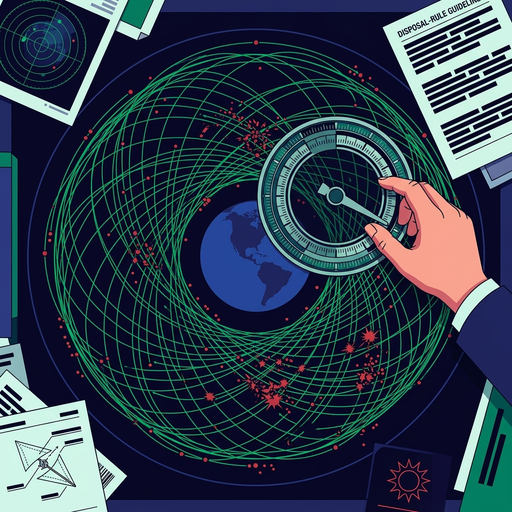
The people who watch this traffic for a living have a number they use to measure how close we are to losing control of it, and the number has a name: the CRASH Clock — Collision Realization And Significant Harm — an estimate of how long it would take, if every maneuvering system went dark at once, before the first catastrophic collision occurred between large objects. The clock is not a metaphor. It is a calculation from the actual object catalog, the actual orbits, the actual traffic density. And this year, the scientists who maintain it reported that the clock had ticked down to about two and a half days. Two and a half days of margin between the managed highway and the first link in a chain reaction that could, in the worst case, render the most useful orbits around Earth unusable for generations.
This is the story of the slow-motion crisis above our heads — of how we built a shell of machines around the planet faster than we built the rules to run it, what the two and a half days actually measure, and why the people who understand the problem best disagree about whether it is already too late. It is also, like every story about a commons, a story about who is responsible for the sky when the sky belongs to everyone and no one.
At My Audio Books dot A I, you can create your own audiobooks from prompts, turn your documents into audio, all with one subscription, and store your items in your own personal library.
First, the physics that makes this unforgiving, because the numbers explain the fear. Objects in low Earth orbit move at roughly seven and a half kilometers per second — fast enough to cross the continental United States in about nine minutes. At those speeds, collision energy is not about size; it is about velocity squared. A bolt, a paint fleck, a fragment of a shattered rocket stage — each carries the kinetic energy of a hand grenade. A defunct satellite hitting a live one does not dent it; it shatters both into thousands of new projectiles, each one joining the traffic at the same lethal speed, each one now a candidate to strike something else. That is the chain reaction the specialists fear, and it has a name older than the problem's urgency: the Kessler syndrome, proposed in nineteen seventy-eight by two NASA scientists, Donald Kessler and Burton Cour-Palais, in a paper that asked a question almost nobody was asking then: what happens if the debris population grows past the point where collisions beget more debris faster than the atmosphere can clean it up? The paper was a thought experiment more than a forecast — the orbit belt of nineteen seventy-eight held a few hundred payloads — and its power was purely logical: it showed that a threshold must exist somewhere, a density beyond which the belt feeds itself, and that the threshold would be crossed quietly, without any single dramatic event, the way a lake goes from clean to choked. For thirty years it was cited mostly as a curiosity. It is not cited that way anymore. Past that point, the shell feeds itself. Each collision manufactures the debris for the next, and the orbit belt becomes a self-sustaining shrapnel field — not immediately, not like the movies, but on a timescale of decades, which in the life of a civilization's infrastructure is no timescale at all.
For forty years the syndrome was a warning, and the warning had a safety valve built into it: the atmosphere. Below about six hundred kilometers, the faintest whisper of air drag still reaches, and it pulls dead objects down — slowly, over years or decades, but inexorably. Low Earth orbit, the specialists said, is self-cleaning, if you are patient and if you do not feed it faster than it cleans. The megaconstellation era broke both halves of that bargain. In the space of six years, the number of active satellites in orbit more than quintupled — from well under two thousand to over ten thousand, with the great majority belonging to a single company's constellation — and the filings describe what that means for the traffic: conjunction alerts — the warnings that two objects will pass within a danger distance — now arrive in volumes no human team could manually review, which is why the maneuvering is automated, which is why the system works only as long as the automation works. The two-hundred-thousand-maneuver figure is not a sign of failure. It is a sign of success at scale, and it is also a measure of how much success the system now requires every single day to stay ahead of the physics.
At My Audio Books dot A I, you can listen to this story and thousands of others that explore the hidden science and mechanics behind the headlines.
Now the clock, because it is the heart of this story and it rewards precision. The CRASH Clock asks a deliberately stark question: if the management stopped — all of it, every automated swerve, every ground controller, every station-keeping thruster — how long before the traffic produces the first catastrophic collision between large objects? Not the end of spaceflight. Just the first link in the chain. The answer, computed from the catalog as it stood this year, is roughly two and a half days, and the researchers who publish the number are careful about what it means: it is not a countdown to doom, it is a measure of dependence. The highway has become so dense that its safety is no longer a property of the road but of the continuous, active, automated steering of the vehicles on it. Remove the steering for a long weekend, and the probability of the first big collision stops being small. The same researchers added the detail that turns an unsettling number into a structural diagnosis: the density is now dominated by a handful of megaconstellations, and their analysis found that the situation where even perfect compliance with disposal rules fails to stabilize the debris population is no longer hypothetical — under plausible growth, the shell can cross the self-feeding threshold even with everyone following the rules. That is the sentence in the recent literature that should be read twice. For forty years, the debris problem was framed as a discipline problem: if operators behaved — disposed of their dead, avoided explosions, minded their tests — the sky would take care of itself. The new analysis says the frame has changed: past a certain density, good behavior is necessary but no longer sufficient, because the live traffic itself, through sheer proximity, generates the collision risk the debris used to own. The danger is no longer rule-breaking. It is the traffic itself.
The history that brought us here is shorter than it feels, and it runs on two kinds of events: the accidents and the choices. The accidents have names. In two thousand nine, an active American communications satellite and a dead Russian military satellite collided over Siberia at a closing speed of eleven kilometers per second — the first accidental hypervelocity collision of two intact spacecraft — and produced more than two thousand trackable fragments, most of which are still up there. The choices have names too. In two thousand seven, China destroyed one of its own weather satellites with a missile in an anti-satellite test, creating the largest single debris-generating event in history — over three thousand newly tracked fragments, some of which will orbit for a century. In twenty twenty-one, Russia did the same to a dead Soviet-era satellite, forcing the crew of the International Space Station — including its own cosmonauts — into their escape capsules as the debris cloud passed. Between the accidents and the choices, the debris population kept growing, and then the constellations arrived and changed the denominator of everything: more live satellites than ever, doing more good than ever — broadband to villages, disaster mapping, climate monitoring — in the same shell where the fragments of the bad decisions still circle.
The good deserves its own honest accounting, because it is the reason the traffic grows and the reason the answer cannot simply be stop. The constellations have put broadband into places no cable will ever reach — fishing villages, disaster zones, war zones, farms, ships mid-ocean — and they did it in half a decade, at consumer prices, in the teeth of every incumbent. Earth-observation fleets now image the whole planet daily, and the data feeds crop forecasts, wildfire tracking, insurance markets, and the climate science this channel has covered all year. The same shell that carries the debris risk carries, now, a measurable share of the planet's information infrastructure. That is not an argument for accepting the risk. It is the reason the risk is hard to price: the highway is genuinely useful, which is exactly why losing it would genuinely hurt.
The rules, meanwhile, are a patchwork with a hole at the center. There is no international traffic-control authority for space. There are guidelines — and the history of the main one is a parable in miniature. For decades, the rule of thumb was the twenty-five-year guideline: operators should arrange for their satellites to come down within twenty-five years of death, a number negotiated in an era of far less traffic, when a dead satellite circling for a quarter-century was an acceptable rarity. As the constellations swelled, some regulators began replacing it with a five-year standard — the American communications regulator adopted a five-year deorbit rule for the constellations it licenses — a fivefold tightening in the span of a few years, which tells you how fast the consensus moved. And there are national regulators, like the Federal Communications Commission, which has asserted authority over the orbital-debris practices of the constellations it licenses and has proposed measures from deorbit deadlines to, controversially, exempting satellite constellations from certain environmental review.
The tracking, meanwhile, is done largely by the United States military, which watches the catalog — the master list of every tracked object in orbit, maintained from a global radar and telescope network and updated around the clock — and issues the warnings the whole world relies on: a global public service provided, oddly, by one nation's air force. And the cleanup technologies — harpoons, nets, drag sails, robotic tugs that would grab the dead and drag them down — exist mostly as demonstrations, elegant and small, while the problem scales like the traffic. The demonstrations deserve their due, because they prove the physics if not the economics: a Japanese-led mission has flown a robotic servicer that rendezvoused with a prepared client satellite and held formation with it, a proof that the rendezvous half of the problem is solvable; European and British teams have flown nets, harpoons, and dragnets on test articles; and a first-of-its-kind mission is planned to grab an actual dead rocket body and pull it down. What none of these has yet shown is the part that matters for a shell of thousands of fragments: a business model. Removing one large dead satellite costs on the order of a hundred million dollars by current methods, and the catalog holds thousands of candidates — the cleanup era will begin, if it begins, when someone finds a way to make removal pay, and that someone has not yet appeared.
The strongest case against alarm — the argument that the system is working and the clock is being misread — deserves a full hearing, because it is held by serious people. No Kessler cascade has begun; the automated avoidance systems have, so far, a perfect record of preventing catastrophic collisions between large tracked objects; the megaconstellations fly low enough that their dead fall out of the sky in years, not centuries; and the same filings that report two hundred thousand maneuvers report a collision-avoidance system that is, by its own numbers, coping. The CRASH Clock, in this reading, measures a dependency we have every reason to keep maintaining — we do not panic that cities would flood if pumps stopped, because the pumps are reliable and redundant, and the same logic applies to the constellation's autonomy. Space has absorbed worse scares before, the argument runs, and the alarm underestimates the adaptability of the operators who profit from keeping the highway open. There is real force in this, and the perfect record is real too.
And the strongest case that the margin is genuinely fragile is written in the single points of failure. The avoidance system depends on tracking data that can be degraded, on automation that can share a common bug across a whole fleet, on solar weather — the same geomagnetic storm that makes the aurora dance heats the upper atmosphere, expands it, and changes every drag calculation in the catalog at once; a storm in twenty twenty-two knocked forty brand-new satellites out of the sky in a single batch, not by collision but by drag — the satellites had just been launched into a low parking orbit when the storm swelled the atmosphere at their altitude, and they fell out of the sky before their thrusters could climb them clear. Forty machines, lost to weather, in space, in one event. The operators' models now watch the Sun as carefully as they watch the traffic. It depends on no one testing another anti-satellite weapon into the crowded shell. And it depends, above all, on the traffic not growing faster than the management — while the filings and the launch manifests describe a sky filling by thousands more satellites per year, from more than one constellation, from more than one country. A system that requires two hundred thousand correct decisions a year to avoid the first bad outcome is not a system with a wide margin, whatever its current record. The perfect record is the thing being measured by the clock.
Three developments would disprove or confirm which reading of the sky is right, and each is observable. First, the independent trackers: as more nations and commercial firms field their own space-tracking networks, the conjunction data stops being a single nation's service and becomes a verifiable public utility — and the quality of that shared picture will show whether the world's accounting of the sky is keeping pace with the sky itself. Second, the large-constellation filings: watch the maneuver counts and the disposal compliance in the years ahead, because they are the honest telemetry of the problem — if maneuvers per satellite keep climbing, the density is outrunning the management even as the management improves. Third, the regulators: the licensing decisions now being written — deorbit deadlines, environmental review, liability for debris — are the first real attempt at rules for the megaconstellation era, and whether they arrive with teeth or as exemptions will decide whether the commons gets a traffic code before the traffic gets too thick to code. The sky is not falling. But the margin is a policy choice, and it is being chosen right now.
It is worth saying what this article has not claimed. It has not claimed that a Kessler cascade is imminent or inevitable; the leading researchers themselves describe the threshold as something we are approaching through growth, not something already crossed. It has not claimed the constellations are the villain; they are the largest single driver of new traffic and also of the world's orbital-debris compliance data, and both facts belong in the ledger. It has not claimed the two and a half days is a prediction; it is a dependency measure, and the researchers who publish it say so. And it has not claimed space commerce should stop; the argument here is about the traffic code, not the traffic.
Which returns to the satellite about to swerve, three hundred and fifty miles up, doing its quiet mathematics every two minutes. It is easy to hear the two and a half days as a doomsday number, and it is not that. It is a measure of something subtler and more modern: a piece of civilization's infrastructure that has become so dense and so fast that its safety is no longer passive — no longer a property of the place — but active, continuous, and automated, a steering wheel that can never be set down. The sky did not become dangerous in a day; it became dependent, one launch at a time, until dependence itself became the thing to measure. We built the highway first and the rules second, as we usually do. The question the clock asks is not when the sky falls. It is how long we are willing to drive like this — and whether we write the traffic code while the road is still navigable, or after the first pile-up teaches us the speed limit.
At My Audio Books dot A I, you can create fiction, non-fiction, and turn your documents into audio, all stored in one place with a single subscription — plus get instant access to thousands of audiobooks and deep-dive investigations. Learn more today at My Audio Books dot A I.