The Weddell Sea Polynya: How Wind, Salt, and Deep Heat Open Antarctic Sea Ice
In the 1970s, satellites spotted a vast patch of open water in Antarctica’s winter sea ice; after four decades, it returned near the underwater plateau of Maud Rise. There, storms and shifting salt can break the ocean’s protective surface layer, allowing deep heat to rise and keep the ice from closing. These openings reveal a powerful link between Antarctic weather and the deep ocean, though their effects on global circulation and carbon remain uncertain.
By MyAudioBooks.ai ·
Listen free: The Weddell Sea Polynya: How Wind, Salt, and Deep Heat Open Antarctic Sea Ice
In the depths of the Antarctic winter during the mid-nineteen-seventies, early earth-observing satellites captured an extraordinary sight. Amidst millions of square kilometers of freezing pack ice, an immense patch of completely open water held its ground. It returned across three consecutive winters, exposing dark ocean where bitter polar winds should have frozen it solid, before vanishing for roughly four decades. When exposed ocean refuses to freeze beneath sub-zero air, the explanation reaches thousands of meters downward into the hidden circulation of the planet.
At My Audio Books dot A I, you can create your own audiobooks from prompts, turn your documents into audio, all with one subscription, and store your items in your own personal library.
When polar scientists describe an opening of this kind, they use the term polynya, a word borrowed from Russian that designates an area of open water or unusually sparse ice surrounded entirely by sea ice. This is not a fracture through Antarctica's continental ice sheet, nor is it an opening leading into land. It is an open-ocean phenomenon, developing hundreds of kilometers away from the coastline within the Weddell Sea.
Most polar polynyas develop along coastlines. In those coastal zones, persistent winds blowing off the continental ice shelf push newly formed sea ice away from the shore, leaving open water in their wake like a conveyor belt. Oceanographers refer to these coastal clearings as latent-heat polynyas, because their survival depends on winds driving the ice away as fast as it freezes.
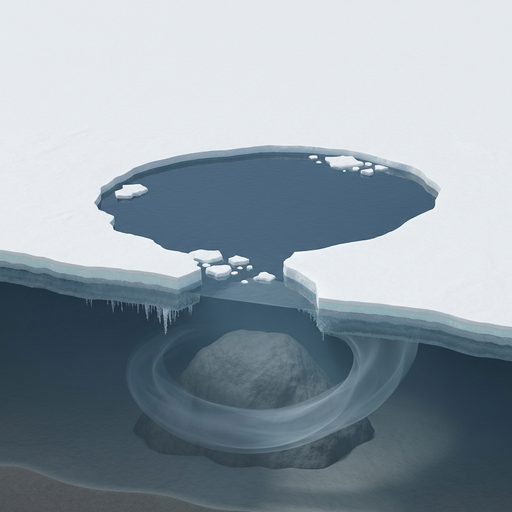
The opening in the Weddell Sea behaves very differently. It forms far out in the open ocean pack ice, where winds cannot simply blow the ice away against a distant shore. Modern observations place these recurring openings near Maud Rise, an underwater mountain plateau rising from the ocean floor around sixty-six degrees south and three degrees east.
The presence of Maud Rise is an essential part of the physical mechanism, not simply a geographic reference point. As deep currents strike the submerged flanks of the seamount, the topography forces water upward and generates swirling eddies. The underwater mountain preconditions the ocean above it, steering heat and salt closer to the surface.
Under normal winter conditions, a thick cover of sea ice acts like an insulating blanket, separating the ocean from polar air that often plunges tens of degrees below freezing. When that blanket is pulled back, heat loss accelerates dramatically. Heat escapes directly into the cold atmosphere, while freezing and evaporation alter the saltiness of the surface water.
At its historical maximum, the opening expanded across roughly three hundred thousand square kilometers. For scale, that is more than four times the size of the Republic of Ireland, which covers approximately seventy thousand square kilometers. The exact measured area depends on the sensor threshold used to define open water versus scattered ice, but the scale remains staggering.
To keep an expanse that large from freezing requires an immense, continuous delivery of heat from below. The central puzzle has two parts: what engine pumps that heat to the surface, and why does a region capable of such massive events go quiet for decades at a time?
The events recorded from nineteen seventy-four through nineteen seventy-six became the classic case of open-ocean deep convection in polar waters. During those three successive winters, satellites documented an unbroken cycle where surface water sank and mixed directly with the ocean interior. Later analyses confirmed that this vigorous overturning altered water properties thousands of meters down, leaving behind a cold deep-water signature that persisted for years.
Following nineteen seventy-six, roughly four decades passed without a comparable opening near Maud Rise. That quiet interval does not mean the region was completely static; smaller, short-lived rifts likely formed and closed undetected. Furthermore, continuous satellite monitoring only began in the early nineteen-seventies, providing a narrow window into the ocean's multi-century history.
Then, during the southern winter of twenty-sixteen, the ice opened once more. Between late July and mid-August, satellites recorded a relatively small, short-lived polynya over Maud Rise that persisted for about three weeks before freezing over.
The following year brought a far larger and more persistent event. Beginning in early September twenty-seventeen and lasting into mid-November, the ice pack parted again, stretching from the dead of winter into the polar spring. At its peak, one satellite analysis calculated an area of approximately two hundred ninety-eight thousand square kilometers, counting regions with sea-ice concentration below fifteen percent.
Published estimates vary depending on how sensors differentiate true open water from slush, thin pancake ice, and scattered floes. What remained clear was that an opening approaching the footprint of the mid-nineteen-seventies had returned.
Yet direct measurements from ships and autonomous floats revealed an important contrast. While twenty-sixteen and twenty-seventeen broke the four-decade silence, the modern mixing did not penetrate as deeply into the ocean interior as the events of the nineteen-seventies. Surface ice maps tell only part of the story; understanding why an opening persists requires examining the delicate layers of water hidden beneath the surface.
Under normal conditions, the Weddell Sea is carefully layered. At the surface sits a cold, relatively fresh layer of water maintained by melting ice and precipitation. Directly beneath that buoyant cap lies a much thicker reservoir known as Weddell Deep Water, which is slightly saltier and several degrees warmer than the surface.
Because fresh water is less dense than salty water, that thin, buoyant surface layer acts like a lid. It traps the vast reservoir of deep heat below, keeping it from reaching the ice. If that lid is compromised, the stored heat can escape.
The topography of Maud Rise provides the initial leverage. Currents flowing around the Weddell Gyre strike the submerged plateau, generating circulating eddies that bend the subsurface layers upward. Oceanographers describe this process as the doming of isotherms and isopycnals, where surfaces of equal temperature and density are pushed toward the sky. This bathymetric lift brings the warm, salty Weddell Deep Water hundreds of meters closer to the surface ice.
Atmospheric forces supply the next disturbance. Intense cyclonic storms driving across the Southern Ocean churn the upper ocean and push the sea ice apart. Strong winds alone do not create a lasting polynya; a storm passing over a strongly layered ocean simply closes up once the winds die down. A persistent opening requires a fundamental change in water density.
Winds blowing over the water also drive ocean currents at an angle to the wind, a process known as Ekman transport. Because Earth rotates, surface water in the Southern Hemisphere is deflected to the left of the prevailing wind direction. In twenty twenty-four, researchers identified wind-driven Ekman transport around Maud Rise as a decisive mechanism. As strong cyclonic winds blew across the ice edge, they steered higher-salinity water directly over the seamount.
Bringing saltier water into the surface layer weakened the density barrier that normally prevents deep mixing. When freezing air chilled this newly salted surface water, ice began to form, expelling concentrated brine into the liquid below. The combination of intense cooling and added salt made the surface water dense enough to sink.
Once surface water sinks, it triggers a self-sustaining convective loop. Sinking cold water displaces the warmer water below, forcing it upward into the open patch. That upward surge delivers a continuous supply of heat, melting incoming ice and keeping the opening exposed to the sky.
This loop links freezing air directly to stored ocean heat. It continues until atmospheric conditions shift, storms subside, or melting ice releases enough fresh water to rebuild the protective surface cap. Modeling studies suggest that the brief twenty-sixteen event played a key role in this sequence by preconditioning the water column, eroding the density barrier so that the larger twenty-seventeen opening could take hold.
The physical consequences of this ocean overturn reach across the globe. The Weddell Sea is one of the primary engines producing Antarctic Bottom Water, the densest and coldest water mass on Earth. Sinking along the perimeter of the continent, Antarctic Bottom Water spreads across the abyssal plains of the global ocean, driving a deep circulation branch that redistributes heat, oxygen, and carbon over centuries.
Polynya convection acts as a vertical ventilation shaft. Instead of circulating slowly over centuries, atmospheric properties—including oxygen and cold surface temperatures—are carried directly into the deep interior. At the same time, long-sequestered deep water is drawn up to the light.
Weddell Polynya events can modify this dense-water formation, though their total contribution remains a subject of ongoing research. Coastal polynyas along the continental shelf also produce vast amounts of dense water through brine rejection over shallow banks, and measuring the exact balance between open-ocean convection and shelf processes is challenging.
This convective mixing also creates what oceanographers call a heat paradox. An open polynya loses enormous amounts of heat to the freezing atmosphere, cooling the surface water. Because it taps into the deep reservoir, the event acts like a chimney, venting vast amounts of subterranean oceanic warmth that had been insulated beneath the ice.
Carbon moves in competing directions during these events. The deep water brought to the surface is naturally rich in dissolved carbon dioxide accumulated over centuries. When this water meets the atmosphere, it can release carbon gas directly into the air.
When spring arrives, sunlight penetrates the ice-free water. Unlocked from the dark ice pack and supplied with upwelled nutrients, the open water becomes an incubator for microscopic marine life. In twenty-seventeen, satellite sensors recorded an early, prolonged phytoplankton bloom over Maud Rise, driving exceptionally high biological productivity across the region.
These microscopic organisms absorb dissolved carbon through photosynthesis, counteracting the initial outgassing. If that organic matter sinks to the deep sea when the organisms die, it can store carbon away from the atmosphere for centuries. If violent mixing sweeps the algae into the dark depths before they mature, the bloom collapses. Whether a polynya serves as a net source or a net sink of carbon remains an open question.
The return of the Maud Rise openings reveals how tightly surface weather is coupled to the deep ocean interior. Brief atmospheric storms acting on a susceptible ocean column can trigger convective overturning that persists for months, reorganizing heat and salt across thousands of square kilometers.
The twenty-sixteen and twenty-seventeen openings arrived during a major turning point in polar observation. Antarctic sea ice extent had climbed to record highs around twenty-fourteen, before undergoing an abrupt continent-wide decline. The Maud Rise events coincided with this rapid transition, though scientists caution that local polynyas did not by themselves cause the broader shift across the Southern Ocean.
Large-scale atmospheric patterns also complicate the picture. The Southern Annular Mode, which tracks the north-south shift of westerly wind belts circling Antarctica, was in a distinctly more positive phase during the modern events than during the nineteen-seventies. This contrast shows why single climate indices cannot explain these openings by themselves; local storm tracks and regional ocean preconditioning are equally decisive.
Looking to the future, competing forces govern the stability of the Weddell Sea. As the climate warms, deep ocean layers are absorbing additional heat, which could supply more thermal energy to sustain future openings once mixing begins. Conversely, accelerated melting of the Antarctic ice sheet dumps fresh water into the coastal seas. This fresh water spreads northward, strengthening the buoyant surface lid and making it harder for vertical convection to break through.
Reconstructions based on marine sediment cores have traced the behavior of Maud Rise over two and a half centuries. These records suggest that open-ocean polynyas are naturally intermittent phenomena, shaped by multi-decadal cycles of heat accumulation followed by convective release, rather than a simple, steady trend.
Three unresolved questions connect these local openings to the wider planet. First, what is the net amount of heat lost to the atmosphere during an active opening? Second, how significantly does open-ocean mixing alter the long-term production of Antarctic Bottom Water compared to coastal shelf processes? Third, over the full lifecycle of an event, does biological growth absorb more carbon than upwelling releases?
These questions remind us that the polar ice pack is not an impenetrable frozen ceiling. It is an active boundary where wind, salt, cold, and seafloor topography interact, periodically opening a window into the deep breathing of the world ocean.
If this exploration changed how you picture the forces shaping polar ice, sit with how deeply surface weather is tied to the ocean floor. The timing of the next great opening depends on subtle shifts already underway beneath the ice.