The Ten-Thousand-Year Clock: Engineering for Deep Time and Future Stewardship
Deep inside a Texas mountain, an unfinished mechanical clock is being built to mark time for ten thousand years—and to challenge a culture fixated on the next quarter or election. Its weights, solar systems, and durable materials confront the engineering problem of deep time, but no design can eliminate its need for future caretakers. The project’s ultimate test is whether people will choose to preserve it, and whether it inspires us to take responsibility for generations we will never meet.
By MyAudioBooks.ai ·
Listen free: The Ten-Thousand-Year Clock: Engineering for Deep Time and Future Stewardship
The Clock of the Long Now begins with a vision of extraordinary slowness. Its designers imagined a machine that ticks once a year, advances its century hand once every one hundred years, and sounds a chime only once each millennium. These intervals stretch far beyond the boundary of any single human life. Deep inside a limestone mountain in the Sierra Diablo range of West Texas, near the remote town of Van Horn, a monument-scale version of that clock is slowly taking physical form. Public records and project accounts describe an unfinished installation, not a proven demonstration of ten-thousand-year survival. That vast horizon forces two fundamental questions to the surface: what does it actually take to engineer a mechanical system across ten millennia, and why would anyone attempt it?
At My Audio Books dot A I, you can create your own audiobooks from prompts, turn your documents into audio, all with one subscription, and store your items in your own personal library.
In the mid-nineteen nineties, computer scientist Danny Hillis proposed building a clock that would tick once a year, move a century hand once every one hundred years, and chime on the millennium. Hillis was responding to what he diagnosed as a dangerous acceleration in modern culture. In business, planning horizons often shrink to the quarterly earnings report. In politics, horizons rarely extend beyond two-year or four-year election cycles. In daily life, digital networks compress attention into the immediate second. Hillis argued that society was losing its mental purchase on the distant future, producing a civilization capable of astonishing short-term calculation but increasingly blind to long-term consequences.
In nineteen ninety-seven, industrial designer Alexander Rose joined the effort, becoming a principal collaborator in translating that conceptual challenge into physical machinery. Rose would later serve as executive director of the Long Now Foundation, a San Francisco nonprofit established by Hillis, Rose, writer Stewart Brand, musician Brian Eno, and their circle. The foundation framed the proposed clock not simply as a timepiece, but as an architectural and philosophical instrument designed to expand human temporal awareness.
The ten-thousand-year horizon was chosen with historical symmetry in mind. Reaching back ten thousand years takes human imagination to the early Holocene epoch, the formative period when agriculture, settled communities, and pottery first emerged across several continents. That span covers the entirety of recorded civilization. Looking forward ten thousand years creates a deliberate mirror. It challenges modern people to care for a future as vast and varied as the collective past, without treating ten millennia as a scientifically privileged endpoint. It is an intentional cultural threshold, long enough to force designers to reckon with the collapse of nations, the extinction of software, and the drift of human language.
In nineteen ninety-nine, the team completed a working two-meter prototype, which was tested just as the millennium turned. Today, that first clock resides in the Science Museum in London. It demonstrated that the mechanical logic functioned at a gallery scale, but keeping time inside a climate-controlled museum is entirely different from surviving inside an isolated desert mountain.
To build the full-scale monument, the foundation turned to private backing. The Texas project is situated on remote ranchland associated with Amazon founder Jeff Bezos, who provided tens of millions of dollars to fund excavation and fabrication. That arrangement creates a striking tension: a nonprofit initiative intended to cultivate universal, long-term stewardship for all humanity is built upon private property and financed through concentrated private capital.
The resulting artifact carries three distinct roles at once. It is a functional mechanical clock, a geological monument, and an experiment in cultural psychology. Transforming those ambitions into reality demands that every design choice answer a single standard: what must a machine look like if it is meant to outlast its creators, their governments, and the memory of their civilization?
Any conventional building exposed to the surface must confront continuous environmental destruction. In the high desert of West Texas, the elements are relentless. Surface structures endure fierce ultraviolet solar radiation, sudden flash floods, violent dust storms, and daily temperature swings that fracture stone and buckle steel. Surface installations are also vulnerable to human vandalism, conflict, and neglect. To protect the clock, the designers abandoned surface architecture entirely, choosing instead to hollow out a permanent subterranean sanctuary inside the Sierra Diablo range.
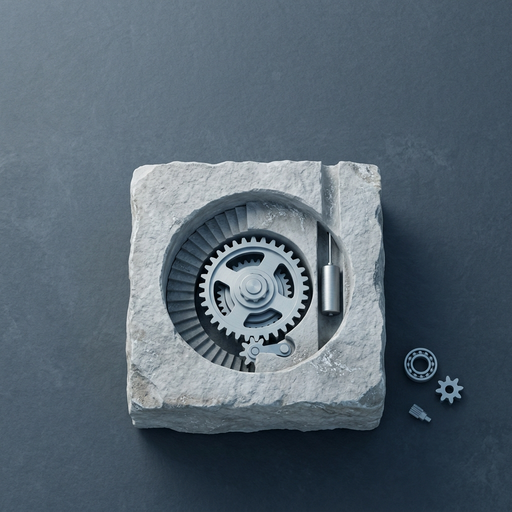
Engineers selected a massive limestone mountain and began excavation around two thousand ten. Heavy drilling rigs bored a vertical shaft approximately five hundred feet deep through solid limestone. Workers carved a continuous spiral staircase directly into the interior rock wall, wrapping around the central shaft so that heavy components could be brought in, lowered into place, and assembled from the foundation upward. More than one hundred fifty meters of tunnels, corridors, and chambers were carved into the mountain interior.
By two thousand eighteen, the Long Now Foundation announced that the primary underground excavation was complete. Assembly teams began securing heavy structural steel framework and mounting initial components within the chamber, including the immense gravitational drive weight, the mechanical winding equipment, and sections of the primary gear train.
Subterranean placement provides a stable thermal buffer against desert weather, but it replaces surface hazards with subterranean ones. Mountain interiors are living geological environments. Water seeps through porous limestone, carrying dissolved minerals that leave corrosive mineral crusts on metal surfaces. Humidity condenses on cold rock walls. Fine limestone dust floats through the air, threatening to settle into gear teeth and pivot bearings. Over centuries, surrounding rock strata settle, shift under tectonic strain, and respond to regional seismic tremors.
Placing the clock deep underground also introduces an operational paradox. The safer the mechanism is from surface disruption, the more difficult it becomes to reach, inspect, and maintain. Transporting replacement parts down an isolated mountain trail and lowering them into a vertical limestone shaft requires specialized logistics that cannot be taken for granted across future centuries. While the completed excavation and structural assembly represent major engineering milestones, independent reports confirm that the Texas installation remains unfinished, with no formal completion schedule or public opening date. The mountain offers shelter, but it turns every simple maintenance routine into a profound technical challenge.
To operate across ten thousand years, the clock must reject nearly every convention of modern timekeeping. It uses no microprocessors, no digital logic boards, no liquid-crystal screens, and no chemical batteries. Modern electronics degrade rapidly; soldered joints crack, capacitors leak, plastics become brittle, and microcode becomes unusable the moment its proprietary software environment disappears. The Clock of the Long Now returns timekeeping to pure mechanical physics, where motion is visible, durable, and governed by gravity and mechanics.
The primary engine of the clock is a descending drive weight, following the traditional logic of a grandfather clock on a massive scale. A weight of several tons hangs suspended within the vertical shaft. As gravity pulls the mass downward, its descent turns a mechanical drive shaft, feeding stored potential energy through an intricate gear train that moves the hands and calendar wheels.
Human visitors cannot be relied upon to wind the clock continuously. An installation designed for deep time might stand unattended for decades, centuries, or even entire historical dark ages. To keep the weight lifted, the design incorporates a passive environmental winding system powered by solar heat. One documented mechanism relies on thermal expansion between the sunlit surface and the cool subterranean chamber. A collector on the mountain exterior warms an air reservoir during the heat of the day, while a corresponding reservoir remains chilled inside the deep rock. The resulting pressure differential forces air through a pneumatic linkage that mechanically raises the drive weight.
This thermal engine is an ingenious use of natural daily rhythms, but it is not a perpetual motion machine. It relies on flexible seals that must remain airtight across generations, check valves that must resist corrosion and sticking, and air passages that must stay free of dust, condensation, and desert wildlife.
Even if mechanical power continues without interruption, timekeeping accuracy faces the compounding threat of drift. No purely mechanical oscillator can divide time with perfect precision. Over ten thousand years, an imperceptible daily discrepancy multiplies into disastrous failure. If a mechanical pendulum or balance wheel loses just one second per day, the clock will lose more than six minutes in a single year. After a single century, the error reaches ten hours. Across ten thousand years, that tiny one-second error compounds into a drift of more than forty-two days, completely severing the clock's calendar from the physical seasons of the Earth.
To solve this problem, the clock pairs its mechanical duration with astronomical recurrence. A solar synchronization system connects the underground mechanism to the position of the Sun. An optical corridor cut through the mountain peak directs sunlight down into the shaft at local solar noon on clear days. When the midday solar beam strikes a thermal sensor mechanism, the intense focused heat triggers a mechanical governor that automatically adjusts the clock's escapement, snapping the time display back into alignment with true astronomical noon. Yet this correction mechanism carries its own physical vulnerabilities. The solar aperture must remain clear of debris, the lenses and mirrors must not crack or collect dust, and the optical path must survive any subtle settling of the mountain rock.
The choice of fabrication materials mirrors this continuous defense against physical wear. To prevent catastrophic seizure, the engineers turned to marine-grade stainless steel, titanium, and precision-engineered ceramic bearings. Traditional petroleum oils and synthetic greases cannot be used; wet lubricants inevitably oxidize, evaporate, gum into paste, or attract abrasive grit. By utilizing dry ceramic bearings and corrosion-resistant alloys, the designers aim to minimize friction without relying on recurring chemical maintenance. Yet even advanced metallurgy has limitations. Dissimilar metals placed in contact can experience galvanic corrosion when moisture is present, and dry bearings can still experience surface galling under high mechanical loads. High-performance alloys represent educated bets against time, but they remain design choices rather than proven ten-thousand-year guarantees.
No mechanical design, regardless of how robust its alloys may be, can achieve ten thousand years of continuous, autonomous operation without human care. Over millennia, a drive cable will eventually fray, a gear tooth will suffer fatigue, a pivot will wear unevenly, or a seismic shift will throw shafts out of true alignment. The Clock of the Long Now cannot survive solely through material endurance; its long-term survival depends upon human beings who choose to understand, tend, and repair it.
This social reality demands that the machinery possess physical legibility. If future caretakers encounter the clock centuries from now, after civilizational collapses or radical linguistic shifts, they must be able to comprehend how it functions without reference to modern technical manuals, operating systems, or written English. The mechanism is therefore designed on a macro scale, where its operational principles are visually transparent. A visitor standing inside the chamber can follow the physical chain of cause and effect. One can watch the descending weight turn the drum, observe the escapement regulate the tick, and trace the gear reductions as fast rotational speed steps down into century and millennial motion.
Yet this legibility creates a fundamental engineering trade-off between accessibility and security. If the subterranean chambers remain open for caretakers to inspect parts and repair linkages, the machinery becomes vulnerable to vandalism, metal theft, and outside humidity. Conversely, if the installation is permanently sealed inside a tamper-proof vault, no future community can perform the repairs required when a component inevitably fails.
This paradox illustrates the difference between robustness and adaptability. A purely robust strategy attempts to withstand every conceivable force through sheer mass, impenetrable barriers, and over-engineered strength. An adaptable strategy acknowledges that failure is inevitable over long timescales, prioritizing human access, modular replacement, and mechanical simplicity so that future societies can recreate broken components using whatever manufacturing tools they possess.
The Long Now Foundation explicitly treats the Texas clock as an adaptable, living artifact that will require ongoing human stewardship and continuous improvement across generations. Yet human social institutions are historically far more fragile than mechanical bronze or steel. History records almost no political governments, academic universities, or religious organizations that have maintained unbroken organizational continuity for a single millennium, let alone ten. The foundation cannot guarantee its own corporate survival, nor can it bind future private landowners or future states to maintain the surrounding access roads, fund security, or allow public entry. The physical survival of the mechanism and the cultural survival of its caretakers remain two separate and unequal problems.
Designing for deep time is not unique to the Long Now Foundation. Modern society has faced similar engineering and semiotic challenges in the field of nuclear waste disposal, most notably at the Waste Isolation Pilot Plant in southeastern New Mexico. There, federal panels composed of geologists, linguists, and anthropologists worked to design physical monuments intended to communicate lethal danger across ten thousand years.
The contrast between these two deep-time projects is profound. The nuclear waste repositories designed markers meant to frighten, repel, and discourage human presence: creating ominous earthworks and universal warning glyphs whose singular message is to keep away. The Clock of the Long Now takes the opposite philosophical posture. It is designed to intrigue, enchant, and invite human presence, drawing visitors across difficult desert terrain to participate in an act of civilizational maintenance. Yet both projects grapple with the same fundamental uncertainty: neither can predict the language, culture, or values of the human societies that will inhabit North America ten millennia from now.
The Texas clock also attracts significant ethical and social criticism. The installation is privately financed, constructed on private ranchland, and located in an exceptionally isolated region of West Texas. Visiting the site requires cross-country travel, private gate access, rough vehicle tracks, and a strenuous mountain hike. For the foreseeable future, direct personal engagement with the monument will be largely restricted to those with the financial resources, personal leisure, and physical ability to make the pilgrimage.
Some critics question whether investing tens of millions of dollars into a remote underground monument is an exercise in intellectual luxury. They argue that fixating on an abstract ten-thousand-year horizon can serve as an emotional escape from the acute crises of our own time, such as accelerating climate disruption, poverty, biodiversity loss, and immediate institutional decay. Spending resources to send a mechanical message to the distant future can appear hollow if the present generation fails to ensure that its immediate descendants inherit a stable, habitable world.
The most compelling argument in favor of the clock treats it not as an ultimate survival bunker, but as a physical catalyst for the imagination. Abstract concepts like deep time, civilizational responsibility, and millennial horizons are almost impossible for human minds to grasp through statistics or calendar dates alone. A monumental, working machine translates those vast intellectual abstractions into direct physical reality. Hearing a mechanism that ticks only once every three hundred sixty-five days, or standing beside a dial engineered to complete a single rotation every ten thousand years, creates an immediate, visceral encounter with duration.
Ultimately, the success of the Clock of the Long Now cannot be measured by a single standard. One measure is mechanical longevity: whether its gears continue to turn without catastrophic failure. Another is technical resilience: whether future humans, finding the clock stopped, possess the insight and goodwill to repair its linkages and wind its weights. The most immediate measure is cultural. It asks whether the sheer audacity of building for ten thousand years encourages people living today to look past the next election or financial quarter, extending their moral responsibility far beyond their own brief lives.
The Clock of the Long Now reminds us that designing for deep time is never simply a question of gears and stone; it is an enduring social pact. A machine can only keep time across millennia if future generations decide that its message is worth preserving. As you consider this ambitious project, reflect on the works and institutions within your own community. What are we creating today that is built to outlast us, and whom will it serve? How might our choices change if we held ourselves accountable to the people who will inhabit this world ten thousand years from now?