The Silent Fold: Part 2
The extraction has begun, but the weapon was never confined to Russia. As the team fights toward Georgia with scientist Irina Sorokina, allied laboratories in France and Kenya race to identify dormant stock. Russia's general wants his secret preserved; China's Colonel Guo wants Russia blamed and the recovery under Chinese control. The second book in the original R-rated techno-thriller trilogy, narrated by Orus. All operational programs and villains are fictional.
By MyAudioBooks.ai ·
Listen free: The Silent Fold: Part 2
The screaming stopped before Irina got the door fully open.
A man lay beneath the containment bench with his cheek in a pool of urine. His right arm struck the steel leg in rapid, involuntary jerks. The left sleeve of his laboratory coat had been cut away months earlier, and the skin beneath carried the scars of old restraint injuries.
Irina knelt beside him. "Help me turn him."
Sofia was already moving. She slid a folded jacket beneath the man's head and held it away from the floor while the seizure spent itself. He could not have been older than forty. His eyes found Irina without finding her face.
"How long has he been like this?" Sofia asked.
"Since before the accident. Malenkov said he was being treated."
The man's mouth worked. A thread of blood ran from his bitten tongue.
Caleb stood at the outer door, listening to the firefight divide itself into two different rhythms. Russian rifles in the yard. Another group moving through the north corridor with suppressed weapons.
"Which side is ours?" Irina asked.
"Neither. We need to go."
The dying man caught her sleeve with surprising force.
"Mombasa," he said.
Irina bent close. "What about Mombasa?"
"Guo keeps the master stock on the water." His gaze slid past her. "He made me sign for clean protein. I knew. I knew and I signed."
His body tightened once. Sofia called his name and checked for a pulse, then began compressions. Irina held his hand until Sofia shook her head.
"We can carry him," Irina said.
"No," Sofia answered. Not cruel. Final.
A figure appeared at the far door and shouted in Mandarin, "Fang xia wuqi!" Put down the weapon.
Caleb fired twice. The figure dropped behind the door frame. Sofia pulled Irina up, and they ran for the service tunnel as rounds tore through the containment bench behind them.
The tunnel sloped toward the boiler house. Caleb took the first turn too fast and a Russian soldier came out of the smoke with his rifle already up. Caleb drove into him before the barrel could level. The soldier's weapon discharged into the ceiling. Concrete dust filled the tunnel. Caleb felt something give along his left ribs as they hit the floor.
Sofia fired past him. The Russian stopped moving.
"Can you breathe?" she asked.
"Apparently."
"That wasn't my question."
A blast wave threw them against the wall. Something sharp opened Sofia's right thigh above the knee. She swore, pressed her palm over the wound, and kept moving when Irina tried to help.
They came out beyond the rail spur with the facility burning behind them. The two remaining operators had their stolen vehicle waiting. One pulled Caleb inside. The other wrapped Sofia's leg while she told him where to press.
Irina looked back at the black smoke rising above Zarya Twelve.
It was never alive. It only needed a place to wait. Now the place had a name, and the name was Mombasa.
At My Audio Books dot A I, you can create your own audiobooks from prompts, turn your documents into audio, and store everything in your personal library.
The Scientist's Confession
They hid in a railway maintenance house outside Kirov until the search helicopters moved north.
The building had one working stove, a sink full of split ice, and a timetable from the previous decade nailed over the cot. Sofia sat with her back against the wall while an operator stitched her thigh. She had given herself a local injection and complained about the quality of his conversation.
Caleb lay on the cot with his left side bound. Every breath caught before it reached the bottom.
Irina stood at the window with Pavel's wedding ring in her pocket, although she did not yet know it was there. Caleb carried it wrapped in cloth inside his own jacket. Nino's instruction stayed with him: do not tell her before you get her out.
He was tired of carrying other people's last objects.
"Start with the marker," he said.
Irina did not turn from the window. "I put a structural signature into the work. Not a label you could scrape off. A behavior your assays could recognize if you knew what you were seeing."
"You wanted to be caught."
"I wanted someone outside to be able to prove it existed." She pressed her burned palm against the cold glass. "Wanting to be caught would have required more courage than I had."
Caleb waited. He had learned that confessions curdled when helped along too quickly.
"We began with a medical question," she said. "Could a misfolded protein be detected earlier, guided, perhaps interrupted? Then the military saw a different answer. Could the same process be made reliable enough to use? Could it survive outside a body? Could it be placed somewhere and left?"
"And could you do it?" Caleb asked.
"Yes."
Sofia stopped complaining about the stitching.
Irina finally turned. "Not in the way your newspapers will describe. Not a cloud that kills a city before dinner. That is cinema. This is patient. It hides in material people trust. It makes exposure difficult to prove and treatment impossible to promise. The accelerated course is what makes it a weapon instead of an accident."
Caleb thought of the man under the bench. "How many did you test it on?"
Her face hardened. "More than I will ever be able to name."
"That isn't an answer."
"It is the answer I have."
He pushed himself upright against the pain. "You want forgiveness, find a priest. I need to know where Guo put it."
Irina crossed the room and stood over him.
"And you want a simple villain because you are hurt and far from home. I can give you that too. I designed the signature. I trained two of the people who expanded the program. I told myself my husband's position would protect us. Then I told myself my sabotage made us innocent." She tapped her chest with two fingers. "No absolution. Only geography."
Caleb held her gaze. "Good."
Sofia laughed once, winced, and put her head back.
Irina explained that Guo's network used ordinary commercial confidence as camouflage. Hospitals, relief stocks, research controls, veterinary supply chains. Most material was harmless. The danger lay in not knowing which items carried the signature and which had been moved beyond her knowledge.
"The master stock can identify the armed lines," she said. "Guo keeps it separate. If he destroys it, every compromise becomes a guessing game. If we reach it, your scientists can stop guessing."
Caleb picked up the secure handset. Static answered. The jammer at Zarya had been left behind, but Russian mobile interception made an open call a different kind of suicide.
"No one gets left in the dark." He looked at the dead handset. "Not the allies waiting for this. Not the public if it spreads. We find a way to tell them."
Lyon in the Rain
Doctor Aurelie Roche removed an election leaflet from her laboratory bench and used it to cover a coffee stain.
The leaflet promised order. Another on the tram had promised rupture. A third had shown a candidate's face above the word renewal, which Aurelie considered an ambitious claim in a country that had been arguing about the same pension age for years.
Outside, Lyon shone with cold rain. Inside, the public-health laboratory worked through the night with the American detection method on one screen and a Russian control sample inside a sealed reader.
The first presidential round was scheduled for April eighteen. Ministers wanted no emergency that could be called foreign manipulation, no secrecy that could be called an American operation, and no body bags under any circumstances. Aurelie wanted the same three things with fewer speeches.
Her assistant pointed to the reader. "There."
The control had converted.
Aurelie called the French health security directorate, then the American liaison. She kept both calls on speaker so nobody could later pretend they had not heard her.
"The signature is real," she said. "We have it in a research control from a Rotterdam shipment. Not a patient. Not an outbreak. A product sitting in a room."
The French director asked about public communication.
"Tell people the truth before the campaign tells it for you."
"You mean issue a national warning about an unproven Russian weapon?"
"I mean prepare one, and stop using the election as a reason to be slow."
At My Audio Books dot A I, you can listen to this story and thousands of others that explore the hidden science and mechanics behind the headlines.
The fire alarm sounded before the director answered.
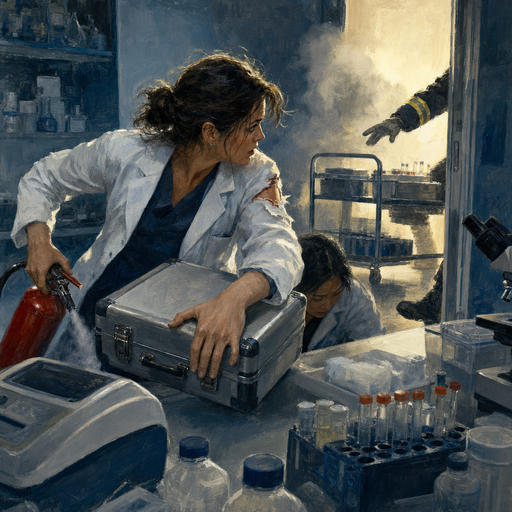
Not a drill. The service corridor filled with smoke that smelled of burning plastic. Aurelie shut down the reader and put the original control into its transport case. Two laboratory security officers met her at the interior door.
A man in a firefighter's helmet came through the far entrance too quickly. His jacket carried the right reflective bands, but his boots were clean.
"Ne bougez pas," he told the security officers. Do not move.
Then he raised a pistol.
The nearer officer drove a metal trolley into him. The pistol fired into the ceiling. Aurelie pulled her assistant behind the reader as the second officer tackled the man against the wall.
A second attacker came through the smoke and reached for the transport case. Aurelie struck his wrist with the metal edge of a fire extinguisher. Bone cracked. He swore in Mandarin and slashed at her with a short knife. The blade opened her sleeve and the skin beneath.
She discharged the extinguisher into his face.
By the time police reached the laboratory, one attacker was dead and the other was restrained with his own flex cuffs. A French flag patch had been sewn into the dead man's jacket. The stitching was new. Aurelie understood the intended story before the first detective arrived: a domestic radical, an election grievance, a fire in a public laboratory. Anything but a foreign colonel cleaning up evidence.
She looked down at the transport case in her bleeding hand.
"You will not get my country that cheaply," she said.
Nairobi Control
In Nairobi, Doctor Wanjiru Kimani hung up on a campaign adviser and answered the American scientist.
"Forgive me," she told Miriam over the secure link. "Some people believe an election makes every laboratory result politically negotiable."
Miriam sat in a Washington operations room with Theo's fencing glove in her coat pocket. She had flown back from Boston only after his surgery was complete and his father had promised to call her before making any decision about further care.
"Nairobi has what it needs?" she asked.
"People and detection support, yes. Speeches, too many." Wanjiru held up the small cooler containing the Rotterdam-linked control. "We are testing now."
Outside her facility, matatus pushed through the morning traffic with their conductors hanging from open doors. A campaign convoy blocked one intersection, loudspeakers promising cheaper food and honest government. On the next street, students carried hand-painted signs about fuel and jobs. The general election was still months away, but everybody with a microphone had already moved into it.
Wanjiru's deputy brought in a second reader. An Australian analyst joined the call from Geelong, with a maritime operations officer linked from Canberra. Australia's role was not decorative: satellite and shipping specialists had begun narrowing Guo's possible vessels, while its alliance planners kept the scientific work separate from the submarine schedules and domestic arguments dominating Canberra.
"We have a candidate pattern in the western Indian Ocean," the maritime officer said. "Nothing clean enough for a boarding order."
Wanjiru pressed the cooler's latch. "Then give me something clean enough for a laboratory order."
The Russian General's Price
Malenkov found them near Rostov because Irina wanted him to.
She had insisted on using an old emergency frequency. Caleb had called it a trap. She had agreed and used it anyway.
Now the general stood beneath the rusted roof of a freight depot with six soldiers and no coat, as though the cold were another subordinate he had disciplined.
"You look older," Irina told him.
"You look American." Malenkov's gaze moved to Caleb's bound ribs and Sofia's bandaged leg. "Or what remains after they use you."
Caleb kept his rifle low. The two surviving operators covered the rail entrance. Beyond the depot, a suburban train rolled past without stopping.
Malenkov held out one hand. "Give me the samples you took, and I will allow the scientist to leave."
"You shot your own site commander," Caleb said.
"He was panicking."
"You sealed eleven people behind a door."
"Twelve," Irina said. "You never could count the people you spent."
The general's face tightened. He had aged since the Vienna photograph not by years but by appetite. His cheeks had sunk. The pistol at his belt was polished bright enough to reflect the depot lights.
"China will betray you," Irina said. "Perhaps they already have."
Malenkov smiled. "China needs Russia angry and dependent. I need Russia feared. Our interests are compatible."
A suppressed shot struck the soldier beside him through the eye.
Then the depot came apart.
Guo's men fired from the rafters and the rear loading bay. Russian soldiers turned toward the new threat, uncertain whether the Americans had sprung the trap. Caleb dragged Irina behind a locomotive wheel as rounds cut through the space where she had stood.
Malenkov crawled toward a service office, still shouting orders. One of his own soldiers dropped beside him with blood pumping from his neck. The general tried to use the dying man as cover while he returned fire.
Caleb saw the pistol in his hand and the polished belt buckle beneath it.
"Malenkov!" he shouted.
The general looked toward him.
"Russia was supposed to be feared," Caleb said. "Guo just decided you were the part he could burn."
A rafter exploded above the service office. Burning insulation dropped across Malenkov's shoulders. He rolled, screaming, and tried to rise. Irina stepped out from behind the wheel before Caleb could stop her.
She picked up the general's pistol.
For one second, Malenkov understood the arithmetic completely.
"Doctor," he said.
She fired into the floor beside his head, not into him.
"That is for the part of me that wants you dead quickly," she said.
Then Guo's sniper fired through the office window.
Malenkov's head snapped sideways. He collapsed into the burning insulation.
Irina dropped the pistol. Caleb pulled her back as Russian and Chinese fire crossed above them.
They escaped along the drainage cut while the depot burned. Behind them, surviving Russian soldiers began shooting at the Chinese without waiting for orders. The alliance Malenkov imagined had died with him, in the dirt, under a roof he had chosen for an ambush.
Rustaveli Again
Nino met them south of the border with a medical vehicle and no questions about the blood.
She took one look at Sofia's leg and ordered the driver toward Tbilisi. Caleb refused until the other two operators had been accounted for. Nino listened, then put him in the front seat and told him he could count people from there.
At the safehouse, the child who had brought khachapuri was gone. Her family had left the building. Nino had moved them after the Russian insertion, unwilling to let hospitality become a target.
"No one gets left in the dark." She answered Caleb's unspoken question. "They knew enough to be safe and not enough to be useful to anyone."
The protests on Rustaveli were larger. Police had closed the avenue, and people were passing water bottles between the crowds and the officers who would accept them. Nino would not route the vehicle through the demonstration.
"We are not hiding behind them," she said.
Only after Sofia's wound had been cleaned and Caleb's ribs examined did Nino ask to see Irina alone.
Caleb brought her the cloth-wrapped ring and left the room.
Through the old plaster wall, he heard Nino say Pavel's name. He heard Irina answer with a question. Then he heard nothing for a long time.
When Irina came out, she wore the ring on a chain around her neck.
"He sat with her," she said to Caleb. "Nino sat with my husband while he died."
"Yes."
"And you knew."
"Since Tbilisi."
She slapped him hard enough to turn his face. He let her.
"You do not get to decide when I am strong enough for the truth."
"No," he said. "I don't."
She walked to the window. Her shoulders did not shake. That frightened him more than weeping would have.
"Guo told me he admired Pavel's endurance," she said. "I thought there might be something left to find."
Caleb stayed by the door.
She touched the ring through her shirt. "Bring the living home."
"We will."
"Not all of us."
"No."
She turned back. "Then do not waste the dead either."
The First Fold
Wanjiru Kimani had run the same control six times.
The first five were negative. The sixth began to rise after midnight, a slow curve where a flat line should have been.
Her deputy said the instrument might be drifting. She replaced it. The new instrument produced the same answer.
On the secure link, Miriam watched the curve and felt the room contract around her. Aurelie joined from Lyon with her forearm bandaged. Australian analysts remained on the maritime channel. Irina had just arrived on a separate link from Tbilisi.
"Is it the marker?" Wanjiru asked.
Irina studied the image.
"No," she said. "The marker was my way of finding the stock. This is something else. Guo has changed the signature."
Miriam understood before anyone spoke. "He learned from our detection method."
"He learned from our cooperation," Irina said. "I gave him that possibility when I designed the program. You gave him the confirmation when you shared the assay."
Wanjiru looked toward the window. Beyond the glass, Nairobi's lights shimmered after rain.
"Can you still identify the master stock?"
"By behavior, yes. Not from a distance."
The Australian maritime officer broke in. "We have narrowed the vessel. A state-linked cargo ship holding off Mombasa. It changed its transponder identity twice and requested a medical waste exemption."
Wanjiru picked up the secure telephone to the Kenyan cabinet secretary.
"This is now a Kenyan operation with allied support," she said. "Not an American boarding party on our coast."
Then she turned back to Miriam.
"Bring the living home." Wanjiru said it like an instruction to every government on the call.
It was never alive. It only needed a place to wait. In the sealed reader beside her, the next control began to fold.
At My Audio Books dot A I, you can create fiction, non-fiction, and audio from your own documents, all in one library. Learn more today at My Audio Books dot A I.