The Satellite Built to Scar: Material Lessons From Nearly Six Years in Low Earth Orbit
NASA sent the Long Duration Exposure Facility into orbit to let space leave its mark on thousands of material samples. Stranded for nearly six years after retrieval delays and the Challenger disaster, it returned with scars from atomic oxygen, debris, radiation, and contamination—evidence that reshaped how engineers protect and test long-lived spacecraft.
By MyAudioBooks.ai ·
Listen free: The Satellite Built to Scar: Material Lessons From Nearly Six Years in Low Earth Orbit
Most spacecraft carry layered thermal blankets, metallic shields, and protective coatings designed to prevent orbital hazards from leaving a mark. In April nineteen eighty-four, NASA placed a twelve-sided satellite into low Earth orbit engineered to do the exact opposite. It carried no thrusters, no solar arrays, and no data downlink. Instead, it was built to sit silently above the atmosphere, exposing thousands of carefully measured material samples directly to open space. Every collision, chemical reaction, and radiation event would leave a permanent, readable physical record. What can engineers learn when an orbital laboratory deliberately surrenders its exterior to the space environment?
At My Audio Books dot A I, you can create your own audiobooks from prompts, turn your documents into audio, all with one subscription, and store your items in your own personal library.
Standard aerospace engineering treats environmental damage as an operational failure to be avoided. The Long Duration Exposure Facility inverted that priority. NASA designed the platform as a reusable, open-frame aluminum structure, roughly thirty feet long and fourteen feet across, with twelve peripheral sides and two ends. The structure held eighty-six standardized experiment trays. Across those trays, fifty-seven distinct international investigations mounted more than ten thousand individual specimens.
The inventory included polymer films, thermal-control paints, optical mirrors, solar cells, detector crystals, mechanical fasteners, composite structures, and biological spores. Each specimen had a documented pre-flight history. Technicians measured initial mass, surface roughness, optical reflectance, chemical purity, and mechanical strength before launch. If a sample eroded, discolored, cracked, or shattered during flight, investigators would have a baseline to calculate the exact rate and nature of the degradation. The primary requirement for the satellite itself was survivability. The structure had to endure the environment without breaking apart so that the specimens could be recovered, returned to terrestrial laboratories, and analyzed under electron microscopes.
Space Shuttle Challenger carried the facility into space on April sixth, nineteen eighty-four. Crew members lifted the twenty-one thousand pound structure from the payload bay and released it into orbit. It settled into a path between two hundred fifty-five and two hundred fifty-seven nautical miles above Earth, inclined twenty-eight point five degrees to the equator.
The satellite relied entirely on gravity-gradient stabilization to maintain its orientation. Earth's gravitational pull naturally aligned the long axis of the cylinder toward the center of the planet. Small internal magnetic dampers stopped the vehicle from oscillating. As a result, one specific face of the twelve-sided polygon always pointed directly forward into the orbital path, while the opposite face pointed backward along the ground track. One end consistently faced Earth, and the other faced deep space. This rigid, passive orientation meant every tray occupied a known coordinate relative to incoming orbital winds, sunlight, and cosmic debris. Engineers planned to retrieve this physical record within a single year, but an unforeseen national crisis was about to strand the facility in the void.
NASA originally intended the facility to remain in space for roughly ten to twelve months, with a planned retrieval in nineteen eighty-five. Space shuttle manifest changes and payload scheduling conflicts pushed that retrieval into nineteen eighty-six. Those operational delays preceded any shuttle launch accidents.
Then, on January twenty-eighth, nineteen eighty-six, Space Shuttle Challenger broke apart seventy-three seconds into flight, killing all seven crew members. The tragedy grounded the entire space shuttle fleet for nearly three years while NASA investigated the accident and redesigned the solid rocket boosters. With the shuttles grounded, the exposure facility remained stranded in low Earth orbit.
Months turned into years. The passive satellite continued circling Earth sixteen times every day, silently accumulating exposure to radiation, temperature extremes, and microscopic debris.
By late nineteen eighty-nine, a new crisis emerged. The satellite operated in low Earth orbit, where a tenuous residual atmosphere still creates aerodynamic drag. During periods of high solar activity, ultraviolet heating expands Earth's upper atmosphere, increasing drag on orbiting objects. The facility was experiencing steady orbital decay. Over its time in space, its altitude dropped from more than two hundred fifty nautical miles down to roughly one hundred seventy-eight nautical miles. Ballistic calculations indicated that if NASA did not retrieve the platform by early nineteen ninety, atmospheric drag would pull the satellite into a destructive reentry within months.
Space Shuttle Columbia launched on mission thirty-two on January ninth, nineteen ninety. Three days later, on January twelfth, astronaut Bonnie Dunbar operated the shuttle robotic arm to grapple the floating cylinder and secure it into Columbia's payload bay. The mission had lasted five years and nine months, spanning sixty-nine continuous months and thirty-two thousand four hundred twenty-two orbits.
The unplanned delay created a profound experimental opportunity alongside significant analytical complexity. The extended timeline allowed researchers to record cumulative, slow-moving material degradation and rare particle impacts that a one-year mission would have missed entirely. At the same time, because the satellite descended into progressively denser atmosphere as solar activity fluctuated, investigators could not assume a steady environmental dose. Recovering the hardware brought home a physical archive; decoding that archive required isolating several overlapping destructive forces. Chief among those forces was an invisible atmospheric headwind that was quietly dissolving the satellite's forward-facing surfaces.
Discussions of space exposure often invoke the idea of hardware being sandblasted by the void. That phrase conflates mechanical abrasion with aggressive chemical erosion. The primary agent stripping material from the facility's forward surfaces was not grit, but atomic oxygen.
In the upper reaches of Earth's atmosphere, intense solar ultraviolet radiation splits ordinary diatomic oxygen molecules into single, unbonded oxygen atoms. While this residual atmosphere is an extreme vacuum by terrestrial standards, the satellite moved through it at orbital velocity, roughly seventeen thousand five hundred miles per hour. That forward velocity turned the rarefied gas into a relentless atomic headwind.
Because the facility maintained a fixed orientation, the environmental dose varied dramatically across its exterior. The leading face, pointed directly into the velocity vector, swept up a total fluence reaching into the order of billions of trillions of oxygen atoms per square centimeter. Trailing surfaces, shielded from the forward wind, received several orders of magnitude less atomic oxygen, encountering only the small fraction of atoms with sufficient thermal motion to scatter backward.
When atomic oxygen atoms strike organic materials at orbital velocities, they carry sufficient kinetic and chemical energy to break carbon-to-carbon and carbon-to-hydrogen bonds. The oxygen reacts with the organic matrix to form volatile gases like carbon monoxide and carbon dioxide, which boil off into space.
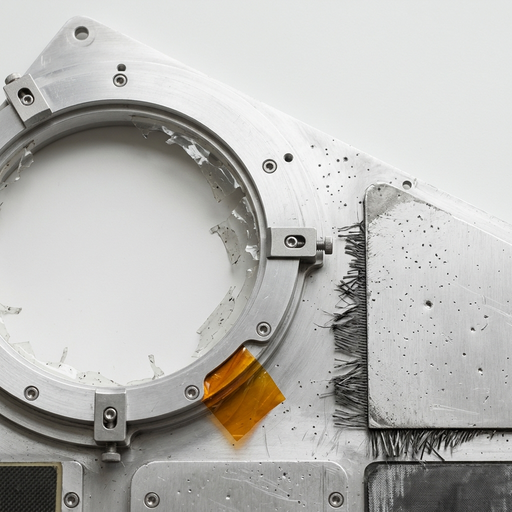
On leading-edge trays, unprotected polymer films suffered severe degradation. Multi-layer insulation blankets made of aluminized Kapton or Mylar eroded down to their metallic backing. In several locations, thin polymer films vanished completely, leaving behind bare mounting rings. Structural composites reinforced with carbon fibers saw their epoxy resin binders stripped away, leaving dry, brittle carbon fibers exposed like the bristles of an old brush. Elastomer seals lost mass, became brittle, and discolored, showing that flexible components like O-rings and wire insulation face structural failure when exposed directly to the orbital ram direction.
Atomic oxygen did not act in isolation. Solar ultraviolet radiation broke molecular bonds and created free radicals, accelerating chemical breakdown. At the same time, the vacuum environment encouraged volatile additives to outgas, while ninety-minute orbital cycles caused surface temperatures to swing across hundreds of degrees as the platform moved between full sunlight and Earth's shadow.
Yet atomic oxygen produced one counterintuitive optical effect. Certain white thermal control coatings and metallic test surfaces on the leading face appeared visibly cleaner and maintained better solar reflectance than identical samples on the trailing face. On the leading edge, the reactive oxygen wind chemically stripped away outgassed organic contaminants as quickly as they deposited. On trailing surfaces, those same contaminants accumulated undisturbed, slowly baking into dark stains under solar ultraviolet radiation. Yet chemical erosion was only part of the story, because orbiting alongside that molecular wind were solid hypervelocity projectiles and invisible outgassed films.
While atomic oxygen altered chemistry on the forward-facing surfaces, solid particles subjected the entire satellite to high-velocity mechanical impacts. Over sixty-nine months, the structure collected thousands of microscopic pits, punctures, and craters across its aluminum frame and experiment trays.
The impacts came from two distinct populations: natural micrometeoroids traveling at interplanetary speeds, and human-made orbital debris left behind by rocket stages, fragmented satellites, and solid rocket motor firings. Dedicated particle-capture experiments supplemented the damage cataloged on structural hardware.
Using scanning electron microscopy and energy-dispersive X-ray spectroscopy, researchers analyzed the chemical residues left inside the crater walls. Craters containing magnesium, iron, and silicon traced back to natural stony micrometeoroids originating from comets and asteroids. Craters lined with aluminum, zinc, chlorine, and silver revealed artificial debris, including flakes of paint, burned fuel particles, and fragments of electronic hardware.
Many marks remained difficult to identify because the kinetic energy of an impact at several miles per second vaporizes both the projectile and the target metal, leaving clean, melted aluminum pits with no readable chemical residue. The nearly six-year flight provided one of the first long-baseline empirical records of microscopic debris fluxes in low Earth orbit. It proved that human orbital debris was already rivaling the natural meteoroid population at certain particle sizes.
Alongside visible craters, the satellite recorded quiet, non-mechanical damage through molecular contamination. The high vacuum of space pulled volatile organic compounds out of paints, adhesives, wire jackets, and silicone potting materials. These outgassed molecules drifted away from their sources and condensed onto nearby colder surfaces. Solar ultraviolet radiation then cross-linked these thin molecular deposits, transforming transparent chemical films into golden-brown organic residues.
These contamination layers did not puncture metals or shatter substrates, but they fundamentally altered surface thermal physics. Spacecraft rely on carefully balanced thermal control surfaces to survive. Radiator panels and specialized coatings must reflect incoming solar radiation while radiating internal electronics heat away into deep space.
Thin contamination deposits caused reflector materials coated with silicon monoxide and silicon dioxide to absorb significantly more sunlight. The facility's onboard Thermal Measurements System recorded internal temperatures across the early years of the mission, showing how shifting optical properties altered the vehicle's thermal balance.
Solar cell experiments showed similar performance drops. Over time, power output fell due to a combination of darkened cover glasses, micro-cratering from particulate strikes, and lattice displacement caused by trapped radiation belt protons. The facility proved that long-duration spacecraft degradation rarely stems from a single failure mechanism. Instead, it is the result of continuous, overlapping interactions among chemical erosion, contamination, radiation, and physical impacts. These combined scars did more than catalog damage. They forced aerospace engineers to rewrite their rules for building long-lived spacecraft.
The recovered hardware permanently shifted how engineers design and qualify hardware for long-duration orbital flight.
The most immediate impact was on material selection. The severe erosion of polymer films forced aerospace programs to abandon bare organic materials on external, forward-facing surfaces. For missions requiring flexible blankets or composite structures, engineers introduced protective barriers, including thin glass-like silicon dioxide coatings and metal overcoats that resist atomic oxygen attack. System architects also began shaping spacecraft geometry to place sensitive polymers and wiring behind structural shields or on trailing surfaces shielded from the velocity vector.
The mission also transformed environmental testing protocols. Before these findings, laboratories often tested space materials inside simple vacuum chambers or under isolated ultraviolet lamps. The facility proved that single-variable testing produces misleading predictions. A material might resist vacuum and ultraviolet radiation in a standard chamber, yet disintegrate when exposed simultaneously to atomic oxygen and thermal cycling. Aerospace qualification moved toward combined-environment testing that mimics multiple orbital forces at once.
In thermal engineering, the data dismantled the assumption of static beginning-of-life performance. Spacecraft radiators, paints, and multi-layer insulation blankets age continuously. Thermal balance equations now incorporate explicit end-of-life margins, ensuring that a satellite maintains safe internal temperatures even after its white radiators absorb contamination and yellow under years of solar radiation.
Simultaneously, contamination control evolved from a basic cleaning checklist into a rigorous discipline. Strict outgassing standards, pre-flight thermal bake-outs, and deliberate venting paths were implemented to prevent outgassed compounds from condensing onto sensitive optical instruments, star trackers, and solar arrays.
These findings formed the technical foundation for the design, material selection, and lifetime predictions of the International Space Station, which was engineered to operate for decades within the same low Earth orbit environment.
Yet the facility's data carries clear boundaries. The platform flew at an inclination of twenty-eight point five degrees across a specific, declining altitude during solar cycles twenty-one and twenty-two. Its findings do not serve as a universal forecast for satellites flying in polar orbits, geostationary orbits, or interplanetary space, where atomic oxygen is absent and radiation levels are far higher. Furthermore, the orbital debris population has expanded significantly since nineteen ninety, meaning its historical impact counts represent a baseline rather than current conditions.
NASA's Long Duration Exposure Facility established its legacy by treating damage not as a failure, but as an irreplaceable source of physical evidence. When you hear that a modern spacecraft has been certified for a ten- or twenty-year mission, consider the harsh physics quietly acting on its hull, and the recovered experimental satellite whose scars first showed us how to survive them.