The Richard Montgomery Wreck: Why Wartime Explosives Remain in the Thames Estuary
The SS Richard Montgomery broke apart off the Kent coast in 1944, leaving an estimated 1,400 tons of explosive material in its submerged holds near busy shipping lanes. Removing the corroded munitions could trigger the disaster it aims to prevent, so British authorities restrict access, monitor the deteriorating wreck, and intervene only when a specific risk warrants it. The ship remains a test of how to manage danger when both action and inaction carry risks.
By MyAudioBooks.ai ·
Listen free: The Richard Montgomery Wreck: Why Wartime Explosives Remain in the Thames Estuary
For decades, three rusted masts broke the surface of the Thames Estuary roughly one and a half miles off the Kent coastline, marking the submerged remains of an American wartime freighter. Beneath the shallow water, packed inside the silt-filled forward holds, sit hundreds of tons of live high explosives. Conventional intuition suggests that when a massive cache of military ordnance threatens a bustling shipping lane and nearby coastal communities, authorities should immediately clear the site and eliminate the hazard. Yet for more than eighty years, the governing policy of British maritime agencies has been the exact opposite: cordon off the area, monitor the wreckage continuously, and strictly avoid disturbing the cargo. That enduring decision poses a fundamental question for modern engineering and public policy. Can leaving a recognized catastrophe risk sitting on the seabed actually represent a calculated form of safety management, rather than a failure of political will?
At My Audio Books dot A I, you can create your own audiobooks from prompts, turn your documents into audio, all with one subscription, and store your items in your own personal library.
To understand why this vessel remains underwater, we have to look back to the logistical lifeline of the Second World War. The Richard Montgomery was an American Liberty ship, one of more than twenty-seven hundred emergency cargo vessels built to standard plans in shipyards across the United States. Welded together in Florida during nineteen forty-three, the ship was designed for rapid production and heavy utility, carrying the fuel, food, and armaments needed to sustain the Allied offensive in Western Europe.
In August nineteen forty-four, two months after the Normandy landings, the Richard Montgomery set out across the Atlantic. The vessel was laden with thousands of tons of aerial bombs, detonators, and ammunition bound for the battlefields of France. Upon arriving in the Thames Estuary, the ship was directed to an anchorage off Sheerness, awaiting the formation of an onward convoy. The Thames was crowded, tides in the estuary were notoriously fierce, and the seabed shifted constantly under strong currents.
While anchored in shallow water at the Great Nore, the ship dragged its anchors during a gale and ran hard aground on the Sheerness Middle Sandbank. As the tide fell, the weight of the dense military cargo placed catastrophic bending stress on the welded hull. The keel buckled, the structural plating cracked, and within days the vessel fractured across its midsection, flooding the engine rooms and cargo holds.
Naval authorities and civilian stevedores immediately began an emergency salvage operation. Working through autumn gales, salvage crews labored for weeks to discharge munitions from the aft section of the broken hull. By the time worsening weather and advancing structural breakup forced crews to abandon the wreck, roughly half the cargo had been recovered from holds four and five. Holds one, two, and three in the forward section could not be emptied before the vessel settled permanently into the sand.
The resulting wreck sits in shallow, macro-tidal waters just one and a half miles from Sheerness on the Isle of Sheppey. It lies directly adjacent to the primary approach channels serving the Port of London and the Medway ports. The site rests within sight of critical coastal infrastructure, including the liquefied natural gas import terminals on the Isle of Grain. The grounding created a dilemma that has persisted across nine decades: a broken hull, exposed to shifting sands and harsh saltwater, holding an enormous quantity of unresolved wartime explosives. To assess what that danger truly means today, we have to examine the precise arithmetic of what was left behind.
Public discussion of the Richard Montgomery often relies on competing numbers that sound alarming but describe fundamentally different measurements. A specialist historical study of the ship's manifest records that the freighter originally departed the United States with roughly eight thousand six hundred eighty-seven tons of munitions. In contrast, technical condition reports, including a detailed survey published in twenty twenty-two, describe approximately one thousand four hundred tons of net explosive quantity remaining in the forward holds.
It is tempting to subtract one figure from the other to conclude how much was salvaged or what percentage remains, but doing so produces a false picture. Gross cargo weight includes heavy forged-steel bomb casings, wooden packaging, steel pallets, and ancillary shipping hardware. Net explosive quantity isolates only the chemical mass of the energetic fillings, such as amatol and trinitrotoluene, stripped of every pound of steel and timber that surrounded them. When contemporary technical reports cite one thousand four hundred tons, they are measuring raw explosive mass, not the total deadweight of the munitions resting on the seabed.
Furthermore, that remaining figure is a calculated estimate rather than a modern itemized inventory. It was reconstructed by cross-referencing wartime cargo manifests, historical stevedore discharge tally sheets from nineteen forty-four, and subsequent acoustic inspections. No contemporary salvage team has physically unpacked and counted the contents of the submerged forward section. The deep holds are choked with silt, blocked by buckled deck beams, and flooded with opaque tidal water.
While the ship's position, legal designation, and outer dimensions are established with navigational certainty, the physical condition and mechanical stability of individual fuzes and charges inside those holds remain uncertain. Eight decades submerged in cold, brackish water force us to look beyond raw numbers and confront the complex chemistry and structural physics at play beneath the waves.
The forward holds do not contain a single uniform substance. They house a volatile, mixed arsenal. Historical records confirm the presence of large general-purpose aerial bombs weighing up to one thousand pounds each, smaller fragmentation bombs, white-phosphorus smoke munitions, pyrotechnic signals, and sensitive explosive booster charges. Each weapon type uses different chemical compounds, casings, and fuzing mechanisms. An aggregate figure of one thousand four hundred tons does not mean the wreck functions as a single unified bomb that will automatically detonate in one simultaneous blast.
Seawater submersion does not reliably neutralize military explosives. While moisture and biological growth can degrade certain auxiliary components, high-explosive compounds like trinitrotoluene are chemically stable and insoluble in water, retaining their explosive energy over decades. At the same time, mechanical fuzes made of brass, steel, and copper corrode at varying rates. This process can create sensitive metallic salts, like copper picrates, or leave internal striker springs under unpredictable mechanical tension. A slight physical disturbance, friction, or crushing impact can present a hazard depending entirely on the individual weapon's local condition.
Here lies the fundamental role of the hull. The steel structure serves as a protective envelope, sheltering the munitions from scouring currents, storm surge, and accidental collisions with passing marine traffic. Yet that same hull is slowly deteriorating. Marine corrosion gradually thins the steel deck plating, while tidal currents shift the supporting sandbanks beneath the keel. If structural bulkheads collapse internally, the shifting weight could compress, drop, or destabilize fragile munitions packed tightly below.
A benchmark assessment published in nineteen ninety-nine analyzed the likelihood of an explosion. It concluded that the probability of a spontaneous mass detonation was remote, but recognized that the potential consequences were severe. An explosion could produce intense blast overpressure, localized water displacement, high-velocity metal fragments, and seabed scouring. In the immediate vicinity, such an event could cause catastrophic damage to small vessels, rupture regional port facilities, and shatter glass across nearby coastal settlements.
Sensational claims that the blast would devastate central London are unsupported by explosive physics and coastal topography. Shockwaves dissipate rapidly over distance, and water confinement absorbs substantial energy. Nevertheless, remote probability does not mean zero risk, and the local consequences are serious enough to demand continuous defensive planning.
This balance leads directly to the core dilemma of salvage: the removal paradox. Every known method for recovering the munitions requires sending heavy salvage vessels, divers, cutting equipment, and dredging machinery directly onto a weakened structure containing sensitive explosives. To reach the lower holds, contractors would have to mechanically cut through collapsed decks, dredge away heavy sediment, and handle corroded bombs whose exact fuzing conditions are unknown. The very act of intervention introduces vibration, mechanical shock, changing center-of-gravity loads, and friction. Touching the wreck introduces an immediate, acute hazard that could trigger the exact catastrophe that salvage seeks to prevent. To resolve that paradox, authorities chose a path that looks passive from a distance, but in reality requires an elaborate system of continuous operational control.
Leaving the Richard Montgomery in place does not mean walking away from it. The site is governed by a strict legal, physical, and technological management framework designed to insulate the wreck from human disturbance. Under section two of the Protection of Wrecks Act of nineteen seventy-three, British authorities designated the vessel a dangerous wreck. Entering the designated exclusion zone, anchoring near it, or diving on the site without formal written permission from the Secretary of State for Transport is a criminal offense under British law.
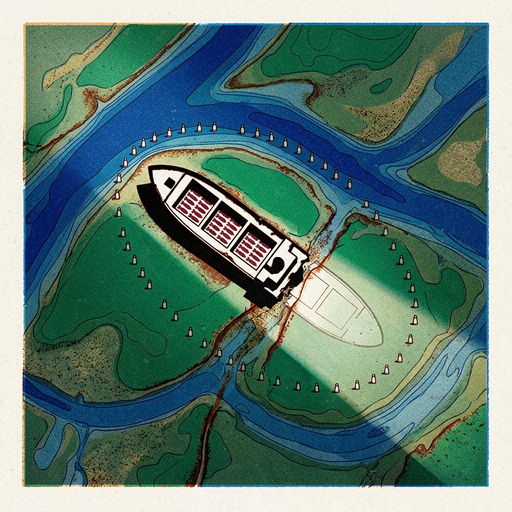
The wreck's perimeter is clearly marked for commercial and recreational mariners. It appears prominently on all Admiralty navigational charts, bordered by four lit cardinal buoys and twelve red hazard buoys. The exclusion zone is placed under continuous, round-the-clock surveillance by Medway Vessel Traffic Services and coastal maritime radar systems. If a vessel deviates from commercial shipping channels and heads toward the restricted perimeter, radar operators alert the bridge immediately, and patrol launches intercept intruders before physical contact occurs.
Alongside physical security, the Department for Transport and the Maritime and Coastguard Agency commission regular non-invasive scientific surveys. Over several decades, hydrographic teams have deployed high-resolution multibeam bathymetry, side-scan sonar, magnetometer sweeps, and diver-held ultrasonic gauges to measure hull-plate thickness. These surveys track the structural degradation of the steel framing millimeter by millimeter, mapping sandbank migration and monitoring the structural cracks that run through the forward decks.
Environmental agencies also keep watch on the surrounding marine ecosystem. A survey in twenty seventeen detailed water and sediment testing conducted through the Centre for Environment, Fisheries and Aquaculture Science. Monitoring stations placed outside the prohibited perimeter analyze samples for heavy metals, chemical residues, and energetic breakdown products. These continuous environmental audits ensure that if corroding casings begin leaching chemical compounds into the estuary, environmental health teams can detect the change early, without relying on speculative assumptions about ecological damage.
The principle of non-disturbance was put to the test when British maritime authorities planned a targeted project to address the ship's remaining masts. For over eighty years, the masts had projected above the waterline, functioning as a visible reminder of the wreck. Structural analysis revealed that the heavy steel masts were acting as long levers. They transmitted wave energy and wind vibration downward into the rotting deck framing, threatening to collapse the forward hull into the cargo holds.
Specialist salvage teams were contracted to carefully cut and hoist the masts away, leaving the explosive cargo undisturbed on the seabed while retaining the legal exclusion zone. That project proved that minimizing disturbance is not an unbending taboo against all physical intervention. Instead, it is an active engineering strategy: authorities intervene selectively when structural analysis proves that a specific mechanical risk outweighs the danger of taking targeted action.
The management of the Richard Montgomery represents an active engineering decision made under deep, irreducible uncertainty. It balances two competing hazard profiles: the chronic, slow-moving hazard of gradual hull deterioration against the acute, immediate hazard of physical salvage.
Restricted access, radar surveillance, and navigational markers effectively eliminate avoidable human contact. They prevent fishing trawlers from dragging nets across the holds and stop pleasure craft from colliding with the upper framing. What those measures cannot prevent is the inexorable progression of natural forces. Chemical corrosion continues to consume the steel plate, tidal currents continue to shift the sand beneath the hull, and storms repeatedly stress the broken framing. Monitoring provides situational awareness, but it cannot guarantee predictive warning before a sudden structural failure occurs deep inside a flooded compartment.
As long as surveys confirm that the hull remains stable and the surrounding seabed supports the forward section, the calculated choice favors leaving the cargo undisturbed. Yet that calculation is not permanent. Future ultrasonic testing might show that the hull is approaching catastrophic collapse, or shifting sandbanks could expose the holds to destructive currents. In that scenario, the chronic hazard of non-intervention could eventually exceed the acute risk of touching the site.
Technological progress may also change the equation. The salvage capabilities available in nineteen forty-four were limited to heavy crane barges, hard-hat divers, and mechanical cutting tools that exerted massive shock and vibration. Today, rapid developments in autonomous underwater robotics, cold-water abrasive jet cutting, and standoff sensor technologies offer recovery methods that were unimaginable decades ago. A future robotic system capable of stabilizing and inerting the munitions without placing human divers at risk could eventually make removal safer than continued waiting.
Until that threshold is reached, critical scientific and operational questions remain open. We do not know the precise chemical stability of the deep trinitrotoluene charges, the mechanical state of hundreds of submerged fuzes, or the structural breaking point of the remaining hold bulkheads. We cannot fully predict the exact proportion of energetic material that would participate in a sympathetic blast, nor can we pinpoint every environmental byproduct slowly dispersing into the surrounding sediment.
The Richard Montgomery remains what it has been since nineteen forty-four: a wartime loss transformed into a modern engineering dilemma. It sits inside a busy tidal estuary as a reminder that risk management does not always mean choosing between total safety and sudden destruction. In the real world, engineering decisions often require navigating the tension between two dangerous paths, where both disturbance and inaction carry unavoidable risks. When you encounter accounts framing the wreck as an overlooked bomb waiting to detonate, look at what the physical evidence confirms. Acknowledge what remains unknown, and ask whether an immediate intervention would genuinely reduce the danger, or multiply it.
If this investigation changed how you think about maritime risk and wartime legacies, reflect on how many other structural hazards around our world are quietly managed through active restraint rather than swift intervention. Safe stewardship often demands the patience to monitor uncertainty rather than rushing into an uncalculated solution.