The Rhineland Coal Machine: Lignite Mining, Village Displacement, and Germany’s Energy Transition
Bagger 288’s vast bucket wheel helped power Germany by stripping lignite from the Rhineland, but the mining system behind it also drained groundwater, erased landscapes, and uprooted villages. As the region races to end coal by 2030, the decision to spare some communities while demolishing Lützerath exposes a lasting question: who bears the cost of the electricity everyone uses?
By MyAudioBooks.ai ·
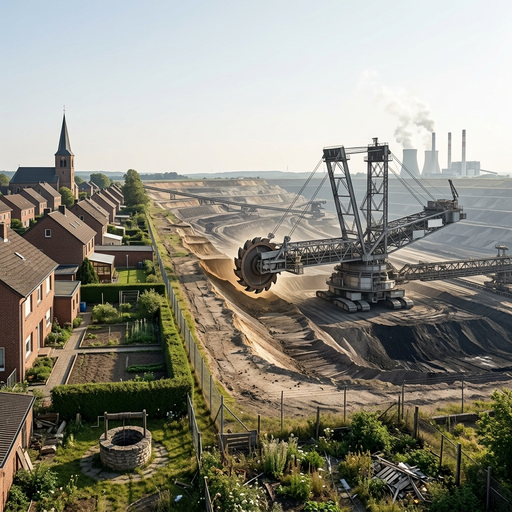
The machine measures roughly two hundred twenty meters from its rear discharge boom to the outer edge of its cutting wheel, standing ninety-six meters tall against the horizon. Yet when it crawls across the prepared ground of an open-cast pit, it advances at only a few meters per minute. Centuries-old villages in western Germany can enter an approved mining boundary decades before any digging equipment arrives at their borders. The machine moves with deliberate slowness, but the legal, economic, and political systems directing it move years ahead of the blade. Understanding what connects this engineering marvel to an emptying village reveals how an entire regional energy system was constructed, how it sustained an industrial economy, and how its accelerated closure reshaped the land.
At My Audio Books dot A I, you can create your own audiobooks from prompts, turn your documents into audio, all with one subscription, and store your items in your own personal library.
In nineteen seventy-eight, the manufacturing firm Krupp completed Bagger two hundred eighty-eight for the mining company Rheinbraun, which later became the lignite division of the energy utility R W E. The machine was designed for continuous surface extraction in broad open-cast pits. Its operation relies on a mechanical principle fundamentally distinct from intermittent shovel excavators that scoop, swing, dump, and return. Instead of pausing between cycles, it cuts and transfers material in an uninterrupted stream.
Its total mass reaches approximately thirteen thousand five hundred tonnes, distributing that weight across three sets of four broad crawler tracks. With an overall height comparable to a thirty-story building, the machine spreads its weight over a vast surface area, keeping ground pressure low enough to travel across soft soil without sinking. Its cutting wheel measures twenty-one point six meters in diameter, carrying eighteen massive buckets around its perimeter. Each bucket holds roughly six point six cubic meters of material, fitted with heavy steel teeth that slice directly into the exposed mine face.
As the wheel rotates, each bucket scrapes upward through the geological strata, fills with earth or fuel, and empties onto an internal conveyor belt near the top of its arc. That conveyor feeds a central transfer system, which directs material outward along a suspended discharge boom to a waiting network of regional conveyors.
The machine's rated capacity reaches about two hundred forty thousand tonnes of coal per day, or alternatively two hundred forty thousand cubic meters of loose overburden soil every twenty-four hours. Those figures represent separate engineering benchmarks tailored to differing material densities, with actual daily output shifting based on seam hardness, weather, and logistical flow.
To sustain continuous excavation, Bagger two hundred eighty-eight relies on an external electrical feed delivered through thick, high-voltage trailing cables, drawing an operating load of about sixteen point five six megawatts. The machine steers and crawls at a pace between two and ten meters per minute. While often cited as the largest land vehicle on earth, it shares that echelon with sister machines like Bagger two hundred ninety-three. Depending on the criteria used, that sister excavator slightly exceeds it in weight or boom reach.
The immense physical scale of Bagger two hundred eighty-eight is a direct consequence of the geology beneath western Germany. The Rhineland lignite basin, stretching across the lowlands between Aachen and Cologne within the state of North Rhine-Westphalia, contains thick, stratified beds of brown coal deposited millions of years ago.
Lignite represents an early stage of coal formation. It is geologically young, soft, and retains a moisture content often exceeding fifty percent by weight. Because of that trapped water, brown coal possesses a relatively low heating value per tonne compared to older bituminous coal or anthracite. Underground tunneling would be structurally unstable in soft sediments and economically nonviable given the low energy density of the seams. Extracting lignite demands open-cast strip mining, removing everything lying above the coal bed to uncover wide horizontal deposits.
Open-cast operations like Hambach and Garzweiler established an integrated industrial circuit across the region. Transporting high-moisture brown coal over long distances by traditional freight rail is economically inefficient because moving it requires paying to transport water. The industry resolved that limitation by building thermal power stations directly alongside the open-cast pits.
Mine faces, heavy-duty belt conveyors, private company rail corridors, and power plants operate as a single synchronized system. Steady electricity demand from nearby manufacturing centers, chemical plants, and urban grids required a continuous, uninterrupted flow of fuel. Bagger two hundred eighty-eight was engineered specifically to maintain that throughput, turning a vast regional deposit into reliable baseload power. Yet clearing the sheer volume of earth needed to reach those seams demands an immense surface footprint that collides directly with human settlement.
Uncovering a lignite seam requires stripping away deep layers of accumulated sediment known as overburden. In the Rhineland, layers of gravel, sand, clay, and fertile topsoil often measure hundreds of meters in depth before the dark coal beds appear.
The extraction cycle follows a strict mechanical sequence. Bucket-wheel excavators work the upper terraces, shaving away millions of tonnes of overburden. High-speed overland conveyor belts transport the soil around the perimeter of the pit to giant spreader machines. These spreaders backfill previously mined sectors or build elevated spoil heaps outside the working basin, creating artificial landforms such as the Sophienhöhe. Only after the overburden is cleared can extraction machines cut into the underlying fuel seam, routing the coal to blending yards, rail loading depots, and power station boilers.
The physical reality of an open-cast mine extends far beyond the active cutting face. An operational concession includes active excavation zones, spoil dumps, multi-kilometer conveyor paths, rail junctions, maintenance stations, and mandatory geotechnical buffer zones.
Equally significant is the invisible hydrological boundary. Because open-cast pits penetrate deep below the natural groundwater table, operators run hundreds of deep wells around the periphery, pumping out billions of cubic meters of water to prevent slope collapse and keep the working terraces dry. That continuous pumping forms a massive cone of depression, lowering groundwater tables across hundreds of square kilometers. It can dry out municipal wells, alter forest soils, and diminish surface streams long before an excavator's steel teeth physically arrive at a property line.
When an approved mining sector coincides with inhabited land, industrial expansion becomes a social transformation. Village resettlement in the German lignite fields is a formal legal and administrative procedure that can unfold over fifteen to twenty years before demolition crews arrive.
A study associated with R W T H Aachen University documented the modern resettlement experience across the Rhineland basin. Researchers examined five Garzweiler-area settlements relocating since two thousand sixteen, alongside a Hambach-area village where relocation began in two thousand twelve. The research team examined how physical displacement and surrounding environmental degradation correlated with elevated psychological distress among affected populations.
While cross-sectional analyses record specific moments in time rather than demonstrating direct linear causation, they document the profound strain of protracted uncertainty. The formal process begins when state planning authorities approve a regional mining perimeter, effectively freezing long-term local investment. The mining operator then negotiates property acquisitions, designs a joint replacement settlement, constructs modern infrastructure, and coordinates phased departures.
Replacement villages are often built several kilometers away, frequently incorporating original street names, religious shrines, and replica town greens to simulate historical continuity. Yet modern suburban layouts rarely sustain the intricate social fabric of the historic communities they replace. Homeowners receive monetary compensation based on structural valuations, but compensation frameworks struggle to capture multi-generational family farms, local retail shops, historic parish records, and century-old neighbor networks.
Residents do not experience relocation uniformly. Older property owners facing the loss of ancestral homes navigate distinct financial and emotional realities compared to younger families seeking modern housing. Meanwhile, local tenants who hold no property title must find rental accommodation in an inflating regional market. A financial settlement replaces real estate, but it cannot automatically reconstruct a living community.
Tensions between extraction boundaries and public resistance produced prominent environmental standoffs in the Rhineland basin. One major conflict centered on Hambach Forest, an ancient woodland reduced to a fraction of its original extent by decades of mining expansion.
In two thousand eighteen, an eviction operation targeting activist treehouse settlements in Hambach Forest provoked nationwide demonstrations. Weeks later, the Higher Administrative Court in Münster halted forest clearance. The court found that potential habitat protections under European conservation directives required thorough judicial review. The court victory halted chainsaws in that specific woodland sector, illustrating the role of administrative litigation, even as earthmoving continued across adjacent mining fields.
At the national level, energy policy began establishing strict extraction deadlines. In two thousand twenty, Germany passed the Coal Phase-out Act, mandating the end of coal-fired power generation by two thousand thirty-eight at the latest. The federal government estimated that closing coal plants would reduce overall national greenhouse-gas emissions by approximately one-quarter relative to two thousand eighteen levels, leaving around nine gigawatts of lignite generation active through two thousand thirty.
In autumn two thousand twenty-two, amid acute European energy supply concerns, the federal economic ministry, the state government of North Rhine-Westphalia, and operator R W E negotiated a revised agreement. The pact accelerated the Rhineland lignite phaseout by eight full years, establishing a binding regional end date in two thousand thirty.
The compromise created a striking spatial paradox. Moving the extraction deadline forward allowed authorities to spare five threatened villages in the Garzweiler concession from future demolition. R W E projected that the shortened timeline would leave roughly two hundred eighty million tonnes of lignite permanently in the ground.
Simultaneously, government energy modeling concluded that coal beneath the agricultural hamlet of Lützerath remained necessary to supply power plants through the expedited transition window. In early two thousand twenty-three, police forces cleared activists and remaining residents from Lützerath, leading to its rapid demolition. The settlement became a symbol of how an accelerated energy transition can simultaneously preserve one set of communities while ordering the destruction of another.
Focusing purely on the scale of Bagger two hundred eighty-eight obscures the systemic nature of mining. The bucket wheel possesses no internal agency. Its movement is determined by concession boundaries, power purchase contracts, regional court judgments, and federal statutes. The machine is the physical instrument of an energy consensus that prioritized heavy industrial power, municipal employment, and domestic energy security for generations.
That consensus produced an unequal distribution of impacts. Stable baseload electricity powered aluminum smelters, chemical complexes, and millions of homes across Germany. Municipal budgets in mining territories collected corporate tax revenues that built public schools and community sports centers. Yet the direct human costs—displacement, diminished air quality, the severing of family ties, and the loss of centuries of village history—were borne almost entirely by the populations living along the pit margins.
Even as coal generation winds toward its two thousand thirty conclusion, the obligations left in the earth will persist for generations. Mine reclamation plans involve regrading colossal overburden terraces, converting deep mine voids into massive artificial lakes, and establishing new agricultural parcels. Yet post-mining landscapes do not replicate historical ecosystems. Filling the deepest pits with water diverted from the Rhine and local waterways will take several decades, while restoring natural groundwater balances will require continuous monitoring and geotechnical pumping well into the next century.
The colossal machinery itself presents an unresolved question of industrial heritage. As extraction ceases, machines like Bagger two hundred eighty-eight will either be dismantled for scrap metal or preserved as monumental artifacts of the industrial era. If preserved, they will stand not merely as engineering achievements, but as physical monuments to a carbon economy that reshaped geography to power modern society.
The continuous motion of the bucket wheel shows how the earth was moved, but political and economic decisions explain why the ground beneath people's feet was taken. As coal gives way to newer energy systems, we are left to consider what responsibilities are owed to the communities and landscapes that bore the physical burden of keeping the electrical grid alive.