The Porteous Riots: Royal Authority and Civic Resistance in Edinburgh, Seventeen Thirty-Six
In 1736, Edinburgh’s fury over taxation, smuggling, and an abusive Town Guard erupted after Captain John Porteous’s troops killed civilians at a public execution; when the Crown postponed his death sentence, an organized crowd stormed the Tolbooth and lynched him themselves. Westminster answered with fines, censure, and demands on Scotland’s churches, but retreated from dismantling Edinburgh’s institutions—revealing how limited state power becomes when legal authority loses public legitimacy.
By MyAudioBooks.ai ·
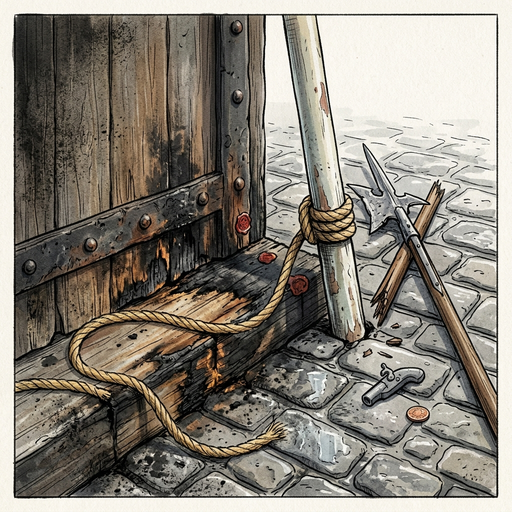
Just before midnight on September seventh, seventeen thirty-six, several thousand people moved through the narrow streets of Edinburgh with muffled drums and captured weapons. They locked the eastern gates of the city against the British army, surrounded the Tolbooth prison, and set fire to its fortified oak doors. Inside sat Captain John Porteous, an officer of the municipal guard convicted of murder and sentenced to hang, whose execution Queen Caroline had postponed only days before. The crowd dragged him into the street, marched him down to the public execution grounds, and hanged him from a dyer's pole. When a community decides that royal mercy is an act of tyranny, it exposes a fundamental vulnerability in state power. What can a government do when an entire city chooses to carry out a sentence that the crown suspended?
At My Audio Books dot A I, you can create your own audiobooks from prompts, turn your documents into audio, all with one subscription, and store your items in your own personal library.
To understand how an armed crowd seized the authority of the gallows, we have to look at the atmosphere in Scotland nearly three decades after the seventeen oh seven Act of Union. The political merger of Scotland and England created the Kingdom of Great Britain, but it also introduced English customs rates and excise taxes to northern ports. Across Scotland, ordinary citizens viewed these duties as foreign impositions designed to enrich London at their expense. Smuggling goods like brandy, tea, and tobacco into coastal towns became a widely supported economic activity rather than a shameful crime. Communities routinely sheltered contraband, intimidated customs officers, and regarded merchants who defied the revenue service as defenders of local independence.
This civic tension converged on a merchant and smuggler named Andrew Wilson, who operated out of the county of Fife. Customs officers had seized a valuable cargo of his imported goods, leaving him financially ruined. In retaliation, Wilson and an associate named George Robertson broke into the house of an excise collector in the town of Pittenweem and seized public revenue to recoup his losses. Wilson's offense was not routine smuggling, but armed robbery of crown funds. The High Court of Justiciary in Edinburgh condemned both men to die on the scaffold.
Wilson's public image changed dramatically while he awaited execution inside the Tolbooth, the ancient prison standing beside Saint Giles Cathedral. Condemned prisoners were brought under armed guard to attend a final Sunday church service at the adjacent Tolbooth Kirk. As the congregation listened to the sermon, Wilson suddenly leaped forward, grappled with three guardsmen, and held them fast with his hands and teeth while shouting for Robertson to run. Robertson slipped through the startled worshippers, vanished into the city streets, and escaped punishment entirely. By sacrificing his own remaining hope of escape to liberate his younger partner, Wilson transformed himself in the public imagination from a convicted robber into a heroic martyr.
His impending execution turned the Grassmarket, Edinburgh's open market basin beneath the castle rock, into a volatile arena. Scottish public executions drew massive crowds that packed the cobblestones and leaned out from the windows of ten-story stone tenements enclosing the square. To maintain order, the Edinburgh magistrates relied on the Town Guard, an armed municipal police force composed largely of Highland veterans. The guard was intensely unpopular, often viewed by working-class Lowland citizens as an abusive and predatory instrument of civic authority.
In command of the guard detachment on execution day was Captain John Porteous. Porteous had served for years as a professional soldier and had earned a reputation among the townspeople for arrogance, harsh discipline, and a violent temper. Over the years, popular memory has sometimes confused Porteous with the executioner. The executioner was an appointed municipal laborer charged with adjusting the rope and turning the condemned off the ladder. Porteous was an armed military officer whose sole responsibility was to deploy troops and preserve civic authority around the scaffold. That distinction is critical, because when the Grassmarket erupted, the crowd was confronting the armed power of the state that stood behind the gallows.
On April fourteenth, seventeen thirty-six, Andrew Wilson was brought to the scaffold in the Grassmarket and hanged until dead. The execution itself proceeded without interruption, but the moment the hangman stepped forward to cut the body down, the crowd's restrained anger broke loose. Spectators hurled stones, mud, and street refuse at the hangman and the magistrates. Stone-throwing at public executions was a recognized ritual of crowd displeasure in eighteenth-century Britain, but what followed escalated far beyond conventional disorder.
Captain Porteous and his guardsmen faced the barrage of stones without adequate room to maneuver. According to subsequent witness testimony, Porteous grew furious, seized a musket from one of his soldiers, and ordered his company to fire into the crowd. Some guards fired directly into the dense press of people gathered around the gallows, while others discharged their weapons high into the air.
In an open field, firing over the heads of a crowd might serve as an intimidating warning. In the Grassmarket, it was lethal. The square was an enclosed basin surrounded by towering multi-story tenements whose windows were packed with spectators watching the scene below. Musket balls aimed above the crowd struck bystanders leaning out from second-story and third-story sills. One victim was shot through the head while looking down from an upper window, and several other onlookers inside nearby buildings were wounded.
Contemporary records and subsequent legal proceedings indicate that between six and nine people were killed on the spot or died shortly after of their wounds. Around twenty others suffered severe injuries from musket fire. What was beyond dispute was that the armed guard of Edinburgh had slaughtered unarmed spectators, including citizens observing from the shelter of their own homes.
Public outrage was immediate and overwhelming. To prevent an immediate armed uprising, the city magistrates arrested Porteous and confined him inside the Tolbooth. In July, Porteous faced trial before the High Court of Justiciary, Scotland's supreme criminal court, on formal charges of murder.
The courtroom testimony presented sharply conflicting narratives. Prosecution witnesses insisted that Porteous personally leveled his piece and shot a young man dead, while shouting repeatedly to his men to fire upon the crowd. The defense argued that Porteous had never fired his weapon, that any orders he gave were aimed at securing the scaffold under violent assault, and that panicked guardsmen had discharged their muskets without direct command. The Edinburgh jury rejected his defense. On July twentieth, seventeen thirty-six, the court found Captain John Porteous guilty of murder and sentenced him to hang on September eighth, in the very same Grassmarket where his troops had taken civilian lives.
As September eighth approached, an intervention from London altered the course of events. King George the Second was abroad in Hanover, leaving Queen Caroline to govern as regent. When petitions on Porteous's behalf reached Westminster, ministers questioned whether an anti-English and anti-military bias in Edinburgh had denied the captain a fair trial. On August twenty-sixth, Queen Caroline signed a royal reprieve, suspending the execution for six weeks to allow the crown time to review the court proceedings.
In legal terms, a reprieve was merely a procedural postponement that kept the prisoner alive while senior legal officers examined the record. In Edinburgh, however, that distinction was instantly lost. To the citizens who had seen their neighbors shot dead in the street, the reprieve looked like the corrupt protection of an abusive officer by the London court. A shared conviction spread through the taverns and workshops that royal authority intended to grant Porteous a full pardon and let him walk free.
On the evening of September seventh, the night before the original execution date, Edinburgh witnessed an act of cold, calculated insurrection. Rather than an impulsive riot, the operation functioned with military discipline. Around ten at night, a small band began beating a drum through the city's southern suburbs, gathering recruits at every corner. The crowd swiftly marched to the Netherbow Port, the heavy eastern gate that controlled access through the city walls, and locked it. By securing the Netherbow, they severed communication between the city and regular British troops garrisoned nearby in the Canongate and at Holyrood. Other detachments seized the Town Guard's headquarters, overpowered the guardsmen, and armed themselves with municipal muskets, halberds, and ammunition.
The crowd then converged on the Tolbooth prison. Finding the massive outer door impervious to sledgehammers and iron bars, the leaders gathered tar barrels and timber, piled them against the door, and set them ablaze. Once the iron-studded oak burned through, the leaders systematically marched inside, ignoring the other prisoners and heading straight for Porteous's cell. They found the captain hiding inside a chimney, pulled him down, and carried him out into the night.
The march down the High Street and into the Grassmarket was chillingly deliberate. The leaders stopped at an open shop along the way to secure a rope, leaving a coin on the counter to pay for it. They carried torches and maintained a tight perimeter around their prisoner, rebuffing pleas from local officials and clergy. Arriving at the Grassmarket, they found the public gallows dismantled. Rather than wait, they commandeered a wooden pole outside a nearby dyer's workshop, placed the noose around Porteous's neck, and hoisted him into the air.
After hanging him repeatedly to ensure death, the leaders abandoned the body, broke their captured weapons on the cobblestones, and dispersed quietly into the alleys. By morning, the streets were deserted. When crown authorities arrived to investigate, they met a wall of absolute silence. Despite generous cash bounties and intensive interrogations, not a single participant in the lynching was ever convicted.
When news of the lynching reached London, the British government interpreted it as a direct assault on royal sovereignty and a challenge to the Union itself. Queen Caroline and her ministers were furious that an organized conspiracy had nullified royal prerogative and executed a crown prisoner under the noses of city officials. When Parliament convened in seventeen thirty-seven, Lord Carteret led a hardline faction demanding severe collective retribution against Edinburgh. Carteret argued that the entire municipality had become an accessory to murder through the negligence or complicity of its magistrates, and the government introduced legislation to punish the city as a corporate body.
The initial bill proposed three severe measures. First, it called for the imprisonment and permanent disqualification of Lord Provost Alexander Wilson, Edinburgh's chief magistrate during the riots. It is important to distinguish Lord Provost Alexander Wilson from Andrew Wilson, the executed smuggler. The provost was the wealthy civic official who had failed to disperse the crowd or alert regular troops in time. Second, the bill proposed the complete abolition of the Town Guard, stripping Edinburgh of its independent police force. Third, it ordered the demolition of the Netherbow Port, tearing down the historic city gates to ensure British regular troops could enter Edinburgh at will without municipal hindrance.
This legislation touched off a fierce constitutional clash in the House of Lords. Scottish peers, led by John Campbell, the Duke of Argyll, mounted a fierce defense of Scottish institutional rights under the Treaty of Union. Argyll pointed out that collective punishment against an entire community for the crimes of unidentified individuals violated the principles of Scots law. He argued that tearing down the city's gates and stripping its armed watch would leave Edinburgh defenseless against common criminals, alienating loyal Scots and reviving support for the exiled Stuart monarchy.
Under relentless Scottish opposition, the government backed down and dramatically altered the bill. The proposal to disband the Town Guard was dropped, allowing the municipal police to survive. The order to dismantle the Netherbow Port was abandoned, preserving Edinburgh's physical boundaries.
When Parliament finally passed the Act of seventeen thirty-seven, the resulting civic penalties were remarkably limited. Lord Provost Alexander Wilson was disqualified from holding municipal office, and the City of Edinburgh was assessed a fine of two thousand pounds. Parliament awarded this money exclusively to the widow of Captain Porteous, bypassing the families of the civilians killed in the Grassmarket. Parliament asserted its supremacy over the city, but it did so through financial compensation and symbolic censure rather than institutional destruction.
Parliament attempted a second, more intrusive measure to hunt down the conspirators, and in doing so, ignited an entirely different conflict over religious independence. In the summer of seventeen thirty-seven, Parliament passed an additional statute designed to bring the murderers to justice. This act mandated that every minister of the Church of Scotland read the entire text of the statute from their pulpits during Sunday morning worship, on the first Sunday of every month for an entire year.
The statute threatened ministers with civil penalties if they refused, including the loss of their church seats. To Westminster, using the national church was simply a practical way to deliver public notices in an era before mass print media. To Scottish presbyterians, however, it was an intolerable violation of spiritual autonomy. The Church of Scotland had fought for generations to protect its internal governance from crown and parliamentary control. Ministers argued that the pulpit belonged exclusively to the preaching of the Gospel, not to secular police announcements and state bounties.
Many ministers flatly refused to read the act, while others complied under protest, reading the text before the formal start of worship or muttering the words so parishioners could not understand them. Congregations walked out of services the moment their pastors unfolded the government document. Refusing the pulpit proclamation reflected a defense of ecclesiastical independence rather than sympathy for the mob.
The memory of these events lingered long after the monthly pulpit readings ceased. Nearly a century later, in eighteen eighteen, Sir Walter Scott published his novel, The Heart of Midlothian, immortalizing the storming of the Tolbooth and the death of Porteous in British literary imagination. Scott depicted the lynching with striking dramatic gravity, emphasizing the eerie silence and solemnity of the crowd. Yet beneath that literary account lay an unresolved historical reality: the identity of the leaders who orchestrated the assault remained an enduring mystery. Rumors persisted that members of Edinburgh's merchant elite, or even Scottish aristocrats, had disguised themselves in working clothes to lead the raid, but no concrete evidence ever emerged to confirm those suspicions.
What the historical record leaves us with is a stark study in the limits of centralized state power. When we look closely at the aftermath of seventeen thirty-six, the central paradox becomes clear. Parliament changed Edinburgh's civic finances, removed a single magistrate, and demanded public condemnations from the pulpits, but it left the city's fundamental institutions intact. Westminster discovered that in a fragile union, you cannot govern a capital city simply by declaring its entire population guilty.
The events of seventeen thirty-six force us to ask a difficult question: what happens when formal legal authority loses its moral credibility in the eyes of the public? If you want to explore more deep investigations into the turning points of constitutional history, stay with us as we examine the moments where law, power, and resistance collide.