The Pitch Drop Experiment: Extreme Viscosity and a Century of Patient Observation
Since Thomas Parnell opened a funnel of pitch in 1930, the seemingly solid material has crept downward one drop at a time, showing how it can shatter under a sudden blow yet flow under gravity. Generations of researchers have measured its extraordinary viscosity while repeatedly missing the fleeting moment a drop falls, turning a simple demonstration into a century-long lesson in patience, observation, and the limits of everyday perception.
By MyAudioBooks.ai ·
Listen free: The Pitch Drop Experiment: Extreme Viscosity and a Century of Patient Observation
At the University of Queensland in Brisbane, a dark mass of pitch rests quietly inside a glass funnel. Strike that same pitch with a heavy steel hammer, and it shatters like flint into razor-sharp, glassy shards. Leave it completely undisturbed under its own weight, and it creeps downward molecule by molecule, releasing a single drop roughly once every decade. Thomas Parnell prepared this experiment in nineteen twenty-seven to demonstrate that appearances can deceive our senses. Yet across nearly a century of continuous flow, decisive moments have repeatedly escaped direct human observation. What allows a substance that feels like solid rock to behave as a slow-moving liquid, and why has a process unfolding over generations proved so difficult to witness at its turning point?
At My Audio Books dot A I, you can create your own audiobooks from prompts, turn your documents into audio, all with one subscription, and store your items in your own personal library.
In nineteen twenty-seven, Thomas Parnell, the first professor of physics at the University of Queensland, set out to resolve an everyday sensory illusion. We routinely divide the physical world into rigid solids and flowing liquids based on how materials respond during the few moments we spend handling them. Parnell designed a demonstration to show that slow mechanical deformation can occur across timescales far beyond ordinary human perception.
He selected a quantity of pitch, a dense bituminous substance obtained from the distillation of coal tar or crude petroleum. Composed of high-molecular-weight hydrocarbons and complex organic resins, pitch appears as a glossy black rock at room temperature. Parnell heated the material until it liquefied into a thick, dark fluid, then poured it into a glass funnel whose bottom stem had been sealed with heat.
He did not immediately open the stem. Instead, Parnell kept the funnel completely sealed and undisturbed for three full years. That prolonged settling period was essential for establishing scientific control. It allowed trapped air bubbles to rise and escape, gave the internal structure time to relax, and ensured the entire mass reached thermal equilibrium with the surrounding Brisbane air.
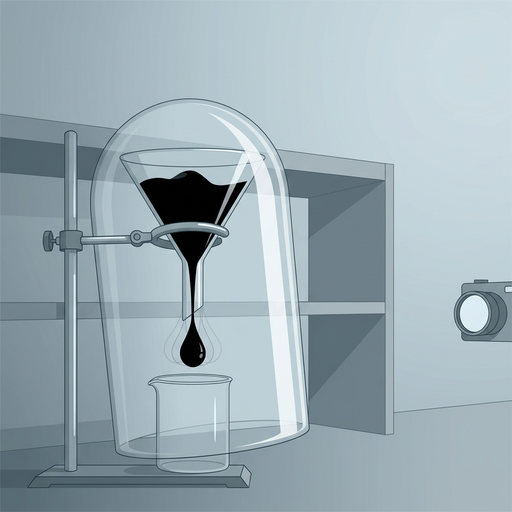
In nineteen thirty, Parnell finally severed the glass stem beneath the conical reservoir. That single physical cut marked the formal beginning of the experiment, separating the preparatory stage from the active flow. The apparatus itself is remarkably simple and elegant. A wide glass cone holds the bulk reservoir of pitch above a narrow cylindrical stem. Beneath the stem sits a glass beaker to catch whatever falls, and a heavy glass bell jar covers the entire assembly to shield it from dust and air currents.
The physical behavior of pitch bridges three mechanical properties that are often mistakenly conflated: elasticity, brittleness, and viscosity. Elasticity refers to the capacity of a material to deform under load and then spring back to its original shape when that load is removed. Brittleness describes a material's tendency to fracture catastrophically with little or no prior plastic deformation when subjected to a sudden mechanical shock. Viscosity measures internal fluid friction, determining how rapidly adjacent molecular layers can slide past one another under a sustained shear force.
Pitch exhibits pronounced brittleness under a rapid blow while possessing extraordinary viscosity under persistent gravitational pull. When struck by a hammer, its tangled hydrocarbon chains have no time to reorient or disentangle, forcing the material to shatter like glass. When steady gravity pulls on the pitch month after month, those same chains slide past one another in an imperceptibly slow, continuous shear flow. Parnell had initiated a demonstration that would soon outlive him, setting in motion an inquiry that demanded generations of sustained patience.
Gravity supplies the persistent physical force driving the experiment forward. The column of pitch resting in the upper funnel produces hydrostatic pressure proportional to its height and density. That pressure forces the pitch downward into the narrow constriction of the glass stem, governing the rate of flow according to the principles of fluid dynamics in cylindrical pipes. As the material clears the lower outlet, it slowly gathers into a rounded pendant drop under its own weight.
Drop formation in this apparatus unfolds through distinct morphological stages rather than a sudden drip. First, the pitch emerges from the stem tip and gradually bulges into a spherical bulb. Next, the growing mass pulls the bulb downward, stretching the material into an elongated, tapering neck. Finally, that connecting strand thins until the drop detaches cleanly, or until the bottom of the mass makes physical contact with the container below.
Because of this extreme timescale, pitch appears entirely motionless across weeks or months, yet deforms measurably across a decade. Its mechanical response depends directly on observation time, applied stress, and ambient temperature. For the first half-century of the experiment, university observers recorded the emergence of drops without establishing an official mathematical estimate of the material's resistance to flow.
In nineteen eighty-four, physicists at the University of Queensland published a formal technical analysis in the European Journal of Physics. They measured the dimensions of the glass funnel, determined the average mass of the fallen drops, and modeled the flow through the cylindrical stem. Their calculations yielded an effective dynamic viscosity of approximately two point three times ten to the eighth pascal-seconds, with an uncertainty of roughly fifty million pascal-seconds.
A pascal-second is the standard international unit of dynamic viscosity. For comparison, liquid water at twenty degrees Celsius has a viscosity of roughly one one-thousandth of a pascal-second. The pitch in the Brisbane funnel resists flow on the order of one hundred billion to two hundred fifty billion times more than water, depending on reference temperature and rounding.
That nineteen eighty-four figure represents an effective estimate under specific historical conditions, rather than a universal constant of nature. For most of its history, the apparatus stood in an un-air-conditioned display case exposed to Brisbane's subtropical climate. Queensland's warm summers softened the pitch and lowered its viscosity, accelerating downward movement, while cooler winters increased internal resistance and slowed the flow. These shifting seasonal temperatures explain why the interval between drops has never followed a rigid, predictable calendar.
The chronological record of the experiment reflects decades of quiet waiting punctuated by elusive, fleeting milestones. After the stem was unsealed in nineteen thirty, the first drop required more than eight years to fall, finally landing in nineteen thirty-eight. The second drop completed its descent in nineteen forty-seven, nine years later. Thomas Parnell passed away the following year, having witnessed only those first two events.
A third drop fell in nineteen fifty-four. Then, in nineteen sixty-one, physicist John Mainstone assumed custodianship of the apparatus, beginning a stewardship that would span more than five decades. Under Mainstone's watchful care, the drops continued their slow cadence. A fourth drop fell in nineteen sixty-two, followed by a fifth in nineteen seventy. The sixth arrived in April nineteen seventy-nine, and the seventh in July nineteen eighty-eight. Over that early span, seven drops fell, establishing an average rhythm of roughly one drop every eight years.
Yet sustained attention across years does not guarantee presence at the critical instant of separation. Mainstone later recalled missing the nineteen seventy-nine drop by approximately a single day during a brief absence. When the seventh drop approached separation in July nineteen eighty-eight, Mainstone stepped out of the laboratory for a five-minute break, only to return and discover that the drop had already detached. These near-misses reveal how difficult it is to align human routines with a transition that occurs across unpredictable minutes.
Technology seemed ready to solve the problem as the twentieth century ended. The university installed an automated camera to monitor the display case and broadcast continuous frames. On November twenty-eighth, two thousand, the eighth drop finally fell. At that precise moment, an electrical outage and technical disruption disabled the camera, leaving the lens blank and the detachment unrecorded.
John Mainstone passed away in August two thousand thirteen without ever seeing a drop fall in person. Custodianship then passed to physicist Andrew White. By early two thousand fourteen, the ninth drop had stretched downward until it hovered mere millimeters above the eighth drop resting inside the beaker.
On April twenty-fourth, two thousand fourteen, the descending ninth drop gently touched the accumulated pitch below. The university adopted that physical contact as its operational criterion for the completion of the drop. Because the beaker had gradually filled over eighty years, the drop could not fall through open air. The connecting neck remained intact for weeks until custodians temporarily lifted the bell jar to reposition the beaker, clearing space for future flow.
In two thousand five, John Mainstone and the late Thomas Parnell were awarded an Ig Nobel Prize for physics. The honor celebrated an experiment that first provokes laughter, and then inspires deep respect for scientific patience.
The University of Queensland funnel illustrates core principles within rheology, the branch of physics devoted to how materials deform and flow under applied forces. Introductory science often divides matter into neat categories: solids retain their fixed shape, while liquids conform to the shape of their container. The pitch experiment proves that these definitions are deeply dependent on the timescale across which an observation is made.
Brittle fracture under a sudden impact and viscous flow under sustained gravity are entirely compatible behaviors within a single substance. When a mechanical shock strikes pitch, energy transfers through the material in milliseconds, causing it to crack before internal bonds can slide. When gravity pulls on the pitch across months and years, the material has ample time to relieve that stress through slow internal molecular rearrangement.
This behavior does not prove the popular myth that every solid is secretly a liquid in disguise. True crystalline solids possess orderly atomic lattices that resist steady shear flow unless heated close to their melting points. Pitch is an amorphous bituminous mixture lacking any long-range crystalline lattice. That disordered internal arrangement allows its molecules to yield continuously under sustained downward stress. The experiment demonstrates extreme viscosity, not a universal reclassification of all matter.
At the same time, the apparatus reveals the practical realities of long-duration science. Missing the exact second of detachment limits timing precision and leaves the fine mechanics of filament pinch-off unrecorded. Yet those brief observational gaps do not diminish the scientific validity of the result. The accumulated mass resting in the beaker and the changing profile of the neck provide indisputable macroscopic proof of continuous flow.
Long-term scientific observation requires far more than an attentive individual researcher. It depends on institutional memory, stable laboratory environments, meticulous record-keeping, and generational handovers. The near-misses in Brisbane highlight the inherent tension between human daily schedules, which operate on cycles of hours, and physical processes that unfold across lifetimes.
As the experiment approaches its centennial, several scientific questions remain open to inquiry. One major question concerns whether the pitch has altered chemically over nearly a century of exposure. Under ambient room conditions, lighter volatile organic compounds may slowly evaporate from the exposed upper surface of the pitch. If the material's chemical composition shifts over decades, the pitch could become progressively more viscous, subtly altering its flow rate during its second century.
Another open question is what modern analytical instruments would reveal about this specific sample. Contemporary rotational rheometers can map viscoelastic moduli, yield stress, and temperature dependence with remarkable precision. However, extracting a physical sample would permanently alter Parnell's historical apparatus. Investigators must therefore continue inferring the material's properties through non-invasive observation from outside the glass bell jar.
Historical questions also surround the early timeline. Archival records from the nineteen thirties and nineteen forties do not preserve exact hourly timestamps for early milestones. Furthermore, early observers may not have applied identical criteria when deciding that a drop had officially fallen. The ninth drop brought that definitional challenge into sharp focus. Observers had to decide whether a drop officially counts as fallen at the moment of physical contact with the mass below, when its connecting neck snaps, or at some other measurable threshold.
Today, redundant digital cameras monitor the display case continuously. The university previously projected that the tenth drop would complete its descent sometime during the twenty-twenties. Whether that tenth drop will detach cleanly or settle quietly against the pitch beneath it remains an ongoing physical process.
Pitch appears completely solid when examined across ordinary human timeframes, yet under persistent gravity, its fluid nature is undeniable. Parnell's funnel provides compelling evidence of extreme viscosity, while its history reminds us that observing the natural world often requires patience that outlasts a single lifetime.
If the story of this slow-moving funnel changes how you think about matter and time, consider the quiet transformations unfolding unnoticed around you. The next time a physical process appears entirely motionless, ask yourself whether it is truly standing still, or if understanding it simply requires someone willing to keep observing across a lifetime.