The Nuclear Torpedo Below: Arkhipov and the Cuban Missile Crisis at Sea
During the Cuban Missile Crisis, American warships dropped signaling explosives near a Soviet submarine, unaware it carried a nuclear torpedo. Cut off from Moscow and fearing war had begun, its captain considered using the weapon, but senior officer Vasili Arkhipov urged restraint, and the submarine surfaced without firing. Hidden for decades, the encounter reveals something more unsettling than the legend of one man saving the world: how easily isolation, miscommunication, and exhaustion can bring nuclear forces to the brink.
By MyAudioBooks.ai ·
Listen free: The Nuclear Torpedo Below: Arkhipov and the Cuban Missile Crisis at Sea
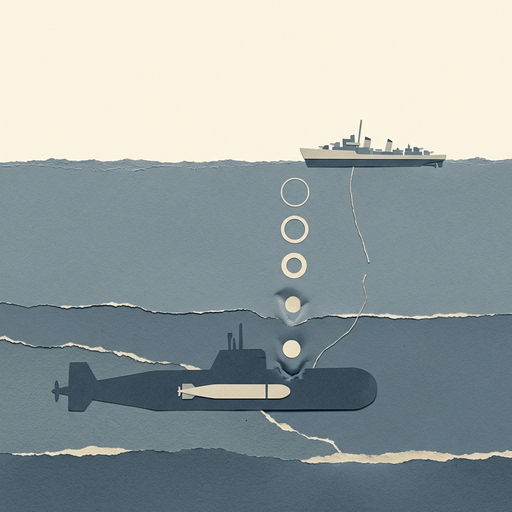
On the afternoon of October twenty-seventh, nineteen sixty-two, American naval destroyers in the Sargasso Sea began dropping explosive signaling charges into the deep ocean. Hundreds of feet beneath the surface, a submerged Soviet submarine shuddered under the concussions. American commanders believed they were using non-lethal signals to force an unidentified intruder to surface. They had no idea that the vessel trapped beneath them was armed with a ten-kiloton nuclear torpedo. Inside the sweltering, air-depleted hull, completely severed from communication with Moscow, the exhausted Soviet crew feared that a third world war had already begun.
Roughly forty years later, the senior officer aboard that vessel, Vasili Arkhipov, became internationally famous as the man who single-handedly saved the world. Popular retellings often describe a dramatic cinematic vote: two officers demanding an atomic launch, and one lone voice refusing to consent. Yet examining naval deck logs, declassified records, and firsthand testimonies reveals an encounter far more complicated and far more instructive than the popular legend suggests. To understand what truly happened aboard submarine B-fifty-nine, we must look past the mythology. We must examine the mechanics of crisis at sea, and trace how historical memory took shape through four decades of official secrecy.
At My Audio Books dot A I, you can create your own audiobooks from prompts, turn your documents into audio, all with one subscription, and store your items in your own personal library.
The road to confrontation began in mid-October, when American reconnaissance aircraft photographed Soviet medium-range ballistic missile installations under construction in western Cuba. The discovery ignited what historians conventionally mark as a thirteen-day crisis, spanning from October sixteenth through October twenty-eighth. On the evening of October twenty-second, President John F. Kennedy addressed the American public, announcing a strict naval quarantine around Cuba to block further offensive shipments. The administration chose the word quarantine with deliberate legal care. Under international maritime law, declaring a naval blockade constituted an open act of war.
Beneath the Atlantic, a covert deployment had been underway for three weeks. On October first, nineteen sixty-two, the Soviet naval command dispatched four diesel-electric Foxtrot-class submarines from the Arctic port of Polyarny on the Kola Peninsula. Designated Operation Kama, their secret mission was to cross the North Atlantic, slip through Western patrol lines, and establish a permanent naval presence at the Cuban port of Mariel. Among these four vessels was submarine B-fifty-nine, commanded by Captain Valentin Savitsky.
Each of the four submarines carried nineteen conventional torpedoes and a single special weapon. That special weapon was a torpedo tipped with a nuclear warhead rated at approximately ten kilotons, an explosive yield comparable to the atomic bomb detonated over Hiroshima. The rules of engagement issued by the Kremlin were dangerously ambiguous. The submarine captains held standing permission to fire conventional torpedoes in self-defense if attacked. Deploying the nuclear weapon, however, required explicit orders from Moscow, unless the submarine sustained catastrophic hull damage and faced imminent destruction.
Three senior officers shared the cramped command spaces aboard B-fifty-nine. Captain Savitsky directed the ship and its eighty-man crew. Political officer Ivan Maslennikov represented the Soviet Communist Party, supervising ideological discipline and political loyalty. The third man was Captain Second Rank Vasili Arkhipov. He sailed aboard B-fifty-nine not as its captain, but as the chief of staff of the entire submarine flotilla, responsible for overseeing all four vessels in the operation.
Arkhipov commanded immense professional respect across the Soviet submarine fleet. In July nineteen sixty-one, he had served as executive officer aboard the nuclear-powered ballistic missile submarine K-nineteen when its reactor cooling system suffered a catastrophic pipe rupture. Arkhipov helped manage that terrifying emergency in the North Atlantic, watching his crewmates absorb lethal doses of radiation while welding a makeshift cooling line to prevent a core meltdown. That harrowing ordeal gave him direct, firsthand experience with nuclear hazard, though public records provide no evidence that this earlier trauma directly dictated his decisions in the Caribbean.
By Saturday, October twenty-seventh, a date remembered in crisis historiography as Black Saturday, tensions reached a dangerous breaking point. In the skies above Cuba, a Soviet surface-to-air missile battery shot down an American U-two reconnaissance plane, killing its pilot, Major Rudolf Anderson. Hundreds of miles to the north, east of the Bahamas, eleven American destroyers and the aircraft carrier USS Randolph detected B-fifty-nine running deep, its batteries nearing absolute exhaustion.
Submarine B-fifty-nine was operating far outside the conditions it was built to endure. Designed for the icy waters of the Arctic and the North Atlantic, the Foxtrot-class possessed rudimentary ventilation and no air-conditioning systems capable of handling tropical ocean currents. Deep inside the steel hull, heat generated by the diesel engines, electrical switchboards, and human bodies accumulated with relentless intensity. Temperatures in the crew quarters climbed above one hundred degrees Fahrenheit, or roughly forty degrees Celsius. In the aft engine spaces, temperatures exceeded one hundred twenty degrees Fahrenheit, reaching fifty degrees Celsius. Crew members stripped to their underwear, suffering from chronic heat exhaustion, dehydration, and painful skin infections, while drinking water was rationed to a single cup per sailor each day.
Compounding the oppressive heat was the steady degradation of the breathing air. Diesel-electric submarines rely on chemical carbon dioxide scrubbers and compressed oxygen reserves while running submerged. Having spent days evading American anti-submarine patrols, B-fifty-nine remained beneath the surface far longer than operational limits permitted. Carbon dioxide concentrations rose to toxic levels, producing blinding headaches, blurred vision, dizziness, and cognitive impairment across the entire crew.
To recharge its vast banks of lead-acid batteries, a diesel-electric submarine must surface or raise a snorkel mast to draw atmospheric air for its engines. Every time Savitsky attempted to reach periscope depth, American sonar operators detected the vessel and dispatched hunting destroyers and carrier-based tracker aircraft. By late afternoon on October twenty-seventh, the submarine's electric reserves were nearly gone. The steering gear responded sluggishly, interior lighting flickered, and the vessel risked losing buoyancy control altogether.
Above them, American naval forces initiated signaling procedures designed to force the unidentified submarine to the surface. The United States Navy had drafted a signaling protocol specifying that surface ships would drop five small practice depth charges to communicate a demand to surface and identify. Yet the Soviet high command had never forwarded this signaling notice to its submarine captains at sea.
Contemporaneous American ship deck logs provide precise timestamps for the physical pressure applied from above. Aboard the destroyer USS Beale, officers recorded dropping acoustic signaling charges and hand grenades into the water at four fifty-nine PM. At five twenty-nine PM, lookouts logged additional explosive charges detonating along the submarine's sonar track.
To the American commanders on the surface, these practice charges were non-destructive acoustic signals. To the men trapped inside the submarine, the detonations sounded like the beginning of an all-out attack. Underwater shockwaves strike a submarine hull with tremendous acoustic violence, sounding like heavy iron hammers smashing against the steel casing. In the red glow of emergency lighting, suffering from oxygen starvation and battery collapse, the Soviet officers faced a terrible uncertainty. They had no way to confirm whether the explosions were harmless signals or the opening salvo of a campaign to crush their hull.
The total breakdown of communications heightened the danger inside the control room. Because B-fifty-nine had remained submerged to evade American sonar nets, its radio antennae could not breach the surface. The crew had received no radio broadcasts, diplomatic updates, or directives from Moscow for several days. Operating in absolute informational isolation, Captain Savitsky faced the distinct possibility that full-scale nuclear combat between the superpowers had already erupted across the globe.
Witness accounts recorded decades later indicate that the toxic air, physical exhaustion, and deafening underwater concussions pushed Savitsky to the brink of despair. Convinced that his vessel was under direct attack and that general war had begun, the captain reacted with explosive fury. Witnesses recalled him declaring that the crew would not perish in disgrace, and ordering the nuclear-armed torpedo prepared for action.
This dramatic moment gave birth to the widely repeated Cold War legend. Popular retellings assert that Soviet military regulations required unanimous agreement from three officers to launch the nuclear torpedo: Captain Savitsky, political officer Ivan Maslennikov, and flotilla chief of staff Vasili Arkhipov. According to this narrative, Savitsky and Maslennikov both demanded an immediate nuclear strike, while Arkhipov cast a solitary dissenting vote, single-handedly preventing a nuclear launch.
The primary source for this three-officer voting account was Vadim Orlov, an intelligence officer serving aboard B-fifty-nine whose recollections entered public circulation decades after the crisis. Yet when Cold War historians, including Sergey Radchenko, examined surviving Soviet naval records, the procedural reality proved far more complicated than a simple three-man ballot.
Soviet naval regulations contained no provision establishing a democratic three-man vote to deploy tactical weapons. Under official doctrine, the authority to fire rested with the commanding officer and the political officer, who held joint custody of the authorization codes. Arkhipov was not merely a third voter; he was the flotilla chief of staff, making him Savitsky's direct operational superior aboard the vessel. His authority stemmed not from a codified veto mechanism, but from his senior military rank, his recognized standing within the submarine service, and his remarkable composure inside a panicked command group.
Furthermore, historians draw a crucial distinction between preparing a weapon and issuing an irreversible launch order. In naval combat doctrine, flooding a torpedo tube and running weapon gyroscopes represents a standard defensive precaution when an officer suspects his vessel is about to be destroyed. Surviving evidence confirms that Savitsky considered using the weapon and ordered preliminary combat preparations, but no contemporary logbook documents a confirmed, final launch order delivered to the torpedo room.
Arkhipov intervened directly to calm the distraught captain. He pointed out that the small, intermittent explosions did not match the destructive pattern of a lethal anti-submarine barrage. Had the Americans intended to sink B-fifty-nine, their destroyers possessed full-scale depth bombs capable of tearing the pressure hull apart within seconds. Arkhipov argued that the vessel must preserve its crew, climb to the surface, and establish direct radio contact with Moscow to confirm whether hostilities had actually begun.
Arkhipov's steady technical assessment shifted the command consensus. Savitsky rescinded combat preparations. Instead of firing, B-fifty-nine vented its ballast tanks, climbed through the water column, and surfaced at approximately eight fifty PM into the center of the American naval formation.
When B-fifty-nine surfaced, the encounter shifted from an acute crisis into an uneasy standoff. American destroyers illuminated the submarine with powerful searchlights, while naval aircraft dropped magnesium flares overhead. Crew members climbed onto the conning tower to pull clean ocean air into their lungs. The submarine held its fire, and the American warships made no attempt to board the vessel. After recharging its exhausted batteries on the surface and receiving encrypted directives from naval headquarters, B-fifty-nine turned north to begin its transit back to Soviet waters.
For four decades, the public remained entirely unaware of the nuclear weapon carried aboard that submarine. This prolonged silence stemmed from strict Cold War secrecy and institutional embarrassment within the Soviet navy. Soviet naval leadership viewed Operation Kama as an operational failure, because American forces had successfully detected and forced three of the four Foxtrot submarines to surface. Upon their return to Polyarny, Soviet naval leadership, including Admiral of the Fleet Sergei Gorshkov, reprimanded the officers for allowing their vessels to be tracked and exposed. The mission logs were locked inside classified state archives, and the crew members remained bound by official secrecy oaths.
In the West, public memory centered almost exclusively on the diplomatic negotiations between President Kennedy and Soviet Premier Nikita Khrushchev. American naval logs recorded the surfacing of Soviet diesel submarines, but United States intelligence agencies remained completely unaware that the Foxtrot-class carried tactical nuclear warheads.
The full details emerged in October two thousand two, exactly forty years after the crisis, during an international conference held in Havana, Cuba. Organized by the National Security Archive, the conference brought together surviving American decision-makers, including former Defense Secretary Robert McNamara, alongside Soviet military veterans. Declassified documents and personal testimonies presented at the conference revealed that Soviet submarines had carried tactical atomic weapons, and that the command team aboard B-fifty-nine had debated their use while under depth-charge signaling.
International media quickly adopted the revelation, popularizing the phrase, the man who saved the world, to describe Vasili Arkhipov. Yet casting the event as a clean individual triumph simplifies the historical warning. The claim that Arkhipov alone prevented a global nuclear war relies on unprovable counterfactual assumptions. It assumes that Savitsky would have fired without Arkhipov present, and that the torpedo would have struck an American aircraft carrier. Crucially, it also assumes that tactical warfare at sea would have triggered an automatic, uncontrolled strategic exchange between the superpowers.
The documented reality points to a different and more sobering lesson, defined by the concept of crisis instability. Kennedy and Khrushchev believed they exercised rigorous command over their nuclear arsenals. Yet thousands of miles away, the threshold of escalation rested with exhausted officers trapped in a sweltering steel compartment, attempting to interpret explosive signals while severed from national leadership.
Vasili Arkhipov passed away in nineteen ninety-eight, four years before the Havana conference brought his actions to global attention. He consistently framed his conduct as the routine execution of professional naval duty. The lasting significance of B-fifty-nine rests on the decisive value of human restraint when communication systems and operational doctrines fail.
Consider what the encounter aboard B-fifty-nine reveals about crisis management. When technical systems and clear communications collapse under pressure, the line between control and catastrophe depends on individuals who choose restraint when circumstances urge escalation.