The Nineteen Oh Seven Panic: Morgan’s Rescue Decisions and the Origins of the Federal Reserve
A failed copper-stock gamble helped ignite the Panic of 1907, exposing a banking system with too little ready cash and no central bank to stop runs on trust companies. J. P. Morgan helped organize a rescue, but his decision to support one major trust while leaving another to fail challenged the legend of a lone savior. The crisis helped spur the creation of the Federal Reserve—and raised a lasting question about who should decide which institutions receive help in an emergency.
By MyAudioBooks.ai ·
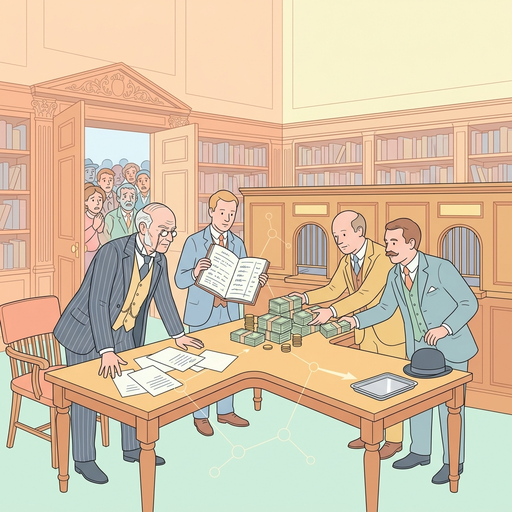
In October of nineteen oh seven, crowds of depositors stretched down the sidewalks of Wall Street, waiting in line to pull their life savings out of New York trust companies. The United States had built the world's most productive industrial economy, yet it possessed no central bank to backstop its commercial system. When the country's second-largest trust company faced collapse, the emergency response did not originate in Washington. It gathered inside a private library on Thirty-Sixth Street, orchestrated by financier J. P. Morgan. This crisis produced one of the most durable legends in American finance: the story of an aging private citizen who stepped into the vacuum of public authority and single-handedly rescued the financial system. Yet that same week, Morgan declined to rescue one of the largest financial institutions in the country, allowing it to fail while marshaling tens of millions of dollars to protect another. Investigating what took place inside those rooms reveals a far more complex reality. It was an improvised struggle over scarce currency, high-stakes judgments between liquidity and solvency, and an alarming demonstration of what happens when a modern nation depends on the discretionary decisions of a single individual.
At My Audio Books dot A I, you can create your own audiobooks from prompts, turn your documents into audio, all with one subscription, and store your items in your own personal library.
To understand how a failed stock market gamble brought the American economy to the edge of ruin, we have to look first at how money and banking functioned at the start of the twentieth century. Unlike Britain, France, or Germany, the United States possessed no permanent central bank. There was no standing public institution authorized to inject emergency reserves into the financial system or act as a reliable lender of last resort when ordinary credit markets froze.
The national currency supply was structurally inelastic. Under the National Bank Acts passed during the Civil War, national banks could issue paper currency only up to the value of United States government bonds they deposited with the Treasury. If the public suddenly demanded more physical cash, banks could not simply expand their notes to meet the need. They had to locate and purchase specific federal bonds first. If the federal government ran budget surpluses and retired its debt, the supply of those bonds contracted. As a result, the volume of money in circulation could actually shrink precisely when an expanding commercial economy required more liquidity.
This structural rigidity made the autumn months exceptionally dangerous. Every year, agricultural harvests across the American West and South required massive transfers of cash to pay farm hands, purchase crops, and ship commodities to market. To provide this seasonal liquidity, country banks throughout the United States withdrew their surplus balances deposited in major New York City banks. During the spring and summer, those rural banks kept spare funds in Manhattan to earn modest interest. When autumn arrived, that money was recalled in physical coin and paper currency. This predictable drain concentrated reserves and tightened liquidity in New York every October, leaving the metropolitan financial core operating with minimal safety margins.
The closest thing the country had to an organized financial backstop was the New York Clearing House. Established as a private association of commercial banks, the Clearing House coordinated the daily settlement of checks and payments among its members. During severe financial panics, member banks could pool their credit and issue Clearing House loan certificates. These certificates allowed them to settle balances with one another without draining their vaults of gold and legal tender. But Clearing House arrangements were designed strictly for members, not the broader financial universe.
Meanwhile, an entirely different kind of financial intermediary had grown rapidly in New York: trust companies. Trust companies were state-chartered institutions originally established to manage estates, corporate trusts, and property. By nineteen oh seven, however, they engaged in aggressive commercial banking. They accepted deposits, made commercial loans, and invested heavily in corporate equities and real estate.
Because they were regulated under state law rather than the National Bank Act, trust companies were not subject to the strict cash reserve requirements imposed on national banks. While national banks in New York were legally required to maintain a twenty-five percent reserve of cash against demand deposits, trust companies often kept cash reserves equal to only five percent or less. Because they held fewer idle cash reserves, trust companies could offer higher interest rates to depositors. Over two decades, vast sums of capital migrated from traditional commercial banks into these lightly regulated institutions, and most of them remained entirely outside the New York Clearing House.
This structure created a perilous maturity mismatch. Trust companies accepted demand deposits that customers could withdraw at a moment's notice, while investing those funds in long-term loans, bonds, and real estate that could take months or years to liquidate without punishing losses. When depositors grow uneasy about a bank's stability, this mismatch triggers a self-reinforcing panic. Depositors realize that because the institution holds only a fraction of its deposits in liquid cash, those who withdraw first will get paid, while those who wait may receive nothing. The rational decision for each individual depositor is to rush to the teller window immediately. That collective rush produces the very cash shortage everyone fears, turning a passing rumor into an immediate institutional collapse.
The spark that ignited this fragile system came not from a broad macroeconomic shock, but from an aggressive speculative scheme. In mid-October of nineteen oh seven, copper magnate F. Augustus Heinze and his associates attempted to execute a market corner in the stock of the United Copper Company. In financial markets, a corner involves acquiring enough of a company's floating shares to trap short sellers, traders who have borrowed shares in hopes of buying them back at a lower price. When short sellers are forced to deliver shares they cannot find on the open market, the speculators who control the supply can dictate an inflated price.
The plan collapsed completely. When Heinze attempted to drive the price of United Copper up on the curb market, unexpected blocks of shares flooded the trading floor from other sources. Heinze and his brokers could not absorb the volume. Within days, United Copper stock tumbled from sixty dollars a share to under twenty, and soon down to ten dollars, bankrupting the brokerage firms involved in the scheme.
The failure immediately traveled across the financial network. Heinze served as president of the Mercantile National Bank, and his associates sat on the boards of several other New York banks and trust companies. Depositors who read about the market debacle in morning newspapers drew immediate connections between the disgraced speculators and the institutions where they held personal savings. Lines formed outside Mercantile National and related banks. While the Clearing House stepped in to examine and support Mercantile National on the condition that Heinze resign, public anxiety had already broken loose.
The panic quickly focused on Knickerbocker Trust Company, the second-largest trust institution in the United States, managing more than sixty million dollars in deposits. Knickerbocker's president, Charles T. Barney, had personal business relationships with Heinze's speculative network. Although Barney had not directly committed Knickerbocker funds to the copper corner, his association was enough to shatter depositor confidence. Barney resigned under pressure, but the bleeding did not stop.
On Monday, October twenty-first, the National Bank of Commerce delivered a crushing blow: it announced it would no longer clear checks for Knickerbocker Trust. Without a clearing agent to process its daily transactions, Knickerbocker could not settle payments with the rest of the banking system. Barney rushed to J. P. Morgan's private library on Thirty-Sixth Street to plead for emergency assistance.
Morgan, seventy years old and semi-retired, recognized the danger to the wider financial district, but he demanded verification before committing money. He dispatched a small team of financial analysts led by Benjamin Strong, a respected young vice president at Bankers Trust. Strong spent the evening of October twenty-first examining Knickerbocker's ledgers and loan portfolios, attempting to answer a fundamental financial question: was Knickerbocker merely illiquid, or was it insolvent?
In financial panics, distinguishing between those two conditions is critical. An institution is liquid when it has enough physical cash and short-term reserves to honor immediate payment requests. An institution is solvent when the total market value of its assets exceeds its total liabilities. A bank can be fully solvent, meaning its loans and investments are sound and will eventually be repaid in full. Yet it can simultaneously be illiquid, unable to convert those long-term investments into physical currency before anxious depositors drain its vaults. Providing emergency loans to a sound but illiquid institution preserves its operations and protects the financial system. Lending to an insolvent institution, by contrast, throws good money after bad, exposing rescuers to severe losses when the troubled asset portfolio finally unravels.
Within the few frantic hours available before markets opened on the morning of October twenty-second, Strong could not verify that Knickerbocker's assets were sufficient to cover its obligations. Knickerbocker held large concentrations of speculative securities and real estate loans whose immediate liquidation value was impossible to determine in a falling market. Morgan made his decision: without proof of solvency, no rescue funds would be provided.
When Knickerbocker opened its doors at ten o'clock that morning, a line of depositors stretched around the block. The institution paid out roughly eight million dollars in physical cash in under three hours. Shortly after noon, with its vaults emptied and no emergency assistance forthcoming, Knickerbocker closed its doors and suspended operations. Its suspension sent a shockwave across the national economy. Depositors throughout New York reached an alarming conclusion: if the second-largest trust company in the country could fail before lunchtime, no financial institution was safe.
The suspension of Knickerbocker did not contain the panic; it amplified it. The very next morning, frightened depositors descended on the Trust Company of America, an institution with nearly sixty million dollars in deposits whose president had been named in press reports as holding connections to the Knickerbocker circle.
On October twenty-second, depositors pulled out approximately one and a half million dollars from the Trust Company of America. On October twenty-third, the run intensified into a full-scale siege, draining an additional thirteen million dollars from its reserves. The company faced imminent suspension unless it received immediate cash injections.
This time, Morgan's investigators reached a different verdict. Strong and his audit team examined the assets of the Trust Company of America throughout the night and concluded that its securities were high-grade and its loans fundamentally sound. The institution was solvent, but it was being drained of currency by a pure liquidity shock.
Morgan acted decisively. He assembled the presidents of New York's major trust companies and commercial banks in his private library. Morgan warned them that if the Trust Company of America were allowed to collapse, the contagion would spread through every remaining trust institution in the city and break the commercial banks behind them. Morgan insisted that the trust companies themselves provide the funds to backstop their peer. Over twenty-three million dollars in emergency credit was assembled, secured against the sound collateral Strong had verified. Cash was delivered by armored wagons to the Trust Company of America's tellers. Although the lines of depositors persisted for days, the institution continued to honor every withdrawal, and the run gradually subsided.
The crisis, however, was already spreading through the broader financial infrastructure. On October twenty-fourth, call money rates on the New York Stock Exchange, the interest rate brokers paid for short-term daily loans to finance stock holdings, soared from twenty percent to over one hundred percent. Banks had stopped lending, and brokers faced immediate liquidation. Morgan intervened directly on the trading floor, summoning commercial bank leaders and raising twenty-five million dollars in ten minutes to keep exchange trading open. Days later, he arranged an emergency purchase of thirty million dollars in municipal bonds to save the City of New York from defaulting on its payroll warrants.
The rescue was never an exclusively private affair. Treasury Secretary George Cortelyou traveled to New York, setting up headquarters at the Sub-Treasury building on Wall Street. Cortelyou channeled approximately thirty-six million dollars of federal government deposits directly into national banks across New York, significantly bolstering the cash reserves available to meet depositor demands.
On October twenty-eighth, the New York Clearing House took a step it had resisted for weeks: it authorized the issuance of Clearing House loan certificates. Member banks used these certificates to settle balances between one another, conserving their scarce gold and currency to meet depositor runs. Around the same time, banks in New York and other major cities restricted the direct conversion of deposits into physical cash, limiting withdrawals to small allowances. Those cash restrictions signaled an acute scarcity of physical currency across the national economy, forcing businesses to rely on certified checks and private scrip to meet payrolls.
During the final days of the panic, Morgan also coordinated a controversial industrial merger. The prominent brokerage firm Moore and Schley stood on the brink of failure, holding a massive collateral position in shares of the Tennessee Coal, Iron and Railroad Company. If the brokerage failed, those shares would be dumped onto the market, triggering liquidations across Wall Street. Morgan arranged for United States Steel to purchase the company, absorbing the debt and stabilizing the brokerage. Before closing the deal, Morgan dispatched representatives to the White House, securing personal reassurance from President Theodore Roosevelt that the federal government would not mount an antitrust challenge against the acquisition.
By early November, the immediate panic had been contained, but the mechanics of the rescue exposed the realities behind the Morgan legend. The financier did not resolve the panic by pouring out his own bottomless fortune. His contribution was institutional and organizational: gathering intelligence through Strong's audits, convening rival financiers who otherwise refused to cooperate, pressuring reluctant executives to pledge capital, and coordinating public funds from the Treasury with private bank reserves.
Yet this reliance on private leadership carried profound dangers. In the absence of a public framework, the power to decide which institutions survived and which failed rested with an unelected financier meeting behind closed doors. Knickerbocker had been left to fail; the Trust Company of America had been rescued; and corporate dominance had been further consolidated. The country had averted a total monetary collapse, but it had done so by surrendering sovereign financial judgments to private discretion.
The Panic of nineteen oh seven convinced political leaders and bankers across the ideological spectrum that the American currency system was dangerously obsolete. Leaving the liquidity of a continental economy to private coordination in a Manhattan townhouse was no longer defensible.
Congress moved first with temporary legislation. In May of nineteen oh eight, it passed the Aldrich-Vreeland Act. The law authorized national banks to form emergency currency associations and issue temporary bank notes backed not by federal bonds, but by commercial paper and state or municipal bonds during acute crises. This created an immediate safety valve for cash shortages, ensuring that future runs would not instantly freeze physical payments.
More importantly, the Aldrich-Vreeland Act created the National Monetary Commission, chaired by Rhode Island Senator Nelson Aldrich. For nearly four years, the commission conducted an exhaustive investigation of banking systems across Britain, France, Germany, and Canada. The commission's findings demonstrated that modern commercial economies relied on two foundational institutions the United States lacked. The first was an elastic currency that expanded and contracted alongside business activity. The second was a centralized discount window where sound commercial banks could routinely exchange eligible assets for liquid reserves.
Transforming those findings into permanent law provoked intense political conflict. Eastern financiers favored a centralized institution controlled largely by private bankers, while agrarian Democrats and western progressives fiercely opposed any plan that concentrated monetary authority in New York. The election of President Woodrow Wilson in nineteen twelve shifted the political balance toward a public compromise.
The resulting legislation, the Federal Reserve Act, was signed into law in December of nineteen thirteen. Instead of a single central bank modeled on European lines, Congress established a decentralized system consisting of twelve regional Federal Reserve Banks, overseen by a politically appointed Federal Reserve Board in Washington. This regional architecture balanced local commercial autonomy with public governance.
The Federal Reserve Act resolved the specific vulnerabilities that had fueled the nineteen oh seven panic. First, it created Federal Reserve notes, establishing a truly elastic currency backed by gold and qualifying commercial loans. When seasonal agricultural harvests or economic stress increased the public demand for cash, the currency supply could expand smoothly to absorb the pressure. Second, it instituted the rediscount mechanism. Commercial banks holding short-term loans made to businesses and farmers could take that eligible paper to their regional Federal Reserve Bank and rediscount it, obtaining immediate reserves or physical currency without waiting for the loans to mature.
The human connections between the improvised rescue of nineteen oh seven and the new institutional framework were direct. Benjamin Strong, the financial analyst who had spent sleepless nights inspecting the ledgers of Knickerbocker Trust and the Trust Company of America, was appointed the first governor of the Federal Reserve Bank of New York in nineteen fourteen. Strong spent the next decade shaping the operational doctrine of the Federal Reserve, building institutional procedures to replace the personal interventions once mounted from Morgan's library.
The creation of the Federal Reserve did not eliminate financial panics, nor did it guarantee that central bankers would always wield their tools effectively. The Great Depression two decades later demonstrated that institutional architecture alone cannot prevent catastrophic policy failure. Furthermore, the core dynamic of nineteen oh seven, where financial activity migrates outside traditional banking regulations into less protected intermediaries, remains a recurring feature of modern financial systems. What we describe today as shadow banking reflects the same fundamental maturity mismatch that doomed Knickerbocker Trust: institutions relying on short-term funding to finance long-term investments while operating beyond the direct perimeter of government safety nets.
The Panic of nineteen oh seven remains a clarifying case study in financial history because it illustrates the full sequence of systemic failure: speculative excess leading to reputational contagion, sudden runs overwhelming an inelastic currency, and the immense hazards of improvised private rescue. When you examine episodes where an individual is remembered as the savior of an entire economy, look past the legend and investigate the institutional machinery behind the scenes. In the minutes ahead, consider the central question the crisis left behind: when emergency liquidity is scarce, who holds the authority to decide which institutions are saved, and who accounts for the ones left outside?