The Men Who Tried to Weaponize the Weather: Operation Popeye and the Treaty That Buried It
From 1967 to 1972 the United States ran a secret cloud-seeding program over Southeast Asia to make rain a weapon of war. Told entirely from the government's own paper: the 1967 memo that launched it, the 1974 top-secret Senate hearing that confessed it — including the Pentagon's own verdict that the results were 'limited and unverifiable' and the National Security Council panel that was refused the file — and the 1977 treaty that made the weather weapon sound like a conspiracy theory.
By MyAudioBooks.ai ·
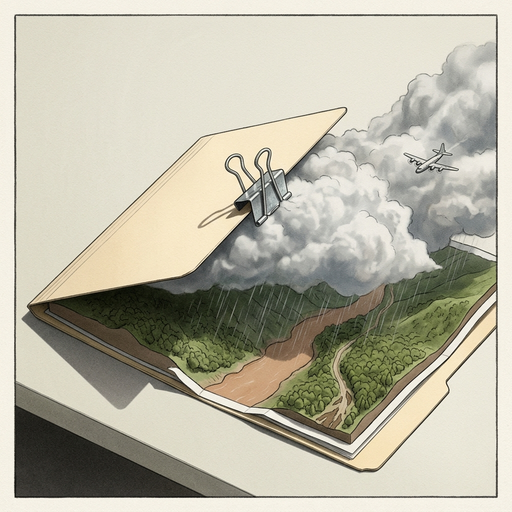
In October of nineteen sixty-six, in a valley of the Se Kong River in southern Laos, the United States ran more than fifty secret experiments to make rain fall on command. The State Department's own memo on the results says that eighty-two percent of the clouds seeded produced rain — and it records what happened next with bureaucratic calm: one seeded cloud drifted east across the Vietnamese border and, in the memo's words, "inundated a U.S. Special Forces camp with nine inches of rain in four hours." The memo's judgment on the whole test was two words long: the experiments were, quote, "too successful." We have read the government's own paper trail — the nineteen sixty-seven memo that authorized the program, the nineteen seventy-four Senate hearing that confessed it, and the treaty that buried the subject — and our verdict is this: the only weather war in history was fought in secret for five years, the government's own witnesses admitted under oath they could not prove it worked, and that is precisely why the weather weapon now sounds like a conspiracy theory.
This is the story of Operation Popeye, told entirely from the paper. And the question the paper never answers is the one to hold through the next twenty minutes: if you cannot steer the rain, what did two thousand six hundred and two sorties actually buy?
At My Audio Books dot A I, you can create your own audiobooks from prompts, turn your documents into audio, all with one subscription, and store your items in your own personal library.
Section One. The Memo
On January thirteenth, nineteen sixty-seven, the Deputy Under Secretary of State for Political Affairs, Foy Kohler, sent Secretary of State Dean Rusk a top-secret memorandum titled Weather Modification in North Vietnam and Laos. The Department of Defense, it said, wanted approval to begin the operational phase of Project Popeye: sustained cloud seeding along the infiltration routes of North Vietnam and southern Laos, to produce enough rain to interdict or at least interfere with truck traffic between North and South Vietnam — rain out of season, through the months of the normal dry season, including the northeast monsoon, the seasonal wind-and-rain pattern the Americans called the Crachin. The test phase had already happened, the previous October, conducted without consulting the Lao government and known, in the memo's words, to only a severely limited number of American officials. The Defense Department viewed the results as outstandingly successful: eighty-two percent of seeded clouds produced rain within a brief period, and the rain, the memo judged, had contributed substantially to rendering routes in the test area inoperable.
The same memo then does something rare in a war document: it argues with itself. It notes that neither the volume of induced rain nor the area affected could be precisely predicted — that the only absolute control was to stop flying. It estimates that a single seeded cloud might carry its effects across an area fifty by one hundred miles. It admits the program would create rainy-season conditions in dry months over a friendly country whose prime minister had not been told. And then it writes the sentence that should have stopped everything, and did not: We cannot lightly assume responsibility for unilaterally altering climate, and possibly landforms, in other sovereignties. Rusk approved anyway — in the archive's own annotation, on a strictly experimental basis, in five limited areas, with weekly summaries to the State Department and the President to be advised. And here is the detail that tells you the government was arguing in both directions at once: the following March, Secretary of Defense McNamara formally disapproved the Seventh Air Force's parallel operational plan for Popeye, while noting in the same breath that testing had shown it to be, quote, "a potentially powerful weapon against lines of communication in Southeast Asia." The same sentence that says powerful also says no. Washington read only the first half.
Section Two. The Program, Nineteen Sixty-Seven to Nineteen Seventy-Two
What followed was a five-year air campaign against the water cycle. The program was authorized three WC-one-thirty weather aircraft and two RF-four-C reconnaissance jets operating out of Thailand, and they provided two WC-one-thirty and one RF-four-C sorties per day when required — a sortie being one aircraft flying one mission. The authorized battleground grew by decree: Laos first, then on July eleventh, nineteen sixty-seven, additional portions of Laos and North Vietnam; on September thirteenth, a small area over the A Shau Valley in South Vietnam; on September twenty-fifth, nineteen sixty-eight, another slice of North Vietnam. The annual cost of the whole program, the Pentagon later testified, ran about three point six million dollars — operation, maintenance, temporary duty pay, and seeding materials, which is to say, cheaper than a handful of the jets flying over the same trails.
Then comes the date that reveals what the program actually was. On November first, nineteen sixty-eight, President Johnson announced the bombing halt over North Vietnam — and the seeding over North Vietnam was terminated the same day, and never reinstituted. The bombing itself later resumed. The rainmaking did not. A weapons program is one that stands down with the other weapons; this one did, and the record says so in plain sequence. Around it, the secrecy apparatus did its work: approximately one thousand four hundred personnel had to be briefed into the project and debriefed over six years, and the code names rotated as they leaked — Popeye, Intermediary, Compatriot, changed when uncovered, until a senator had to ask whether they were one and the same. They were.
The totals, when they finally came out, came from the Pentagon's own accounting. As read in the Air Force Historical Foundation's journal from the project's final report: approximately two thousand six hundred and two cloud-seeding sorties, expending approximately forty-seven thousand, four hundred and nine canisters of silver iodide seeding material over North Vietnam, Laos, Cambodia, and South Vietnam, at a cost of twenty-one point six million dollars, between nineteen sixty-seven and nineteen seventy-two. The last mission was flown on July fifth, nineteen seventy-two. And for that entire effort, the Defense Department's formal assessment to the Senate, delivered by Lieutenant Colonel Soyster in the classified briefing of March twentieth, nineteen seventy-four, was eleven words long: "the results were certainly limited and unverifiable." Let those sit. We will come back to them.
Section Three. The Hearing
The program did not end because anyone confessed; it ended, and then it leaked. In July of nineteen seventy-two, the syndicated columnist Jack Anderson published the existence of the rainmaking operations. And here is the detail that should make every listener sit up: Dennis Doolin, a deputy assistant secretary of defense whose office portfolio included Southeast Asia for five years, did not have the clearance. The Pentagon's own point man for the region learned that his government was making rain on command, in his words, "as the result of a Jack Anderson column," and when he inquired — simply, he said, for his own edification — he was told the moisture budget made no difference and not to pursue the matter.
What Congress then did is the reason you can hear this story. The Senate Subcommittee on Oceans and International Environment, chaired by Claiborne Pell of Rhode Island, held hearings in January nineteen seventy-four, and on March twentieth of that year it took the Defense Department's classified briefing — a session stamped top secret and made public on May nineteenth. Soyster walked the senators through the charts: the authorized areas by year, the flight tempo, the seeding units expended. And then he delivered the assessment the whole book turns on. The program, he said, had an effect on the primitive road conditions, but "the results were certainly limited and unverifiable." It was conducted, the briefing continued, because of its apparent contribution to the interdiction mission — the military term for cutting an enemy's supply movement — and its relatively low cost. Even in the one region of the world suited to it, the record says, "program effectiveness cannot be conclusively established." Pell pressed Doolin for his own view, and Doolin gave the hearing's most quoted arithmetic: if an area is getting twenty-one inches of rain and the seeding adds two, then, quote, "I do not think I would know the difference between twenty-one and twenty-three."
Inside the same transcript sits the governance scandal, and it is worse than the rain. The National Security Council's own interagency panel — the Pollack committee — had sought information on military weather modification in Southeast Asia. Pell put three questions to the Defense Department for the record. Did the Pollack committee seek the information? Was the information denied? If so, why? The department's written answers came back: Yes. Yes. And a promise to research the third. Read that slowly: a panel of the National Security Council was refused the file on a weapons program by the department running it. When Pell asked whether this had been the government's only classified weather-modification operation of the past ten years, the witnesses answered one after another — to the best of their knowledge, yes; the only one, said Soyster; "The only one," said Doolin.
Pell understood what he was looking at, and his questions show it. The thing that concerns me, he told the witnesses, is not rainmaking per se, but when you open that Pandora's box, what comes out with it — will we achieve a technique to both create and point a hurricane or a typhoon, will we be able to "put a charge under the surface" and let the earthquake follow? The January session had already given him the vocabulary for that fear. Gordon MacDonald, the geophysicist who had spent years on the government's science panels, testified that the key to geophysical warfare — the deliberate weaponization of earth processes — is, in his words, "the identification of the environmental instabilities" where a small addition of energy releases vastly greater amounts. And he offered the hearing's coldest analogy: military weather modification, in his assessment, resembled the policies sold by, quote, "unscrupulous insurance agents" — expensive protection against risks that barely exist. His closing request was simple: declassify the documentation of the Southeast Asia operations, and the evaluation of their effectiveness, so the scientific community could finally judge. Two months later, part of it was public. You have just heard what it said.
At My Audio Books dot A I, you can listen to this story and thousands of others that explore the hidden science and mechanics behind the headlines.
Section Four. The Treaty
The legislative chain from the hearing room to the treaty text is short and fully documented. The Senate had first held hearings on the subject in nineteen seventy-two. On July eleventh, nineteen seventy-three, it adopted Senate Resolution seventy-one overwhelmingly, calling for an international agreement banning environmental warfare. From there the file moved to the United Nations: on December tenth, nineteen seventy-six, the General Assembly adopted Resolution thirty-one seventy-two, approving the Convention on the Prohibition of Military or Any Other Hostile Use of Environmental Modification Techniques. It opened for signature at Geneva on May eighteenth, nineteen seventy-seven, and it entered into force on October fifth, nineteen seventy-eight, when the twentieth instrument of ratification — the formal deposit by which a state binds itself — was filed. Seventy-eight states are parties today.
Here is what the treaty actually prohibits. Article one: each state party undertakes not to engage in military or any other hostile use of environmental modification techniques having, quote, "widespread, long-lasting or severe effects," as the means of destruction, damage, or injury to any other state party. Article two defines the techniques: changing, through the deliberate manipulation of natural processes, the dynamics, composition, or structure of the Earth — including its atmosphere, or outer space. Article three preserves peaceful use entirely. And then there are the Understandings — the negotiators' own definitions, not written into the treaty but part of its official record. Widespread means an area on the scale of several hundred square kilometres. Long-lasting means months, "or approximately a season." Severe means "serious or significant disruption or harm" to human life or resources. Now do the arithmetic this treaty was written next to. The Kohler memo's own estimate put the footprint of a single seeded cloud at fifty by one hundred miles — five thousand square miles, about thirteen thousand square kilometres. On the definitions as agreed, one cloud from Operation Popeye could outsize the treaty's threshold for widespread by a factor of twenty. Whether you find that reassuring or alarming is the correct response to this treaty, and we'd argue it is the point.
And the enforcement? There is no inspectorate. A Consultative Committee of Experts can be convened to make findings of fact and distribute a summary. Complaints go to the Security Council — where the two countries whose weather programs fill the documented record hold vetoes. The peaceful-use carve-out means every rainmaking program on Earth is legal by its own description. The first review conference met in Geneva in nineteen eighty-four, five years after entry into force, as the treaty required, and the world has held no weather war since — or none with a paper trail, which, after Popeye, is the only kind you can prosecute.
Section Five. What the Paper Buys
So why does the weather weapon now sound like a conspiracy theory? Because the real one was secret, small, cheap, confessed as unverifiable under oath, and banned — all five facts at once, and the rumor version needs none of them. Our read of the file is that the conspiracy theories are not the opposite of the documented history; they are its residue. When a government hides a program for five years, refuses its own security council panel, and then admits the whole thing in a top-secret hearing, it teaches the public a lesson it cannot unteach: that the denials are negotiable and the paper eventually talks. The truth about Popeye is not stranger than the myths. It is more useful, because it is checkable.
MacDonald asked for the file so that science could judge. The file came out, and here is the judgment it supports. A capability demonstrated at eighty-two percent in a limited test. A program flown at scale for five years, at a cost the Pentagon itself called low. A confession, under oath, that the results were limited and unverifiable. And a treaty, six years after the last mission, that made the whole category of weapon disreputable in law. We think the weather weapon is neither a myth nor a menace; it is a precedent with a paper trail — and the paper trail is what keeps every future claim honest, because after Popeye, anyone who says it cannot happen is wrong, and anyone who says it is happening had better bring documents.
At My Audio Books dot A I, you can create fiction, non-fiction, and turn your documents into audio, all stored in one place with a single subscription — plus get instant access to thousands of audiobooks and deep-dive investigations. Learn more today at My Audio Books dot A I.