The Mangrove Rivulus on Land: How a Fish Remodels Its Skin and Gills to Survive Out of Water
When mangrove pools turn toxic, the tiny rivulus escapes into damp logs, where it can survive out of water for weeks by breathing through its moist skin and temporarily reshaping its gills. It is not a living replay of the first vertebrates to reach land, but its reversible adaptations reveal how much survival in air depends on flexible bodies—and the right refuge.
By MyAudioBooks.ai ·
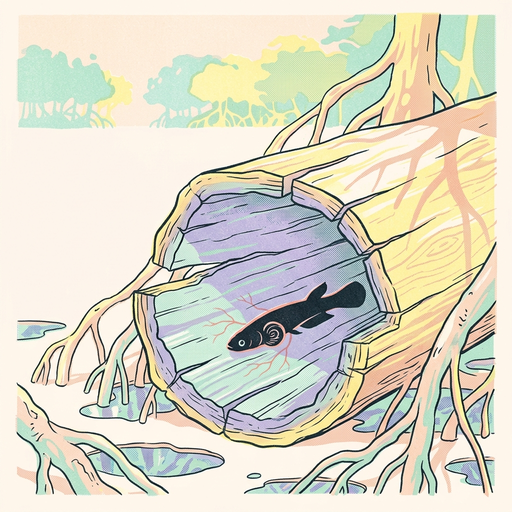
Inside a rotting mangrove log stranded above the reaching tide, a fish only two inches long rests quietly in damp darkness. It is surrounded entirely by air, yet its heart continues to beat, its blood circulates, and its tissues receive a steady supply of oxygen. Under favorable conditions, this tiny vertebrate can remain out of water for weeks, with documented observations exceeding a full month. Rather than relying on lungs or ancestral anatomy frozen in time, it depends on an astonishing suite of reversible bodily transformations. The mangrove rivulus reveals how far vertebrate physiology can stretch when water disappears. It exposes the delicate biological machinery that separates life in the water from life in the open air, challenging long-held assumptions about how aquatic creatures cross the terrestrial threshold.
At My Audio Books dot A I, you can create your own audiobooks from prompts, turn your documents into audio, all with one subscription, and store your items in your own personal library.
The mangrove rivulus, classified scientifically as Kryptolebias marmoratus and historically referred to as Rivulus marmoratus, belongs to the killifish order Cyprinodontiformes. These small, slender fish inhabit the tropical and subtropical coastal wetlands of Florida, the Caribbean islands, Central America, and northern South America. On the surface, a mangrove forest appears saturated with water. Below the dense canopy, however, shallow pools are among the most unstable aquatic environments on the planet.
Tidal fluctuations regularly isolate shallow puddles from the open sea. Under the tropical sun, high ambient temperatures drive rapid evaporation, concentrating dissolved salts until salinity surges to punishing levels. At night or during stagnant midday heat, decomposing organic debris strips dissolved oxygen from the water, creating severe hypoxia. High concentrations of hydrogen sulfide from sulfur-reducing bacteria further degrade the water quality, turning these pools into toxic chemical traps.
For the rivulus, leaving a pool is an active escape from lethal water rather than a passive accident caused by total drought. When water becomes suffocating or dangerously toxic, the fish launches itself across the muddy bank. It is amphibious and semi-terrestrial, shifting between water and land to exploit damp refuges. In the forest understory, decaying logs bored out by beetles and marine isopods offer sheltered microcavities. Thick layers of damp leaf litter and the abandoned burrows of land crabs provide additional pockets of cool, humid air, serving as critical sanctuaries across different coastal forests.
Survival outside the pool depends entirely on the quality of these microhabitats. In direct sunlight, a small fish dries out and overheats within minutes. Deep inside a saturated log or buried under layers of wet mangrove leaves, relative humidity remains near one hundred percent. This enclosed moisture shields the animal from thermal spikes and deadly water loss.
Finding shelter buys precious time, but it does not eliminate the physical reality of being out of water. Any aquatic vertebrate that ventures into the atmosphere immediately faces three linked physiological challenges. It must absorb oxygen and release carbon dioxide without water flowing over its gills. It must maintain its internal balance of water and salts without an external reservoir. And it must dispose of toxic nitrogenous waste without a current of water to carry it away.
When a typical fish leaves the water, its primary breathing apparatus fails almost instantly. In the open air, the thin, delicate filaments of fish gills collapse under gravity and surface tension. They stick together in clumps, drastically reducing the functional surface area available to absorb oxygen. To bypass this catastrophic collapse, the mangrove rivulus transforms its skin into an expansive breathing organ.
This process, known as cutaneous respiration, allows respiratory gases to diffuse directly across the animal's outer barrier. Oxygen moves from the surrounding air through a microscopic layer of surface moisture, across the epidermal cells, and directly into the bloodstream. Carbon dioxide follows the opposite path, diffusing outward into the atmosphere to prevent lethal acidosis in the blood.
This exchange works because the skin of the rivulus features an exceptionally thin cellular barrier paired with a dense network of blood vessels running just beneath the surface. When the fish enters the terrestrial environment, air exposure mobilizes dynamic anatomical adjustments alongside these existing structures. Prolonged exposure triggers cutaneous angiogenesis, a physiological process where the body develops additional capillary networks throughout the skin. By multiplying these tiny blood vessels closer to the surface, the fish shortens the diffusion distance for oxygen, significantly increasing the efficiency of cutaneous gas exchange over time.
Skin respiration imposes strict physical constraints. Oxygen and carbon dioxide cannot cross dry tissue; they must dissolve in an aqueous layer before diffusing into living cells. Surface moisture is an indispensable component of the respiratory mechanism itself. If the skin dries, diffusion stops and the animal suffocates, even while surrounded by an atmosphere rich in oxygen.
Emerging into air also alters the animal's metabolic budget. In the opening hours out of water, the stress of transition and the heightened energy cost of maintaining posture can raise the fish's metabolic rate. This transition drives up its demand for oxygen precisely when its breathing surfaces are undergoing functional reorganization. The fish manages this early vulnerability through behavior, selecting cool, humid microhabitats that lower metabolic rate and preserve surface moisture until slower vascular adjustments mature.
Meanwhile, the skin takes on additional duties normally handled by the gills and kidneys. Embedded within the epidermis are specialized transport cells known as ionocytes. These cells actively pump ions such as sodium and chloride, maintaining the correct osmotic concentration of body fluids even when the fish cannot drink or pass water over its internal membranes.
The third hurdle is nitrogen waste. Most bony fishes are ammonotelic, meaning they excrete toxic ammonia directly through their gills into the surrounding water. The rivulus remains primarily an ammonia producer when out of water, but it avoids self-poisoning by routing ammonia out through the skin. Specialized cellular transporters move ammonia across the epidermis, where it volatilizes into the humid air or dissolves into the thin film of moisture coating the body. In this single organ, the rivulus unifies gas exchange, salt regulation, and waste elimination.
While the skin expands its role in the air, the gills undergo a structural transformation. In a submerged fish, gills consist of primary filaments lined with hundreds of microscopic, paper-thin plates called lamellae. In water, these lamellae fan out freely, providing an immense surface area that captures dissolved oxygen and vents carbon dioxide. In air, however, that vast, delicate surface becomes a liability. Without water to support them, the lamellae stick together, and their immense surface area accelerates catastrophic moisture loss from the bloodstream to the atmosphere.
To counter this vulnerability, the rivulus remodels its gill architecture. After several days of continuous air exposure, a specialized mass of tissue called the interlamellar cell mass begins to proliferate. This cellular matrix grows upward from the base of the gill filaments, filling the narrow spaces between adjacent lamellae. As the mass expands over approximately seven to ten days, it effectively embeds the delicate plates within a protective layer of living tissue.
This structural change reduces the effective gill surface area exposed to the surrounding air. By burying the delicate lamellae, the interlamellar cell mass provides mechanical support that prevents physical damage while curbing evaporative water loss across the gill membranes. The fish temporarily shields the delicate gills, transferring the burden of respiration almost entirely to the vascularized skin.
This morphological shield carries a clear physiological tradeoff. When an air-acclimated rivulus suddenly returns to water, its functional gill surface area remains deeply reduced by the expanded tissue mass. In the water, where cutaneous respiration provides only a fraction of required oxygen, the fish exhibits depressed aquatic respiratory performance. It cannot immediately access the full gas exchange capacity of a typical submerged gill.
The adaptation proves its worth through reversibility. Over the course of approximately one week following reimmersion, the interlamellar cell mass regresses. The extra cells die back through controlled cellular processes, peeling away from the lamellae and fully reopening the microscopic channels between them. The delicate plates fan out into the current once more, restoring normal aquatic gas exchange and ion transport. The very same individual fish can shift back and forth between these anatomical configurations multiple times across its lifespan, tracking the rise and fall of its volatile coastal environment.
The remarkable ability of a single fish to reshape its gills and blood vessels within days demonstrates phenotypic plasticity, specifically reversible physiological acclimation. Phenotypic plasticity is the capacity of a single genome to produce different observable traits or behaviors in response to environmental cues. In the rivulus, the genetic code does not change when the fish climbs onto a rotting log; rather, environmental signals trigger altered gene expression, cellular proliferation, and blood vessel growth. When water returns, the process reverses.
Plasticity also appears in developmental forms, where conditions experienced during early growth permanently alter adult anatomy or physiology. In contrast, evolutionary adaptation is a multigenerational process. Natural selection acts on heritable variations within a population over long periods, favoring traits that improve survival and reproduction. The capacity for plasticity is itself an evolved, inherited trait. Generations of selection in shifting mangrove environments favored lineages possessing the genetic machinery to remodel tissues dynamically.
This distinction between individual plasticity and generational evolution clarifies how living fish connect to the deep evolutionary history of land vertebrates. Modern killifishes are teleosts, ray-finned fishes that diversified along a lineage entirely separate from the ancestors of land animals. The transition of vertebrates from water to land occurred among lobe-finned fishes, known as tetrapodomorphs. This transition unfolded over a prolonged period between three hundred eighty-five and three hundred forty million years ago, spanning the Middle Devonian into the Early Carboniferous.
Fossils from this ancient interval demonstrate that the emergence of terrestrial traits was a mosaic process, not a sudden collective leap. Acanthostega, an early tetrapod that lived roughly three hundred sixty million years ago, possessed distinct limbs with eight well-formed digits instead of fins. Yet anatomical evidence reveals that Acanthostega retained internal gills supported by robust bony arches, a tail fin adapted for propulsion through water, and limbs incapable of supporting its body weight on dry land. The presence of digits did not make Acanthostega a terrestrial animal; it was an aquatic creature navigating shallow, weed-choked waters with paddle-like limbs.
The mangrove rivulus is not a window into the exact anatomy or genetic pathways of ancient tetrapod ancestors. Researchers cannot assume that Devonian fishes grew interlamellar cell masses or used their skin precisely as modern killifishes do. What the rivulus proves is a set of fundamental biomechanical and physiological principles. It demonstrates that vertebrate skin can shoulder the complete burden of oxygen uptake and waste disposal, that respiratory tissues can remodel reversibly to manage structural collapse, and that microhabitat behavior can buffer the steep physiological costs of entering the atmosphere.
Examining the mangrove rivulus clarifies the physiological challenges vertebrates confront when leaving the water. The fish survives outside the pool by occupying a microrefuge that preserves aquatic levels of moisture and shelter. A rotting log saturated with freshwater or brackish moisture acts as a biological buffer, decoupling the fish from the harsher macroclimate outside. Inside that confined chamber, water loss slows, solar radiation cannot penetrate, and the microclimate remains stable.
Even with these defenses, the animal operates near the edge of physical tolerance. Extended terrestrial survival represents a balancing act between ambient temperature, relative humidity, and salinity. When ambient temperatures rise, the animal's metabolic rate accelerates, consuming oxygen more rapidly and demanding greater diffusion across the skin. At the same time, warmer air can drive faster evaporation if humidity dips even slightly below saturation. If the skin loses its thin aqueous coating, oxygen diffusion drops precisely when metabolic demand is highest, forcing the fish toward suffocation and dehydration.
Understanding this delicate equilibrium highlights several open questions in vertebrate biology. Researchers continue to investigate the precise mathematical thresholds where temperature and humidity interact to limit endurance. Ongoing work examines the shifting balance of oxygen uptake between the skin and gills during different stages of air exposure, as well as the genetic networks that control the rapid build-up and breakdown of the interlamellar cell mass. Field observations also seek to resolve how survival times in wild microhabitats compare with controlled laboratory trials, and whether different coastal populations possess unique degrees of terrestrial tolerance.
These living amphibious fishes offer tangible proof that moving between water and land is a spectrum of functional compromises. Existing tissues take on unexpected duties, behaviors compensate for physiological deficits, and survival depends on the microclimate immediately surrounding the animal. The mangrove rivulus survives on land not by transforming into a terrestrial animal, but by using every physiological tool at its disposal to keep the aquatic world alive within its own skin.
Consider the mangrove rivulus the next time you picture life emerging from ancient waters. If this exploration shifted how you think about the boundary between water and land, reflect on how many other living creatures might be solving ancient evolutionary problems in the shadows of modern wetlands. There is far more to discover about the hidden mechanics of the natural world.