The Longitude Clock: John Harrison, the Board, and the Fight to Prove It
John Harrison’s extraordinary marine watches solved longitude at sea with unprecedented accuracy, transforming a problem that had cost countless lives and baffled Europe’s leading minds. But although his H4 timekeeper decisively outperformed astronomical alternatives, decades of demands for repeatability, disclosure, and mass production delayed his recognition—revealing the uneasy line between necessary public scrutiny and institutional resistance to innovation.
By MyAudioBooks.ai ·
Listen free: The Longitude Clock: John Harrison, the Board, and the Fight to Prove It
In seventeen fourteen, the British Parliament offered a life-changing fortune of twenty thousand pounds to anyone who could solve the most dangerous navigational puzzle on Earth: determining longitude at sea. Nearly half a century later, a self-taught Yorkshire craftsman named John Harrison delivered a mechanical pocket watch that crossed the storm-tossed Atlantic and lost just five seconds over eighty-one days. By the explicit terms of the statute, his precision instrument had conquered the problem. Yet the government board overseeing the prize refused to pay him in full. Decades of bureaucratic delay, shifting requirements, and fierce institutional disputes followed. To understand why a proven engineering breakthrough spent years trapped in political limbo, we have to look past the brass gears. We have to examine how governments, scientific institutions, and inventors define what it actually means to prove that an idea works.
At My Audio Books dot A I, you can create your own audiobooks from prompts, turn your documents into audio, all with one subscription, and store your items in your own personal library.
For centuries, setting sail into the open ocean meant wagering human lives against crude guesswork. Navigators understood how to measure latitude, their north-south position, with dependable accuracy. By measuring the angle of the midday Sun above the horizon, or calculating the elevation of the North Star using an octant, a trained mariner could establish distance from the equator within a few miles.
Longitude, the east-west coordinate, offered no such celestial landmark. Because the Earth rotates constantly from west to east, the night sky appears in steady motion relative to an observer on the surface. Far from land, sailors relied on dead reckoning. They threw a wooden log attached to a knotted line over the stern to measure speed, noted compass headings, and tracked elapsed time with sand glasses. Over days and weeks, unaccounted ocean currents, subtle steering errors, and leeway from crosswinds accumulated steadily. A navigator might believe a ship remained fifty leagues out to sea when jagged coastal rocks were already breaking the surf ahead.
That uncertainty carried catastrophic consequences. In October seventeen oh seven, an entire British naval squadron commanded by Admiral Sir Cloudesley Shovell lost its bearings in heavy weather while returning from the Mediterranean. Believing they were safely entering the English Channel, the fleet struck the rocks of the Isles of Scilly. Four warships sank, and nearly two thousand sailors perished within sight of their homeland. The disaster crystallized a commercial and military emergency that Britain could no longer ignore.
The underlying geometry of the longitude problem was simple. Earth rotates three hundred sixty degrees on its axis every twenty-four hours. Divide three hundred sixty by twenty-four, and you find that the planet turns fifteen degrees of longitude each hour, or one degree every four minutes. Navigating by longitude is fundamentally an exercise in comparing two times. If a sailor observes local solar noon aboard ship and simultaneously reads the time at a reference meridian like Greenwich, the difference between those two clocks reveals the ship's position. If local noon arrives when the Greenwich reference clock reads two in the afternoon, the vessel is exactly thirty degrees west of Greenwich.
The mechanical obstacle lay in the severe penalty for timing errors. Because four minutes of time equals one degree of longitude, an error of just four minutes corresponds to sixty nautical miles of navigational error at the equator. In seventeen fourteen, Parliament passed the Longitude Act to break the deadlock. The statute established graduated cash rewards. It reserved the maximum payout of twenty thousand pounds for any method capable of determining longitude within half a degree, or thirty nautical miles, at the end of a voyage to the West Indies.
The Act created an oversight body known as the Board of Longitude, composed of the Astronomer Royal, senior naval commanders, mathematics professors from Oxford and Cambridge, and leading politicians. Their mandate was to judge proposals, disburse developmental funds, and certify when a solution met the statutory standard. Most scientific authorities believed the answer would eventually come from astronomy. John Harrison, a carpenter and clockmaker born in sixteen ninety-three, believed the answer lay in a machine.
Harrison began his career working with wood rather than metal. In his twenties, he constructed longcase clocks using dense tropical hardwoods such as lignum vitae. Its natural oils allowed the mechanisms to operate without external lubricants that would gum up with dust. His clocks achieved an astonishing rate of stability, varying by barely a second over an entire month. Taking that precision to sea, however, meant confronting hostile forces that destroyed ordinary timekeepers.
Pendulums, which governed land-based precision clocks, depended entirely on the steady downward pull of gravity. A rolling ship subjected a mechanism to violent accelerations that rendered pendulums useless. Furthermore, extreme changes in temperature caused balance springs to expand or contract, altering their tension and throwing off their rate. Salt air corroded delicate steel pivots, and marine humidity thickened animal oils.
Harrison spent the seventeen thirties building his first marine machine, later designated H one. Weighing more than seventy pounds, the clock eliminated pendulums entirely. In their place, Harrison installed two large brass balances linked together by wire springs, oscillating in opposite directions. Because the balances were mechanically paired, any sudden tilt or pitch of the ship exerted an equal and opposite effect on the weights, canceling out the disturbance. In seventeen thirty-six, the Board approved a test voyage to Lisbon aboard HMS Centurion. On the return journey, the clock performed well enough that Harrison correctly warned the ship's master that their dead reckoning had miscalculated their landfall by more than sixty miles.
The Board awarded Harrison five hundred pounds to continue his research. Yet Harrison was driven by an exacting standard of mechanical perfection. Before submitting his second machine, H two, for an official ocean trial, he discovered an inherent vulnerability in its balance wheel system during rotational yawing motions. Rather than risking a flawed demonstration, he abandoned H two in his workshop and began work on a third machine.
H three consumed seventeen years of Harrison's life. Although the machine never achieved the decisive stability he sought, the effort yielded two foundational engineering inventions. To eliminate frictional drag without relying on degrading oils, Harrison invented caged roller bearings, a technology still used in modern industrial machinery. To counteract temperature shifts, he developed the bimetallic strip. He riveted together two thin strips of brass and steel, metals that expand at different rates when heated. As the temperature shifted, the composite strip bent, automatically altering the active length of the balance spring to keep its oscillation constant.
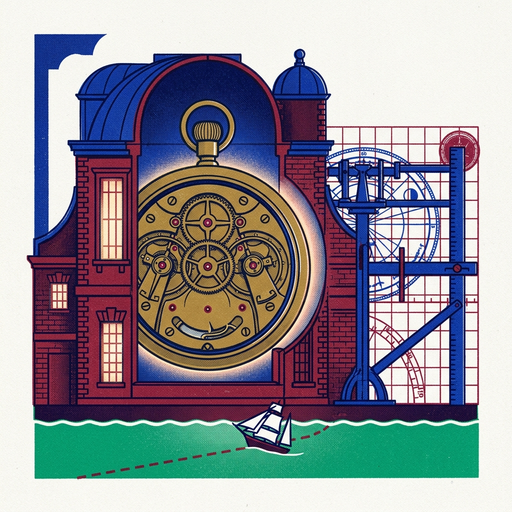
By the late seventeen fifties, after nearly three decades of work on heavy sea clocks, Harrison recognized a fundamental truth. Massive balances moving slowly were far more susceptible to the erratic motions of a ship than small balances moving at high speed. He abandoned the physical scale of his earlier clocks. With the assistance of London watchmaker John Jefferys, Harrison spent four years creating H four. Completed in seventeen fifty-nine, it was roughly thirteen centimeters in diameter and ran for thirty hours per winding. To outward appearances, it looked like an oversized pocket watch. Internally, it featured a high-speed balance beating five times a second, diamond pallets, and a miniaturized temperature compensation curb. The instrument was compact, portable, and remarkably resilient.
In November seventeen sixty-one, Harrison’s son William boarded HMS Deptford at Portsmouth, carrying H four in a secured case bound for Jamaica. The journey across the Atlantic took eighty-one days. Navigators on the Deptford calculated their progress using conventional dead reckoning. Meanwhile, William Harrison tracked their position solely by comparing local solar time to the reference time maintained by his father’s watch. Nine days into the voyage, William alerted the captain that their traditional estimates were drifting dangerously off course, and that Madeira would appear directly ahead the following morning. Dawn broke, and the island emerged precisely where the watch indicated.
When the expedition reached Port Royal, Jamaica, astronomers measured local solar time ashore to evaluate H four against the reference longitude established by previous astronomical observations. After eighty-one days at sea, Harrison’s watch had drifted by just five point one seconds. When converted to geographic coordinates at that latitude, that discrepancy represented an error of approximately one nautical mile. The Longitude Act required accuracy within thirty miles. H four had exceeded the legal standard by a factor of nearly thirty.
Harrison expected an immediate disbursement of the twenty thousand pound reward. The Board of Longitude, however, declined to certify the voyage as conclusive. The commissioners raised technical and legal reservations. They questioned whether the destination longitude of Port Royal had been established with absolute certainty. Furthermore, they argued that a single successful Atlantic crossing might represent an accidental balance of competing errors rather than consistent reliability. The Board demanded a second sea trial, emphasizing that repeatability was the bedrock of scientific proof.
This reluctance was also rooted in a competing philosophy of navigation. The academic astronomers on the Board believed that the only durable, universal solution to longitude lay in the sky, not in mechanical devices subject to wear and breakage. Their favored approach was the method of lunar distances. The Moon orbits the Earth relatively quickly, moving roughly its own angular diameter across the background of fixed stars every hour. In effect, it acts as the celestial hand of a natural clock. A navigator could measure the exact angular distance between the Moon and specific stars using an octant or sextant. By comparing that angle to precalculated tables showing when that angle occurred at Greenwich, sailors could recover Greenwich reference time without carrying a precision watch.
The lunar distance method received its critical mathematical foundation from the German astronomer Tobias Mayer, whose intricate tables predicted lunar orbital motion with unprecedented accuracy. Nevil Maskelyne, a brilliant Cambridge-trained astronomer, published The British Mariner's Guide in seventeen sixty-three to popularize the technique. Yet lunar distances demanded complex, steady observations on an unstable deck, followed by up to four hours of manual spherical trigonometry. Under practical shipboard conditions, reported accuracy hovered around one degree of longitude, or sixty nautical miles.
In seventeen sixty-four, the Board organized a second official trial for Harrison's watch, sending William Harrison and H four to Barbados. To ensure rigorous scientific control, the Board dispatched Maskelyne to Barbados ahead of the ship to establish the island’s precise longitude by observing the eclipses of Jupiter’s moons. The trial served as a direct head-to-head comparison. When H four arrived after seven weeks at sea, its accumulated error placed the ship within roughly ten nautical miles of true longitude. Maskelyne's lunar distance calculations placed the island within approximately thirty miles. Both techniques demonstrated viable navigational value, but Harrison's mechanical timekeeper proved three times more accurate than the celestial method.
The results from Barbados forced the Board of Longitude to confront a profound question about the purpose of public prizes. The statute of seventeen fourteen had called for a method that was practicable and useful for ordinary mariners. Was H four an engineering blueprint that could be manufactured at scale for the entire Royal Navy? Or was it an exquisite masterwork that only Harrison possessed the genius to build? If the instrument could not be duplicated, it could not protect the merchant fleet.
In seventeen sixty-five, Parliament intervened by passing new legislation that restructured the reward. Under the revised terms, Harrison was eligible to receive half the reward, ten thousand pounds minus previous grants, provided he fully disclosed the internal workings of H four. He had to dismantle the watch before an expert committee and surrender all four of his marine timekeepers to the Crown. The remaining ten thousand pounds would be awarded only when Harrison proved that the design could be reliably replicated by other clockmakers. At the same time, Parliament acknowledged the contributions of astronomical navigation by awarding three thousand pounds posthumously to the widow of Tobias Mayer for his lunar tables.
Harrison complied with the disclosure conditions under deep protest, viewing the demand to surrender his intellectual property as institutional extortion. He dismantled H four before a panel of watchmakers, demonstrating its balance assembly, its jewel bearings, and its temperature curb. Nevil Maskelyne was appointed Astronomer Royal that same year, gaining an influential seat on the Board. He took custody of the machines and subjected H four to an extended stationary trial at the Royal Observatory in Greenwich. Harrison bitterly objected to the testing conditions, arguing that stationary observatory trials did not reflect the maritime conditions for which the watch was engineered.
To test whether Harrison's watch could truly be reproduced, the Board commissioned Larcum Kendall, an elite London watchmaker, to build an exact copy using Harrison’s disclosed designs. Kendall spent two and a half years painstakingly constructing the replica, later designated K one. Completed in seventeen sixty-nine, K one matched the high performance of Harrison’s original. When Captain James Cook embarked on his second voyage of discovery across the South Pacific from seventeen seventy-two to seventeen seventy-five, he carried Kendall's timekeeper aboard the Resolution. Cook praised the instrument repeatedly in his logs, relying on it to chart Pacific coastlines and island groups with unprecedented precision.
Kendall’s successful replication resolved the central technical doubt: Harrison’s engineering principles were reproducible. Yet the financial standoff between Harrison and the Board showed no signs of ending.
By the early seventeen seventies, John Harrison was approaching eighty years of age. The Board maintained that before releasing the final ten thousand pounds, Harrison had to construct two additional timekeepers entirely with his own hands. They also required him to submit those timekeepers to further rounds of official testing. Believing that the goalposts were continually being repositioned to protect the interests of astronomical navigation, Harrison chose to bypass the Board entirely.
In seventeen seventy-one, Harrison’s son William secured an audience with King George the Third, an enthusiastic patron of the mechanical and natural sciences. The King took an immediate personal interest in the case. Over ten weeks in seventeen seventy-two, Harrison's newest watch, H five, was tested inside the King’s private observatory at Kew. Daily observations against transit instruments confirmed that the watch maintained an average daily variation of less than one-third of a second.
Armed with royal backing, Harrison presented a petition to Parliament in seventeen seventy-three. Recognizing that decades of dispute had damaged Britain's scientific reputation and that Harrison had provided the nation with an operational solution, Parliament passed a dedicated financial bill. Rather than certifying Harrison under the original seventeen fourteen statute, Parliament awarded him an exceptional grant of eight thousand seven hundred fifty pounds for his public service.
Combined with his earlier research grants of four thousand three hundred fifteen pounds and his seventeen sixty-five partial payment, Harrison received a lifetime total of approximately twenty-three thousand sixty-five pounds from public coffers. He had secured financial comfort and vindication before his death in seventeen seventy-six, even if the Board never formally proclaimed him the winner of the primary prize.
The legacy of the dispute reshaped world navigation, but not through the absolute triumph of one method over another. The word chronometer, coined in the late eighteenth century, became the standard term for precision marine timekeepers. Master horologists such as John Arnold and Thomas Earnshaw simplified Harrison’s intricate mechanisms. By standardizing the spring detent escapement, they enabled commercial workshops to produce reliable chronometers at prices naval vessels and merchant ships could afford.
Yet for several generations, mechanical timekeepers and lunar distances coexisted on the high seas. Ships carried chronometers for daily positional readings. Even so, prudent navigators continued observing lunar distances with their sextants to verify that mechanical clocks had not suffered an unnoticed rate change from a sudden jolt or magnetic interference. The two competing systems functioned in practice as complementary checks on each other.
The half-century contest over longitude demonstrates the complex boundary between rigorous public oversight and institutional obstruction. Harrison’s mechanical brilliance is undeniable, having solved an engineering problem that the greatest minds of Europe declared impossible. At the same time, the Board’s demand for reproducibility reflected a legitimate public responsibility. A government prize funded by public money could not simply reward an isolated stroke of genius unless that breakthrough could be manufactured and deployed across the fleet. Harrison proved that precision timekeeping could survive the ocean. It fell to the wider manufacturing world to turn that breakthrough into a universal tool.
As you reflect on Harrison's long struggle to validate his invention, consider the breakthroughs of our own era. When public institutions fund scientific advancement, how should they strike the balance between demanding exhaustive proof and recognizing a revolutionary discovery? Take that question with you as you explore the hidden histories behind the instruments that measure our world.