The Letter: The FBI's Anonymous Threat to Martin Luther King Jr.
In 1964 the FBI mailed Martin Luther King Jr. a tape and an unsigned letter calling him a fraud and telling him there was one thing left to do. It was an official operation. The letter survives in the National Archives — and King answered it by refusing to move.
By MyAudioBooks.ai ·
Listen free: The Letter: The FBI's Anonymous Threat to Martin Luther King Jr.
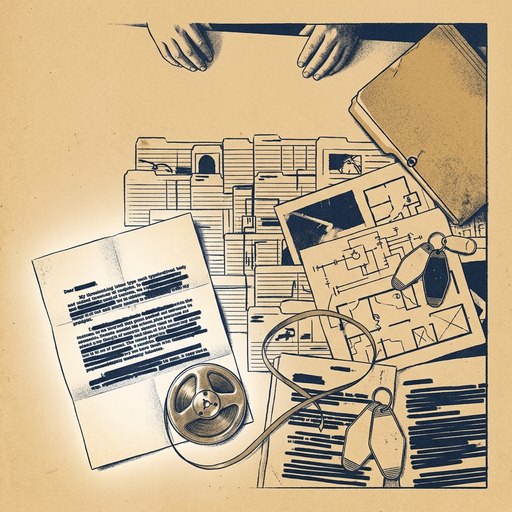
In November of nineteen sixty-four, a package arrived at the Atlanta headquarters of the Southern Christian Leadership Conference, addressed to the Reverend Doctor Martin Luther King Junior. Inside was a tape recording — a compilation, assembled by the Federal Bureau of Investigation, of material captured by the Bureau's own microphones in King's hotel rooms — and a letter, unsigned and typewritten, composed to look as though it had been written by a disillusioned admirer from within the Black community. The letter called the recipient a colossal fraud. It called him, in language this article will handle with care, a moral imbecile and an evil beast. It told him his alleged adulteries and orgies were on tape and would be released to the press, to his movement, and to the world. And it ended with an instruction that has lost none of its chill in sixty years: there is only one thing left for you to do. You know what it is.
The package was not the work of a rogue agent or a hate group. It was an official operation of the Federal Bureau of Investigation, approved at the highest levels of the Bureau, drafted under the authority of the man who ran its domestic intelligence division, and mailed to the most famous civil-rights leader in the world days before he was to travel to Oslo to accept the Nobel Peace Prize. The letter survives, intact. It is a public document, held in the National Archives, published in full, and authenticated beyond argument by the Senate's own investigators a decade later. The story of that letter — who wrote it, what it was meant to accomplish, and how it came into daylight — is the story of what happens when an institution with the power of secret surveillance decides that a private citizen's influence is a threat to the republic, and appoints itself the remedy.
This is not a story about Martin Luther King's private life, and it will not litigate one. It is a story about a document: what it says, what it reveals about the institution that produced it, and what it still demands of every democracy that fields a secret police power in its name.
At My Audio Books dot A I, you can create your own audiobooks from prompts, turn your documents into audio, all with one subscription, and store your items in your own personal library.
To understand the letter, you have to understand the apparatus that produced it, and the apparatus had a name: COINTELPRO, shorthand for Counterintelligence Program, a series of covert operations the FBI ran from the nineteen fifties into the nineteen seventies against domestic organizations it deemed subversive — the Communist Party first, then the Ku Klux Klan, then, with escalating ferocity, the civil-rights and antiwar movements and the people who led them. The word counterintelligence deserves a hard look, because what the program actually did was not counter foreign spies; it disrupted, discredited, and demoralized American citizens exercising American rights. The techniques, documented later in the Bureau's own files: forged letters like this one, planted press stories, informant-fueled factional warfare, tax audits, and, at the extreme edge, the deliberate engineering of violence between rival groups. The program against King was one of its largest and longest. The Bureau had placed a wiretap — the listening device that turns a telephone line into an open microphone — on his home and office, with authorization from Attorney General Robert Kennedy, a fact the record does not let anyone's side escape, and it had bugged his hotel rooms across the country, collecting, among other things, the intimate material that ended up on the tape in the package.
All of it flowed into what the Bureau called a file and what historians call a dossier: an institution's secret biography of a private citizen, compiled without his knowledge, corrected by no one, and available for use whenever the institution judged the moment right. The King dossier ran to hundreds of thousands of pages. It contained his travel plans, his associations, his private conversations, and his private life, cross-referenced and indexed — a parallel life, written by people who wished the real one ill.
The man who ran the machinery was William Sullivan, the Bureau's domestic intelligence chief, and the letter bore his fingerprints — a fact established decades later by the Senate committee that investigated the intelligence agencies. The authorization chain matters here, because one of the uses institutions make of complexity is to distribute guilt until it belongs to no one. The wiretaps were requested by the Bureau and approved by the Attorney General; the bugs in the hotel rooms were the Bureau's own; the letter was conceived and executed within the Bureau's intelligence division; and the Director, J. Edgar Hoover, presided over all of it, signing memos, approving operations, and feeding his decades-long personal fixation on King with the institution's full resources. No single signature on any single document captures the campaign. The campaign was the signature. Sullivan's memos in the Bureau's files are as chilling as the letter itself, and more explicit about intent. One, written months before the package, described King as the most dangerous Negro of the future in this nation from the standpoint of communism, the Negro, and national security, and discussed the Bureau's ambition to see him replaced, in his own movement, by a leader more to the Bureau's liking — a memo that went so far as to name the man the Bureau hoped would take his place. Another memo, written in the same period, advocated neutralizing King as an effective Negro leader. This is the part that bears stating slowly: the Federal Bureau of Investigation had a written policy of removing a civil-rights leader from his own movement, and the letter was one of its instruments.
The letter's method was blackmail, and its mechanism was shame — specifically, the shame of a minister exposed as an adulterer in an era when such exposure could end a public life. It is hard, from the far side of a half-century of changing norms, to feel how sharp that lever was in nineteen sixty-four. Public figures' private lives were then protected by an unwritten press code, and the Bureau's plan depended on breaking it: the package threatened to deliver the tape not only to King but to the press, to the movement's donors, to the Nobel committee itself. A minister exposed as an adulterer, a husband exposed to his wife's congregation, a moral leader recast as a hypocrite — in that decade, each was a career-ending headline, and the Bureau knew the arithmetic of scandal as well as any editor. The letter was, in that sense, a media operation as much as an intelligence one: it was designed to manufacture the story that would write itself. The package was timed to arrive as King prepared for the Nobel ceremony, when the stakes and the spotlight were at their maximum. And its final paragraph, the one thing left for you to do passage, was read then — and is read by nearly every historian since — as a suggestion that King take his own life. The Bureau's defenders have argued over that reading for decades; the Senate's investigators found the document part of a campaign to discredit and neutralize, and the neutral scholarly consensus is that the letter's intent was at minimum King's political destruction, with his self-destruction left deliberately on the table. The document itself is the strongest evidence in the argument, and it is worth reading the way the Senate read it: as an instrument, chosen carefully, to do maximum damage at maximum moment.
At My Audio Books dot A I, you can listen to this story and thousands of others that explore the hidden science and mechanics behind the headlines.
Here is what happened when the package arrived, and it is the part of the story that redeems it. King's wife, Coretta Scott King, opened it first. She played the tape. She read the letter. And then she gave it to her husband, and King gathered his closest advisors — Abernathy, Young — and they read it together, understood instantly who had sent it, and made the decision the Bureau had not priced in: they refused. King did not withdraw. He did not step aside. He flew to Oslo, accepted the Nobel Peace Prize, and returned to lead the march from Selma to Montgomery months later, through the passage of the Voting Rights Act, and on to Memphis, where an assassin's bullet found him in nineteen sixty-eight. The letter that was engineered to end him became, instead, a footnote to his resolve — a document he never spoke of publicly, answered by continuing to exist in the open.
The letter itself surfaced slowly, in pieces, like everything the Bureau kept. Fragments appeared in reporting in the early nineteen seventies. The Senate Select Committee to Study Governmental Operations with Respect to Intelligence Activities — the Church Committee, named for its chairman, Senator Frank Church of Idaho — dragged the program into the light in nineteen seventy-five and nineteen seventy-six. The committee's staff read the Bureau's internal files in the Bureau's own building, and its published volumes on the King campaign remain the foundational account: the wiretaps and their authorizations, the hotel bugs, the informants inside the movement, the memos about neutralization and succession, and the letter, whose provenance the committee established in the Bureau's own records. Church's warning at the hearings deserves quotation in every generation: the technological capability of surveillance, he said, could at any time be turned around on the American people, and no American would have any privacy left — such is the capability to monitor everything. He was describing nineteen seventy-five's microphones. He could not have imagined the pockets the microphones would eventually live in. But the letter the committee quoted had been sanitized by the Bureau's record-keeping; the full, unredacted text — with its ugliest passages intact — did not reach the public until twenty fourteen, when the historian Beverly Gage found a copy in an unexpected place: not in the King surveillance files, where the Bureau would have looked for such things, but in J. Edgar Hoover's own official-and-confidential files at the National Archives, misfiled or deliberately set apart for fifty years. She published it in the New York Times, and for the first time the public could read what the Bureau had actually written. The full text is short — a single page — and it is worth understanding what fifty years of custody had done to it: nothing. The sentences had not weakened with age. The colossal fraud was still colossal; the countdown was still on the page; the instruction was still at the bottom, unamended by five decades of reconsideration. Documents do not repent. They only wait to be reread, and every generation that rereads this one finds the same thing: an agency of the United States government telling the nation's foremost civil-rights leader that his time was up, in writing, on its own letterhead's equivalent, with the full confidence of an institution that did not expect to be read.
It is worth pausing on the institutional logic, because this is where the document stops being history and becomes instruction. The FBI of that era was not a rogue agency; it was a revered one, armed with secret surveillance powers, insulated by a director who had outlasted presidents, and convinced — sincerely, by its own internal rhetoric — that it was the nation's last defense against subversion. Within that conviction, the syllogism ran: King's influence is enormous; enormous influence in the wrong hands is a security threat; therefore his private conduct is a national-security matter; therefore the Bureau's powers apply. Every step of that logic was bureaucratically comfortable, every step was approved through channels, and every step was, in the plainest reading of the Constitution the Bureau had sworn to defend, an abuse. The lesson is not that the Bureau was staffed by villains. It is that an institution granted secret powers and left to define the threat itself will eventually treat dissent as the threat — and will write the letter with clean hands and an official stamp.
The strongest case against this article's reading — the case for the Bureau's conduct — must be heard at full strength, because dismissing it cheaply is how institutions escape accountability, and it rests on the genuine anxieties of the era. Communist infiltration of American institutions was a documented reality, not a fantasy; the Soviet Union did run agents and influence operations in the United States; and King's circle included men with past party associations, which the Bureau cited constantly as justification. The Attorney General had authorized the initial wiretaps. The Director testified before Congress that the Bureau acted within its lawful authorities, and some of the surveillance, taken piece by piece, had lawful warrant behind it. A government that ignores genuine foreign-adversary interest in domestic movements would be negligent. That is the strongest version of the case, and it is true as far as it goes — and it goes no distance at all toward the letter, which defended no one from any foreign power, was designed to destroy an American citizen's standing through sexual blackmail, and was, by the Bureau's own later internal assessments and the Senate's findings, outside any conception of lawful authority. The wiretaps had a rationale one could argue. The letter had none.
Three developments would disprove or confirm what the letter finally means for the present, and each is observable. First, the completion of the documentary record: the FBI's King files, assembled for a civil suit decades ago, remain under court seal until twenty twenty-seven — next year — and their opening will either confirm the known outline of the campaign or deepen it; either outcome is a finding. A court seal, for those who have never watched one work, is the judiciary's pause button: records gathered in litigation are closed to the public for a set period, on the theory that time will defuse whatever damage disclosure might do to the living. The King estate accepted the seal to win the files' preservation; the consequence is that the most complete single archive of the campaign has spent five decades in a vault, and its opening is now a matter of months. Historians have lists ready. The Bureau, one assumes, does too. Second, the pattern's recurrence: every modern debate about secret surveillance of domestic political movements — of protesters, of activists, of communities — is the letter's logic returning in new clothing, and the speed with which institutions reach for the old syllogism is the live test of whether the lesson was learned. Third, the accountability question: the Bureau has never issued a formal institutional apology for the King campaign, and whether it ever does — and what it says when it does — will tell us whether the letter is treated as history or as an open file.
The letter's afterlife is its own small history. For decades the Bureau's headquarters in Washington has carried J. Edgar Hoover's name over its doors, and every few years a bill is introduced to remove it, and every few years the bill goes nowhere, and the name stays. The arguments on each side are familiar — institutional continuity versus institutional accountability — but the letter sits underneath all of them like an unanswered question: can an agency honor the man who signed the campaign and disown the campaign at the same time, under one roof, in one name? The King family has said its piece; historians have said theirs; Congress has said nothing, which is its own answer. The building, the name, and the letter coexist for now, three artifacts of the same institution, and which of them outlasts the others is not yet decided.
It is worth saying precisely what this article has not claimed. It has not claimed the letter proves the Bureau's involvement in King's assassination; there is no evidence for that, and the article makes no such suggestion — the letter is damning enough on its own terms. It has not claimed every surveillance action in the campaign was warrantless; some had authorization, and the article says so. It has not claimed the Bureau's fears of foreign infiltration were imaginary; they were real, and disproportionate to the response in ways the documents themselves establish. And it has not litigated King's private life, which the letter tried to make public property and which this article declines to make public property again; the story here is the institution's conduct, not the private citizen's.
Which returns to the moment that decides the story's meaning: a kitchen table in Atlanta, a tape, a letter, and the people who read it and understood exactly what it was and who had sent it — and chose, anyway, to keep walking. The Bureau had calculated that shame was a lever, that the right package at the right moment could move a man off the stage of history without a single arrest. What it had not calculated was that the man it addressed had already decided what he was willing to lose, and a tape was not on the list. The letter survives in the National Archives as the government of the United States' own written confession of what unchecked secret power does with itself. It is there to be read, by anyone, free of charge, in the custody of the same government that wrote it — which is, in the end, the one institutional instinct that has ever corrected the others. It should be read often — especially by the institutions that hold its author's powers today, by the citizens in whose name those powers are held, and by anyone who believes that what a democracy does in secret, it eventually does to itself.
At My Audio Books dot A I, you can create fiction, non-fiction, and turn your documents into audio, all stored in one place with a single subscription — plus get instant access to thousands of audiobooks and deep-dive investigations. Learn more today at My Audio Books dot A I.