The Leaning Tower of Pisa: How Removing Soil Stabilized Its Foundation
The Leaning Tower of Pisa was sinking unevenly into soft ground, and by 1990 its growing tilt threatened collapse. Engineers saved it by carefully removing soil beneath its higher north side, letting that side settle and easing the lean without erasing it. The tower’s tilt does not protect it from earthquakes; its survival depends on the complex behavior of the soil beneath it and on continued monitoring and care.
By MyAudioBooks.ai ·
Listen free: The Leaning Tower of Pisa: How Removing Soil Stabilized Its Foundation
In January of nineteen ninety, authorities closed the Leaning Tower of Pisa to the public, convinced that after eight centuries of slow rotation, the monument was approaching catastrophic collapse. The rescue plan that eventually saved it sounded, at first glance, like deliberate sabotage. Instead of propping the tower up or driving massive steel piles through its base, geotechnical engineers drilled underneath the structure and hauled away its supporting ground. The tower still leans today, and a persistent claim suggests that the lean itself somehow shields the monument from destruction. The true physics reveals a different story. To understand what actually keeps this massive marble cylinder standing, you have to examine why removing ground was the only way to save it.
At My Audio Books dot A I, you can create your own audiobooks from prompts, turn your documents into audio, all with one subscription, and store your items in your own personal library.
Construction of the bell tower began in August of eleven seventy-three on the coastal flood plain of the Arno River. Beneath the manicured turf of the Piazza dei Miracoli sits an unstable geological sequence. The ground consists of several meters of river silt and silty sand, resting over a thick deposit of soft, compressible marine clay, followed by deeper sand formations. To make matters worse, the local groundwater table rests only one to two meters beneath the grass.
Almost as soon as medieval masons completed the first three tiers of white marble, the earth began to give way. When heavy stone rests on soft ground, the soil skeleton compresses and slowly expels trapped water, forcing the surface downward. If a building sinks at an equal rate across its entire footprint, engineers call that uniform settlement. Uniform settlement lowers a structure relative to the surrounding street, but it keeps the walls plumb and preserves vertical alignment.
At Pisa, the underlying soil layers vary in thickness, water content, and compressibility from one edge of the foundation ring to the other. The clay beneath the southern rim proved far softer and more compressible than the ground just twenty meters away to the north. As the masonry grew heavier, the south side settled faster and sank deeper into the mud.
This differential settlement tilted the circular foundation slab, locking in a permanent southward inclination. The south side became the low side, and the north side became the high side. Medieval builders tried to correct the error by curving upper columns and thickening stone layers on the sinking southern flank. That well-intentioned adjustment backfired. Adding more stone added more dead load, pushing the south side even deeper.
Once a tall, heavy tower begins to tilt, a destructive mechanical feedback loop takes over. Every physical object has a center of mass, the theoretical point where its entire weight can be considered concentrated. On a level, plumb building, that center of mass sits directly above the geometric center of the foundation, distributing the downward load evenly across the subsoil. But as the Pisa tower tilted southward, its center of mass shifted sideways relative to the foundation footprint.
That horizontal displacement meant the tower's dead weight was acting off-center, creating an eccentric load. The structure behaved like a gigantic, slow-motion lever pressing into the ground. As the center of gravity traveled south, contact pressure under the southern edge climbed steeply, while pressure under the northern edge fell. That concentrated southern pressure compressed the soft clay further, producing additional southern settlement, which increased the tilt and shoved the center of mass still farther south.
By the early nineteen nineties, that feedback loop had pushed the tower toward structural collapse. The tower's inclination reached five point five degrees from vertical, sloping southward at an alarming angle. At the top of the belfry, the upper masonry overhung the foundation base by roughly four point five meters. Down at the foundation level, the tower's total weight was acting approximately two point three meters off-center.
When officials shut the monument to visitors in nineteen ninety, an international committee installed an extensive instrumentation array. Approximately one hundred twenty electronic sensors continuously tracked foundation displacement, rotational tilt, masonry stress, ambient temperature, wind vibrations, and fluctuating groundwater levels. The readings confirmed that the tower was steadily moving toward a tipping point where either masonry shear failure or foundation soil collapse would trigger a sudden fall. The engineering challenge was not simply to force the tower vertical. The task was to arrest dangerous movement without destabilizing the fragile ground or sacrificing the historic monument.
Before anyone could alter the ground beneath the tower, the engineering committee had to stabilize the existing motion and buy time for long-term solutions. Any ill-conceived construction vibration or sudden change in soil stress could trigger immediate failure. In nineteen ninety-three, the engineering team introduced a temporary counterweight system on the north side, which formed the high edge of the foundation.
Workers placed approximately six hundred metric tons of lead ingots onto a temporary prestressed concrete ring cast around the base of the northern masonry. Because the tower was leaning south, adding mass to the northern edge created an opposing moment. Placing weight on the raised side of a seesaw pulls the structure back toward level. The lead counterweights did not straighten the tower, but their added weight helped counter the southward overturning tendency, halting the progressive crawl and opening a window for intervention.
Alongside the lead ingots, engineers anchored heavy steel restraint cables to the tower's third level and ran them back to secure anchor blocks located several hundred meters away. These steel cables did not exert an active pull to hoist the stone upright. They served as a passive emergency safeguard against excessive movement, remaining tensioned to catch the tower if an unexpected ground shift or earthquake began tipping the masonry past the point of recovery.
Both the counterweights and the restraint cables were temporary measures. Six hundred metric tons of industrial lead cluttering a medieval monument was visually unacceptable, and mechanical cables cannot maintain indefinite structural tension over decades. The permanent improvement had to come from changing how the foundation and ground carried the tower.
At the same time, sensor data revealed that the tower moved back and forth with every change in the Tuscan water table. Beneath the northern side, seasonal rainfall and agricultural pumping caused groundwater levels to fluctuate unpredictably. High water tables increased pore water pressure within the soil pores, temporarily weakening the earth's shear resistance, while receding water allowed settlement to accelerate. Controlling the flow of groundwater beneath the piazza became an essential companion to physical intervention.
The permanent intervention relied on an operation that defied everyday intuition: underexcavation. Traditional civil engineering instinct would suggest underpinning the sagging southern edge, pumping grout into the soft clay, or driving mechanical jacks under the low side to push it upward. Yet historical interventions in Pisa showed that disturbing the highly stressed southern ground was dangerous. In nineteen thirty-four, an attempt to inject chemical grout beneath the south side caused an immediate acceleration of the southward tilt. The southern soil was already stressed close to its bearing capacity; any disturbance risked triggering structural failure.
The engineering committee decided to do the exact opposite. They left the precarious southern side untouched and focused entirely on the high, northern foundation.
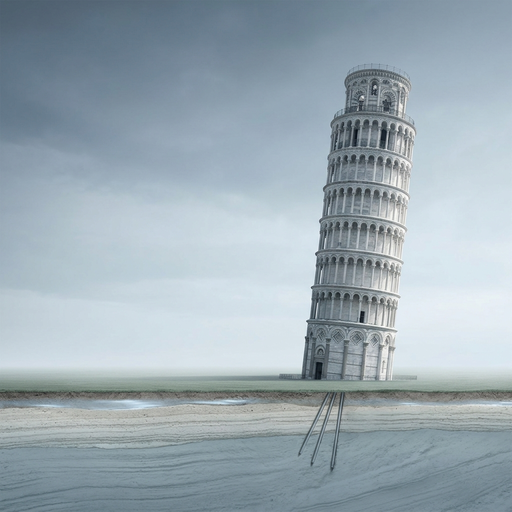
Underexcavation meant removing small quantities of soil beneath the higher, north side through inclined drill holes. The objective was controlled settlement. If you want to rotate a leaning cylinder back toward vertical without touching its low side, you can deliberately cause its high side to sink. By withdrawing soil from beneath the northern edge, engineers allowed that higher flank to settle slightly, rotating the entire structure a fraction toward vertical and away from its dangerous southward lean.
Removing soil beneath the low, south side would have accelerated disaster. The direction of the work was as vital as the volume removed. Instead of lifting the low side with jacks or forcing the masonry upright, the team changed the subsoil support so that the foundation rotated back on its own. To prevent sudden collapse, the drill extracted soil incrementally through narrow, inclined casings, allowing the surrounding ground to close the small cavities through slow, plastic deformation.
The team proceeded with extreme caution. Between February and June of nineteen ninety-nine, they conducted a preliminary campaign using twelve inclined drill holes beneath the northern foundation, removing approximately seven cubic meters of soil. The tower's measured response established the empirical basis for the larger operation, showing that the northern foundation settled predictably and the tower rotated northward without structural distress.
The full campaign ran from February twenty-first, two thousand, to June sixth, two thousand one. A specialized auger operated through forty-one inclined holes driven beneath the northern foundation edge and beneath the catino, the ring-shaped marble drainage basin surrounding the foundation perimeter. Most of the soil extraction occurred beneath this outer annular area rather than directly under the central foundation footprint.
Over sixteen months, the team carried out one thousand five hundred sixty-eight individual extractions, removing roughly thirty-eight cubic meters of soil in total. Extraction proceeded in small increments, with repeated measurements guiding further removal. Too much settlement, or settlement in the wrong place, could create unwanted rotation. Engineers reviewed sensor readings daily, mapped the settlement contours, and decided which individual hole to drill for a few minutes before pausing to observe the structural response.
The result was a reduction in foundation tilt of one thousand eight hundred eighty arc seconds by mid-two thousand two, which represented approximately ten percent of the earlier maximum inclination reached in nineteen ninety-three. In angular terms, the intervention achieved the target reduction of approximately half a degree. At the top of the belfry, the overhang swung back by about forty-five centimeters, drawing the center of gravity inward and relieving the ground pressures beneath the south side.
Workers progressively removed the lead counterweights from the high side, and the temporary cable restraints were later dismantled. The tower reopened to visitors in December of two thousand one. By the middle of two thousand two, the combined effects of underexcavation and groundwater control had established a stable, working equilibrium.
Even with that half-degree correction, the Leaning Tower of Pisa still tilts by nearly four degrees today. That persistent tilt raises two separate questions: why an inclined tower can remain standing under everyday gravity, and whether the lean provides any protection during earthquakes.
A tilted tower does not automatically overturn. Its weight can still act through a supported part of the foundation, provided the soil can sustain the uneven pressure and the structure can carry the resulting stresses. The foundation's broad footprint matters, but the position of the weight alone is not an absolute guarantee. Compressible soil can deform progressively even before a simple rigid-block picture would predict toppling. The real threat was that concentrated stress on the south side would exceed the soil's ultimate bearing capacity, causing the ground to shear and fail completely.
Reducing inclination brought the weight's line of action closer to the foundation's center and improved the margin against further rotation. A modest correction preserved the historic lean while reducing the danger associated with it.
Yet an enduring myth claims that the lean itself protects the tower from earthquakes, acting like a structural shield. The physics demonstrates the opposite. The visible tilt is a mechanical liability during an earthquake. An off-center mass increases bending moments and magnifies shear stresses within the brittle stone masonry. If seismic shaking pushes in the direction of the lean, that lateral inertia brings the tower closer to toppling.
The tower's survival of four major regional earthquakes since twelve ninety-eight stems from a different mechanism: dynamic soil-structure interaction. Soil-structure interaction means that the tower, foundation, and ground move and deform together rather than behaving as a structure fixed to an immovable base.
The tower is tall, stiff, and heavy, built with thick masonry walls. The underlying soil is soft, water-rich, and flexible. When seismic shaking travels through the ground, this flexible soil-foundation system lengthens the tower's natural period of vibration. Under specific earthquake conditions, that shift reduces the transmission of destructive, higher-frequency ground motions into the masonry. By vibrating out of sync with those violent frequencies, the monument avoided the resonant destruction that brought down stiffer, conventional buildings nearby.
That benefit belongs to the behavior of the coupled ground-and-structure system, not to the visible lean acting as a shield. It may help explain the tower's survival of past earthquakes without guaranteeing its response to future ones. Earthquake behavior depends on the shaking's frequency content, duration, and direction, as well as soil stiffness, damping, groundwater, masonry condition, and the tower's geometry.
The same ground flexibility that can reduce some shaking demands also permits settlement and rotation. More flexibility, or a greater lean, does not automatically mean greater safety. Reducing the inclination improves stability, while any beneficial earthquake response is a separate, conditional effect of soil-structure interaction.
After active underexcavation ended in two thousand one, the soil-foundation system continued adjusting in small amounts. Stabilized does not mean permanently motionless. Over several years, the soil beneath the north side continued to consolidate gradually, pulling the tower an additional fraction of an arcminute toward vertical before settling into dynamic equilibrium.
Electronic sensors continue to track displacement, tilt, and joint behavior. The data reveals that the monument moves continuously throughout the year. Monitoring distinguishes short-term seasonal movement from a sustained long-term trend. In the heat of summer, solar radiation warms the southern masonry face, causing the stone to expand and tipping the upper belfry slightly northward. In winter, cooler temperatures and shifting moisture reverse that deflection. A small seasonal swing is not, by itself, evidence of renewed instability. It is the predictable elastic response of stone exposed to the elements. What the instruments watch for is irreversible creep: a steady, directional change that would indicate the positive feedback loop had begun anew.
Underexcavation created the principal reduction in lean, while groundwater control, inspection, maintenance, and continuing measurements help preserve and assess the improved condition. Measurement does not physically hold up the tower. It reveals changes that can inform maintenance or renewed intervention before dangerous movement progresses unnoticed.
The continuing protection is a system: reduced inclination, manageable foundation pressures, groundwater control, sound masonry, and care that avoids disturbing the established ground conditions. The tower remains inclined because a modest correction delivers a safety benefit without attempting complete straightening. Its remaining lean is a preserved condition, not the protective mechanism itself.
Underexcavation may help other leaning structures where the soil and foundation conditions are suitable. Pisa's success is not a universal prescription for historic buildings. The process requires cohesive soils, such as clays and silts, that allow ground to collapse slowly into small drilled cavities without sudden subsurface piping or sinkholes. Applying the technique to loose gravel, coarse sand, or fractured rock could bring a fragile building down.
Several open questions remain for engineers tasked with preserving the monument across the coming century. One fundamental question is what stable should mean: no movement at all, bounded seasonal movement, or a sufficiently low long-term rate of change. Further questions concern groundwater, soil aging, masonry cracking, and climate-related changes in water conditions. As shifting weather patterns alter regional rainfall intensity and subterranean water tables, identifying which measurements give the earliest warning, and determining what threshold should trigger renewed intervention, remains the core challenge of long-term conservation.
The tower was saved not by being forced upright, but by allowing its high side to settle a fraction at a time, proving that its safety depends on the ongoing relationship among mass, soil, water, and continuing care. The next encounter with the monument can reveal more than a famous lean: an invisible foundation system made understandable. The question worth carrying to any great structure is what the ground beneath it is quietly doing.