The Invisible Armory: Inside Today's Sanctions on Cuba's Military Procurement Network
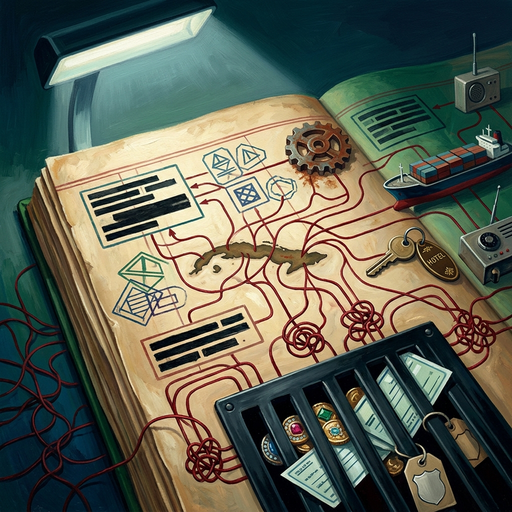
On August 6, 2026, the State Department designated five entities and eight individuals under E.O. 14404 targeting Cuba's arms-import apparatus — including the island's central weapons importer and military holding conglomerate — while OFAC updated the SDN list.
By MyAudioBooks.ai ·
Listen free: The Invisible Armory: Inside Today's Sanctions on Cuba's Military Procurement Network
On Thursday, August sixth, twenty twenty-six, the United States Department of State announced the designation of five entities and eight individuals under Executive Order fourteen four zero four, targeting the procurement networks that keep the Cuban regime's military supplied. In parallel, the Treasury Department's Office of Foreign Assets Control updated its Specially Designated Nationals list, adding Cuban state firms including the island's central arms-import enterprise and its military technology holding company, and issued a new set of frequently asked questions interpreting the order.
No shots were fired, no ships were boarded, and no press conference filled a cable-news hour. But the designations, executed through the quiet machinery of administrative sanctions law, severed the named companies from the U S financial system, froze any assets touching American jurisdiction, and warned every bank on Earth that continuing to do business with Cuba's arms importers now carries the risk of losing access to dollars. It is economic warfare conducted entirely through compliance departments — and it landed this morning.
At My Audio Books dot A I, you can create your own audiobooks from prompts, turn your documents into audio, all with one subscription, and store your items in your own personal library.
During our research into the primary State Department fact sheet, the Treasury sanctions list update, and the executive order behind them, we found a story about how a sixty-year embargo evolved into a precision financial weapon; who the companies on today's list actually are and what they move; and why the newest front in sanctions enforcement runs through banks, shipping registries, and shell companies rather than warships.
Section One. The Architecture of a Designation.
To understand what happened today, you have to understand what a sanctions designation actually is. When the President issues an executive order under the International Emergency Economic Powers Act — the nineteen seventy-seven statute that underpins most modern sanctions — he declares a national emergency and authorizes the Treasury to block the property of designated persons. A designation by the State Department under such an order is not an accusation or an indictment; it is an administrative finding that takes legal effect the moment it is published, with no trial, no hearing, and no judicial review at the front end.
The consequences are immediate and global. Every asset of the designated party within U S jurisdiction is frozen. Every American is prohibited from transacting with them. And because nearly every significant international payment clears through correspondent accounts in New York, every foreign bank faces a choice the moment a name hits the list: drop the client or risk being cut off from the dollar system itself. That is the entire mechanism. There is no police force, no seizure team. There is a database update, and then the compliance software at ten thousand banks does the rest. Today's action targeted the companies and operatives that keep Cuba's armed forces stocked — chief among them the island's state arms-import firm and the military conglomerate that sits atop much of the Cuban economy.
Section Two. Inside Cuba's Military-Commercial Empire.
To appreciate the targets, you need a map of the Cuban state economy, because it is not organized the way a Western defense establishment is. Cuba's armed forces do not merely consume a defense budget; they own the economy. A single military-run holding conglomerate controls the island's tourism hotels, its retail stores, its remittance processors, and much of its import logistics. The same institution that fields soldiers also books the beach resorts foreign tourists pay to visit, meaning that for years, hard currency from tourism flowed into the same entity that sustains the security services.
On the procurement side, state import enterprises handle the acquisition of everything the military cannot make domestically — vehicles, communications gear, dual-use technology, spare parts for aging Soviet-era equipment. These firms operate through layered front companies, third-country intermediaries, and barter arrangements designed to obscure end-users from foreign banks. Today's designations name the central players in that apparatus directly: the arms-import company that brokers the regime's weapons purchases, the military holding company that manages its commercial empire, and the individual operatives who run the procurement relationships with suppliers in Russia, China, and elsewhere. The stated purpose is to raise the cost of foreign military cooperation with Havana and to squeeze the revenue streams — tourism, remittances, imports — that flow through the military's commercial holdings.
Section Three. The Enforcement Machinery.
What makes a twenty-first-century sanctions action effective is not the press release; it is the plumbing. The moment a designation posts, Treasury's list-feed propagates to the sanctions-screening software used by every global bank, and payments that previously moved invisibly begin to halt mid-transfer. Correspondent banks issue quiet exit letters. Ship registries ask questions about beneficial ownership. Insurers review policies on vessels that called at Cuban ports. The effect is less like a blockade than like raising the viscosity of the entire financial fluid the target depends on — everything still moves, but slower, at higher cost, through fewer channels, with more risk priced in.
This is also why the accompanying guidance matters as much as the list. The new frequently-asked-questions document issued alongside today's designations tells global compliance officers exactly how Treasury will interpret the order — which dealings trigger exposure, how the military holding company's sprawling subsidiaries are treated, what due-diligence standard foreign banks are expected to meet. In modern economic statecraft, the FAQ is the weapon's instruction manual, and its audience is not the Cuban general staff. It is the general counsel of every bank in Madrid, Panama City, and Singapore that might otherwise process the next payment.
At My Audio Books dot A I, you can listen to this story and thousands of others that explore the hidden science and mechanics behind the headlines.
Section Four. The Original Angle: The Embargo's Mutation.
Taking today's designations and placing them in the sixty-year arc of U S–Cuba policy reveals how completely the instrument has mutated. The original embargo, built in the nineteen sixties, was a blunt trade ban — a static wall designed for an era of goods and gunboat diplomacy. Its logic was denial by geography: nothing American crosses to the island. The modern successor is something else entirely: a dynamic, name-by-name targeting system that treats the global financial network as the battlefield and specific procurement officers as the targets.
The difference is not cosmetic; it is doctrinal. The old embargo punished an entire population and changed little; the new designations attempt to sever specific arteries — arms imports, military-controlled tourism revenue, dual-use technology channels — while leaving humanitarian trade legally intact. Whether that surgical theory works is the central debate of sanctions policy. Critics note that decades of designations have not loosened the regime's grip, while the island's chronic shortages fall hardest on ordinary Cubans. Defenders counter that the goal is no longer regime change but cost imposition: making every military resupply flight, every front-company wire, every Russian or Chinese shipment measurably harder and more expensive than the last. Today's action is a data point in that unresolved argument — five entities, eight individuals, and one more turn of the financial vise.
Section Five. What to Watch.
- For Diplomats and Policy Analysts:
- Watch whether Moscow and Beijing issue formal protests or merely absorb the designations quietly; the response signals how much each values the Cuban military relationship relative to banking access.
- Track any Cuban retaliation against U S diplomatic functions or cooperative agreements, which has historically followed tightly targeted military-economic measures.
- For Compliance Officers and Trade Lawyers:
- Screen immediately against the updated list and map exposure to the designated military holding company's subsidiary network, which reaches into tourism, retail, and remittance processing.
- Read the new FAQ closely for Treasury's position on indirect dealings; secondary exposure through third-country intermediaries is the central risk area this round.
- For Investors and Risk Researchers:
- Monitor Caribbean and Central American shipping and insurance pricing for early signs of regional risk repricing following the designations.
- Watch Cuba's tourism-dependent foreign exchange flows; the military conglomerate's hotel and retail holdings are the regime's primary hard-currency engine and the implicit target of sustained designation pressure.
Section Six. The Broader Pattern and Open Question.
The broad pattern is the financialization of conflict. Sanctions were once the prelude to war or the poor substitute for it; they have become a standing instrument of daily statecraft, updated weekly, enforced by software, and aimed at procurement officers and holding companies rather than armies. The weapon of the twenty-first-century standoff is not the carrier group. It is the compliance filter.
There is a second pattern, and it is about endurance. Sixty-five years of pressure on one small island have produced neither capitulation nor normalization — only adaptation on both sides. The regime learned to build shell networks and military conglomerates; Washington learned to map and designate them faster. Today's list is one more move in the longest-running economic confrontation in the modern world, and neither side shows any sign of ending it.
Which leaves the open question: when an arms-import network can be wounded by a database update and a bank memo, but the underlying regime endures for six decades, is the financial weapon actually working — or has it become the permanent condition that both governments quietly prefer to peace? The designations are posted. The banks are already filtering. The vise tightens by one notch more.
At My Audio Books dot A I, you can create fiction, non-fiction, and turn your documents into audio, all stored in one place with a single subscription — plus get instant access to thousands of audiobooks and deep-dive investigations. Learn more today at My Audio Books dot A I.