The Interpreter’s Brother
Over four days of an asylum appeal in The Hague, interpreter Nasrin Haidari discovers that the soldier an Afghan appellant accuses of a shooting was her late brother, whose private confession she has never repeated. As the appellant demands acknowledgment rather than apology, her pride in exact translation becomes a means of withholding her own answer. When she finally speaks as his sister, she loses her interpreting role and undermines his lawyer’s remaining argument—giving him the acknowledgment he sought without ending his fear of return.
By MyAudioBooks.ai ·
Listen free: The Interpreter’s Brother
This is a work of fiction. The tribunal, the officials, the interpreter and every person in it are invented, and no real case is described.
I was already carrying his first sentence into Dutch. "I had been in that courtyard before." The man beside me waited until I finished, then continued in Dari. I kept my attention on the judge. Through the headset I heard the slight friction of his sleeve against the microphone.
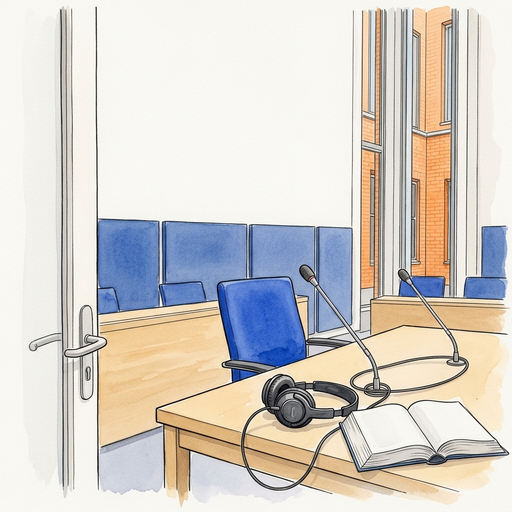
That October morning in two thousand twenty-six, in The Hague, the equipment worked well. The padded earpiece pressed against the arm of my glasses, but I had adjusted it before we began. Nothing required my attention except the distance between his sentence and mine.
The judge allowed him to stop. Her name was Annelies de Wit, and I respected her for several things, this among them. She could leave a silence available to the person who had made it. She waited with both hands on the table, leaving the next sentence to the appellant.
You will know the temptation to help. You will already have qualified when you take this chair, and someone will have warned you against completing a sentence. The less obvious temptation is to complete a silence. A man has said something difficult. Everyone waits. You offer a small explanatory word, and suddenly the room can continue. I kept my mouth closed.
The appellant, Jawad Rahimi, moved his microphone a little nearer.
"I can explain why I was there. It is the part about the other man that people do not accept."
I carried that too, in the first person. His lawyer drew her chair forward without interrupting.
Four days had been set aside for his asylum appeal. He believed that returning to Afghanistan could get him killed. His lawyer had a remaining argument to make about an accusation arising from a courtyard in Herat. The hearing needed more than an account of something terrible happening there. It needed his account of why that event put him personally in danger now.
I carried his words. I did not provide a certificate that they were true.
I had been a sworn interpreter of Dari and Pashto for sixteen years. At forty-four, I could still take pleasure in a sentence arriving complete, with its qualifications intact. I had never knowingly substituted a more useful answer for the answer given. If you had asked me then, I would have said I had never once changed a word.
The state representative, Bram Oosterhuis, waited for de Wit to give him the turn. He spoke evenly, with enough space between his questions for me to carry each one.
"You say you are accused of firing. I want to distinguish that from being present. Which accusation do you say you would face?"
Rahimi rubbed the side of one finger with his thumb.
"That I fired. They have made me the man who fired."
"And when you say they, you mean the soldier's family?"
"His family, and the people who accept what they say. If I return, they will not arrange a meeting to ask me again. They will kill me."
His legal-aid lawyer, Sanne Visser, waited until I had finished.
"That distinction is part of our submission. His account is that the accusation concerns the shot itself. We need him to explain what he says the family has refused to acknowledge."
De Wit gave Rahimi time to hear this through me. He turned towards my voice, and I directed my attention back to her.
"Please speak to the judge. I will follow you."
I then told the court, in Dutch, what I had asked him to do. An interpreter's instruction also belonged in the room.
A procedural question between the lawyers brought a short pause. I left the headset at my place and stayed by the hearing-room door, where I could hear when they were ready. My interpreter card remained clipped low on my jacket. At the table, I had felt its corner against my hip.
My running partner telephoned while the clerk was speaking to de Wit. The call connected normally. We had been running the same route together long enough to disagree about it without arranging another occasion.
"Could we take the path past the allotments tonight? Just for a change."
I moved a step farther into the doorway.
"It adds a turning. We would have to come back along the road."
"I know where it comes out. I've been there."
I had come to the Netherlands from Herat at nineteen. There were still streets here that I could use without knowing where they led, but our running route required no such uncertainty. It had outlasted my marriage. I considered that a point in its favour.
"We can leave a little later if that helps. I would like to keep the usual route."
"Leaving later doesn't help. I wanted to go somewhere else."
Through the open door, I saw Sanne sit down again. Since my divorce, with no children to collect or consult, I had become accustomed to treating the end of work as the beginning of my own time. I guarded this run even from a small alteration proposed by the person who shared it.
"Tomorrow, perhaps. Today I would prefer the route we know."
My partner let the silence last.
"You've got your work voice on."
"This is my voice."
"All right. The usual route. But you don't generally sound as though you're explaining where I'm allowed to sit."
The clerk beckoned from inside. I said goodbye and disconnected the telephone.
When I returned to my place, Rahimi was holding his headset clear of one ear. He lowered it as I sat. I put my own headset back on. Sanne asked whether he was ready to continue, and he answered her through me.
"Yes. I would like to finish the answer I began."
De Wit brought us back to the family. She asked what acknowledgment he had sought from them, and Rahimi used a word I had often rendered as apology.
I gave the habitual rendering.
His head turned before I had reached the end of the sentence. He waited for me to finish, then raised his hand a little above the table.
"Excuse me. I know that Dutch word."
I kept my hands beside the microphone.
"Please tell the judge what you want to correct."
Rahimi addressed de Wit, though his next words were still in Dari.
"The word she used is what people say when they are sorry. I hear it at work. Someone leaves a bucket in the way, and then he says it. That is not what I asked for."
I carried his correction in the first person. Then I identified my own speech.
"Interpreter's correction. I supplied apology. The speaker is rejecting that rendering."
Oosterhuis put down his pen. Sanne kept her attention on Rahimi. Nobody offered to make the correction smaller.
De Wit spoke after I had finished.
"What did you ask for?"
Rahimi shifted his forearms on the table.
"For them to acknowledge what I had said. They could still disagree. But they would have to answer that part."
"Which part?"
"That the soldier fired. They say I did. I want them to answer what I have told them about him."
I transmitted this without finding another single word to replace the first. Sometimes a short phrase is the exact rendering. The oath does not require matching lengths.
Sanne leaned towards her microphone.
"Can we keep his distinction in the question? He is asking for acknowledgment of an account. He has not said that a polite exchange would remove his fear of return."
Oosterhuis answered her.
"I agree those are different propositions. I still need to understand how the accusation reaches him now."
De Wit allowed both statements to stand. Then she turned back to Rahimi.
"You may explain that. Take the time you need."
He began again, more slowly. His courtesy had survived my error. He apologised for the interruption, and on that occasion the ordinary Dutch word was right.
You must announce an error as soon as you recognise it. A speaker's correction is not a private exchange between the two of you. The people hearing your voice have already received the wrong thing, and they are entitled to hear it put right.
There is an exception to carrying everything in the first person. When you speak about your work, you identify yourself as the interpreter. I had done that clearly. I had exposed the error to precisely the people who needed to know.
I included such corrections within my claim never to have changed a word. Once disclosed, an error could be bounded. We could establish what I had supplied, what he had intended, and what everyone had now heard. I could return to the next sentence.
Rahimi continued with his attention on de Wit. I kept mine there too. When she eventually released us, I lifted the headset away from my ears.
By the following afternoon, I was back beside Rahimi in the same hearing room. The night between had passed without altering the arrangement of our places. Oosterhuis sat opposite Sanne, and de Wit waited for the clerk to finish before inviting the next question.
Oosterhuis addressed Rahimi through me.
"In the account taken six years ago, you gave a different name for the soldier. Today you have spoken about him without naming him. I want to give you an opportunity to explain the difference."
Rahimi pressed his lips together while I interpreted.
"There were several men. I was asked many questions about them."
"Yes. I am asking about this man. The man you say fired."
The transcript was six years old. It supplied the discrepancy, but it could not supply Rahimi's answer. Oosterhuis left it on the table while he waited.
Rahimi pulled his microphone closer.
"I cannot tell you what was in someone's mind when that name was put there. I can tell you the man I mean."
"Were you giving the name of another man then, or are you saying the name was taken down incorrectly?"
Sanne lifted one hand towards de Wit.
"He may not be able to account for that exchange now. He can still answer whom he means today."
Oosterhuis waited for permission to continue.
"I am not treating a different name as an answer to whether he would be safe. But the account we are asked to accept concerns a particular soldier and a particular family. The distinction matters to that account."
De Wit turned towards Rahimi.
"Do you understand why the question is being asked?"
I carried it. Rahimi's answer came quietly.
"Yes. You want to know whether I have changed the man."
"We want you to answer about the name. You can also tell us what you can and cannot explain about the earlier answer."
Rahimi settled back against his chair. His headset cable rested across his sleeve, and he freed it before speaking.
"I can give you the name. I cannot make his family hear it. Those are different things also."
Sanne moved towards her microphone again.
"Our submission is that his danger arises from being identified as the man who fired. He says the family has never accepted the soldier's part. We are not asking you to infer his personal danger simply from the existence of a courtyard or a death."
Oosterhuis kept his voice level.
"Then we need his account of that distinction. If the family's accusation is different from the one described, the argument needs to address it."
I finished carrying his words. Rahimi waited, his fingers closed around the base of the microphone.
This was the work left to Sanne. She needed a credible account belonging to her client, one that explained why the danger attached to him. Naming a soldier would not do that on its own. Nor would the earlier name settle whether he could safely return. The people across the table were asking him to remain particular.
De Wit allowed the pause. Then she spoke slowly.
"I need the exact words. Tell us whom you mean when you say the soldier who fired."
I gave her request in Dari. Rahimi released the microphone and answered. There was no difficulty in his syntax, no word requiring a choice between two plausible meanings.
My voice followed his without hesitation.
"I have said that the soldier who fired was Farid Haidari."
I completed the surname at my ordinary volume.
Farid was my younger brother. He had died in Rotterdam seven years earlier. Before he died, he had told me that his commander had forced him to shoot a man in a courtyard in Herat in two thousand nine, and that he had done it. I had never repeated this to anyone.
I put my right hand flat on the table. The little finger struck the surface, stopped, then struck it again. I spread my fingers and pressed harder.
De Wit was waiting for the rest of Rahimi's answer. He had begun to draw breath for it when Sanne spoke.
"We need a recess."
De Wit turned towards her.
"Now?"
Sanne kept her attention on my hand.
"Yes. The interpreter needs a moment."
I lifted the hand and caught it at the wrist with the other.
"I can continue."
De Wit let me finish, then moved her microphone away.
"We will pause. You may leave the headset here."
Rahimi removed his own headset. He watched Sanne get up, then moved his chair back to give her space. My card remained below the edge of the table. He had addressed me only as the interpreter.
I laid the headset beside the microphone. The cable caught beneath my wrist, and I freed it carefully. Sanne came around the end of the table and held the door.
At the hearing-room exit, she drew a chair away from the wall. I kept walking until she stepped into my path.
Her voice dropped so that it barely reached me.
"Oh, fuck. Sit down, please."
I held my right wrist against my jacket.
"I need some water."
"I'll get it. Sit while I do."
"I would rather go to the toilets."
She kept one hand on the chair.
"Are you ill?"
I moved my hand from the jacket and tried to let it hang normally.
"I need a little time. Then I can work."
Rahimi remained beside his place, one hand on the back of his chair. The clerk had followed us to the doorway.
"Please stay in the waiting area when you're ready. I'll come for you before we resume."
I said that I would. Sanne went to the water dispenser while the guard moved aside at the entrance to the waiting area. The keys on the guard's belt struck together once. There was room to pass without anyone touching me.
Sanne handed me a paper cup. Water moved against its rim, and I lowered it before I had taken a drink.
A woman waiting beside the dispenser put her hand beneath the cup. She held its base against my fingers until the water stopped moving. She asked no question. Her other hand stayed on the strap of a bag resting against her knee, and she kept her body turned towards the doors. I took a small drink while she supported the cup. When I lowered it, she moved her hand away without examining mine. I put the cup on the narrow shelf beside the dispenser. She shifted her bag to let me pass, and I went towards the toilets.
Sanne followed as far as the turn in the passage.
"Do you want me to come in?"
I stopped with my left hand against the door.
"No. Please tell them I'll be back."
She waited. I pushed the door open.
Inside, I stood at the basin and turned on the tap. My card was still clipped to my jacket. My headset lay at my place in the hearing room. I could return to that place if I kept the relationship to myself.
If I told de Wit, she would stop using me to interpret this appeal. She would need someone who was not the named man's sister. Rahimi would have to give his next answer through another voice, and I would lose the right to sit beside him and hear it.
There was a way to call for her. I could go back through the waiting area and ask the clerk to fetch her without the others. I rehearsed the first sentence in Dutch. It contained no difficult words.
Instead, I decided to return as the interpreter.
I told myself that the hearing should continue without my brother's private account entering it unfinished. I would hear what Rahimi said next. Then I could consider what required disclosure. I had already heard the name, already recognised it, already let the recess be understood as something wrong with my hand.
The water splashed against the empty basin. I loosened my grip on my wrist and moved closer.
I held my hand beneath the running tap.
I turned off the tap with my left hand. Water fell from the other hand into the basin until I took a paper towel and dried it. Then I went back through the waiting area and returned to my place.
I gave no explanation beyond saying that I could continue. The headset lay where I had left it. I put it on and carried the rest of the afternoon's speech.
On the third morning, I arrived at the tribunal with my card clipped to my jacket. I was prepared to give each sentence its full length and leave my brother outside it.
Rahimi was waiting in the corridor near the hearing-room door. When I passed him, he moved enough to let me reach the wall beside it. His jacket brushed the painted surface. The guard stood at the far end, where the keys on his belt made a small sound when he shifted his weight.
Rahimi lowered his head towards my card.
"Haidari."
I put my hand below the card without covering it.
"Yes."
"Are you from his family?"
We were speaking Dari. Inside the hearing room, someone moved a chair. I kept my body turned towards the closed door.
"Whose family are you asking about?"
Rahimi drew back a little, leaving space between us.
"Farid Haidari. The man I named yesterday. Is that the same family?"
"He was my younger brother."
His hands stayed at his sides. He waited before taking up the part of my answer I had hoped to pass without explaining.
"You said he was."
"He died seven years ago."
"In Afghanistan?"
"In Rotterdam."
Rahimi put one hand against the wall, below the place where his jacket had touched it. I could hear the guard's keys again. Nobody approached us.
"I did not know he had died."
I let that stand. I had answered the family question and the question about his death. I waited for the ordinary words that might finish such an exchange.
Rahimi moved his hand from the wall.
"Did you see him here?"
"He was my brother. Yes, I saw him."
"I mean before he died. Were you able to speak together?"
"Yes."
His courtesy became more deliberate. He began each question after giving me time to add something to the answer before it.
"Did he speak to you about Herat?"
"We both came from Herat."
"About the courtyard, then. I am asking about the courtyard."
I moved my hand away from the card. The clip had left a small fold in the cloth beneath it, and I pressed that flat.
"What are you asking me to tell you?"
"What he said."
"You have given your account inside. You can finish it there."
"I know where I can give my account. I am asking whether he gave you one."
I had made the question more particular by asking him to clarify it. There was no difficulty left for me to name. He had asked about my brother, then about our conversations, then about a single part of them.
You will recognise a speaker's right to correct a question that has been put to him. I recognised it too. I had used that right to make Rahimi ask me three times.
I drew my shoulders away from the wall.
"I am here to interpret your evidence. We should keep the questions in the hearing."
Rahimi lowered his voice.
"Will the judge ask you what your brother said?"
"She has questions for you."
"Then who will ask you?"
The guard turned at the end of the corridor. His keys struck the wall and settled. Rahimi stayed where he was, leaving me room to walk past him.
"You have been speaking about his family."
"Yes."
"Did you mean me?"
"I did not know who you were."
He gave the answer without raising his voice. I had offered him an easier question and received an answer that left the other one in place.
"What do you need from me now?"
"If he told you, say that he told you."
"Told me what?"
Rahimi brought his hands together, one laid across the other.
"That he fired. You have heard me say it. I want to know whether you heard him say it."
I could have answered him there. The door stayed closed. The guard remained at the corridor's end. Nothing in the arrangement required me to finish speaking or to leave.
Instead, I asked a question of my own.
"What did you see him do?"
Rahimi took his hands apart.
"That is what they are asking me inside."
"I am asking you now."
"And I have asked you something."
He had used my own distinction. I kept my hands still and waited, giving him the same attention I gave an unfinished answer at the table. He waited too.
Then he moved nearer the door.
"I will answer the judge. You can tell her what I say. That is what you are here to do."
"Yes."
He rested his fingers on the door frame, without knocking.
"But your brother is dead. You have just told me that. I cannot ask him what he told you."
I had accepted the arrangement he offered before he withdrew it. For the space of my answer, we had been appellant and interpreter again.
"Anything he said to me was said privately."
"I am not asking you to repeat every conversation."
"You are asking me about one."
"Yes."
He let go of the door frame. His fingers had left no mark on it.
"You have heard my voice for two days. You knew his voice before that. Did he tell you that he fired?"
I kept my attention on his mouth until he finished. I could have carried the question into Dutch with no change to its order.
"I will not answer that."
I had said it in Dari. Before he could speak again, I repeated it quietly to myself in Dutch.
"I will not answer that."
By the third afternoon, we were back at the hearing table. I had carried the morning's questions and answers without referring to the corridor. Rahimi had addressed de Wit. Sanne had asked him to keep his replies short enough for me to finish them.
Oosterhuis returned to the distinction he had been asking him to make. His pen rested beside his hand. There was no document between him and Rahimi.
"You have explained whom you mean. I still need to understand what follows from that. Why would naming this soldier put you in danger now?"
I gave the question in Dari. Rahimi kept his hands below the table.
"His family will not accept what I have said about him."
"You have told us that. Are you saying they believe you fired, or that they refuse to accept something they know?"
Rahimi waited for me to finish both parts.
"I cannot tell you what they know. You have asked me to explain other people's answers. They have not given me the answer I asked for."
Oosterhuis moved his pen farther from the microphone.
"Then stay with what you can tell us. What did you ask them to accept?"
"That a soldier could have done this and still have a family. Still be someone they wanted to speak about."
I finished the Dutch sentence with my attention on de Wit. Rahimi had begun to turn towards me, but he brought himself back towards her before continuing.
"He was under orders. He was a grown man, but he was a soldier. You cannot ask a man..."
He paused. I began carrying the sentence.
"You cannot ask a man to refuse an order."
Rahimi was still speaking when I reached the last word. In Dari, he completed the thought: to stand before his commander and refuse. His next words allowed my sentence to remain.
I kept my voice level. I had anticipated no unfamiliar expression. I had simply arrived at the answer before he gave it.
I wanted him to say that Farid had had no choice. I had already supplied the refusal he could not make.
Oosterhuis leaned towards his microphone.
"An order may be part of your account of what happened. I am asking how the accusation against you continues. Those are separate questions."
Rahimi listened to my Dari, then spoke more slowly.
"You asked why they would not accept it. That is part of why. They would have to say what he had done."
Sanne drew her chair closer to the table.
"He is trying to explain the family's refusal. He is not withdrawing what he has said about the accusation or the danger."
"I understand. But an explanation of what the soldier was ordered to do cannot by itself answer who is threatening him now."
De Wit put her hand beside the microphone.
"Let him finish this answer. Then we can return to that question."
I carried the exchange. While I spoke, Rahimi lifted his hands onto the table and placed them on either side of his microphone. He waited for the space de Wit had given him.
"If they could hear what I said, they could forgive him. They could say that he did it, and still forgive him."
I gave that sentence its full length. This time I waited until he had finished.
Sanne kept her hand near her microphone, ready to speak. De Wit left hers still.
Rahimi continued.
"I have never asked them to stop being his family."
My headset pressed against the arm of my glasses. I moved the earpiece, then returned my hand to the table. I had heard my own question from the corridor answered in the language of the hearing. There was more I could ask him. There was also what he had asked me.
Oosterhuis waited until my Dutch was complete.
"You have spoken about forgiving the soldier. What are you asking the family to give you?"
Rahimi used the word he had corrected on the first morning. It came within a longer sentence, with no pause that invited me to choose it on its own.
I carried the sentence.
"I am asking them to give me the thing I am owed."
Sanne's hand stopped short of the microphone. De Wit turned towards me.
"The thing he is owed?"
I identified my own speech.
"That is the expression I have supplied."
"Does he mean an answer, or something else?"
"He has used the word we discussed on the first morning."
Rahimi watched us. I gave the question and my reply in Dari so that he could hear what was happening to his sentence. He began to lift his hand, then laid it beside the microphone again.
De Wit waited for me to return to Dutch.
"I need the exact words?"
She left the request with me. I could have asked Rahimi to explain the word again. He had already explained what he rejected and what he wanted. Now he was sitting beside me while I chose how the room would hear that want.
"May I use my dictionary?"
De Wit moved her hand away from the microphone.
"Yes."
I told Rahimi in Dari that I had asked to consult it. Then I took the dictionary from my bag and opened it on the table.
You may need time in this chair. You can ask for a question to be repeated, or for a speaker to divide an answer. I had asked for an object I knew how to use. Everyone could see me using it.
The print was small. My fingers found the edge of a page, and I lifted it without bringing the words into focus. Across the table, Oosterhuis waited. Sanne kept her place. Rahimi had no sentence to continue until I released the one he had given me.
I held the thin page between my fingers.
After I left the tribunal that evening, I went to Scheveningen. By the time I reached the beach it was night. I ran alone, with the pier lights visible ahead of me and sand giving a little beneath each step.
I kept the pace I knew. The route required no decisions until the turn. My shoes found the firmer strip, and I stayed on it.
At the hearing I had completed a sentence about refusing an order. Rahimi had then completed it himself. The words had matched closely enough for the room to continue.
I ran beyond the next set of steps. The lights remained in view.
Farid had told me about the command without giving it another voice. I remembered him saying, "My commander told me to shoot the man. He said I had to do it."
That was one part. I had kept it available whenever the other part came to me. He had been ordered. He had said he had been ordered. I could preserve that distinction with all the care I gave another person's evidence.
There had also been his admission. I remembered him saying, "I did it. I shot him."
He had not asked me to forgive him.
My next step landed in softer sand. I shortened my stride and returned to the firm strip. The pier lights moved with the small rise and fall of my running.
I had asked the question privately for him. I had considered what I could forgive, what I would have to believe first, what an order might permit me to say about the man who obeyed it. Farid had given me neither the question nor an answer to it. Rahimi had offered forgiveness to the family, and I had begun helping him reach the end of the sentence.
My mouth had dried. I let it stay open for several strides, drawing the air in without trying to regulate each breath.
I could return the next morning and keep the relationship out of the room. Rahimi knew it now. I would have to sit beside him, carry his words, and wait to learn whether he would name me.
I could tell de Wit that Farid was my brother and stop there. That would end my work on the appeal. It would leave the question from the corridor unanswered. I had already practised the refusal in both languages.
The remaining course required two statements. I would tell the court who I was. Then I would say what Farid had told me, with Rahimi there to hear it.
The distinction between hearing an admission and witnessing an act would still hold. I had used it for years. It would hold after I answered too. It gave me no reason to keep the admission to myself.
I reduced my pace. My feet sank farther into the sand, and I let my arms fall. The place where I usually turned was still ahead.
I stopped before I reached it.
The fourth morning brought us back to the same table for closing submissions. I put my bag beneath the chair and sat in the interpreter's place. Sanne had drawn her microphone close. The headset lay beside my hand, with the cable clear of my wrist.
De Wit asked whether we were ready.
I spoke in Dutch.
"Before we begin, I need to tell you something. I am the sister of Farid Haidari."
Sanne turned towards me. Rahimi kept his attention on my face.
De Wit waited until I had finished.
"You cannot continue as the interpreter in this appeal. Leave the headset where it is. Please remain seated."
I put both hands on the table. The place was still mine to occupy, but there would be no next question for me to carry.
Sanne spoke before I could add anything.
"When did you know?"
"When he gave the name."
"You knew when we resumed. And yesterday."
"Yes."
De Wit drew her microphone nearer.
"Did your brother tell you anything about the courtyard?"
I turned towards Rahimi. Until then I had kept returning my attention to her, even while I spoke about my own conduct.
"He told me that his commander had forced him to shoot a man in the courtyard in Herat. He told me that he had done it. Before today, I had never repeated that to anyone."
Sanne moved her hand towards me, then put it down.
I kept facing Rahimi.
"Those are the words he gave me. I was not there. I cannot tell you whether his account was true."
I had given the account only in Dutch. I told de Wit that I would repeat what I had just said to him in Dari, as my own statement.
Then I did.
"Farid was my younger brother. Before he died, he told me that his commander had forced him to shoot a man in the courtyard in Herat. He told me that he had done it. Before today, I had never repeated it to anyone. I heard him say it. I was not in the courtyard, and I cannot tell you whether his account was true."
Rahimi moved his hands apart on the table.
"He told you that he fired."
"Yes. He told me."
He lowered his head, then raised it again.
"You have answered me. I still cannot go back. The people who would kill me are still there."
I heard him finish. My hands stayed on the table.
Sanne had heard my account in Dutch. She drew herself towards her microphone and began her submission.
"Our remaining argument is that the accusation against my client has been maintained by a family which has refused to acknowledge..."
She stopped. Her hand closed around the microphone's base.
"That is how we put it. I cannot continue with that submission as it stands."
De Wit left her room to continue. Sanne released the microphone, but gave no further sentence.
Rahimi spoke to me in Dari. He thanked me, and within his thanks he used the word he had stopped me over on the first morning.
I heard it without searching for the Dutch. The headset remained beside my hand.
The clerk leaned towards the table.
"What did he say?"
I remained in the interpreter's chair, and the clerk waited.