The Index of Forbidden Books: Four Centuries of Catholic Censorship and Conscience
For more than four centuries, the Catholic Church’s Index of Forbidden Books sought to control dangerous ideas through bans, revisions, expurgations, and tightly regulated scholarly access—yet its reach was always limited by politics, borders, and readers themselves. From Copernicus and Galileo to Erasmus and Rousseau, the Index exposed the enduring conflict between safeguarding faith and restricting inquiry, until Vatican II and the realities of mass media led Rome to end its legal force in 1966.
By MyAudioBooks.ai ·
Listen free: The Index of Forbidden Books: Four Centuries of Catholic Censorship and Conscience
In June nineteen sixty-six, an official notification from Rome quietly stripped the legal force from a registry that had shaped European intellectual life for more than four centuries. Known formally as the Index Librorum Prohibitorum, this catalog of forbidden books had restricted works by Nicolaus Copernicus, Galileo Galilei, Desiderius Erasmus, and Jean-Jacques Rousseau. Yet the popular image of a monolithic, permanent ban conceals a far more intricate legal apparatus. Some volumes were condemned outright, while others were merely suspended until specific lines could be edited or purged. To understand how a single institution claimed the authority to police the reading habits of the Western world, we have to look past the dramatic imagery of book burnings. We need to examine how the system actually functioned, why its authority was always contested, and why it ultimately collapsed from within.
At My Audio Books dot A I, you can create your own audiobooks from prompts, turn your documents into audio, all with one subscription, and store your items in your own personal library.
Before movable type arrived in Europe in the mid-fifteenth century, Church authorities regulated theological error through localized trials, manuscript confiscations, and hand-copied lists of suspect authors. Because copying manuscripts by hand was slow and expensive, dissenting ideas spread at a manageable pace. The printing press dismantled that bottleneck. Within decades, thousands of identical pamphlets could cross linguistic borders before ecclesiastical authorities even learned of their publication. When Martin Luther launched the Protestant Reformation in the early sixteenth century, print became his primary engine. Rome faced an unprecedented crisis of information management that traditional suppression could no longer contain.
Local Catholic authorities attempted to stem the tide first. During the fifteen twenties, theological faculties in Paris and Louvain compiled regional lists of suspect writings, while civil rulers in Venice and the Low Countries issued their own censorship edicts. These efforts remained fragmented, contradictory, and geographically limited. A volume banned in Antwerp might be reprinted across the border in Germany or circulate unhindered in northern Italy. Rome recognized that piecemeal municipal bans were failing to check the international circulation of reformed theology. The Church required a centralized, universal instrument of control.
That centralized catalog arrived in fifteen fifty-nine under Pope Paul the Fourth. Compiled under the direct oversight of the Roman Inquisition, this first general Roman Index established an exceptionally severe regime. It condemned hundreds of individual works, banned the entire output of designated Protestant authors regardless of subject matter, and restricted vernacular translations of the Bible. Its severity generated immediate resistance, not only from scholars, but from Catholic publishers and monarchs who found its sweeping prohibitions commercially destructive and impossible to enforce.
When the Council of Trent concluded in fifteen sixty-three, Church leaders sought a more systematic and sustainable approach. In fifteen sixty-four, Pope Pius the Fourth promulgated the Tridentine Index. This revised compilation introduced clearer general rules and tempered the earlier rigid bans. Rather than relying solely on catalogs of named authors, the Tridentine rules established ten overarching categories of prohibited literature. These rules covered works defending heresy, treatises on divination, astrology, and magic, and writings judged offensive to Christian morality. Under these guidelines, a book could be legally forbidden even if its title had never been entered onto a formal list.
To maintain this intricate machinery, Pope Pius the Fifth established the Sacred Congregation of the Index in fifteen seventy-one. This specialized council of cardinals, theologians, and legal consultors assumed the permanent duty of reviewing suspect literature, preparing updated editions, and determining the exact degree of restriction each work warranted.
To understand the Index, you have to distinguish it from the wider machinery of ecclesiastical justice. Modern accounts frequently confuse the Index with the Roman Inquisition. The Inquisition, formally known as the Congregation of the Holy Office, was a judicial tribunal. Its mission was to investigate, interrogate, and try living persons suspected of heresy or apostasy. While the Holy Office possessed sweeping authority over literature and issued its own severe condemnations, the Congregation of the Index functioned as a specialized regulatory and cataloging body. Its primary focus was the printed text itself, evaluating its theological arguments rather than conducting the judicial prosecution of the author.
The Index also operated on the opposite end of the publishing timeline from pre-publication review. Under Catholic canon law, pre-publication censorship required authors to submit religious manuscripts to their local bishop before printing. If an appointed theological examiner discovered no doctrinal error, the diocese granted a formal declaration known as the nihil obstat, Latin for nothing hinders. The bishop then granted the imprimatur, meaning let it be printed. The Index, by contrast, was an instrument of post-publication censorship. It regulated books already in circulation, particularly works printed in Protestant territories, volumes produced by clandestine presses, or domestic texts published without episcopal approval.
Even with a centralized Congregation in Rome, actual enforcement depended on local power. The Congregation possessed no customs agents, police officers, or physical search parties. When Roman censors declared a book forbidden, enforcement relied entirely on diocesan bishops, seminary rectors, and secular magistrates. Catholic monarchs frequently restricted or delayed the publication of Roman decrees within their own territories.
France offers the clearest example of this friction. Guarding royal autonomy under traditional Gallican principles, French courts and kings never recognized the Roman Index as civil law. A philosophical treatise or theological study could be strictly forbidden in Rome while circulating openly in Paris under royal privilege. The distance between a papal decree and a reader's bookshelf was consistently shaped by geography, sovereign politics, and administrative capacity.
A book did not enter the Index through automatic clerical surveillance. The process began with a specific denunciation. A university professor, a diocesan bishop, or an inquisitorial official submitted a petition to Rome, identifying a particular title as spiritually or politically dangerous. The Congregation of the Index or the Holy Office then assigned the work to theological consultors, known as qualificatores, who were tasked with reading the volume in its original language.
These consultors prepared detailed written assessments known as censures. They extracted objectionable propositions, evaluated them against Catholic tradition and Scripture, and recommended a course of action. If the cardinals concurred that the errors were fundamental, the Pope approved a formal decree of condemnation. The title was then added to the next supplement or official edition of the Index.
Condemnations were not uniform. Ecclesiastical law recognized several tiers of restriction. The most severe was absolute prohibition, often accompanied by the formula opera omnia, which banned an author's complete works, past and future. Church authorities applied this comprehensive ban to foundational Protestant reformers such as Martin Luther and John Calvin, whose theological frameworks Rome rejected in their entirety.
For works that contained valuable scholarship mixed with questionable statements, Rome developed conditional restrictions. Two technical formulas governed these cases: donec corrigatur, meaning forbidden until corrected, and donec expurgetur, meaning forbidden until purged. Under this mechanism, the text was not permanently suppressed. Instead, ecclesiastical authorities published lists of required errata, identifying the precise sentences, chapters, or prefaces that had to be altered or struck.
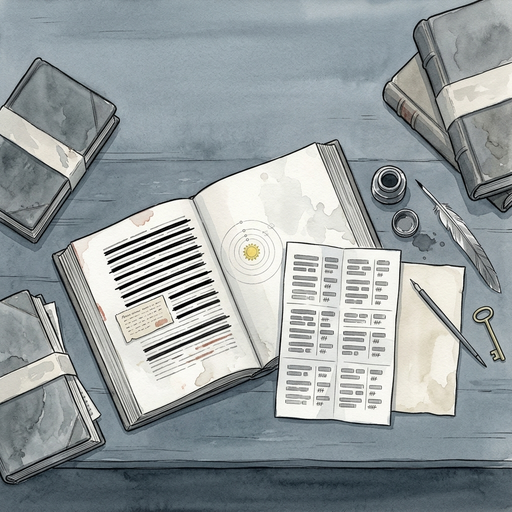
Expurgation turned censorship into an editorial craft. Specialized expurgatory catalogs instructed librarians and scholars on how to alter their personal copies. Readers were required to brush black ink over offending lines, paste paper slips over condemned paragraphs, or physically slice out specific leaves before the volume could be lawfully retained.
The system also contained formal mechanisms for authorized access. Recognizing that university professors and controversialist theologians needed to read prohibited texts to refute them, the Holy See and authorized bishops issued formal reading licenses. These permits granted scholars legal permission to study restricted titles under strict conditions. A licensed reader was typically required to keep prohibited books in a locked cabinet, away from family members and students, to prevent spiritual contamination. The ban was designed not as an absolute cultural erasure, but as a controlled barrier intended to manage exposure.
The practical operation of the Index becomes clearest when you examine four landmark cases, each representing a distinct route into ecclesiastical prohibition.
The first case is Nicolaus Copernicus. In fifteen forty-three, Copernicus published On the Revolutions of the Heavenly Spheres, proposing that the planets orbit the Sun. For more than seven decades, the volume circulated freely across Catholic Europe as a useful mathematical model. Only in sixteen sixteen, amid intensifying theological disputes over biblical passages that described the Sun standing still, did the Congregation of the Index intervene. The Congregation did not ban the book outright. Instead, it suspended the work donec corrigatur, until corrected. In sixteen twenty, Rome issued a decree specifying ten minor alterations. Passages presenting heliocentrism as physical reality had to be rephrased as mathematical hypotheses. Once an owner struck those ten phrases by hand, the book could be read lawfully.
The second case, Galileo Galilei, demonstrates how personal inquisitorial trials collided with book regulation. In sixteen thirty-two, Galileo published his Dialogue Concerning the Two Chief World Systems, presenting physical arguments for the Copernican model in conversational Italian. In sixteen thirty-three, the Roman Inquisition convicted Galileo of suspected heresy, forced his abjuration, and placed him under permanent house arrest. His Dialogue was prohibited entirely and placed on the Index, where it remained alongside Copernicus until the papacy quietly removed both in eighteen thirty-five.
The third case, Desiderius Erasmus, illustrates suspicion directed at humanistic scholarship. Erasmus remained a Catholic throughout his life, but his satirical critiques of church corruption and his critical edition of the Greek New Testament alarmed conservative theologians. Under the fifteen fifty-nine Index of Paul the Fourth, censors condemned his entire body of work, including neutral grammatical texts. Later Tridentine revisions scaled back this blanket ban, permitting expurgated editions of his educational writings, but his religious treatises remained restricted for centuries.
The fourth case, Jean-Jacques Rousseau, shows the Index confronting secular political philosophy. In seventeen sixty-two, Rome placed Rousseau's Emile and The Social Contract on the Index, following condemnations by civil authorities in France. Rousseau's works were banned because they questioned original sin and argued that political sovereignty derives from the people rather than divine authority. Here, the Index functioned to erect a barrier against the emerging philosophy of the democratic state.
How effectively did this system govern daily life? Confessors questioned penitents about whether they possessed forbidden literature, and seminaries kept banned books locked behind wire grates. In nineteen seventeen, the universal Code of Canon Law codified these rules. Canon thirteen ninety-nine defined twelve categories of books prohibited by law, while canon twenty-three eighteen imposed excommunication for printing or knowingly reading works by heretical authors defending heresy.
Yet comprehensive enforcement proved impossible. As industrial printing expanded and print runs surged into the millions, centralized control broke down. Catholic scholars routinely secured dispensations or read restricted books in secret, while booksellers smuggled editions across borders with false title pages. The Index continued to expand, publishing its final official printed edition in nineteen forty-eight, but the distance between Roman legal theory and modern literary reality had become unbridgeable.
The collapse of the legal Index began during the Second Vatican Council, which met between nineteen sixty-two and nineteen sixty-five. The Council produced landmark documents emphasizing religious liberty, individual conscience, and engagement with the modern world. In that atmosphere, a centuries-old catalog backed by automatic excommunication appeared increasingly out of place.
In December nineteen sixty-five, Pope Paul the Sixth issued an apostolic letter titled Integrae servandae, reorganizing the Holy Office into the Congregation for the Doctrine of the Faith. This reform eliminated the historic title of Grand Inquisitor, but it left the status of the Index temporarily unresolved.
The formal resolution came six months later. On June fourteenth, nineteen sixty-six, the Congregation for the Doctrine of the Faith published an official notification. It announced that the Index of Forbidden Books no longer carried the force of ecclesiastical law or its associated penalties. A subsequent decree on November fifteenth, nineteen sixty-six, confirmed the repeal of canons thirteen ninety-nine and twenty-three eighteen. The four-hundred-year legal machinery was formally dissolved.
The notification drew a precise distinction between legal liability and moral responsibility. While the catalog and its canonical penalties ceased to exist, the Vatican affirmed that the Index retained its moral significance. Catholics were reminded that an internal obligation remained—the personal duty under natural law to avoid literature that presented an immediate danger to faith or morals. The pre-publication imprimatur system also continued, allowing bishops to certify authorized liturgical, catechetical, and theological texts. What ended was the centralized legal blacklist and automatic penal sanctions.
Looking back across four centuries, historians evaluate the Index through two competing perspectives. To its institutional designers, the Index was a pastoral shield intended to safeguard the spiritual life of believers from doctrinal and moral corruption. To its critics, it was an instrument of intellectual suppression that hindered scientific inquiry and delayed Catholic engagement with the Enlightenment.
Both dynamics operated simultaneously. The Index unquestionably discouraged intellectual experimentation within Catholic universities and religious orders, where scholars feared investigation and censure. Yet it also stimulated complex strategies of evasion, negotiation, and scholarly adaptation. Its abolition in nineteen sixty-six reflected two converging realities: an internal theological evolution toward individual conscience, and the practical impossibility of policing a global print and broadcast culture.
As you reflect on the four-century history of the Index, consider this underlying question. When an institution can no longer physically control the flow of ideas, how does it redefine the boundary between external law and internal conscience? If you value deep investigations into the institutional forces that shaped the modern mind, stay with us as we continue unpacking the history of ideas.