The Honest Trial: What Twenty-Four Weeks of Lifting Weights Actually Did to Aging Brains
The AGUEDA randomized controlled trial (PMID 41562376) tested 24 weeks of resistance training in 90 cognitively healthy older adults — the honest result: no overall executive-function gain, but a significant 0.43 effect-size win in attentional control.
By MyAudioBooks.ai ·
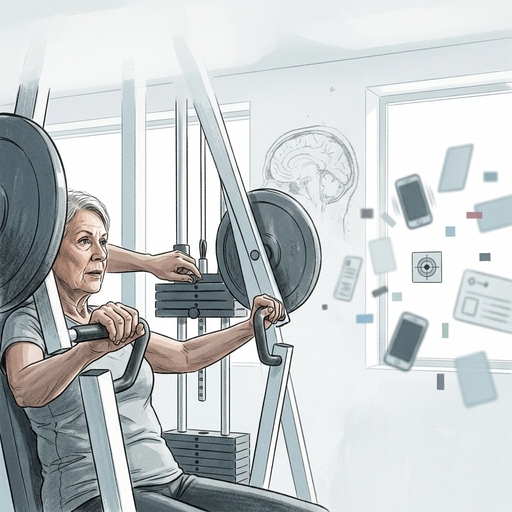
On a research campus in southern Spain, ninety cognitively healthy older adults spent six months lifting weights three times a week under supervision, while neuroscientists tracked what happened inside their skulls. The study, known as the A G U E D A trial and published this year in the journal of the Alzheimer's Association, was designed to answer a question the fitness industry has been selling answers to for a decade: does resistance training improve brain function in people over sixty-five? The results, published in full and cataloged in public medical databases, contain the most honest verdict the exercise-and-brain literature has produced in years.
The verdict is not what the supplement companies and workout-app influencers predicted. After twenty-four weeks, the lifters showed no statistically significant improvement in overall executive function compared to the control group. But buried inside the data was a real, measurable, and specific win: the resistance-training group improved dramatically on attentional and inhibitory control — the exact cognitive machinery that lets you hold a thought in your head while ignoring the phone buzzing on the counter.
At My Audio Books dot A I, you can create your own audiobooks from prompts, turn your documents into audio, all with one subscription, and store your items in your own personal library.
During our research into the primary trial publication, the neuroimaging methodology, and the broader exercise-cognition literature, we found a story about why the "exercise grows your brain" narrative is both true and wildly oversold; what the one cognitive domain that actually improved tells us about how muscles talk to the brain; and why the oldest and least-educated participants benefited the most.
Section One. The Muscle-Brain Hype Machine.
To understand why A G U E D A matters, you first have to understand how thoroughly the exercise-and-brain claim has been commercialized. Over the past fifteen years, a wave of bestselling books and eight-figure apps built an empire on a single seductive idea: that moving your body literally grows new brain cells, floods your cortex with miracle molecules, and protects you from dementia. The centerpiece of that narrative is a molecule called brain-derived neurotrophic factor, or B D N F, which aerobic exercise reliably elevates in animal studies and which marketers promptly rebranded as "Miracle-Gro for the brain."
The narrative is not false. It is incomplete in a very specific way. Nearly all of the famous positive trials studied aerobic exercise — brisk walking, cycling, swimming — and nearly all of them showed their strongest effects on memory and general processing speed. Resistance training, the kind done with barbells and machines, was always the neglected sibling: harder to standardize, harder to blind, and less glamorous to study. Yet resistance training is the intervention most doctors actually recommend to people over sixty, because it is the only proven countermeasure to sarcopenia, the age-related loss of muscle that predicts falls, fractures, and loss of independence. The question A G U E D A finally asked with rigor was simple: if the muscles get stronger, does the mind get sharper too?
Section Two. Inside the Trial Design.
The A G U E D A trial, whose full name translates roughly to Active Gains in Brain Using Exercise During Aging, randomized ninety cognitively normal adults aged sixty-five and older into two groups. The intervention group performed supervised resistance training three days per week for twenty-four weeks — machine-based exercises targeting all major muscle groups, progressively loaded as strength improved. The control group continued their usual routines. The primary outcome was a composite score of executive function: the suite of mental skills governing planning, task-switching, working memory, and impulse control, measured with standardized neuropsychological batteries before and after the intervention.
This design matters because of what it excluded. The participants were not dementia patients. They were healthy older adults, the exact population that buys brain-training subscriptions and follows longevity influencers. The intervention was not a vague recommendation to "move more." It was a dosed, supervised, progressive strength program — the closest thing to a prescription-drug trial that exercise science can produce. And the researchers measured not just behavior but brain structure and function with neuroimaging, hunting for physical evidence that lifting weights reshapes neural tissue.
Section Three. The Results, Unflinching.
Here is what twenty-four weeks of disciplined, progressive resistance training actually did. On the trial's primary endpoint — the executive function composite — the exercise group improved modestly, but so did the control group, and the difference between them was not statistically significant. In the language of the paper, the standardized mean difference was zero point one three, with a p-value of zero point three seven. In plain language: on the headline question, the trial was negative. Anyone who tells you resistance training is proven to boost overall executive function in healthy older adults is either selling something or has not read the results section.
But the trial's secondary analyses told a different, more interesting story. On tests of attentional and inhibitory control — the ability to focus on a target while suppressing distractions, measured by tasks like the classic Stroop test — the lifters improved with a standardized mean difference of zero point four three, highly significant at p less than zero point zero one. That is not a rounding error. That is a real, clinically meaningful effect concentrated in one specific cognitive system: the brain's filtering apparatus. And the subgroup analyses sharpened the picture further — the participants who gained the most were the oldest adults, those with less formal education, and those who arrived already noticing subjective memory slips. The people with the most cognitive headroom to lose gained the most from lifting.
This content is for informational purposes only and does not constitute medical advice; consult a healthcare professional before changing your exercise or health regimen.
Section Four. The Original Angle: The Null Result Is the Product.
Taking the A G U E D A data and setting it against the wellness economy reveals the real lesson. The fitness industry cannot sell a mixed result. "Lift weights and one specific aspect of attention improves while global executive function stays flat" does not fit on an app-store banner. So the industry launders findings like these into absolutes — "lifting prevents cognitive decline" — and the public, unable to read a forest plot, takes the marketing as science.
But the honest reading of this trial is more valuable than the hype. It tells older adults exactly what to expect and what not to expect. Resistance training will not transform you into a mental superhero, and no responsible scientist claims it will. What it appears to do — with a signal strong enough to survive statistical scrutiny — is sharpen the brain's ability to resist distraction, the single cognitive faculty most taxed by modern life and most predictive of everyday mistakes in aging: the wandering attention behind a missed step, a forgotten stove burner, a name lost mid-sentence. And it delivers that benefit precisely to the people who need it most, while simultaneously building the muscle and bone that keep an eighty-year-old out of a nursing home. No supplement on Earth offers that combination.
At My Audio Books dot A I, you can listen to this story and thousands of others that explore the hidden science and mechanics behind the headlines.
Section Five. What to Watch.
- For Clinicians and Patients:
- Prescribe resistance training for its proven musculoskeletal and metabolic benefits, and counsel patients honestly that cognitive benefits, while real, are specific rather than global.
- Prioritize supervised, progressive loading over unsupervised casual activity; the trial's effect came from dosed, escalating resistance, not from simply "staying active."
- For Exercise Scientists and Gerontologists:
- The attentional-inhibitory signal deserves a dedicated confirmatory trial with that domain as the primary endpoint, larger samples, and longer follow-up to test durability.
- The subgroup pattern — greater benefit in the oldest, least-educated, and subjectively-impaired participants — suggests ceiling effects may be masking benefits in healthier cohorts and should shape future enrollment criteria.
- For Longevity Investors and Health-Tech Builders:
- The gap between exercise hype and exercise evidence is a market inefficiency; products that honestly package strength training for older adults, with realistic claims, will outlast those built on overstated neuroscience.
- Watch for neuroimaging biomarker data from this cohort, which may reveal structural correlates that explain why inhibitory control specifically responds to mechanical loading.
Section Six. The Broader Pattern and Open Question.
The broad pattern is the maturation of longevity science from evangelism into measurement. The first generation of exercise-brain research needed believers; the second generation needs honest null results, because only trials willing to report what did not work can tell us what actually does. A G U E D A is valuable precisely because its authors published the negative primary endpoint alongside the positive secondary one.
There is a second pattern, and it is about whom interventions serve. Again and again in aging research, the benefits concentrate in the frailest and most overlooked participants — those with the least education, the most subjective decline, the fewest resources. The exercise that helps them is not a forty-dollar monthly app. It is a barbell, a rack, and a coach, repeated three times a week for six months.
Which leaves the open question: if twenty-four weeks of lifting weights measurably strengthens the aging brain's ability to filter distraction — but not its overall executive horsepower — what combination of resistance, aerobic work, and cognitive challenge would move the needle on both, and who will fund the long trial needed to find out? The data is published. The effect is real but narrow. The barbell is waiting.
At My Audio Books dot A I, you can create fiction, non-fiction, and turn your documents into audio, all stored in one place with a single subscription — plus get instant access to thousands of audiobooks and deep-dive investigations. Learn more today at My Audio Books dot A I.