The History and Myths Behind Handshakes, Toasts, and Everyday Courtesies
From knocking on wood and blessing sneezes to clinking glasses, shaking hands, saluting, and arranging seats of honor, everyday courtesies carry histories far richer—and less certain—than popular origin myths suggest. Separating documented traditions from tales of spirits, poison, and hidden weapons reveals customs shaped by fear, pleasure, faith, and social rank. Whatever their beginnings, these gestures endure as small acts of recognition, respect, and welcome in an unpredictable world.
By MyAudioBooks.ai ·
Listen free: The History and Myths Behind Handshakes, Toasts, and Everyday Courtesies
Notice what happens around a crowded table before anyone takes a second sip of water. Someone makes a confident prediction about the future and immediately reaches down to tap the bare grain of the table. A guest on the other side stifles a sudden yawn behind cupped fingers. A sneeze breaks across the conversation, and before the sound has even faded, two or three voices offer an automatic blessing. Then, glasses are lifted, their rims brought together with a light, clear ring that cuts cleanly through the chatter.
These small gestures are so familiar that we barely register performing them. We inherit them the way we inherit our accents or our natural cadence of speech, picking them up in early childhood and repeating them throughout our lives without ever stopping to ask where they began. For generations, observers and popular historians have been drawn to a seductive explanation: that every courtesy is the fossil of a fear. Under this tidy view, polite manners are simply ancient survival tactics that have lost their sharp edges. They appear as quaint relics of a dangerous past, a world where malignant spirits waited at every threshold, poison lurked in every shared chalice, and an extended hand was the only reliable guarantee that an acquaintance was not concealing a dagger.
It is a thrilling, dramatic way to look at human behavior, but the reality of social life is rarely so neat. When we trace these everyday habits back through the historical record, we discover that while some customs really did emerge as protective shields against invisible perils, many others grew out of affection, sensory pleasure, civic solidarity, or the deliberate staging of social status. The real story does not lie in discovering a single master key for all human manners. Instead, it unfolds as a journey of separating satisfying myths from durable evidence. As the Roman natural historian Pliny the Elder recognized almost two thousand years ago, a social practice can be profoundly ancient even when its true beginning has vanished completely from human memory.
Consider that first instinctive reach for wood. If you mention that your flight will arrive on schedule, or that you have managed to avoid catching the flu all winter, your hand might immediately seek out a wooden tabletop or chair leg. In folklore studies, an action like this is termed apotropaic, a word borrowed from an ancient Greek verb meaning to turn away. An apotropaic gesture acts as a miniature, symbolic shield, intended to deflect misfortune or ward off bad luck before fate can punish our confidence.
Popular folklore has long offered two sweeping explanations for this habit. The first claims that tapping wood awakens benevolent spirits who were once believed to inhabit sacred trees, petitioning them for protection or thanking them for their favor. The second suggests that the practice descends from medieval Christian reverence for the timber of the Cross. Yet when modern folklorists such as Steve Roud and Jacqueline Simpson examine the documentary evidence, these romantic pedigrees quickly dissolve. Had knocking on wood been an unbroken tradition stretching from pre-Christian tree worship or medieval piety down to the modern kitchen table, we might expect to find traces of it in ancient poetry, monastic chronicles, or medieval devotional texts. Instead, the written record is largely silent across many centuries.
The earliest written mentions of touching wood discovered by researchers appear remarkably late, in the opening years of the nineteenth century, between eighteen hundred and five and eighteen hundred and ten. Rather than descending from ancient woodland shrines, the best-supported route identified by Steve Roud points straight to the school playground. In an old children's chasing game known as Tiggy Touchwood, reaching and grasping a piece of wood granted a player temporary sanctuary, creating a safe zone where the pursuer was forbidden to tag them. One plausible possibility is that children who grew up equating wood with safety carried that protective association into adulthood, adapting it as a psychological hedge against tempting fate. While that connection remains a compelling inference rather than an airtight legal trail, it offers a grounded, human portrait of how habits migrate across generations. Today, when our fingers tap a wooden table, we need not believe in forest nymphs or sacred relics. The gesture survives as a modest ritual of hope, an intuitive acknowledgment that our plans remain vulnerable to chance.
If touching wood guards an external boundary against bad fortune, other customs protect the internal thresholds of the body. Consider the instinctive motion that occurs when a yawn overtakes us. Almost before we realize what our muscles are doing, our fingers rise to shield our mouth. Modern etiquette guides often explain this purely in terms of social decorum and personal hygiene, presenting it as a courtesy meant to spare our neighbors an intimate view of our throat or the sound of an involuntary gasp.
Yet across diverse historical cultures, the human mouth was regularly imagined as an open doorway between the physical self and the invisible world. It was a vulnerable threshold where vital forces could cross in both directions: a fleeting moment when the soul or life breath might escape, or when a harmful spirit might find a path inside. During the Renaissance, the Italian-born scholar Polydore Vergil gathered traditions regarding the origins of human customs in his work On the Inventors of Things, first published in fourteen ninety-nine. In that encyclopedic survey, Vergil documented a circulating belief that fatal pestilence could slip into the body during the act of yawning. He observed that people in his era traced the sign of the cross over their mouths to fortify themselves against sudden illness. Vergil was recording an active belief of his own day rather than proving the ultimate genesis of the gesture, but his account reveals how an involuntary intake of air could become entangled with the visceral dread of contagion.
A distinct yet comparable caution appears within Islamic hadith, the collections of sacred traditions recording the sayings and practices associated with the Prophet Muhammad. Within this religious framework, believers are advised to suppress a yawn when possible or to place a hand over the mouth. The yawn is associated with Shaytan, or Satan. This tradition does not indicate a single, universal beginning for mouth-covering, nor does it imply that every society shared the same theological concerns. Instead, it demonstrates how separate cultures, confronted with the strange, uncontrollable reflex of the body, crafted their own spiritual explanations to govern an exposed portal. In contemporary daily life, covering a yawn carries no weight of medieval demons or wandering souls. It persists simply as a mark of attentiveness and shared civic grace.
That same acute sensitivity to the human breath leads directly to the sneeze, which provides the strongest continuous sequence of primary historical records in the study of everyday manners. When someone sneezes, the urge to offer an immediate blessing is nearly irresistible. In the year seventy-seven of the Common Era, Pliny the Elder addressed this exact observance in the twenty-eighth book of his Natural History. Pliny was an extraordinarily diligent cataloger of natural wonders and human habits, yet here he admitted his own profound bafflement. He posed a simple question: why do we salute a person who sneezes? He went on to note that even the Emperor Tiberius, notorious for his unsociable temper, insisted on receiving this customary salutation even while traveling in his imperial carriage.
Pliny's honest perplexity is extraordinarily revealing. If a Roman scholar writing in the first century could survey his world and admit that no one truly knew how the custom began, we can be certain that acknowledging a sneeze was already antique by the height of the Roman Empire. Furthermore, in the ancient Mediterranean, a sneeze was not regarded solely as a warning of sickness or spiritual vulnerability; it could also be interpreted as an auspicious divine sign. In his Anabasis, the Athenian commander Xenophon described the arduous retreat of ten thousand Greek mercenaries through hostile territory after the campaign of four hundred and one before the Common Era. While Xenophon was addressing his troops about the prospect of divine deliverance, a soldier in the ranks suddenly sneezed. The entire army bowed in worship. Xenophon declared the sudden sneeze to be a favorable omen sent by Zeus the Savior, prompting the soldiers to make solemn vows and sing a hymn of collective thanksgiving.
In routine Roman life, the standard spoken response to a sneeze was likely the Latin word salve, meaning be well or may you enjoy good health. In the second century, the novelist Apuleius captured this reflex in his tale The Golden Ass, depicting characters uttering repeated blessings as a companion sneezes several times in succession. These surviving scenes demonstrate that blessing a sneeze was already a deeply ingrained social obligation. Centuries later, a popular legend arose claiming that Pope Gregory the First personally introduced the phrase God bless you during a devastating sixth-century plague in Rome, ordering people to utter a swift prayer because a sneeze was thought to herald rapid death. While an outbreak of pestilence might well have lent fresh urgency to an existing habit, the legend cannot account for the origin of a practice documented centuries before Gregory was born. Nor is there any physiological truth to the persistent folklore that the human heart pauses during a sneeze. What endures across millennia is the recognition of an explosive, involuntary rupture in social space. We offer a greeting because someone has briefly lost command of their composure, and a spoken wish smoothly re-establishes the balance of the room.
From the sudden sound of a sneeze, our inquiry turns to the bright chime of glasses meeting above a table. Whenever companions gather for a drink, their vessels almost invariably touch before the liquid reaches their lips. If you ask why this happens, someone will almost certainly recount the famous poison theory. According to this popular tale, drinkers in treacherous medieval or ancient banquets clinked their flagons with such force that wine sloshed back and forth across the rims, supposedly ensuring that if a deceitful host had spiked a guest's cup, he would be compelled to drink some of the same liquid.
It is an entertaining, cinematic explanation, but it lacks credible support in the historical record. The proposed exchange of liquid would not reliably neutralize a poisoned goblet or ensure that an assassin received a fatal dose. Moreover, if a guest had genuine reason to fear assassination, the rational response was to refuse the drink altogether rather than rely on a violent collision that was just as likely to ruin their clothes and spill onto the floor.
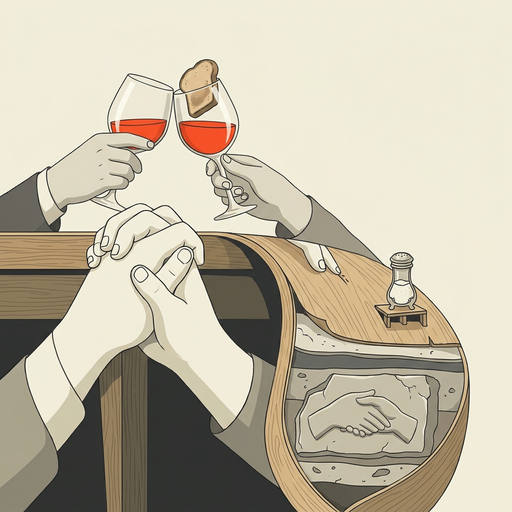
Why, then, do we bring our glasses together? The historian Paul Dickson, who has written extensively on the customs of drinking, emphasizes that the true origin remains unresolved. One prominent theory proposes an apotropaic function: the clear, ringing sound of church bells was traditionally believed to repel demonic forces, and clinking glasses echoed that sacred resonance around a festive board. Another attractive hypothesis is aesthetic. Drinking inherently engages four senses: sight, smell, taste, and touch. Producing a clear chime introduces the fifth sense of hearing, uniting all five human perceptions in a single celebratory act. Yet both explanations remain suggestive possibilities rather than verified historical events. What is entirely clear is the practical social power of the gesture today. In cultures where the clink is customary, the sound acts as a unifying signal. It interrupts individual side conversations, calls for eye contact, and binds a group of people together in a shared moment of mutual recognition before anyone takes a sip.
From glasses brought together in midair, it is only a short step to hands clasped together in greeting. The handshake often feels like the most natural, elemental gesture in the modern professional world, yet its ancient predecessors were far more expansive and solemn than our routine business clasp. In ancient Greece, the practice was known as dexiosis, a term signifying the joining or giving of the right hand.
Archaeological finds preserve this gesture across thousands of years of human culture. An Assyrian relief from the ninth century before the Common Era depicts the monarch Shalmaneser the Third firmly clasping the right hand of the Babylonian ruler Marduk-zakir-shumi the First, sealing a vital political and military alliance between their two kingdoms. In fifth-century Greece, dexiosis appears repeatedly on marble funerary monuments—commemorative stelae erected at burial sites, depicting the departed clasping hands with surviving spouses, parents, or brothers-in-arms. In one renowned Athenian relief, two armed soldiers clasp their right hands in an enduring, solemn farewell.
These ancient images do not show a rapid, casual pump between strangers, nor do they reflect a brisk greeting on a street corner. They commemorate pivotal bonds: royal treaties between sovereign crowns, civic decrees between allied city-states, and profound transitions between life and death. Popular legend frequently asserts that the handshake originated as a practical weapon inspection, a maneuver in which men gripped each other's wrists and shook vigorously to dislodge daggers hidden inside their sleeves. Yet no ancient text, relief, or historical account provides evidence for this dramatic dagger-rattling story. Extending an empty right hand is certainly an intuitive symbol of peace, given that the right hand was traditionally the primary weapon-bearing hand, but transforming that symbolic reassurance into an elaborate mechanical weapons-check is a modern embellishment.
The recent history of the handshake demonstrates how quickly even our most foundational physical rituals can be tested. During the global health crisis of earlier years, the joined hand was abruptly reframed from an emblem of warmth into a potential pathway for infection. From the vantage point of twenty twenty-six, the physical handshake has largely returned in workplace and interview settings. Yet it now comfortably shares the room with a wider variety of greetings, including the fist bump, the respectful nod, and the hand placed over the heart. Choosing an alternate gesture does not diminish social respect; it simply accommodates personal boundaries while keeping the fundamental spirit of goodwill intact.
The joining of hands is closely allied with the act of raising a glass to salute a companion, which leads directly to the curious material history of the English word toast. While civilizations have raised their cups to gods, monarchs, and personal friends since the dawn of antiquity, the specific reason that we call a spoken tribute a toast originated in the tavern culture of early modern England.
During the sixteenth and seventeenth centuries, English drinkers routinely placed actual pieces of toasted bread into their ale, punch, and wine. This was not a culinary eccentricity; the bread was frequently browned, spiced, and seasoned with nutmeg or sugar to soften the rough, acidic edges of young wine and to provide a warm, nourishing treat at the bottom of the bowl. In William Shakespeare's comedy The Merry Wives of Windsor, composed around sixteen hundred, the larger-than-life character Sir John Falstaff calls loudly for a quart of sack—a fortified Spanish wine—and explicitly demands that a piece of toast be put into it. Shakespeare was writing dramatic fiction, but his dialogue accurately mirrored the everyday habits of his contemporary London playgoers.
Across the seventeenth and early eighteenth centuries, the English language made an imaginative metaphorical leap. Drinkers began comparing the person being honored—often a charming woman whose health was enthusiastically drunk by her admirers—to the fragrant piece of toast resting in the bowl. Just as the spiced bread imparted flavor, warmth, and character to the liquid, the honored individual was said to lend zest and spirit to the entire assembly. From describing the person who gave flavor to the party, the word gradually expanded to designate the speech itself, the collective cheer, and the physical act of raising a drink. Later explanations have added more dramatic possibilities, such as bread being charred to absorb poisons or neutralize acidic decay. The account grounded in tavern conviviality and witty wordplay is simpler.
Just as lifting a glass honors an esteemed friend, raising a hand toward the forehead honors a superior officer or a national flag. The modern military salute possesses one of the most romantic origin stories in popular culture: the stirring image of a medieval knight in full plate armor, riding into the lists of a tournament and using his right hand to lift the visor of his helmet. His lord and his opponent could then gaze upon his face.
It is an undeniably picturesque scene, but arms and armor specialists at the Metropolitan Museum of Art have clearly noted that there is no historical evidence linking the movable visor of medieval armor to the modern military salute. The salute is better understood in the context of civilian social etiquette rather than chivalric combat. For centuries throughout Europe, a gentleman showed deference, peaceful intent, and humble respect by uncovering his head in the presence of social superiors, high officials, or religious authorities. As military uniforms became more elaborate in the eighteenth century, soldiers were outfitted with increasingly complex and unwieldy headgear, including wide-brimmed tricorns and tall helmets secured with tight chinstraps. Removing such cumbersome headgear quickly became awkward, messy, and impractical during parade maneuvers. Over time, the physical act of taking off the hat contracted into an abbreviated, symbolic gesture: touching the brim, grasping the edge of the headpiece, or placing a flat hand against the brow. Today, the military salute is a standardized, disciplined movement governed by explicit service manuals, communicating fidelity to the chain of command rather than preserving the ghost of an armored knight.
Finally, our tour of the gathering brings us to the architecture of the table itself. Where each person sits during a meal is seldom entirely accidental. In the great hall of a medieval European castle or manor, the physical arrangement of furniture made social hierarchy visible at a single glance. At one end of the expansive room, the lord, his family, and his most honored guests sat along the high table, which was erected upon a dais—a raised wooden platform that physically elevated them above the rest of the company. Retainers, lower-ranking servants, and itinerant travelers sat below them on long, plain benches arranged along the floor of the hall.
This visible division gave rise to the historical phrases of sitting above the salt or below the salt. In medieval and Renaissance households of high standing, refined salt was an expensive, prized commodity. It was placed on the high table inside an imposing, beautifully crafted vessel known as a great salt cellar. Those of elevated rank sat above the salt, near the host and the ornate container, while those of modest station were seated further down the long tables. Popular folklore has often attached dramatic combat theories to this layout, suggesting that a feudal lord sat at the head of the room with his back against a stone wall to detect approaching assassins, or kept his strongest bodyguard on his right side to protect his vulnerable sword arm. But these fortress legends are not established by the surviving evidence. Seating was fundamentally an expression of lineage, diplomatic alliance, and ceremonial courtesy, not an ongoing defense against an immediate siege. Today, while Western convention often seats the guest of honor to the host's right hand at a long table, different cultures celebrate hospitality through different geometries, including the inclusive circle of a round table where every seat shares an identical prominence.
When we return our gaze to the lively room where our journey began, the scene feels subtly transformed. The familiar courtesies are still unfolding, passing easily between conversation and laughter, but the stories behind them have taken on a clearer, more honest shape. We do not need to invent ancient druids in sacred groves to understand why someone knocks on wood, nor do we need to imagine Renaissance poisoners splashing lethal wine across a banquet board to enjoy the bright ring of our glasses. We can appreciate the romantic story of the knight raising his visor while acknowledging that our salute may descend from the courteous tipping of a civilian hat. We can remember that Shakespeare's contemporaries dropped real, seasoned bread into their cups, and that when we offer a blessing after a sneeze, we are echoing a human impulse that puzzled Pliny the Elder in his carriage and moved an army of stranded Greek soldiers to prayer four centuries before him.
Pliny's ancient humility provides our most reliable guide. We do not require a flawless, unbroken chain of historical documentation to cherish the small courtesies we extend to one another. Some of our daily gestures may indeed preserve the faint, weathered imprint of forgotten anxieties—true fossils of ancient fears smoothed by centuries of repetition. Yet what sustains these rituals in our own lives is something far warmer than dread. What keeps them alive is our shared desire to pause, to acknowledge another person's presence, to signal peaceful intentions, and to carve out a gentle, hospitable space in an unpredictable world.