The Haskell Border Library: How New Rules Ended Shared Entry Between Vermont and Quebec
Built across the U.S.–Canada border as a gift to two neighboring towns, the Haskell Free Library and Opera House lets visitors stand in both countries at once. For more than a century, a special sidewalk arrangement helped Canadians reach its Vermont entrance, but tighter border controls, the pandemic, and a 2025 policy change ended that route and cross-border reunions inside. The building remains shared; the rules governing who can enter, and how, have changed.
By MyAudioBooks.ai ·
Listen free: The Haskell Border Library: How New Rules Ended Shared Entry Between Vermont and Quebec
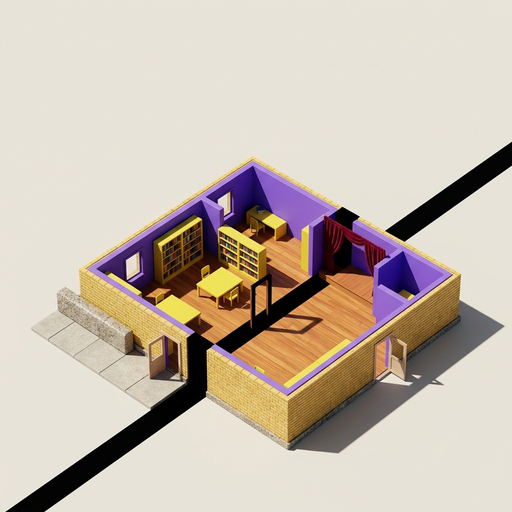
A thick black line runs directly across the floorboards of the Haskell Free Library and Opera House, tracing the international boundary between the United States and Canada. Inside this quiet sanctuary of polished wood and tall bookshelves, you can stand with your left foot in Derby Line, Vermont, and your right foot in Stanstead, Quebec. Yet occupying both countries simultaneously is an architectural novelty, not a grant of unrestricted international passage. For more than a century, an informal understanding allowed Canadian neighbors to walk across an exterior strip of sidewalk directly into the front entrance on the American side without stopping at an official border post. That era ends on October first, two thousand twenty-five, when the sidewalk connecting the Canadian street to the Vermont entrance is permanently closed to cross-border foot traffic. The boundary itself has not moved an inch. What changes is the network of rules, doors, and official permissions that dictate how human beings approach it. In the minutes ahead, we will examine how a single Victorian building was deliberately planted across an international line. We will trace how generations of neighbors maintained a fragile exception to global border security, and what happens to a shared civic space when its doors are divided by national sovereignty.
At My Audio Books dot A I, you can create your own audiobooks from prompts, turn your documents into audio, all with one subscription, and store your items in your own personal library.
The boundary between Derby Line, Vermont, and Stanstead, Quebec, was historically more of a neighborhood seam than a fortified wall. For generations, families lived on one side and worked on the other. Children crossed back and forth to play with schoolmates, and friends walked across the line for evening dinners or daily errands without formal scrutiny. The boundary was marked by granite survey stones, but daily life treated the frontier as a continuous landscape of shared agriculture, commerce, and kinship.
Toward the end of the nineteenth century, an influential local family decided to anchor that cross-border harmony in stone. Martha Stewart Haskell and her son, Horace Stewart Haskell, conceived an ambitious project to honor her late husband, Carlos Haskell, a prominent local merchant. Rather than placing a monument or a public building entirely in Vermont or entirely in Quebec, they chose to build directly upon the international boundary line. Between nineteen hundred one and nineteen hundred four, construction crews assembled a solid two-and-a-half-story structure of local Stanstead granite and yellow brick.
The architecture was designed to house two distinct public functions under one roof. The ground floor contained a free public library, providing educational resources, periodicals, and literature to rural citizens. Directly above it sat a five-hundred-seat opera house modeled in miniature after the Boston Opera House, complete with an ornate proscenium arch, painted stage curtains, and an intimate balcony. In the early twentieth century, libraries, lecture halls, and performance stages were the cultural beating heart of North American towns, bringing literature, traveling troupes, and public lectures to remote communities.
The location was a deliberate statement of international goodwill. The Haskell family intended the institution to serve residents of both countries equally, sustained by an endowment and governed by a binational board of trustees. Instead of forcing one town to visit the other, the building belonged to both jurisdictions at the same time. It stood as a permanent architectural testament to neighborly trust.
Yet that very idealism introduced a fundamental practical riddle. An international boundary is an exercise in legal sovereignty, while a civic institution relies on open, uninhibited public access. By embedding a shared library inside two distinct nations, the founders created an enduring challenge. How could citizens of two sovereign states enter, gather, and depart without violating the immigration and customs statutes of either country? That question would linger quietly in the background for decades, waiting for history to test its limits.
Inside the Haskell, the international boundary is marked by a black strip running diagonally across the floor of the reading room and straight through the theater rows upstairs. In the auditorium, the stage and the front rows of the orchestra sit in Stanstead, Quebec, while the rear seating and the primary exit doors occupy Derby Line, Vermont. Audiences watching a musical performance or a lecture sit primarily in the United States, while the performers sing and act in Canada. Downstairs, the circulation desk and the bulk of the book collection occupy the Canadian side, while the grand front entrance faces south into Vermont.
Because the building rests on both sides of the frontier, it possesses two official postal addresses: ninety-three Caswell Avenue in Derby Line, Vermont, and one Church Street in Stanstead, Quebec. Having two addresses, however, does not make the building an official port of entry. The Haskell has never been an immigration checkpoint, and its staff members are librarians, not customs inspectors.
To resolve the physical layout, local authorities long maintained a practical arrangement for pedestrian access. The primary public entrance was the grand front portal on Caswell Avenue in Vermont. Canadian visitors approached the site from Church Street in Stanstead, walked along a short connecting sidewalk that crossed the boundary on the library lawn, and entered through the front doors on the American side. Patrons were permitted to browse the stacks, check out books, attend community events, and return to Canada along the exact same path.
Under historical visitor guidance, Canadian patrons did not need to present passports or submit to customs declarations simply to walk that pathway into the library. The underlying rule was strict in its simplicity: visitors were required to exit through the same door and return to the country from which they arrived. The building operated as a neutral zone of community enrichment, separating shared civic use from unregulated international travel.
This delicate balance relied on three distinct elements working in harmony: the physical position of the surveyed boundary, the layout of doors and sidewalks, and the discretionary permissions granted by sovereign authorities. The boundary line never shifted, but the viability of the entire institution depended on official tolerance for that short exterior footpath. As long as national governments were willing to look the other way, the illusion of an effortless, borderless community could endure.
The permissive environment of the northern border began to shift fundamentally after September eleventh, two thousand one. In the wake of the attacks, federal authorities in the United States and Canada reevaluated every informal transit point along the four-thousand-mile frontier. What had previously been viewed as an untroubled, neighborly boundary between rural communities came to be viewed through the framework of homeland defense, physical security, and strict border enforcement.
In the border towns of Derby Line and Stanstead, that transition altered daily habits. Streets that once flowed seamlessly into one another were blocked with heavy granite planters, iron gates, and surveillance cameras. Armed border patrol vehicles monitored residential intersections. Crossing the street to visit a neighbor without first reporting to an official border station suddenly risked detention, formal questioning, and federal fines. The geographic reality remained identical, but the administrative climate turned rigid.
The Haskell Free Library found itself in an increasingly anomalous position. Official checkpoints became more rigorous, requiring machine-readable passports and routine vehicle inspections. Yet the library remained one of the few places where a person could cross the boundary line on foot without encountering a border agent.
Throughout these years, the northern border steadily hardened. In practice, this was not an overnight decree, but an accumulation of escalating measures. It brought tighter identification requirements, increased federal monitoring of the surrounding lawns, and continuous official observation of visitors using the sidewalk.
During this era, international families separated by immigration disputes or visa restrictions discovered the library. Because relatives from the United States and other countries could meet inside without passing through formal border control, the reading room became a quiet haven for cross-border family reunions. Grandparents met grandchildren for the first time among the book stacks, and separated families sat together on benches divided by the black line.
Yet that emergent use heightened official scrutiny. Federal authorities grew concerned that the institution was functioning outside the framework of sovereign immigration control. The precise sequence of rules imposed during these years involved overlapping negotiations among United States Customs and Border Protection, the Canada Border Services Agency, and the library board of trustees. While the building remained open, its atmosphere shifted from an untroubled civic refuge to a closely watched perimeter, setting the stage for even more decisive interventions.
The fragility of this cross-border existence became unmistakable in early twenty twenty, when the global coronavirus pandemic closed the international border to non-essential travel. The Haskell shut its doors entirely. Even when local public health conditions improved, the building could not easily reopen. Canadian patrons could not legally enter American territory, and American patrons could not step across the floor into Canada without violating international quarantine statutes.
The pandemic demonstrated that an international building cannot operate as an integrated neighborhood space when national borders snap shut. It laid bare the reality that the library did not float above national sovereignty; it was utterly dependent on the legal agreements that allowed people to reach it. When emergency public-health powers superseded local traditions, the building's physical unity was instantly fractured.
As normalcy returned, the administrative pressure surrounding the exterior sidewalk did not abate. In March two thousand twenty-five, United States Customs and Border Protection formally informed the Haskell administration of significant policy revisions regarding how visitors from Canada could access the facility. The historical concession that allowed Canadian patrons to walk across the lawn to the Vermont front entrance was scheduled for permanent termination.
The library instituted a phased transition. During the summer of two thousand twenty-five, registered library members and staff were granted temporary accommodations, while general Canadian visitors were directed to enter through designated alternate routes or report to official border stations. The institution announced that on October first, two thousand twenty-five, the connecting sidewalk between Stanstead and the American entrance would close permanently.
Under the revised framework, the Haskell adapts by operating two separate national entrances. Visitors arriving from Canada must use the Church Street entrance in Stanstead, while visitors arriving from the United States must enter through the Caswell Avenue entrance in Derby Line. Patrons are required to enter and depart exclusively on their own national side.
Alongside the architectural separation of entryways, the library clarified another fundamental operational change: cross-border reunions and informal meetings between visitors arriving from opposite sides are prohibited inside the building. The Haskell returned to its core institutional mission as a center for quiet study, cultural events, and literary borrowing, formally stepping back from its unplanned role as a diplomatic workaround. The black line on the floor remains where it has been since nineteen hundred four, but the human movement around it has been strictly partitioned.
The transformation of the Haskell Free Library exposes the true anatomy of a modern border. A border is not merely a geographic line determined by surveyors and marked on a map. It is an administrative system of passports, legal statutes, physical gates, inspection agencies, and institutional permissions. When those permissions change, the lived experience of space transforms, even if the underlying geography remains untouched.
Looking at the Haskell today, there are two distinct ways to interpret what has occurred. One perspective emphasizes the profound sense of cultural and community loss. For more than a century, Derby Line and Stanstead proved that an international border could accommodate trust, informal cooperation, and shared civic life. The closure of the historic sidewalk and the prohibition on family reunions represent the erosion of an extraordinary local tradition, replaced by the rigid security protocols of the contemporary nation-state.
Another perspective emphasizes institutional continuity and resilience. The Haskell building still stands squarely on the international frontier. Its binational board continues to meet. Its shelves still carry books in both English and French, catering to Vermont readers and Quebec readers under the same roof. Upstairs in the opera house, an audience member sitting in the United States can still look across the line to watch an artist perform on a Canadian stage. The physical structure and its civic mandate endure, even as the pathways to reach them are reorganized.
Several questions remain unanswered as this new era unfolds. The precise legal foundation that permitted the sidewalk exception to survive for so many decades was never formally codified in a comprehensive treaty; it existed largely through local administrative discretion. Whether future diplomatic agreements might one day restore a shared entryway remains an open question. For now, the library staff, local readers, and municipal leaders must navigate an arrangement where two communities share a building, but enter through different doors.
The black painted stripe on the floorboards of the Haskell does not generate national sovereignty; it merely records where one country ends and another begins. The real border has always lived in the laws, the checkpoints, and the enforcement decisions outside the door. Martha Haskell and her son understood that stone and brick could bridge two nations, but modern history shows that architecture alone cannot hold back the tide of national security.
As you reflect on how national borders shape everyday life, consider what other shared spaces in our world exist on delicate legal foundations. If this exploration gave you a new perspective on the invisible lines that divide us, share this story with someone who appreciates unexpected history. Join us again as we examine the hidden boundaries shaping our world.