The Great Seal Bug: A Passive Listening Device in Cold War Moscow
In 1945, Soviet schoolchildren gave the U.S. ambassador a carved Great Seal hiding a listening device that drew power from radio waves beamed in from outside, making it nearly invisible to routine security sweeps. Discovered in 1952 and revealed publicly during the 1960 U-2 crisis, “The Thing” showed how diplomatic goodwill and assumptions about what a bug should look like could leave a secure room exposed.
By MyAudioBooks.ai ·
Listen free: The Great Seal Bug: A Passive Listening Device in Cold War Moscow
On August fourth, nineteen forty-five, a delegation of Soviet schoolchildren presented the United States ambassador in Moscow with a hand-carved wooden replica of the Great Seal of the United States. It was offered as a grand gesture of wartime friendship, designed to hang with honor on an American diplomatic wall. Concealed inside the solid wood was an eavesdropping device containing no battery, no wires, and no conventional powered transmitter.
For years, that carved eagle hung inside the inner sanctum of American diplomatic operations in Moscow. It was capable of sending private conversations out into the street without a single moving electrical part. A listening device with no internal power source sounds contradictory on its face. An electronic search hunting for live wires or a humming radio carrier would detect nothing at all.
Understanding how this device operated uncovers one of the most ingenious surveillance systems of the twentieth century. It was built on an unexpected architectural premise: if you want a microphone to remain undetectable, you supply its power from outside the room.
At My Audio Books dot A I, you can create your own audiobooks from prompts, turn your documents into audio, all with one subscription, and store your items in your own personal library.
In August nineteen forty-five, the wartime alliance between the United States and the Soviet Union had reached a delicate turning point. Nazi Germany had surrendered three months earlier, while the war in the Pacific was entering its final, devastating days. Diplomatic relations between Washington and Moscow were rapidly shifting from joint military coordination against common enemies to deep mutual suspicion.
Against that tense backdrop, Ambassador Averell Harriman attended a celebratory gathering at the Artek youth camp on the Crimean coast. During the festivities, members of the Soviet Young Pioneers presented him with a two-foot-wide wooden carving of the American bald eagle. The emblem was beautifully detailed, clutching an olive branch and arrows beneath a patriotic banner.
The ceremony was a masterpiece of social engineering. Coming from young children belonging to a state youth organization, the presentation carried an undeniable veneer of innocent goodwill. Rejecting the gesture would have appeared petty, hostile, and diplomatically insulting. Subjecting the gift to an aggressive, destructive physical inspection would have triggered an immediate public controversy.
The object itself reinforced that psychological shield. The carving depicted the Great Seal of the United States. Because it was an explicit emblem of American national sovereignty, it belonged naturally inside an American diplomatic compound. The gift required no awkward explanation, invited no immediate suspicion, and claimed a legitimate decorative purpose before anyone ever considered what might sit behind the wood.
The custody trail of the carving is far less tidy than popular Cold War legends suggest. Retellings often describe the seal hanging on Harriman's private study wall from the day it arrived. However, historical security records indicate a more complicated journey. According to intelligence histories, the plaque was never displayed inside the central chancery building of the embassy. Instead, it was stored in several different diplomatic holdings over multiple years before it was finally mounted in the study of Spaso House, the ambassador's official Moscow residence.
A seven-year gap elapsed between the presentation ceremony in nineteen forty-five and the eventual discovery of the hidden listening mechanism. That interval does not establish seven uninterrupted years of continuous eavesdropping on a single wall. What it demonstrates is how effectively diplomatic courtesy and patriotic symbolism shielded the object. The carving enjoyed the full protection of American diplomatic custody, while the equipment required to activate it waited quietly beyond the perimeter.
By nineteen fifty-two, the Cold War was firmly entrenched across the globe. Spaso House was occupied by Ambassador George F. Kennan, one of the primary architects of American containment policy. The residence was an intelligence target of the highest priority for the Soviet government.
British and American military radio monitors in Moscow had periodically intercepted strange voice transmissions on unconventional frequencies. Spoken English drifted across radio channels near diplomatic compounds, but technical sweeps could find no obvious transmitters within the buildings. The intermittent nature of the signals suggested that someone was transmitting only at specific, coordinated moments.
In late summer nineteen fifty-two, the United States Department of State dispatched a technical-security officer named Joseph Bezjian to investigate the Moscow properties. Bezjian arrived with specialized radio monitoring equipment, determined to trace the mysterious signals to their exact source.
Historical technical records place the crucial breakthrough on September tenth, nineteen fifty-two. Bezjian arranged for an embassy secretary to sit in the study at Spaso House and read unclassified documents aloud. As the reading continued, Bezjian tuned his radio receiver from an adjacent room. Suddenly, the secretary's voice boomed through his earphones with crystalline clarity.
Bezjian knew a microphone was active in the room, but an electronic search for an active carrier signal would only work while the external transmission was running. Armed with an acoustic probe and a metal detector, he began a methodical physical sweep of the study. He examined the desk, probed the upholstery, inspected the fireplace, and tested the walls.
His attention soon settled on the heavy wooden carving of the Great Seal hanging above the ambassador's desk. Bezjian took the carving down, carried it to a secure work area, and carefully opened the back panel.
Inside a hollowed-out chamber, he uncovered a tiny, delicate metal assembly. It consisted of a small cylindrical capsule and a thin wire antenna. There were no batteries, no vacuum tubes, and no power cords. There was no connection to the electrical wiring of the house. To American technical officers, the apparatus looked unfinished or broken. They soon labeled the mysterious device simply The Thing.
Finding the physical artifact solved the immediate mystery of the room's vulnerability, but it opened an alarming technical puzzle. Bezjian had located the listening post, yet American engineers had no immediate understanding of how an unpowered scrap of metal could turn human speech into a radio broadcast.
The physical simplicity of the device concealed a sophisticated radio architecture. The mechanism contained three primary functional elements: a hollow resonant cavity, a thin metallic diaphragm, and a small monopole antenna.
The core of the unit was a cylindrical cavity machined from solid metal and plated in silver. In radio engineering, a resonant cavity acts as an electrical resonator. It responds powerfully to a very specific radio frequency determined by its precise internal dimensions.
Stretched across the open face of this cavity was an ultra-thin membrane. This diaphragm was flexible enough to move in response to the subtle pressure variations of sound waves in the room. When someone spoke near the carving, acoustic energy traveled through the wood, striking the membrane and causing it to vibrate at the frequencies of human speech.
Suspended just behind the diaphragm was a small metal post. The minute space between the vibrating diaphragm and the stationary post formed an electrical capacitor. As the diaphragm moved in and out with the speaker's voice, that capacitance fluctuated. That mechanical movement directly altered the electrical tuning and resonant frequency of the entire cavity.
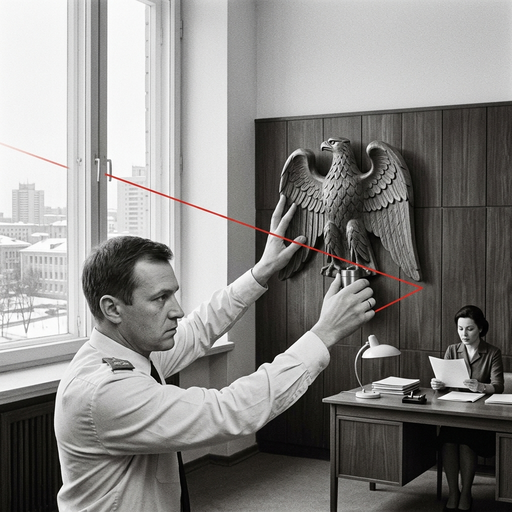
The missing element was energy. The device generated no power of its own. To extract audio from the room, Soviet intelligence operated a powerful radio transmitter situated outside the residence, often concealed in an adjacent building or inside a modified vehicle parked nearby.
The external transmitter beamed an unmodulated radio signal directly at the window of the ambassador's study. The small antenna on the seal collected that incoming radio energy and directed it straight into the resonant cavity.
Inside the cavity, the incoming radio wave interacted with the vibrating diaphragm. As the speaker's voice altered the cavity's electrical tuning, the device reflected a portion of the incoming radio energy back out through the window. That reflected wave was no longer a flat radio carrier. It was modulated by the acoustic vibrations of the room, carrying the human voice encoded onto its signal like an echo reshaped by speech.
Across the street, a specialized Soviet receiver intercepted the reflected signal. The receiver filtered out the primary radio wave, demodulated the acoustic variations, and converted the signal back into audible speech.
The entire listening journey was closed: external radio energy entered the room, internal voice vibrations reshaped that energy, and an altered return signal escaped back to the listener.
Describing the device as passive means only that it lacked an internal power supply. It did not lack energy. The energy was simply delivered through the air from an external vantage point. When the Soviet operators turned off their external transmitter, the device fell completely dormant.
This operational dormancy explains why routine countermeasure sweeps missed the bug for years. Conventional electronic sweeps of the nineteen fifties hunted for active transmitters that radiated continuous radio frequencies, or they searched for power cables and battery compartments. When unilluminated, the device produced zero radio emissions, generated zero heat, and consumed zero electrical current. It was acoustically sensitive at all times, but electrically invisible until illuminated from outside.
Western intelligence widely attributed the invention to Lev Sergeyevich Termen, the Russian physicist known internationally as Leon Theremin. Theremin had pioneered early electronic musical instruments before returning to the Soviet Union, where he was put to work developing covert surveillance technologies in specialized state laboratories. While the engineering concept is credited to Termen, the precise division of labor among design, manufacture, and operational deployment remains difficult to disentangle.
Technical accounts also differ regarding exact operating specifications. Reconstructions commonly cite an activation frequency around three hundred thirty megahertz, though alternative frequencies and harmonics appear across historical analyses.
Whether classified as a resonant-cavity microphone, a passive repeater, or a modulated retro-reflector, the operational principle was revolutionary. It decoupled the listening sensor from the power plant, leaving only an inert piece of hardware inside the target zone.
Discovering the device in September nineteen fifty-two did not trigger an immediate public outcry. Washington chose to keep the discovery secret for nearly eight years.
American technical personnel, working alongside British experts, spent those years examining the device, testing its operating limits, and attempting to replicate its mechanics. Security teams had to assess how much classified information had slipped through Spaso House, while counterintelligence officers searched for other passive devices across diplomatic facilities in Eastern Europe.
The public exposure of the carving came only when an acute diplomatic crisis forced Washington's hand. On May first, nineteen sixty, Soviet air defense forces shot down an American U-two reconnaissance aircraft piloted by Francis Gary Powers over Soviet territory.
Soviet Premier Nikita Khrushchev used the incident to dominate global headlines. He accused the United States of reckless, bad-faith espionage, leveraging the captured pilot and the wreckage of the aircraft to undermine American standing before the international community.
Washington responded three weeks later. On May twenty-sixth, nineteen sixty, Henry Cabot Lodge Junior, the United States ambassador to the United Nations, took the floor at the United Nations Security Council.
Answering Soviet accusations of American duplicity, Lodge produced a replica of the carved wooden Great Seal. Before delegates, photographers, and reporters, he opened the eagle's body to reveal the small metal cylinder and its antenna.
Lodge used the physical artifact to dismantle the narrative that espionage was a one-way street. The presentation demonstrated that while Washington was flying reconnaissance planes at high altitudes, Moscow was using children's gifts to penetrate the private residential quarters of American ambassadors.
The diplomatic irony was unmistakable. The Great Seal was selected because its patriotic symbolism made it a natural fixture in an American residence. That same symbolism turned its betrayal into a devastating diplomatic rebuttal on the world stage.
The case revealed a fundamental asymmetry in surveillance architecture. By keeping the heavy transmitters, power generators, and recording receivers outside the building, Soviet intelligence reduced the device inside the target room to an almost indestructible minimum.
The counterintelligence lesson was not that electronic sweeps were useless, but that searches are bounded by their underlying assumptions. Security teams trained to find powered circuits and humming radio carriers walked right past a mechanical cavity that required no electricity to function.
The Great Seal bug stands as one of the earliest working examples of passive backscatter communication, anticipating concepts that govern modern radio-frequency identification systems decades later.
Yet despite its technical notoriety, significant historical questions remain unanswered. Soviet operational logs describing the daily use of the bug have never been released. We do not know how frequently the external transmitter was powered up, which specific policy discussions were overheard, or how much usable intelligence the Kremlin actually gathered. The physical artifact sits in museum collections, but its complete operational record remains locked in archival silence.
The paradox of a bug that listens without a power source disappears once you view the entire system. The carved eagle was never a standalone microphone. It was one component of an architectural loop, energized from the outside and returning a signal sculpted by human speech.
The wooden shell provided physical concealment, but the true camouflage was the story that accompanied it. The carving was accepted because it arrived wrapped in diplomatic courtesy and national pride. It survived in a secure room because nobody questioned why an American emblem belonged on an American wall.
Every security system is shaped by what it expects to find. When investigators search only for familiar signatures, they leave the quietest vulnerabilities untouched. The enduring question raised by the Great Seal bug is not merely what new technologies are listening today, but which familiar, harmless objects in our surroundings we have stopped examining altogether.
If this investigation gave you a new perspective on historical intelligence and hidden technology, take a moment to reflect on the baseline assumptions you rely on. There are many more stories behind the quiet mechanisms of the past, and we look forward to exploring them together.