The Gene That Starves the Brain: APOE4 and the Vascular Turn in Alzheimer's
One in four people carries APOE4 — the biggest genetic risk factor for Alzheimer's. Mount Sinai just showed what it actually does: hijack the cells guarding the brain's blood vessels and turn them into scar-builders, starving the brain from the inside. And blocking the pathway reversed it.
By MyAudioBooks.ai ·
Listen free: The Gene That Starves the Brain: APOE4 and the Vascular Turn in Alzheimer's
One person in four carries a gene that is, statistically, a loaded weapon pointed at their own brain. The gene is called APOE4, and its numbers are the coldest in all of human genetics: inherit one copy from one parent and your lifetime risk of Alzheimer's disease roughly triples or quadruples; inherit two, and the risk climbs to something between ten and fifteen times the average — a risk so large that many genetic counselors treat the test for it as information you should think carefully about before requesting. For thirty years, the mystery attached to those numbers was not whether the gene was dangerous — the statistics on that are as solid as anything in medicine — but how. APOE4 is, on paper, a cholesterol-transport gene: its protein's day job is to carry cholesterol, a piece of cellular plumbing for moving fats around the body. Nobody could fully explain why a fat-plumbing variant became the single biggest genetic risk factor for the most feared disease of the aging brain. The leading theory, for three decades, has been about plaques — the amyloid deposits that define Alzheimer's under the microscope — and the gene's role in how they form and clear. The theory was never complete, and everyone in the field knew it. This month, a team at Mount Sinai published a pair of papers, in Cell and in Cell Stem Cell, that does not just complete the theory — it reroutes it, and the rerouting runs through the brain's blood supply. The gene, they showed, starves the brain from the inside: it hijacks the cells that guard the brain's blood vessels and turns them into the cells that build scar tissue. The vessels stiffen and narrow. The blood flow drops. And the brain, slowly, begins to suffocate in its own skull — years, perhaps decades, before the first plaque would ever be counted. The most important part of the finding is the last sentence in it: when they blocked the pathway, the damage reversed — in human stem-cell models, and in living aged mice.
At My Audio Books dot A I, you can create your own audiobooks from prompts, turn your documents into audio, all with one subscription, and store your items in your own personal library.
To see why this is such a large claim, you have to meet the cell at the center of it, because almost nobody outside neuroscience has ever heard of it, and it may be the most important cell in your head that you do not know you own. The pericyte is the guardian of the brain's smallest blood vessels — the capillaries where the actual business of feeding the brain happens. Every capillary in your brain is wrapped in these cells, and they do the three jobs that keep the tissue alive: they squeeze and relax to meter the blood flow to each neighborhood of the brain, they maintain the blood-brain barrier — the border wall that decides what may pass from the blood into the brain and what may not — and they repair the vessels when they are damaged. The brain is the most blood-hungry organ in the body, consuming a fifth of the heart's output, and the pericytes are the reason the delivery system works. Lose them, corrupt them, or turn them against their own vessels, and the richest tissue in the body begins to starve in the middle of plenty.
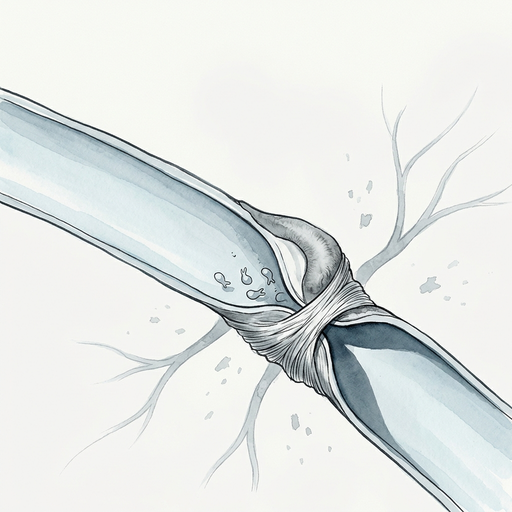
What the Mount Sinai team showed, across the two papers, is the hijacking in molecular detail — and it is a hijacking, not a malfunction. In cells and models carrying APOE4, the pericytes do not merely weaken; they change identity. The gene's presence flips a cellular switch, and the vessel-guarding pericytes begin converting into fibroblast-like cells — the body's scar-builders, the cells whose proper job is to lay down tough fibrous tissue to seal wounds. In the skin, that scarring instinct is a miracle of repair. In the wall of a brain capillary, it is a catastrophe: the fibrous tissue stiffens the vessel, narrows its channel, and destroys its ability to dilate on demand — a process the researchers call vascular fibrosis, the scarring of the brain's own plumbing. The downstream arithmetic is brutal and simple: stiffer vessels mean less blood, less blood means less oxygen and glucose, and a brain running on reduced supply begins the long slow decline that, years later, a clinician will call Alzheimer's disease. The gene does not poison the brain directly. It turns the brain's own maintenance crew into saboteurs, and lets the shortage do the killing.
The reversal is the finding's second half, and it is the reason the field is treating the papers as more than mechanism. Because the conversion runs through a specific molecular pathway — a signaling route the team mapped from the gene to the identity flip — the researchers could block it: intervene in the pathway and watch whether the pericytes stayed pericytes. In human stem-cell models carrying APOE4, blocking the pathway prevented the conversion and preserved the vessel-guarding cells. And in aged mice — old animals, with old vessels, carrying the human risk gene — blocking the pathway reversed the vascular fibrosis that had already formed: the scarring receded, the vessels recovered their function, and the blood flow improved. Reversal is the word that changes everything in disease research, because mechanisms are common and reversals are rare. Plenty of pathways explain damage; the ones that let you take the damage back are the ones that become drugs.
At My Audio Books dot A I, you can listen to this story and thousands of others that explore the hidden science and mechanics behind the headlines.
The finding lands in the middle of the longest and bitterest argument in modern medicine, and it lands on a specific side — which is why it will be fought over as well as celebrated. For three decades, Alzheimer's research has been dominated by the amyloid hypothesis: the theory that the disease is driven by the plaques, and that clearing them would cure it. The hypothesis consumed tens of billions of dollars, produced a handful of approved drugs, and delivered — by the consensus of everyone honest in the field — crushingly modest results: the anti-amyloid drugs slow the disease slightly, at serious cost and risk, and the argument about whether the plaques are the disease's cause, its tombstone, or its byproduct has never been settled. Into that exhausted argument, the Mount Sinai papers carry a different model entirely: the vascular hypothesis, the older and long-neglected idea that Alzheimer's begins in the blood supply — that the brain fails because its delivery system fails first. The gene at the center of the disease's genetics, the papers show, does its earliest damage not to plaques but to plumbing. The vascular camp has waited thirty years for evidence this strong, and the evidence arrives with the field's biggest genetic villain caught in the act of strangling the vessels.
The strongest case against the vascular reading — and it deserves to be stated at full strength, because the amyloid field's skepticism is not mere territorialism — begins with the oldest warning in translational medicine: mice are not men, and stem-cell models are not patients. The reversal that makes the papers sing was achieved in model systems, and the history of Alzheimer's research is a cemetery of treatments that reversed disease in mice and failed in humans — the disease has broken more promising pathways than any other in medicine. The vascular mechanism may be one cause among several rather than the master switch: APOE4 also affects amyloid clearance, inflammation, and lipid metabolism — the body's fat-processing chemistry, and the disease may be all of these at once, which would make blocking the vessel pathway necessary but nowhere near sufficient. The timing problem is real too: if the vascular damage begins decades before symptoms, a therapy that reverses it may still arrive too late for brains already years into decline, and the population most helped may be young carriers who do not yet know they are carriers — which reopens every ethical question about testing for the gene. And the reversal itself needs independent replication at scale before the field's money follows its excitement; two papers from one institution, however strong, are the beginning of the evidence, not the end.
Three developments would disprove or confirm the vascular turn in the years directly ahead, and each is observable. First, the replication: independent laboratories repeating the pericyte conversion and its reversal — in other models, other institutions, other species — will decide whether the mechanism is a pillar or a flag; Alzheimer's research has been burned too many times to move on one team's result, and the field's replication machinery is already pointed at these papers. Second, the human vessel evidence: if brain imaging of living APOE4 carriers shows the predicted vascular fibrosis and flow deficits years before symptoms — and if the deficits track with who declines — the mechanism will have been seen in the only model that finally matters, the living human brain. Third, the first clinical attempt: a drug program targeting the pathway will either find its way to patients and show that blocking the conversion slows real disease, or it will join the cemetery — and with the reversal data in hand, that program is now a matter of when, not whether.
It is worth saying what this article has not claimed. It has not claimed a cure exists; the reversal is in models, and the article says so at length. It has not claimed amyloid is dead; the plaque pathway is real, and the relationship between the two mechanisms is an open question, presented here as open. It has not claimed anyone should rush to be tested for APOE4; the genetics are population statistics, and the article has not offered anyone medical advice. And it has not claimed the mechanism is the whole disease; Alzheimer's is complex, multifactorial, and still argued about by serious people on every side. The claim here is narrower and, for the families the statistics hang over, more hopeful than anything the field has produced in years: the biggest genetic villain in the disease has been caught damaging the brain's blood supply, the damage has been reversed in models, and for the first time in the long war on this disease, the reversal is the finding.
Which returns to the one in four — the quarter of everyone listening who carries the gene, most of whom will never know it, and the larger fraction who love someone whose future the number shadows. For thirty years, the gene was a sentence without a mechanism: a statistic you could not act on, pointing at a disease you could not stop, through a pathway nobody could see. The Mount Sinai papers do not lift the sentence. They do something that, in the long fight against this particular killer, may matter more: they finally show the weapon's barrel — the vessel it fires through, the cells it hijacks, the moment the damage starts, and the switch that, in the models, turns the damage back. A mechanism is not a cure. But it is the first time the gene has been anything other than fate. And for a disease that has spent three decades refusing every other door we tried, a visible barrel and a working switch are, at last, somewhere to stand.
At My Audio Books dot A I, you can create fiction, non-fiction, and turn your documents into audio, all stored in one place with a single subscription — plus get instant access to thousands of audiobooks and deep-dive investigations. Learn more today at My Audio Books dot A I.