The Fallowmere Door
When her trainee Kwame vanishes through a door that should not exist, surveyor Ruth must navigate Fallowmere House’s shifting rooms and an imitation of her own commanding voice to rescue him before dawn. Saving him means trusting his judgment over her need for certainty—and confronting owner Lionel’s decades of evasion over his lost brother. Lionel’s fatal decision to remain behind allows them to escape, but Kwame leaves injured, their trust remains fractured, and the house’s familiar tapping follows them to the door.
By MyAudioBooks.ai ·
Listen free: The Fallowmere Door
Ruth held Fallowmere House’s front door with her heel while Kwame lifted his equipment case over the sill. The bottom caught, and she took the weight from him without asking. Behind her, a teaspoon tapped twice against china, paused, then tapped again.
Lionel waited beside the central staircase with a tray.
“Do leave that for a moment. You must both have some tea. Before you begin, I have three rather particular rules.”
Ruth lowered the case. At forty-eight, she could still carry the equipment up three flights, but her thumb had started objecting to its handle. Kwame could have managed it. He had only needed her to open the door wider.
They had come to Nether Haddow that Halloween morning to measure the house for sale. October thirty-first, two thousand and twenty-six: the date Lionel had insisted upon when every other appointment she offered had been refused.
Kwame eased the case clear of her boot. “I did have it.”
“Aye. Mind the step.”
He took it through into the hall. Beyond the staircase, the kitchen had a side door opening onto the forecourt. Lionel led them right into the dining room, beneath the upstairs bedrooms. The shutters stood closed, their catches furred with old paint. Ruth set her survey folder beside the tea tray.
Lionel poured with both hands around the pot.
“You must finish before dark. Keep to the rooms on the plan. And should you encounter a door which wasn’t present this morning, please leave it alone.”
Kwame stopped unfastening his coat. “Does that happen often?”
“The house can be confusing.”
Ruth asked, “Has somebody blocked up a staircase? Put partitions in?”
Lionel offered her milk.
She kept her cup where it was. “We need access to every ordinary room. Otherwise I can’t complete the survey.”
“Every room you see this morning. Of course.”
He had the careful manners of someone long accustomed to arranging a conversation without quite answering it. Ruth had met plenty of owners like that. Usually they were concealing damp.
She needed a day’s work, dimensions she could stand behind, and the balance payable on completion. That money would carry her small practice through the thin weeks after Christmas. It would also let her keep Kwame, if he wanted to stay. At twenty-three, he had begun doing work she could have charged more for, yet she still introduced him as her trainee.
The folded offer lay inside her folder. She had brought it to give him on the drive home.
Kwame hung his coat over his chair, then reached across to rescue the folder from a creeping drop of tea. Its cover opened. His thumb rested briefly against the folded sheet, where the permanent appointment heading showed.
“Is that about January?”
Ruth closed the cover. “We’ll talk after. Spare key.”
She put the van key on his saucer. He picked it up, waited, then slipped it into his right trouser pocket.
“Right. So I’m trusted with the van.”
“And the measurements, if you stop putting cups on the equipment.”
His cup had been beside the case. She knew that as soon as she said it.
Lionel stirred his tea. Two taps, a pause, another tap. Then the spoon scraped once around the rim.
Ruth wanted to get started.
He showed them the ground floor, then climbed the central stairs ahead of them, one hand sliding along the banister. At the top, the corridor turned right towards the end of the house. Three bedroom doors opened from it. A shallow linen cupboard occupied the opposite wall. Beyond the last bedroom, plain plaster closed the passage.
Ruth opened the cupboard herself. Towels, shelves, a pipe disappearing through the ceiling. No concealed stair.
Behind her, Kwame pressed his heel against the end wall.
“Solid.”
“Your foot won’t tell you that. Knock properly.”
He did. The sound carried down the passage and stopped.
Lionel remained beside the stairs.
“You see? Quite straightforward. I shall leave you to it.”
By midday, Ruth had found enough ordinary faults to keep her occupied: a yielding floor beside a chimney breast, damp beneath the kitchen window, a bedroom door rubbing where its frame had settled. Kwame called out measurements while she checked the structure. Their voices travelled easily between the open rooms.
The first discrepancy amounted to less than the thickness of an old wall.
Kwame stood in the upstairs corridor with the laser measure flat against the plaster. Its red dot held steady at the far end.
“I’m getting more here than downstairs.”
Ruth came out of the bedroom. “More what?”
“Length. From the stair wall to the end. I allowed for the dining-room wall, but there’s still—”
“Give me the reading first.”
He did. She took the instrument and checked that it measured from its back edge, not its front. Then she repeated the reading.
The same number appeared.
“That’s what I was trying to say. I checked the setting.”
“Then we check downstairs.”
They measured the dining room again. The cupboard behind it accounted for some of the difference. Ruth included its wall and returned upstairs.
The corridor had gained another handspan.
She planted the laser against the same patch of plaster. Kwame watched the red dot.
“You moved the end point.”
“No. Same wall. Same height.”
“Something’s catching it.”
He crouched until his face nearly touched the skirting.
“There’s nothing between them. Unless dust counts.”
She made him take the reading once more. His jaw tightened, but his hand stayed steady.
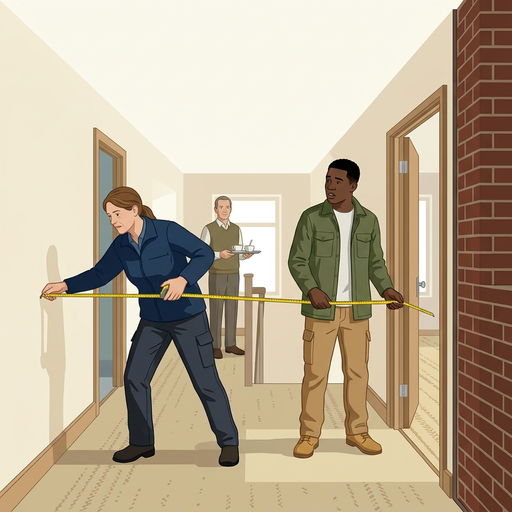
After lunch, they carried a tape measure down the front steps and across the forecourt. Ruth checked the outside dimensions while Kwame held the far end against the corner of the house. Brickwork gave them no concealed extension, no angled wing. The upstairs windows sat over the dining-room windows exactly where they should.
Ruth put the folder on the van’s passenger seat before going back inside. She wanted both hands free for the tape.
By late afternoon, she had measured the corridor with both instruments, checked the bedrooms adjoining it, and returned outside to verify the width of the house.
Kwame waited by the corner with the tape pulled straight.
“Can I say it now without doing the whole preamble wrong?”
She held the tape against the bricks.
“Go on.”
“The corridor’s longer than this wall. Not the room underneath. The whole outside wall.”
Her thumb pressed harder against the tape.
“Aye.”
“And it’s getting longer while we measure it.”
She wanted another explanation. A wrong starting point. A diagonal she had missed. Anything that would survive taking him back upstairs.
“You were right about the first reading.”
“I know.”
He gathered the tape without making a joke.
Inside, Lionel was carrying plates into the dining room. He stopped when Ruth asked whether any part of the house projected beyond the eastern wall.
“No, I don’t believe so.”
“Believe so?”
“No. It does not.”
“Then come up. There’s something you need to see.”
He set the plates down.
“You really ought to be leaving.”
“I can’t complete this.”
“Then leave it incomplete.”
That stopped her. The balance mattered, but she would have lost it for subsidence she could not assess. She could lose it for this.
From upstairs, Kwame called her name.
She climbed quickly, leaving Lionel beside the dining-room door.
Kwame had set his equipment case on the carpet outside the last bedroom. The passage beyond it extended farther than before. A narrow door now occupied the end wall.
The bedroom windows had darkened. Through their open doors, Ruth could see the last grey daylight above the forecourt. She had spent the remaining afternoon proving a thing she should already have acted upon.
Kwame stood beside the new door with his hand on its knob.
“There’s space behind it. You can hear somebody moving. Could be a service passage coming round the chimney.”
“Leave it.”
“I’m checking where it goes, not measuring again.”
He opened it. Beyond lay carpet, a skirting board, the ordinary lower corner of another doorway. A small clatter came from inside, crockery being set down.
“Kwame, we’re going.”
“There’s someone just—”
He stepped across. The door shut between them.
Ruth reached it before the latch had finished clicking. She turned the knob and pulled. The timber held.
“Kwame. Open it.”
She put her shoulder against the door, pushed, then pulled again. Nothing moved at the jamb. There had been no lock on the inside edge when he opened it.
Her phone was in her jacket. She called him.
His ringtone sounded behind the door, close enough to hear the small vibration beneath it. He answered on the third ring.
“Ruth? I turned straight round.”
“I’m outside. Turn the knob.”
“There isn’t a door here. There’s a dining room.”
She pressed the phone harder against her ear.
“Describe it.”
“Table. Chairs. Shutters closed. Like downstairs, only the table’s against the other wall. I came through a door, Ruth. I know I did.”
“Stay where you are.”
She checked the last bedroom. Its walls met cleanly behind the place where he stood. The next room offered a chimney breast, a window, nowhere for a passage. She opened the linen cupboard again and pushed past the towels.
Kwame’s voice came through the phone.
“I can hear you opening things.”
“Keep talking.”
She went down the stairs. His voice grew louder before she reached the dining-room door.
Lionel stood over a place setting at the far end of the table.
“I was about to call you for supper.”
Behind him, from solid plaster, Kwame said her name.
Ruth ended the call. His next words still came through the wall.
“I’m here. Wherever you are, I’m right here.”
Ruth crossed to the plaster and spread her hand against it. Cool paper, a raised seam, the hard wall underneath.
“I hear you. Stay there.”
She checked the kitchen, opened its side door onto the forecourt, then went through the front door and down the steps. No one had come out. The upper windows were shut. She called his name from below them and heard his answer faintly from the dining room instead.
She returned through the hall and found Lionel lifting a chair into place.
“Put that fucking chair down.”
He set it down but kept his fingers on its back.
“There may still be time.”
“For what?”
“To bring him back.”
She went close enough that he had to lift his chin to speak to her.
“You knew.”
Lionel shifted the unused knife at the place setting.
“I gave you the rules.”
“You gave us a fucking riddle with a cup of tea. Tell me where he is.”
From behind the wall came a dull knock.
Kwame’s voice strained through it. “I can hear all of this. Please stop doing the polite version.”
Lionel drew his hand from the knife.
“The door comes on Halloween. It goes at dawn.”
“And the people inside?”
His mouth worked before any sound came.
“They haven’t come out.”
“How many?”
“I cannot give you a satisfactory—”
“How many people, Lionel?”
“My brother. A man who came to repair a ceiling. A woman who wished to see the upstairs rooms. There have been others.”
Ruth stepped back from him. He had set a folded napkin beside the untouched plate, its corners carefully aligned.
“Your brother’s in there?”
“He went in during nineteen eighty-three.”
“The agent said you’d been here forty years.”
“Since nineteen eighty-six. I spent three years looking elsewhere. Hospitals. Other towns. Anywhere a man might go without telling his family.”
His voice lost its careful lift.
“Then I came home. He was still calling.”
Ruth put her palm back against the wall. Kwame was alive on its other side. Whatever part of the building held him, its only known door would disappear at dawn, not to return until next Halloween. The job no longer concerned the dimensions of a house. She had to reach him before the way in ceased to exist.
“Why today? Why insist we came today?”
Lionel held the back of the chair again.
“I find the anniversary difficult alone.”
She wanted to hit him. The plainness of the desire unsettled her.
Kwame knocked once more.
“Ruth. The paper’s moving.”
She turned. A small bulge travelled along the wallpaper, below shoulder height. It stopped beside her hand.
“Where are you touching?”
“Wall by the table. Left hand. There’s a soft bit.”
The wallpaper puckered. A fingertip pushed through it, followed by another. No hole opened around them. White plaster lay tight against the skin.
Ruth caught his fingers.
They were warm.
“I’ve got you.”
His hand came farther, trembling with effort. She held it between both of hers, feeling the small ridges of his nails. His thumb pressed hard into her palm.
“Can you see my arm?”
“Just your hand. Ease forward.”
His wrist emerged to the cuff of his jumper. She could see the inside of it, the faint blue lines beneath his skin. For the first time since the door shut, she had something she could do.
She moved her grip above his hand.
“Come towards me. Slowly.”
The wall gave a little. His cuff scraped over plaster. Lionel pulled the table aside, its legs juddering across the boards.
Then Kwame’s arm stopped.
“There’s something behind my elbow.”
“Can you turn?”
“No. Hang on. No, it’s coming towards me.”
His wrist began sliding back into the wall.
Ruth tightened her grip. Plaster rasped against his cuff and caught the raised bones of his hand. She planted her feet and held him.
“Lionel. Get behind me.”
He took her upper arm. She barely felt his fingers.
Kwame cried out. Skin stripped from his knuckles in wet red lines. His little finger caught against the unbroken surface and bent backwards.
“Fuck. Stop moving. Kwame, stop.”
“I’m not moving. It’s pulling me.”
Blood ran between her thumbs. She tried to hold his hand clear of the plaster, but the wall drew inward around his wrist without cracking. His little finger flattened farther back. His voice broke into a sharp, unformed sound.
She had him. Letting go would leave him there. She could get a better purchase, brace against the table, make the next pull count.
His hand twisted in hers.
A dry crack came from his wrist.
The angle changed. Beneath the skin, where his arm should have continued straight into his hand, a new bend appeared.
Kwame screamed.
Ruth loosened her grip in shock, then caught him again as the wall took another inch.
“Let go.”
“I can hold—”
“Let fucking go. You’re breaking it.”
She opened her hands.
His fingers slipped across her palms. The injured wrist passed into the plaster, then the bleeding knuckles, then the tips of his nails. She kept her hands raised after he had gone.
The wallpaper settled flat. Blood marked its pattern.
From the other side came a low, repeated groan.
Ruth leaned her forehead against the wall.
“Kwame. I’m here.”
His answer took several breaths.
“Don’t pull that arm again.”
“I won’t.”
“You said stop moving. I couldn’t. I told you.”
“Aye. You did.”
Lionel released her sleeve. His hand left a dent in the fabric.
Ruth turned on him.
“The upstairs door. Can we go through it?”
“It may open again.”
“And get back?”
He lowered his face.
“I cannot promise that.”
“What else haven’t you said?”
He began straightening the displaced chair. Ruth caught its back and held it still.
Lionel spoke without raising his head.
“The voices. You must take care with the voices. Sometimes they belong to people who are elsewhere.”
“You mean you hear them through the walls.”
“I mean they can be copied.”
Behind the plaster, Kwame gave a short, angry sob. Ruth knew his hand had been real. The warmth and blood remained on hers. That knowledge gave her no route to the rest of him.
She addressed the wall.
“I’m getting first aid from the van. Then I’m coming in.”
“Don’t take ages.”
“No.”
She made Lionel stay beside the wall while she went through the hall and down the front steps. Outside, she wiped her hands on a rag from the van’s door pocket, leaving red streaks in the seams of her fingers.
Her phone worked at once.
She asked for fire and ambulance, gave Fallowmere House and Nether Haddow, then repeated the address when asked. A man was trapped inside the building. He had an injured finger and what she believed was a fractured left wrist. She had seen it happen.
The operator wanted to know what had trapped him.
Ruth held the phone against her ear and opened the first-aid compartment.
“A wall. I know how that sounds. I can’t reach him through the ordinary rooms.”
She answered the remaining questions. No visible fire. No collapse she could see. Three adults at the property. The front door would remain unlocked.
Help was on its way. The operator told her to stay out of danger.
When the call ended, Ruth stood beside the open van with the first-aid kit in her hand. Waiting offered its own danger. Inside the house, Kwame called her name, faint but distinct.
She took her shoulder satchel from the van, secured the kit inside, and took the folder from the passenger seat. The folded offer was still inside it. She put the whole thing into the satchel, pulled on her work gloves, and checked the torch. Its beam struck the van’s footwell cleanly. She switched it off and tucked it into the satchel. The laser remained clipped to her belt.
At the edge of the forecourt, an adult neighbour was struggling with a shopping trolley. One small wheel had dropped below the broken kerb. The woman hauled twice, each pull driving it harder against the stone.
Ruth shut the passenger door and crossed to her.
“Leave it a tick. I’ll lift.”
The woman kept hold of the handle while Ruth raised the front of the trolley over the broken edge. Something heavy shifted inside its bag. A bottle knocked against another bottle, an ordinary kitchen sound.
The woman’s mouth moved in thanks. Ruth nodded before she could be drawn into anything further. From the house, barely reaching the road, came Kwame’s voice again.
She stepped back onto the forecourt and went straight up the front steps.
Lionel met her at the foot of the central staircase. He held a clean supper napkin, still folded.
“He has stopped answering from the dining room.”
Ruth passed him and climbed.
“Coming?”
He remained below.
She stopped on the stairs, turned, and waited until he faced her.
“You know more than I do. You’re coming with me.”
“I am an old man. I should be very little practical—”
“Then tell me something useful now. How do I find him?”
The napkin tightened in his fist.
“I don’t know.”
She believed that answer more than any he had given over tea.
“Then we’ll both have to find out.”
At the top, Kwame’s case stood where he had left it. Ruth moved it against the wall so no one would trip over it. The new door was ajar.
She could see a passage beyond, narrow enough to touch both sides. Farther in, a chair scraped across a floor. She took out the torch, switched it on, and called for Kwame.
No answer came.
Lionel reached the landing behind her. His breathing made a faint whistle.
“That is where he calls from. My brother.”
A man’s voice came softly from beyond the door, lower than Lionel’s, each word clear.
“Lionel. Come in. I’ve kept your place.”
Lionel pressed the napkin against his mouth.
Ruth wanted a measurement before she entered. A distance to the next corner, the thickness of the wall, something she could use to hold the place in her head. Her right hand went towards the laser.
She left it on her belt.
Instead, she checked her phone. Six ten PM. She zipped it into her jacket, tightened the satchel strap across her shoulder, and put her gloved right hand against the door. The torch stayed in her left.
“Stay close. No wandering off after anybody.”
Lionel lowered the napkin.
“Yes.”
Ruth pushed the door wider and crossed first.
The carpet yielded under one step. She began to turn, checking that Lionel had followed. His sleeve brushed her shoulder; he was immediately behind her.
Beyond his heels, the threshold withdrew.
She kept turning. The original upstairs corridor remained visible through the open doorway, with Kwame’s case against its wall, but a length of passage now lay between them and it. More carpet appeared without a fold, carrying the doorway farther away.
Ruth reached past Lionel towards the retreating door. Her right hand closed on empty air, and the latch clicked at the far end of the passage.
She went after it. Her torch jolted over the carpet; Lionel’s shoes scuffed behind her. The door remained visible until she reached the first turn. Beyond that stood a dining table.
She stopped hard enough for Lionel to catch her shoulder.
The table stood across their path, laid for three. A chair scraped beneath it, although nobody occupied the room. She stepped over a small dark stain beside the table.
Ruth turned back. The passage they had just crossed ended at a pair of closed shutters.
“No. We came straight through.”
Lionel released her shoulder. “It is seldom quite the same on returning.”
“You might have mentioned that before we fucking returned.”
She kept her torch in her left hand and took the laser from her belt. The distance to the shutters measured just under four metres. She walked it, counting her steps, and checked from the opposite end. The instrument agreed with itself.
Through the doorway beside the shutters lay a passage longer than the whole outside wall.
She measured that too. The red dot held steady. Nothing between her hand and the far wall moved.
Lionel waited at the table with the napkin pressed between his palms.
“Perhaps we should call for him.”
Ruth lowered the instrument. She had been inside for minutes and had already begun doing the same useless work.
“Kwame.”
Her voice travelled down the passage. From somewhere to her right came a faint answer.
She put the laser into its belt case, secured the torch in her satchel’s outer pocket and called his phone.
He answered with a groan that he tried to turn into a word. She hated hearing him make that effort for her.
“We’re inside. Where are you now?”
“Same room. I think. The table’s moved, or the door has. My hand’s getting bigger.”
“Can you feel your fingers?”
“Yes. Unfortunately. There’s a door beside the shutters, but it’s a cupboard now. It had a passage behind it when I tried before.”
She made him describe each wall. While he spoke, she looked through the doorway beside her shutters again.
A dining room waited beyond it. The table stood lengthways instead of across the floor. Beneath it lay a small dark stain shaped like the one she had just stepped over.
Kwame’s voice came clearly through the phone and faintly through the wall beside her head.
The shutter latch sat within reach of Ruth’s free hand.
“Knock with your right hand.”
“I’m not using the other one for anything.”
Three knocks sounded behind the shutters.
She unhooked one and pulled it open. Beyond the glass stood the back of a dining chair.
Ruth kept the phone against her ear.
“Stay away from the walls. I’m going to find another way round.”
“You said that downstairs.”
“Aye.”
She closed the shutter, ended the call and pocketed her phone. She took up the torch again; her gloved hand had begun to sweat around it.
They worked within rooms that kept returning them to the same table. Ruth propped doors with chairs and watched the openings alter behind the unmoved chair backs. She found a loose board beside a hearth and marked it for Lionel so he would stop putting his heel through it. Her skill kept them upright. It gave her no route to Kwame.
When her phone rang again, the caller was one of the responders. She secured the torch in her satchel pocket before answering.
She could hear him twice: directly through the phone and distantly from beyond the wall where the shutters had been. Boots crossed the original upstairs corridor. Someone called her name.
Ruth went towards the sound until the wallpaper touched her nose.
“I’m here. This side. Can you hear me without the phone?”
A muffled answer reached her through the plaster.
She pressed her free hand against it. The responder told her that they had found Kwame’s equipment case. Where she described a door, they had a solid wall. They were checking the adjoining bedrooms and the outside face of the building.
“There was an opening. We came through it. Don’t bring anybody through if it appears again. Wait until you can see us.”
Lionel stood beside her, his napkin hanging from one hand.
“They will have to be careful with the fabric of the house.”
Ruth turned on him.
“There’s a man with a broken wrist in the fabric of your house.”
His lips drew together. He put the napkin in his pocket.
The responders stayed audible for a while. Ruth heard tools, short instructions, then the report that the accessible wall contained brick, with no space behind it where she could be standing. After the call, her phone still placed her at Fallowmere House. Kwame reported the same on his.
The address was correct. Everything she needed lay within it.
She took up the torch again.
Hours passed in attempts that left them closer to Kwame’s voice and farther from any door they recognised. Ruth kept contact with him by phone when the rooms carried his voice away. Sometimes he had to set his phone down to adjust the support he was giving his wrist. She waited through his breathing rather than fill it with instructions.
Lionel tried every door except the low one behind the chimney breast.
Ruth noticed that refusal long before she challenged it.
After midnight, the carpet in front of that door became bare boards. Later, one table leg stood on carpet and another on timber, with no raised edge between them. Ruth’s feet hurt. She drank the last mouthful from the small water bottle in her satchel and offered it to Lionel before remembering it was empty.
He accepted it, raised it to his mouth, then lowered it without comment and left it on the table.
Kwame grew quieter. His answers shortened until Ruth asked him whether he was still there after every pause.
At last he snapped through the phone.
“I’m trying to do what you said.”
“I haven’t said anything.”
Beyond the partition, her own voice answered him.
“You’re all right. Turn sideways. Bring your left shoulder through first.”
Ruth stopped breathing through her mouth. The voice had her low register, her working patience. It sounded less frightened than she did.
She put the phone on speaker and held it close to the wall.
“Kwame, that isn’t me.”
His reply came through the phone.
“I know there’s two. I can hear two. Which side are you on?”
She slipped the phone into her open jacket pocket, speaker facing out.
A door at the end of their room eased open. Through the narrow gap Ruth saw a strip of dark jumper.
She hurried towards it. The gap narrowed before she reached it.
From the other side, her copied voice remained calm.
“Keep coming. I can see your arm. You’ve got plenty of room.”
Ruth shouted at the gap.
“There’s fuck-all room. Kwame, don’t—”
He cried out. Wood grated against wood, and the strip of jumper disappeared.
Ruth stopped short of the opening. More commands crowded into her mouth, each one another demand on a man she could barely see.
She lowered her voice.
“I can’t see your arm. I can see a bit of your jumper. Tell me what’s touching you.”
Kwame answered through clenched teeth.
“Door on my back. Frame in front. I’ve got my bad arm against my stomach, and if I turn the way you said, it goes between them.”
“Can you bring your right foot back?”
“No. The sill’s behind my heel. I’ll fall. Stop telling me to move until I’ve finished.”
She pressed her gloved palm flat against her own thigh.
“All right. Finish.”
He took several breaths.
“There’s a shelf opening to my right. Like you’d pass plates through. I can see your torch on the wall behind it. If I go towards that, I can keep my arm in front. But I need to get out of this bit first. Forward, not back.”
Ruth raised the beam. A rectangular shadow moved across the far wall.
“That?”
“Yes. Do it again.”
She moved it once more.
The copied voice spoke from beyond the narrowing door.
“Listen to me. I know what I’m doing.”
Ruth stayed beside the gap.
“I don’t know what’s in front of you. You do. Can you get clear without turning?”
“I think so. Phone’s going in my pocket. Don’t grab anything if you see me.”
“I won’t.”
His shoe scraped. He made a small choking sound and swore once, fiercely. The dark strip of his jumper withdrew from the door.
Ruth stayed where she was.
Then a right hand appeared through the serving opening beside the chimney.
She approached slowly. His fingers spread towards her.
“Can I hold that hand?”
“Yes. Just that one.”
She took it without pulling. Warm skin pressed against her glove. His grip tightened, released, then tightened again.
He was standing on the other side of a shelf, close enough for her to hear him swallow.
“There’s a bigger doorway into this room. Round the back of the chimney, I think. There’s a table through it. A cloth hanging down. Can you come that way?”
Ruth turned her torch towards the low door Lionel had avoided.
He stood directly in front of it.
“Move.”
“There may be another approach.”
Kwame called from the shelf.
“There isn’t one here.”
Ruth gave Kwame’s hand one gentle pressure and let it go.
“I’m coming round. Tell me if anything changes.”
Lionel stepped aside, but only far enough for her to reach the latch. Ruth opened the low door.
The smell reached her first: dry cloth, old dust, and something stale underneath that made her tongue draw back.
Her torch found a long table. Its cloth had yellowed where it hung beyond the edge. A plate, knife and fork occupied the nearest place. At the farther end sat a man.
His head leaned against the high chair back. Shrunken skin lay tight over his cheekbones. The open mouth showed teeth above a collapsed collar, and one sleeve had slipped down to expose the narrow bones of his wrist. His hand rested beside a plate.
Ruth held the beam steady.
Lionel came through behind her. His shoe caught against the threshold, and she caught his elbow before he fell.
He pulled free and went to the chair.
From beside the dead man came the same rounded, patient voice they had heard upstairs.
“Lionel. Come in. I’ve kept your place.”
The mouth remained open and still.
Lionel set his hand over the dead hand. His fingers trembled against its dry surface.
“He wore that ring.”
Ruth could see it, loose around a finger that had narrowed beneath it. She wanted Lionel to step away. She wanted to leave him beside the table and reach Kwame.
Instead, she checked the floor between them and the open doorway on the room’s left. Two boards had lifted at their ends. She pushed a chair over them so Kwame would have a clear route around.
Lionel continued speaking towards the chair.
“I thought he must be somewhere else. When I came back, and he was calling, I thought perhaps time was different for him.”
“You can see him now.”
“Yes.”
The invitation came again, with precisely the same pauses.
Lionel lifted his hand. A flake of pale skin remained against his thumb. He rubbed it away against his jacket, then stopped rubbing.
Ruth moved towards Kwame’s doorway.
“What happened when he went in?”
Lionel’s reply came so quietly that she halted to hear it.
“I was with him.”
She waited.
“In nineteen eighty-three. We went through together. He was ahead of me when the passage altered. He put his hand back for mine.”
“And?”
“I withdrew. I could still reach the door. I thought I could fetch someone.”
His breath whistled through his nose.
“I heard him ask me to wait. I went out.”
From the adjoining room, Kwame’s voice cut across them.
“Ruth. Please.”
She went to him.
He stood beyond a broad doorway, bent slightly over his left arm. His face had a grey cast beneath the sweat. The injured hand had swollen across the knuckles; dried blood darkened the torn skin, and his little finger lay at an angle she refused to test. He held his wrist against his body with his right hand.
She ended the call and zipped her phone away. Then she wedged the torch in the outer pocket of her satchel, angled towards the doorway, leaving both her hands free.
“There’s a small lip under your right foot. Nothing beyond it. Would support at your waist help?”
“Right side. And let me do the step.”
She stood where he asked. He crossed slowly, his good shoulder against hers, and stopped to breathe before bringing the other foot through.
She had him beside her. She kept her hand still at his waist rather than close it harder.
Lionel pulled a chair out. Kwame refused it.
“If I sit down, I’m not sure I’m getting up.”
Ruth took off her gloves and put them in the satchel’s side pocket. She opened the first-aid kit on the table, away from the dead man’s place.
“We can cover the broken skin and support the wrist. I’m leaving everything where it is.”
“Good. Keep leaving it there.”
Lionel produced the napkin. Ruth asked Kwame before sliding the folded cloth beneath his forearm. He lifted with his right hand and allowed her to take the cloth’s ends. She covered his abraded knuckles with a dressing, then used a triangular bandage to support the arm against his chest.
When the cloth brushed his little finger, he swore and jerked away.
She stopped.
“Too much?”
“Yes. Give me a minute. I know you’re trying to help. Just give me the fucking minute.”
She gave it to him.
Behind them, the voice at the dead man’s place invited Lionel to sit.
Lionel folded the empty dressing wrapper between his fingers until Ruth took it away and tucked it into the kit.
“There’s something else. Say it while we can still use it.”
He kept his gaze on the floor.
“I have wondered whether someone might remain here instead.”
Kwame raised his head.
“Instead of who?”
“Whoever had just come in.”
Ruth closed the kit and put it back in her satchel.
“How long have you wondered?”
“A considerable time.”
“And you kept asking people into the house.”
“I thought, if I explained the restrictions—”
Kwame’s voice rose, ragged with pain.
“You thought we might go in when you wouldn’t.”
Lionel opened his mouth. No qualification followed.
A sound of boots came from the passage beyond the older room. Ruth took the torch from her satchel and turned it towards the sound.
At the far end stood an open door. Beyond it she could see the original corridor, Kwame’s case and a strip of bright light across the carpet.
Her phone vibrated in her pocket. The responder had heard them again.
She answered and told him she could see the case. Through the distant opening, an arm lifted.
“Stay there. Keep everybody on that side.”
He told her the sky outside was beginning to lighten.
Ruth zipped the phone away. Her fingers had become clumsy at the fastening.
“We’re going.”
She settled the satchel high against her right hip so it would stay clear of Kwame’s arm. She secured the torch in its pocket again, angled towards the boards in front of their feet.
Kwame put his right arm over her shoulders.
They entered the passage together. Lionel followed.
The open door slid away.
Ruth stopped after two steps. The bright strip of corridor had become smaller. Behind them, Lionel stopped too. She called back to him.
“Back to the table.”
He hesitated, then withdrew.
The doorway came closer.
Kwame’s fingers tightened on her shoulder.
“Did you see that?”
“Aye.”
Lionel moved towards them again, one hand extended. The near wall pressed against Ruth’s satchel. At the far end, the strip of ordinary carpet narrowed.
She raised her free hand.
“Stop there.”
He stepped back. Space returned beside her hip.
Nobody spoke. From the table came the soft invitation to supper.
Ruth could hear Kwame breathing through his nose, fast and shallow. She wanted another test, another movement she could compare. He was shaking against her.
“We’ve seen enough to try. Can you manage another step?”
“One at a time.”
They moved. The original corridor held its position.
Ruth let him set the pace. His right shoe crossed a join in the boards; she warned him about it before his trailing foot reached it. Beyond the door, someone kept calling that they could see them.
They were halfway along when Lionel’s shoe scraped behind her.
Kwame screamed.
The wall had pressed the outer edge of his sling against him. His injured hand was caught between his body and the narrowing plaster. Ruth stopped with her foot raised and put it down exactly where it had been.
“Lionel. Back.”
He stood in the mouth of the passage, close enough for her to see the wetness beneath his nose.
“I was only coming as far as—”
“Back. His arm’s in it.”
He retreated. The pressure eased, but Kwame stayed rigid against her.
“Don’t pull me. Don’t pull.”
“I’m staying still.”
His wrist came clear as the wall withdrew. He made a thin, exhausted sound into her shoulder.
Ruth turned enough to face Lionel. She kept her left arm firm around Kwame’s waist.
“When you follow, it closes on him. You saw it.”
“Yes.”
“I can’t promise what happens if you stay. I can’t tell you there’s another way out.”
He glanced behind him, towards the table. Then he faced her again.
“You might come back.”
“I don’t know.”
For a few breaths she heard only Kwame and the distant movement of the responders.
Lionel took his hand from the doorframe.
“I shall remain here.”
Ruth held his gaze. She could offer him nothing that would make the choice clean.
He stepped farther back, placing himself between the projecting wall beside the doorway and the chimney breast. The passage ahead widened enough for Kwame to stop turning his body sideways.
Lionel tried to straighten his jacket.
“You should proceed while it is possible.”
Kwame shifted his right hand on Ruth’s shoulder.
“I can move.”
She went with him.
Behind them came a scrape, followed by Lionel’s startled intake of breath.
Ruth turned her head. The wall beside him had moved inward. His shoulder pressed against the chimney breast, his chest against the advancing plaster. He had turned sideways in the shrinking space.
His right hand braced on the frame. His left flattened against the wall.
“A moment. There appears to be—”
A crack interrupted him.
His mouth opened. Ruth saw the front of his jacket give inward beneath his breastbone. One knee bent, but the walls held him upright.
“Fuck. Lionel.”
She began to turn back. Kwame’s weight shifted with her, and his knees folded.
She caught him at the waist. His good hand dragged against her collar before finding a grip.
The exit had narrowed again.
Lionel made an effort to lift his head. Blood showed on his lower lip. When he tried to draw breath, a wet clicking came from inside his chest.
Ruth’s free hand reached towards him. Several paces lay between them.
“Can you get your shoulder clear?”
He shook his head once. Another rib broke, louder than the first, and his face changed with the pain.
His hand slipped down the frame, leaving a red smear where his knuckles had split.
“Get him out.”
Ruth kept Kwame upright. The torch beam shook with her, crossing Lionel’s crushed jacket and the blood gathering at his mouth.
Lionel forced out the last words on almost no air.
“Fucking go.”
The walls pressed closer. His chest moved once beneath the cloth, a small failed lift. Blood ran over his chin.
Ruth waited for another breath.
His jaw slackened. The hand on the frame opened, and his fingers hung against the wood. His chest remained still.
She knew what she had seen. Still she waited, until Kwame spoke against her ear.
“Ruth. I’m going down.”
She tightened her support around his waist and brought her free hand to his right forearm.
“I’ve got this side. Can you step?”
“Yes.”
They moved together. Plaster covered Lionel’s hanging hand. The torch lit the floor ahead.
The door was close now, but its upper edge had begun to sink. Beyond it, the responders crouched on the original carpet. Grey daylight reached them from a bedroom.
Ruth lowered herself with Kwame.
“Mind your head. Keep the arm against you.”
He bent at the knees, swore through his teeth and put his right foot across. She followed with her shoulder beneath his good arm.
The satchel caught.
For one sickening instant she thought the wall had taken it. Then she felt the strap drawn tight against the door handle.
She lifted the bag with her free hand. It came clear.
“Come on. Fucking come on.”
Kwame’s left shoe crossed the sill. Ruth pushed from her back foot and landed on the ordinary carpet beside him.
A responder supported his right shoulder. Ruth stayed at his waist until he was lowered safely against the corridor wall.
Behind them, the doorway thinned to a dark seam. The handle disappeared first. Then the seam closed, leaving plain plaster.
Ruth kept her hands on Kwame.
“Can you hear me?”
He opened his eyes.
“Yes.”
“Where’s the worst pain now?”
“Wrist. Still the wrist. And I’m going to be sick.”
She helped him lean forward without putting weight through his left arm. Someone brought a bag. He retched into it while a medical responder knelt beside them.
Ruth’s laser rested against her hip, inside its case.
She left it there.
They checked Kwame before moving him. Ruth answered what she could: the fracture had happened the previous evening; the wall had pulled while she held him; his arm had been compressed again near the exit. She gave the times she knew and said when she was uncertain.
When asked about Lionel, she had to stop.
“His chest was crushed. I saw him stop breathing. He was beyond that wall when it closed.”
The responder followed her indication towards the unbroken plaster.
Ruth shook her head before he could ask the next question.
“I can’t explain it. I can tell you what I saw.”
They brought Kwame along the original corridor, past his equipment case, then down the central staircase. He used the banister with his right hand. Ruth stayed on his left without touching the sling.
At the foot of the stairs, the dining-room door stood open. Three places remained laid at the table.
She guided Kwame towards the front door.
Outside, November first had begun. The forecourt gave them room to work, and the cold made Kwame shiver. A responder wrapped a blanket around his shoulders while Ruth opened the van.
She stayed beside him through the examination and splinting. The crew checked the colour and feeling in his fingers and supported the wrist without trying to straighten it. Kwame answered their questions, sometimes sharply. When the splint was secured, he shut his eyes and asked everyone to stop touching him.
They stopped.
He needed hospital care immediately. Once he had been assessed and given pain relief, he asked to go in the van rather than wait for a vehicle to become available for transport. The crew agreed to a direct journey and told Ruth what changes would require another emergency call.
While he rested on the passenger seat, she spoke to the selling agent by phone. She gave him the brief facts, including both deaths, and refused his attempt to postpone discussion of the survey.
“It’s incomplete. There’ll be no completed-survey endorsement, and nobody enters on my assurance. The completion balance isn’t payable.”
She ended the call and put the phone away.
That balance had been the money for the thin weeks after Christmas. She would have to face those weeks with what she had. Beside her, Kwame watched a responder put his equipment case into the back of the van.
“You’re not finishing it later?”
“No.”
He nodded, then adjusted the blanket with his right hand.
Ruth opened her satchel to put away the unused dressings. The folder pressed against the kit, its corner softened from the night. She left the folded offer inside it.
“The permanent job’s there if you want it. Same offer I brought yesterday. Nothing added for this.”
Kwame kept his head against the seat.
“I saw it. When we had tea.”
“Aye. I should have given it to you then.”
“I thought you were waiting to see if I got everything right.”
She sat on the van’s sill.
“I was waiting to see if you’d say yes.”
He turned towards her. Anger remained in his face, and she let it remain.
“I’m not answering now.”
“All right.”
“And I’m not saying thank you for getting me out yet. I can’t do that part.”
“You don’t have to.”
He closed his eyes again.
She wanted to apologise properly, with enough words to make him understand every part of it. His mouth had tightened with another wave of pain. She got up, switched off the torch and put the satchel behind the seats.
At the open passenger door, she asked before reaching for his seat belt.
“Can I bring this across you?”
“Keep it off the hand. Under the sling there. I’ll tell you.”
She followed his directions. When the buckle clicked, he let his head settle back.
His right hand went to his trouser pocket. He brought out the spare key and held it towards her.
She took it.
From behind the dining-room shutters came two taps against china, a pause, then another tap. A spoon scraped once around a rim.
Kwame opened his eyes.
Ruth closed the passenger door, went round to the driver’s seat and left the laser cased at her belt. She started the van and drove him out of the forecourt towards the hospital.