The Falkirk Wheel: How Balance Lifts Scotland’s Canal Boats With Little Power
Built to reconnect Scotland’s long-severed canals, the Falkirk Wheel replaces a vanished staircase of locks with a rotating lift that raises boats 24 metres. Its water-filled chambers stay level and counterbalance each other, allowing a turn to use just 1.5 kilowatt-hours of electricity for rotation. Though it still requires auxiliary power and maintenance, the Wheel conserves water and gives historic waterways a new life by working with gravity rather than fighting it.
By MyAudioBooks.ai ·
Listen free: The Falkirk Wheel: How Balance Lifts Scotland’s Canal Boats With Little Power
In central Scotland, a colossal steel structure lifts loaded canal boats the height of an eight-storey building, yet the public agency managing it reports that a single rotation consumes only about one and a half kilowatt-hours of electricity.
That is roughly the energy required to boil a few household kettles of water. The comparison sounds almost absurd when you stand beneath thirty-five metres of curving structural steel cradling hundreds of tonnes of water and vessels. A machine operating at this immense physical scale ought to demand an industrial electrical feeder, not the energy equivalent of a domestic kitchen appliance.
The secret rests neither in an exotic power source nor in any violation of physical law. The machine achieves this quiet efficiency because its electric drive is not actually hoisting the boats against gravity. Something far simpler, and much more elegant, is doing the heavy work.
At My Audio Books dot A I, you can create your own audiobooks from prompts, turn your documents into audio, all with one subscription, and store your items in your own personal library.
Central Scotland is carved by two historic waterways engineered during the Industrial Revolution. The Forth and Clyde Canal stretches east to west, providing a sea-to-sea passage that links the Firth of Forth on the North Sea with the Firth of Clyde on the Atlantic coast. Further south, the Union Canal runs eastward, providing a contoured inland navigation that carried bulk trade directly into the heart of Edinburgh.
For generations, these canals served as the freight backbone of central Scotland, moving coal, building stone, and heavy industrial goods between burgeoning urban centers. Where the two routes met near the town of Falkirk, engineers encountered a steep natural ridge. The Union Canal terminated along high ground, separated from the Forth and Clyde Canal below by a vertical difference of more than thirty metres.
To bridge that formidable divide, nineteenth-century builders constructed a monumental staircase of eleven locks. A vessel negotiating the flight had to enter chamber after chamber, waiting patiently as thousands of litres of water were drained and refilled step by step. The transit was slow and physically exhausting, often consuming the better part of an entire working day for a single boat crew.
As commercial freight shifted to railways and paved highways during the twentieth century, commercial traffic withered. The lock flight fell into disrepair, was formally decommissioned, and was ultimately dismantled in the nineteen thirties. Modern roads cut across the old canal bed, residential housing encroached on the right of way, and the through-route connecting the east and west coasts of Scotland was severed for decades.
By the late twentieth century, public authorities recognized that these abandoned waterways represented an extraordinary industrial and recreational asset. In nineteen ninety-nine, a nationwide restoration initiative known as the Millennium Link began work to reopen continuous navigation across the country.
Restoring the lost connection at Falkirk posed a major planning dilemma. Rebuilding eleven conventional masonry locks along the original hillside alignment was practically impossible. It would have required extensive land acquisitions, disrupted modern infrastructure, and consumed vast quantities of water for a transit that would still take hours to complete.
Planners wanted an ambitious alternative: a single, dramatic structure that could move vessels efficiently between the two waterways while establishing a visible modern symbol for Scotland's canal network. Different accounting records report varying totals for the broader Millennium Link project, ranging from approximately seventy-eight million pounds to over eighty-four million pounds, with Scottish Canals citing an eighty-three-point-five-million-pound investment.
On the twenty-fourth of May, two thousand two, Queen Elizabeth the Second officially opened the centerpiece of that restoration. The Falkirk Wheel reconnected the waterways, replacing the vanished staircase with a rotating boat lift. In a single graceful sweep, it carries vessels through twenty-four metres of elevation.
To understand how this machine achieves its remarkable efficiency, consider its physical anatomy. The Falkirk Wheel stands thirty-five metres tall from its foundation in the lower basin to the curved crest of its upper arm. That total structural height is distinct from the twenty-four metres of vertical lift it provides to passing canal boats.
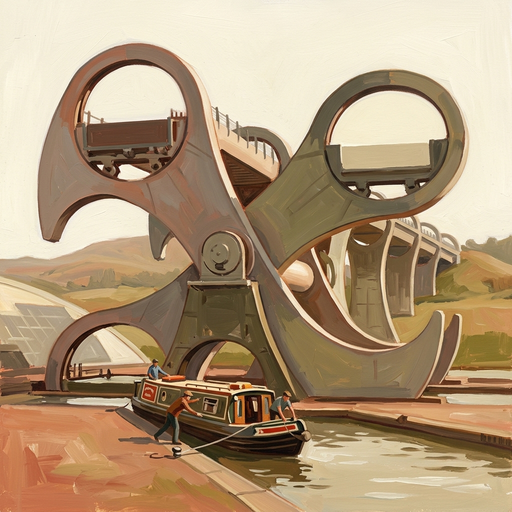
The silhouette of the structure is instantly recognizable. Two curving steel arms extend outward from a central pivot, their distinctive profile inspired by the shape of a double-headed Celtic ceremonial axe. At the center, these arms meet around an enormous horizontal axle measuring three and a half metres in diameter. The axle is mounted on heavy-duty precision bearings and anchored by reinforced concrete support pillars.
Engineering records report the physical mass of this steel assembly in varying figures depending on which components are measured. Scottish Canals cites the total mass of the rotating structure at approximately one thousand eight hundred tonnes, while descriptions from the American Society of Mechanical Engineers place it closer to one thousand five hundred tonnes. Whichever accounting boundary is applied, the installation represents a massive assembly of engineered structural steel.
The crucial design decision sits at the outer ends of the opposing arms. Instead of carrying dry cradles or hydraulic slings that lift boats out of the water, the arms support two massive water-filled steel chambers called caissons, or gondolas. Each caisson measures approximately twenty-one point three metres in length and six and a half metres across, holding around two hundred and fifty thousand litres of water.
This arrangement completely redefines the engineering challenge. The Falkirk Wheel does not lift bare boat hulls through open air; it lifts a fully functioning, self-contained section of the canal itself. A boat glides into the caisson exactly as it would enter an ordinary masonry lock. Because the vessel remains floating in its own pocket of water, its hull experiences no dry stress, pressure points, or structural distortion during the journey.
Each gondola can accommodate up to four standard canal craft at a time, providing a combined capacity of up to eight boats across the two chambers. Combining the structural steel of the gondola, the water, and the payload of vessels, each end of the wheel carries an active load of approximately five hundred tonnes.
Carrying that immense mass through the air introduces an obvious physical challenge. When a rotating arm turns through one hundred and eighty degrees, any open container of water would naturally invert, spilling hundreds of thousands of litres into the basin below.
A vessel begins its passage in the circular lower basin, moving forward at idle speed through the open entry gate of the bottom gondola. At this stage, the gondola is mechanically locked against the stationary approach channel. Watertight rubber seals press firmly against the interface between the fixed canal and the movable chamber, keeping the dry basin below completely protected while the water levels equalize.
Once the boat comes to a stop inside and secures its lines, the operational cycle begins. Heavy vertical gates rise on both the approach channel and the caisson end, sealing the chamber. The pneumatic seal between the gates deflates, a small pocket of water trapped between the doors drains away, and heavy mechanical locking pins retract. The gondola is now completely detached from the surrounding land.
The Wheel begins its half-turn. It sweeps smoothly through one hundred and eighty degrees, carrying the lower gondola upward in an arc while the upper gondola traces an identical downward path on the opposing side. The mechanical rotation itself takes approximately four minutes, while the complete vessel transit from approach to exit occupies roughly fifteen minutes.
Throughout that sweeping arc, the caissons never tip. Each chamber sits on circular tracks mounted inside the ends of the main structural arms and is maintained in position by an epicyclic gear train. A large central gear remains stationary on the main axle, meshing with intermediate idler gears that connect directly to an outer ring gear attached to each gondola.
As the main structural arms rotate through space, this internal gearing forces each caisson to rotate around its own mounting axis in the opposite direction at the exact same rotational rate. The gondola stays completely level relative to the horizon at every point in the turn.
Because the caisson remains level, gravity keeps the surface of the internal water horizontal, and the boats stay quietly afloat throughout the flight. A passenger aboard feels no perceptible lateral tilt, experiencing only a gentle vertical rise as the surrounding Scottish landscape drops away.
At the top of the arc, the caisson glides into precise alignment with the upper aqueduct. Hydraulic locking pins secure the chamber, the watertight seal re-inflates, water fills the narrow space between the gates, and the vertical doors lower into their recesses. The boat floats out into the aqueduct, having scaled twenty-four metres of elevation.
This operational sequence highlights a deeper physical puzzle. What guarantees that a gondola packed with heavy boats will not outweigh an empty chamber on the opposite side?
The answer lies in the classical physics of buoyancy, formalized in Archimedes' principle. When an object floats in water, it displaces a volume of fluid whose weight is equal to the weight of the floating object.
When a canal boat enters the open caisson from the approach basin, it pushes water aside. Because the chamber is still open to the wider canal network, that displaced water simply flows out into the basin. When the gates close at a strictly controlled water line, the total mass within the gondola remains constant.
If a boat weighing twenty tonnes enters the chamber, it displaces twenty tonnes of water before the gates close. If no boat enters, the gondola simply holds twenty additional tonnes of water.
As long as automated control weirs maintain the water at identical depths in both chambers, the total mass of the two gondolas remains balanced. Whether a gondola carries multiple pleasure craft, a heavy service barge, or nothing but open water, each end of the machine maintains a mass of approximately five hundred tonnes.
Because both water-filled gondolas maintain virtually identical mass, the Falkirk Wheel does not function like a conventional construction crane hoisting an unassisted load against gravity. It operates as a finely balanced, rotating counterweight system.
In mechanical terms, the turning effect produced by a force acting at a distance from a pivot is called torque. Torque equals the magnitude of the gravitational force multiplied by its perpendicular distance from the central axle. Because the two arms of the Wheel are equal in length and the caissons are mounted at identical radii from the center, their masses act at equal distances from the pivot.
When one caisson rests at the bottom and the other sits at the top, their gravitational forces exert equal and opposite torques on the central axle. The downward gravitational pull on the rising chamber is directly counteracted by the downward gravitational pull on the descending chamber.
As the structure begins to turn, the descending caisson releases gravitational potential energy. That released energy directly provides the work required to lift the ascending caisson into the sky. The two massive chambers effectively lift each other.
This reciprocal exchange explains why the primary drive system can be surprisingly compact. The rotating assembly is powered by ten hydraulic motors fed by an electric power pack with an installed motor capacity of approximately twenty-two point five kilowatts. That is a power rating comparable to the engine of a small city automobile, tasked with moving thousands of tonnes of structural steel and water.
The electric drive does not need to overcome the gross weight of the caissons. Its mechanical job is to overcome friction in the axle bearings and drive the internal synchronization gears. It must also push through wind resistance across the wide steel arms and manage the inertia of starting and stopping the turn.
This mechanical reality accounts for the widely quoted efficiency benchmark: Scottish Canals reports that a single rotation consumes approximately one and a half kilowatt-hours of electrical energy. Power measured in kilowatts represents the instantaneous rate of energy consumption, while kilowatt-hours measure total energy consumed over time. Applying modest mechanical power across a four-minute operational rotation produces an exceptionally small total electricity draw.
That celebrated metric, however, requires careful engineering context. The one-point-five-kilowatt-hour figure covers only the mechanical energy required to turn the central axle through one half-revolution. It does not encompass the electricity consumed by auxiliary systems. Hydraulic rams operate the canal gates, pumps drain the interface chambers, compressors inflate the seals, and sensors continuously monitor the structure.
Furthermore, the rotating wheel does not complete the entire elevation change between the two canals on its own. After clearing the upper gondola, a boat navigates along a concrete aqueduct over one hundred metres in length. It then passes through the Roughcastle Tunnel beneath the historic Roman Antonine Wall and enters a pair of modern locks. Those two locks provide an additional eleven metres of vertical lift to bring the vessel up to the operating level of the Union Canal.
The machine does not defy gravity. The steel structure of the arms and the bearings of the central axle still bear hundreds of tonnes of continuous structural load. The brilliance of the design lies in arranging those loads symmetrically, so that gravity powers its own ascent.
The Falkirk Wheel represents far more than an ingenious piece of heavy machinery; it embodies a profound reinvention of historic transport infrastructure. When Britain constructed its inland waterways in the eighteenth and nineteenth centuries, canals were commercial corridors dedicated to moving industrial raw materials.
In the modern era, that heavy freight role has largely disappeared. The restored canals function instead as a recreational network dedicated to leisure boating, heritage conservation, public access, and ecological corridors. A major capital investment in this corridor could not be justified solely by calculating commercial freight tonnage per hour.
By selecting a rotating boat lift rather than rebuilding the historic staircase of eleven locks, planners created a functional public monument. Widely described as the world's first rotating boat lift, the installation attracts hundreds of thousands of visitors each year, offering an unmediated encounter with classical physics from the deck of a floating vessel.
Evaluating the Wheel against conventional locks reveals a nuanced set of engineering trade-offs. A traditional staircase of eleven locks consumes hundreds of thousands of litres of fresh water during every transit, as each lock chamber empties into the one below it. In dry summer seasons, managing that water loss across a summit level presents severe operational challenges. The Falkirk Wheel transfers a sealed pocket of water back and forth, reducing net water loss from the upper canal to a bare minimum.
At the same time, conventional masonry locks operate with passive gravity flow and simple wooden or steel gates, requiring minimal electric power and no complex drive systems. The Falkirk Wheel is a dynamic mechanical installation. Its large axle bearings, pneumatic seals, hydraulic power packs, and synchronized internal gears require continuous monitoring, preventive lubrication, and specialized engineering maintenance over decades of service.
Assessing whether a rotating lift is superior to a flight of locks requires looking across an entire structural lifecycle. Engineers must evaluate capital design expense, ongoing mechanical maintenance, water conservation benefits, visitor footfall, and operational reliability over many decades.
Several operational details also remain matters of engineering interest. Public figures rarely document how energy consumption shifts under severe weather. Heavy crosswinds exert lateral pressure on the exposed steel arms, while freezing winter conditions alter hydraulic fluid viscosity and increase bearing resistance.
There is also the requirement for rigorous operational balance. While Archimedes' principle guarantees balance in ideal conditions, an undetected water-level variance of just a few centimetres between the two caissons can introduce several tonnes of unbalanced mass. Automated monitoring systems and weir controls must verify that both chambers match within precise tolerances before the drive motors are cleared to operate.
What the Falkirk Wheel demonstrates is the transformative power of counterbalanced design. When engineers structure a system so that opposing forces cancel one another out, the energy required to complete a massive physical task decreases dramatically.
The next time you step into an elevator, watch a counterweighted tower crane, or pass a historic canal lock, look for the subtle ways engineering balances opposing forces. If your travels ever take you across central Scotland, take the opportunity to glide into this movable pocket of water. Experience firsthand how balancing gravitational loads turns hundreds of tonnes of steel into effortless motion.