The ER Isn't the Bottleneck: Congress Is Finally Measuring the Hospital Around It
A document-first investigation of the AHRQ emergency-boarding report and H.R. 2936 through the MBA lens of constraints, queueing, capacity buffers, and incentive design.
By MyAudioBooks.ai ·
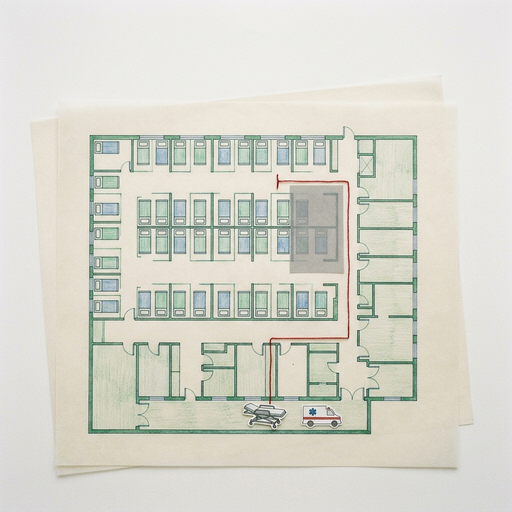
Listen free: The ER Isn't the Bottleneck: Congress Is Finally Measuring the Hospital Around It
Rosie Bartel spent four days beside her mother in a small rural hospital's emergency-department hallway. Her mother had Alzheimer's dementia. The hallway was next to the ambulance entrance; the hospital had intermittent physician coverage; and, according to Bartel's account in a federal technical report, her mother received no food. The confusion did not end when she returned to her nursing home. It worsened.
This was not merely a bad wait. It was iatrogenic—harm produced by the care system itself. And it exposes the error behind decades of emergency-room reform: the emergency department is often where hospital failure becomes visible, not where it begins. Our verdict is that the queue starts upstairs. Congress has finally drafted a bill that points in that direction, but it is still measuring the crisis more boldly than it is prepared to change it.
At My Audio Books dot A I, you can create your own audiobooks from prompts, turn your documents into audio, and store everything in your personal library.
Section One: The Federal Report Changes the Name of the Problem
The March 2025 technical report from the Agency for Healthcare Research and Quality grew out of an October 8, 2024 summit convened after forty-four members of Congress asked the Department of Health and Human Services for immediate and long-term solutions to emergency-department boarding. The report calls boarding a public-health crisis affecting patients, staff, cost, and public safety. It also contains a crucial sentence: boarding is "fundamentally an E D output problem."
That distinction matters. Crowding can begin when too many people arrive or when evaluation inside the department moves too slowly. Boarding begins later: a clinician has decided that a patient needs admission, but the patient remains physically in the emergency department because an inpatient bed is not available. The report therefore calls the term "E D boarding" a misnomer. The emergency department is the display panel for a hospital-wide flow failure.
Aisha Terry of the American College of Emergency Physicians proposed a less misleading name at the summit: "hospital system overload." The phrase is more than rhetoric. Once the admission decision is made, the relevant constraints are staffed inpatient beds, intensive-care capacity, psychiatric placement, post-acute discharge options, prior authorization, transport, and the scheduling choices of the hospital around the emergency department.
The report's trend line is stark. Median boarding time in an Emergency Department Benchmarking Alliance dataset rose from 121 minutes in 2020 to 192 minutes in 2022. Under some conditions, one quarter of admitted patients remained in the department for more than seven hours after a physician decided they required hospitalization.
Section Two: A Bill That Finally Looks Beyond the Waiting Room
On April 17, 2025, Representative John Joyce of Pennsylvania and Representative Debbie Dingell of Michigan introduced House Resolution twenty-nine thirty-six, the Addressing Boarding and Crowding in the Emergency Department Act, or A B C E D Act. Its most revealing provision does not tell patients to use urgent care and does not fund a larger waiting room. It authorizes grants for state- or region-wide systems that would track hospital bed capacity and measure how that capacity affects boarding, treatment waits, and the time emergency-medical-services crews spend waiting to offload patients.
The bill also proposes public-facing dashboards, geriatric emergency-care pilots, psychiatric-crisis units, better coordination with post-acute facilities, and a Government Accountability Office study of capacity data systems. Its diagnosis is operational: if we want to understand emergency congestion, we must see the beds and transfer paths beyond the emergency department.
The measure has accumulated thirty-four cosponsors across party lines. Yet the Congress.gov tracker still classifies it only as introduced; it has remained referred to the House Energy and Commerce and Ways and Means Committees since its first day. That political stasis is part of the story. Washington has reached a bipartisan agreement that the capacity problem should be measured. It has not reached an agreement about who must surrender revenue, schedule preference, or institutional autonomy to solve it.
Section Three: The Eighty-Five Percent Warning
The strongest empirical warning comes from a national benchmarking study by Alexander Janke, Edward Melnick, and Arjun Venkatesh. Their sample grew from 1,289 hospitals in January 2020 to 1,769 in December 2021. They defined occupancy as the share of staffed inpatient beds occupied and boarding as the time from an admission order to departure from the emergency department for an inpatient bed.
When occupancy exceeded eighty-five percent, boarding exceeded the Joint Commission's four-hour standard in eighty-eight point nine percent of hospital-months. Median boarding time was six point five eight hours in those high-occupancy months, compared with two point four two hours in the other months. The authors were careful: their study was observational, service-specific occupancy could not be separated, and medians probably understated the burden on the longest-waiting patients. It establishes a strong association, not a universal law that every hospital fails at exactly the same percentage.
That caveat does not rescue the efficiency doctrine. It sharpens it. The relevant denominator is not licensed beds printed on a regulatory certificate; it is staffed beds capable of receiving a patient now. A room without a nurse is not available capacity. A psychiatric bed that will not accept a medically complex patient is not substitutable capacity. A clean room held for tomorrow's high-margin surgery is physically empty but operationally committed.
Queueing theory explains why modest occupancy changes produce disproportionate delays. J. F. C. Kingman's heavy-traffic work formalized the behavior of a single-server queue as utilization approaches its limit. In the familiar approximation, the waiting-time pressure contains the ratio of utilization to one minus utilization. At eighty percent utilization, that ratio is four. At eighty-five percent it is about five point seven. At ninety-five percent it is nineteen. This is an illustration, not a hospital forecast: real hospitals have multiple units, routing rules, priorities, and non-interchangeable beds. But the direction is ineluctable—impossible to avoid. As slack approaches zero, ordinary variability becomes a queue.
The policy mistake is therefore procyclical—it amplifies the stress already underway. A finance model responds to lower census by reducing shifts and closing staffed beds. The next demand surge then hits a smaller operating system. Boarding grows, staff burn out, more clinicians leave, and effective capacity contracts again. What looks like disciplined cost management on a spreadsheet can become a self-reinforcing capacity failure at the bedside.
Section Four: The Ambulance Becomes the Missing Bed
A hospital queue does not stop at the hospital door. The A H R Q report says more than one in five ambulance trips now leaves a crew out of service for at least an hour. Emergency-medical-services agencies reported 890,000 trips in 2023 in which hospital turnaround delayed the unit's return to active service. One Los Angeles-area crew waited twenty-five hours to transfer care to hospital staff.
Those numbers reveal a hidden balance-sheet transfer. When a hospital cannot receive a patient, the city supplies an unofficial mobile bed: an ambulance, a paramedic crew, fuel, monitoring equipment, and a vehicle no longer available for the next cardiac arrest or stroke. The hospital does not carry that lost emergency coverage as an operating expense. The public does.
This is why boarding is a regional-resilience problem rather than a customer-service problem. A hospital can optimize its own staffed-bed cost while degrading the emergency capacity of every municipality around it. House Resolution twenty-nine thirty-six recognizes that connection by placing hospital bed capacity, boarding time, and ambulance offload delay inside the same proposed data system.
Section Five: The Financial Incentive Nobody Can Wish Away
The best objection to our argument is not that hospital leaders are indifferent. It is that many hospitals live on thin operating margins, must service debt on expensive facilities, and depend on elective procedures to subsidize emergency and chronic care. Brendan Carr, chief executive of Mount Sinai Health System, told the A H R Q summit that canceling a quarter of elective surgeries could make boarding disappear while undermining the health system's finances. Gabe Kelen of Johns Hopkins described the same incentive more bluntly: chief executives must favor higher-paying procedural patients because those margins help support the rest of the mission.
Our read is that the objection wins on one point. Any reform that reserves beds without replacing revenue can destabilize safety-net institutions. Empty capacity has a cost, and telling a hospital simply to lower occupancy is not a financing model.
But the objection does not justify the current queue. The same A H R Q report identifies boarding's hidden costs: patients leave without being seen, ambulances divert, care goes unreimbursed, and delayed discharges consume beds without corresponding payment. One simulation study summarized in the report estimated that boarding-reduction strategies at a single urban teaching hospital could add between two point seven million and three point six million dollars in annual net revenue. Minnesota discharge delays accounted for nearly 195,000 days of unnecessary, unpaid care and almost half a billion dollars in annual cost.
The operational target should not be empty beds for their own sake. It should be usable slack at the places where variability enters the system, paired with payment rules that compensate hospitals for maintaining it. That may mean capacity payments, shared regional reserves, discharge incentives, or reimbursement tied to offload and boarding performance. The exact mechanism can be debated. Pretending the cost does not exist cannot.
At My Audio Books dot A I, you can listen to this investigation and thousands of others that explain the hidden systems behind the headlines.
Section Six: Three Popular Fixes That Miss the Constraint
The A H R Q summit report is unusually direct about failed remedies. Programs intended to keep low-acuity patients out of emergency departments do not materially reduce boarding because those patients are rarely admitted. Urgent-care clinics, telehealth, mobile units, longer primary-care hours, and alternative transport may improve access for the people who use them, but they do not release the inpatient bed awaited by a boarded patient.
Nor does building a larger emergency department solve an output failure. More treatment bays can improve privacy and initial assessment, yet they can also create a more comfortable warehouse for admitted patients if inpatient flow remains blocked. Ambulance diversion moves the queue to a neighboring institution. Hiring another triage physician accelerates the front of a process whose rear remains sealed.
This is a classic constraint-management lesson. Improving a non-bottleneck may increase local productivity while leaving total throughput unchanged. Worse, it can feed work into the blocked stage faster and enlarge work in process. The emergency department appears busy because it absorbs the inventory of a system that cannot complete its final transfer.
Section Seven: What Actually Moves the Queue
The report identifies several interventions with evidence behind them. The first is surgical smoothing: distributing elective cases more evenly across the week instead of concentrating procedures on the days preferred by surgeons. Elective peaks create predictable surges in intensive-care and inpatient-bed demand. Smoothing reduces cancellations, reduces cost, increases revenue, and can improve occupancy while allowing emergency admissions to move.
The obstacle is not technical. It is political. Surgical schedules are tied to clinic days, operating-room privileges, and professional status. Changing them requires executives to confront recalcitrant—stubbornly resistant—internal constituencies whose preferences have been allowed to define hospital capacity.
The second intervention is earlier and more reliable discharge. Morning discharge orders, weekend discharges, discharge lounges, faster prior authorization, and real-time bed management release capacity before the daytime admission wave arrives. The report describes delays of three or four days for authorization to transfer a patient to rehabilitation; when approval arrives on a Friday, the receiving facility may wait until Monday. One administrative sequence can consume a full week of a scarce inpatient bed.
The third intervention is regional visibility. A bed dashboard cannot create nurses or psychiatric facilities, but it can reveal where capability exists, shorten serial phone calls, and show policymakers whether ambulances are queuing because a region lacks physical beds, staffed beds, or transfer coordination. House Resolution twenty-nine thirty-six is strongest here. Near-real-time public data would turn a hidden queue into an accountable one.
Section Eight: Measurement Is Necessary. It Is Not Reform.
We think House Resolution twenty-nine thirty-six deserves credit for naming the correct system. It links bed capacity to boarding, treatment waits, and ambulance offload; it includes skilled nursing, psychiatric care, intensive care, and post-acute coordination; and it asks for regional rather than hospital-by-hospital visibility.
But a dashboard is not a bed, a nurse, a discharge authorization, or a changed operating-room schedule. The bill funds measurement, studies, and demonstration models. It does not create a binding boarding standard, redesign the reimbursement preference for elective procedures, or require hospitals to preserve surge capacity. Its thirty-four cosponsors show broad concern; its introduced-only status shows the distance between concern and execution.
The honest policy sequence is straightforward. First, measure staffed capacity and queue time in real time. Second, publish the relationship among occupancy, boarding, and ambulance offload. Third, change incentives so hospitals do not lose money for preserving the slack that emergency care requires. Fourth, impose accountability when institutions repeatedly externalize their queues onto patients, neighboring hospitals, and municipal ambulance systems.
The E R is not innocent of every delay. Triage design, diagnostics, staffing, and internal process still matter. But the federal report makes the dominant mechanism difficult to deny: once a patient needs admission, the queue starts upstairs. The ninety-five percent catastrophe was always a useful warning about the mathematics of vanishing slack; the verified national evidence places the danger earlier, above eighty-five percent staffed occupancy.
At My Audio Books dot A I, you can create fiction, non-fiction, and audio from your own documents, all in one library. Learn more today at My Audio Books dot A I.
Rosie Bartel's mother did not spend four days beside an ambulance entrance because America lacked a larger waiting room. She remained there because the surrounding care system could not complete a transfer. Congress has finally written hospital bed capacity, boarding, and ambulance offload into the same sentence. That is the right diagnosis. Until financing and governance are rewritten with the same clarity, the queue starts upstairs—and patients will continue to pay for a hospital system optimized one department at a time.