The Engineering, Safety, and Production Challenges of Tesla’s Rocket Roadster
Tesla’s spectacular, unoccupied Roadster demonstration in Texas anchors an investigation into the gulf between making a car leap and building a safe, dependable vehicle for human travel. Tracing the program’s shifting promises, thruster technology, regulatory challenges and rival flying-car designs, the story separates a striking engineering achievement from unverified publicity and unresolved production claims. For customers still waiting, the decisive questions concern not aerial acrobatics, but proven safety, lawful operation and whether Tesla can deliver.
By MyAudioBooks.ai ·
Listen free: The Engineering, Safety, and Production Challenges of Tesla’s Rocket Roadster
At roughly seven fifty-five on the evening of Thursday, October fifteenth, twenty twenty-six, an automobile did something no standard production car was ever engineered to attempt. The scene was an expansive strip of concrete at the SpaceX rocket testing grounds in McGregor, Texas, just southwest of Waco. That facility usually serves as a proving ground for the deafening roar of rocket engines bolted to static test stands. On this night, however, all eyes were on a low, sculpted sports car. The machine accelerated toward a steep, sweeping curved ramp designed like an architectural half-pipe. Rather than simply launching off the lip like a stunt car in an action film, the prototype tracked upward along the surface, clinging to the underside of the curvature until it was briefly inverted. Then, breaking cleanly away into the open air, the vehicle traveled along an airborne trajectory. It executed a deliberate mid-air rotation before touching down squarely on its four wheels amidst a billowing cloud of white vapor.
Moments later, the vehicle demonstrated a second dramatic feat. It accelerated toward a stationary lineup of parked Tesla vehicles, an array that included a Cybercab, a Cybertruck, a massive Tesla Semi, a Model Y, and a Model Three. The sports car propelled itself upward into a clean, arcing leap. It cleared the entire row from end to end, twisting along its longitudinal axis while suspended in mid-flight, before making another controlled landing on the tarmac beyond. In recorded broadcasts of the livestream, the maneuvers appeared almost surreal, possessing the uncanny smoothness often associated with computer simulation. Yet the physical vehicle was unquestionably present, traversing the Texas night through a combination of extreme kinetic energy, specialized suction hardware, and sudden releases of pressurized gas.
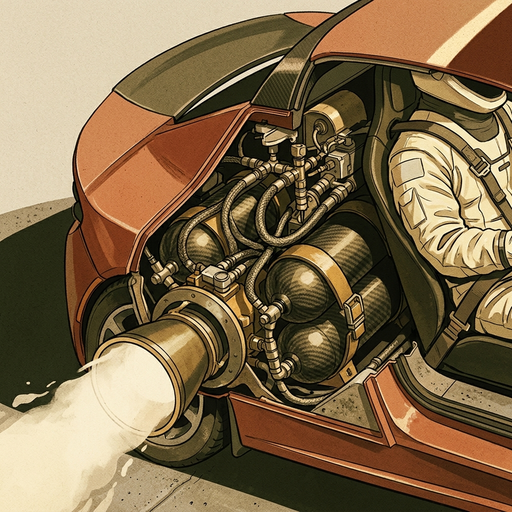
Inside the cockpit, however, the single most telling detail was what was missing. The driver seat was not occupied by a human test driver gripping a steering wheel. Instead, strapped securely beneath the glass canopy sat a mannequin clad in a white SpaceX spacesuit, its helmet visor reflecting the facility floodlights. There were no human hands guiding the car along the inverted ramp, and no human reflexes correcting its attitude while airborne. Tesla’s event presentation attributed the driving entirely to the car’s autonomous software, explaining that an unoccupied cockpit was a mandatory safety precaution for such an extreme demonstration.
That empty seat carries profound implications for how we understand what actually took place. Demonstrating that an automated machine can execute a high-speed acrobatic routine on a closed proving ground proves that precise mechanical programming is possible under controlled conditions. It does not, however, demonstrate that such a vehicle is safe for human occupants. Nor does it provide evidence of an autonomous driving system capable of handling the messy, unpredictable realities of everyday civilian roads. The dramatic flight was an orchestrated technical display, executed under favorable circumstances where the only entity at risk was an expensive prototype and a fiberglass figure in a flight suit.
To understand how a machine weighing several thousand pounds could cling upside down to a curved structure and right itself in mid-air, one must look briefly beneath the polished bodywork. The vehicle relied on two distinct, complementary systems. First, an underbody fan mechanism actively pulled air from beneath the chassis, creating a powerful pocket of low pressure that suctioned the car against the surface of the ramp. Second, once the vehicle broke contact with the ramp, a series of cold-gas thrusters discharged concentrated bursts of stored compressed air through miniature nozzles distributed around the body. On the night of the demonstration, the primary technical guide for the audience was Lars Moravy, Tesla’s vehicle engineering executive. Moravy stepped forward as the public interpreter of the launch, explaining that the car utilized ten thrusters fed by roughly six hundred liters of rechargeable compressed air. This specialized hardware transformed a terrestrial sports car into a ballistic projectile.
Almost immediately, the event broke out of the quiet perimeter of McGregor and flooded the public sphere. Between October twelfth and October nineteenth, the footage circulated across digital networks with astonishing velocity. Elon Musk, serving as chief executive of both Tesla and SpaceX, offered an expansive and triumphant framing of the evening. Shortly after the demonstration concluded, he publicly declared that the long-promised future of flying cars had finally arrived. In Musk’s presentation, the prototype was not merely an experimental laboratory on wheels, but a direct foretaste of a transformative commercial product that would soon be delivered into the hands of ordinary consumers.
That optimism, however, was met with immediate and vocal skepticism from seasoned technology observers. Prominent consumer technology commentator Marques Brownlee publicly questioned the entire premise, pointing out the immense gulf between an unoccupied stunt car and a practical road vehicle. Brownlee openly asked his millions of followers whether the presentation was an elaborate prank. He pointed to the sheer improbability of taking a vehicle weighing over four thousand pounds and endowing it with the ability to perform aerial flips at speeds described as more than three hundred eighty miles per hour. Promising that such a machine would ship to customers by twenty twenty-eight seemed, to Brownlee, beyond belief.
It is important to draw a clear distinction here between two very different kinds of skepticism. Brownlee and other critics were not asserting that the footage itself was an elaborate digital fake or a piece of studio trickery. Rather, their doubts centered on the engineering viability, the regulatory plausibility, and the commercial delivery timeline of the machine. The physical demonstration certainly occurred on the tarmac in Texas. Whether that demonstration represented a deliverable consumer automobile was an entirely separate question.
The visual strangeness of the footage quickly led casual viewers to wonder if they were looking at a sophisticated computer-generated illusion. The viral debate grew loud enough that on October sixteenth, the independent fact-checking organization Snopes published a formal assessment of the video clips. Snopes reviewed the available recordings and confirmed that the footage was authentic, documenting an actual physical prototype performing physical maneuvers at the McGregor facility. Yet, as with any rigorous evaluation, confirming that a video shows a real event is not the same as verifying every technical and commercial claim made on stage. A fact-check confirming that a prototype leaped over five parked vehicles does not validate claims about the car’s eventual production volume, its retail pricing, its passenger safety, or its legality on public highways.
As the footage continued to spread throughout the third week of October, a parallel narrative emerged about the sheer magnitude of the public response. Commentators within the enthusiast community, most notably the Tesla-focused observer Sawyer Merritt, circulated claims that cumulative viewership of the McGregor demonstration had quickly surpassed ten billion impressions across various digital platforms within twenty-four hours. Some coverage repeated claims that the demonstration was among the most-shared technology stories of the week.
Here, a careful listener must pause and examine the nature of modern media metrics. There is no question that the demonstration received comprehensive global coverage from major automotive, business, and technology outlets. But the claim of ten billion views is an unaudited calculation assembled by an individual social media commentator. It is not an independently verified, cross-platform audience measurement certified by neutral data analytics firms.
In digital media, there is a fundamental difference between video views, shares, and distinct human beings. A single automated view counter can register an impression every time a video autoplays in a user’s feed for a fraction of a second, regardless of whether anyone watched it. One individual scrolling through their morning news feed may generate several dozen registered impressions across multiple platforms in a single hour. Furthermore, determining whether any event is truly the most-shared technology moment of a given week requires an established, uniform baseline, a fixed time window, and access to proprietary data across disparate networks like YouTube, Meta, TikTok, and X. Because no such universal audit exists, widespread media attention should never be conflated with an established, audited statistical record. The event was undeniably a massive cultural talking point, but the specific claim of ten billion collective views must be understood as an enthusiast’s informal estimate rather than an established historical measurement.
What remains fascinating about the McGregor demonstration is how neatly it illustrates the enduring distance between an extraordinary public spectacle and a dependable passenger journey. For more than a century, the concept of the flying car has captivated the human imagination, continually promising to liberate personal travel from the constraints of asphalt and traffic congestion. Yet time and again, the history of transportation has shown that getting a machine momentarily off the ground is the easiest part of the challenge. The true hurdles lie in stability, endurance, noise, energy density, emergency failure modes, and the intricate web of safety certifications required to protect both the occupants inside and the public down below.
When the prototype landed in McGregor, it touched down on an empty runway inside a secure, private aerospace installation, shielded from public traffic, pedestrians, and legal liabilities. It operated under ideal, tightly rehearsed conditions, managed by the very engineers who designed its control algorithms. To move from that controlled, unoccupied hop to a commercially viable passenger car requires traversing a vast, unforgiving landscape of engineering compromises, legal definitions, and physical laws.
To understand why this leap from spectacle to reality is so profound, we must return to the moment the car’s wheels left the edge of that curved Texas ramp. At the precise instant of departure, the vehicle ceased to behave purely as an automobile governed by friction, steering angle, and tire traction. It entered a realm governed by three-dimensional aerodynamics, rapid pressure differentials, and ballistic mechanics. How those forces were generated, balanced, and abruptly arrested is where the real engineering story begins.
That engineering story begins with the fundamental physics of surface contact. On solid ground, an automobile is entirely a creature of friction. Its tires serve as its sole connection to the earth. They rely on grip, the frictional force between rubber compounds and rough asphalt, to translate wheel rotation into forward motion, negotiate lateral turns, and bring several thousand pounds of machinery safely to a halt. When performance engineers want to press those tires more firmly into the pavement to extract additional cornering traction, they typically rely on downforce. That aerodynamic force, generated by wings, diffusers, and carefully managed underbody airflow, pushes the chassis downward without adding physical mass.
On the curved ramp in McGregor, however, conventional tire grip was utterly insufficient. As the track swept past vertical toward an inverted ceiling, gravity stopped pulling the car into the surface and began pulling it toward the tarmac below. To keep from falling before reaching the launch point, the prototype relied on an underbody fan suction system. The working principle behind fan suction relies on basic fluid dynamics. By spinning high-powered electric fans to evacuate air rapidly from beneath the floor pan, the system carves out a sealed pocket of low pressure beneath the chassis. Because atmospheric pressure above the vehicle remains higher, ambient air presses down on the bodywork, pinning it against the ramp.
It is a remarkably potent method for generating immediate downforce, even at low speeds, but it is often fundamentally misunderstood. Fan suction is neither an electromagnetic tractor beam nor an all-terrain adhesive. It depends entirely on maintaining an airtight pressure boundary across a very narrow gap. If the flexible skirts that seal the car floor against the running surface are compromised, or if the chassis lifts just a few inches, outside air rushes in. The pressure differential vanishes in milliseconds, and the suction force instantly evaporates. Crucially, an underbody fan can only pull a vehicle toward an existing physical surface. It cannot generate vertical lift in open space. The second the prototype cleared the edge of the ramp, the surface disappeared, the pressure differential collapsed, and the suction fans became entirely irrelevant.
At that point of departure, the machine entered free flight along a classic ballistic arc. In physics, a ballistic arc is the curved path an unpowered object traces through space under the twin influences of initial forward momentum and downward gravity. In a typical stunt, a launched car is simply a heavy projectile. The angle of the ramp sets its trajectory, its approach speed dictates its height and distance, and gravity inevitably curves it back toward the ground. The vehicle cannot steer, rotate, or alter its path once airborne.
What caught the world by surprise in McGregor was that this vehicle did not tumble like an inert weight. Mid-flight, it rolled smoothly along its longitudinal axis, leveled its chassis, and landed squarely on its tires. To adjust its orientation without surface friction, the car engaged its second specialized system: an array of cold-gas thrusters.
A cold-gas thruster is one of the most mechanically straightforward reaction-control devices in aerospace engineering. The system consists of three core components: a pressure vessel storing compressed gas, a high-speed electronic valve, and an exhaust nozzle. When the valve triggers, pressurized gas rushes through the nozzle, expanding and accelerating to high speed as it escapes into the surrounding air. This relies directly on Sir Isaac Newton’s third law of motion, which states that every action generates an equal and opposite reaction. The momentum of that departing gas imparts an instantaneous push to the car in the opposite direction.
The designation cold does not mean the gas is chilled or cryogenically frozen. Rather, it indicates the complete absence of combustion. In a chemical rocket, liquid or solid propellants ignite inside a combustion chamber, burning at thousands of degrees to expel fiery exhaust. In a jet turbine, compressor blades suck in outside air, blend it with fuel, and burn it continuously. A cold-gas thruster does neither. It burns no fuel, ignites no flame, and requires no outside oxygen. It simply releases the mechanical potential energy already locked inside a vessel of compressed gas.
Yet the absence of fire should never be mistaken for an absence of danger. While compressed air is sometimes casually described as inert, ambient air contains roughly twenty-one percent oxygen, a reactive gas that vigorously accelerates combustion. More importantly, cramming any gas to extreme pressures concentrates staggering physical energy inside a confined space. If a vessel suffers structural failure, that stored pressure does not need a spark to cause catastrophic destruction. The mechanical force of pneumatic decompression is easily violent enough to rupture surrounding structures.
SpaceX has long utilized cold-gas thrusters for attitude control, relying on small bursts to orient the upper stages of Falcon rockets and guide crew capsules in space. However, adjusting orientation in the frictionless vacuum of orbit is vastly simpler than maneuvering a multi-ton sports car inside Earth's gravity and turbulent atmosphere. Furthermore, while Tesla and SpaceX share a chief executive and collaborate on technical concepts, they remain distinct corporate and legal entities. Aerospace flight heritage cannot simply be assumed to establish automotive roadworthiness.
The technical layout of this pneumatic system was outlined at the demonstration by Lars Moravy, Tesla’s vice president of vehicle engineering. Moravy told spectators that the prototype was equipped with ten thrusters distributed around the chassis, fed by roughly six hundred liters of compressed air. This air is contained inside carbon-fiber-overwrapped pressure vessels, commonly used in aerospace engineering.
A carbon-fiber-overwrapped pressure vessel is a composite cylinder engineered to withstand extraordinary internal pressures while keeping weight to a minimum. It consists of a thin, impermeable inner liner, typically made of aluminum or a specialized polymer, which prevents microscopic gas molecules from escaping. That liner is then wrapped under mechanical tension with continuous strands of high-strength carbon fiber embedded in an epoxy resin. The carbon-fiber shell supplies the tensile strength needed to hold back extreme burst pressures, while the inner liner ensures a gas-tight seal. Moravy and company materials noted that these vessels were packed into every usable void and cavity within the chassis, turning hollow structural spaces and storage compartments into a distributed pneumatic reservoir.
To evaluate what such a system can actually do, one must separate three distinct properties: internal tank capacity, gas mass, and expanded gas volume. Internal tank capacity is simply the geometric volume of the empty vessels, which Moravy pegged at roughly six hundred liters. That figure merely describes the physical size of the container. The mass of the gas represents the actual weight of the air forced into those tanks, which rises with every increase in storage pressure. Finally, expanded volume is the massive space that air would occupy if released back into the surrounding atmosphere at normal sea-level pressure.
One cannot calculate thruster endurance or total force from tank capacity alone. Thruster endurance depends on mass flow rate, which is the physical mass of gas expelled through the nozzles each second, as well as the pressure ratio across the nozzle. As gas rushes out, internal tank pressure drops, which causes the output force to diminish over time unless governed by complex pressure-regulating valves. In addition, rapid expansion causes the gas temperature to drop sharply through thermodynamic cooling. That chills the remaining gas, lowers internal pressure, and further saps performance during sustained operation. Tesla has not published certified technical specifications for these systems. Consequently, figures circulating in enthusiast reports, such as storage pressures of ten thousand pounds per square inch or thruster forces exceeding eighty kilonewtons, must be understood as uncorroborated claims rather than verified engineering baselines.
Refilling this pneumatic reservoir poses another unresolved operational challenge. Air does not compress itself. Compressing several hundred liters of ambient air to high pressures requires substantial mechanical energy, multi-stage industrial compressors, and robust cooling to shed the intense heat generated during compression. Tesla has not clarified whether the car requires an external compressor to recharge over several hours, or carries an onboard unit powered by its battery. Nor has the company revealed how many consecutive aerial maneuvers the vehicle can execute before its pressure tanks run dry.
This brings us to the central mechanical distinction of the McGregor demonstration: pivoting a car in mid-air is completely different from holding it aloft. Rotating an airborne vehicle requires only torque, which is a rotational force applied at a distance from the vehicle's center of mass. While following a free-fall arc, a car is effectively in momentary weightlessness. If a miniature thruster at the front bumper fires downward while another at the rear fires upward, their combined output creates a rotational moment that pivots the vehicle along its pitch or roll axis. Very little gas mass is consumed to roll or flip the chassis while gravity and initial momentum are already carrying its weight.
Sustaining upward lift, on the other hand, demands immense and continuous vertical force. To keep a four-thousand-pound sports car hovering in mid-air, its thrusters would need to produce more than four thousand pounds of continuous downward thrust, second after second. A brief three-second pulse of compressed air can orient a machine along a ballistic arc established by a ramp. It cannot, however, overcome gravity for sustained flight across a landscape. When the car touched down in McGregor surrounded by expanding white clouds, many casual observers assumed the vapor proved massive thrust. In truth, that cloud was merely ambient moisture condensing in the Texas humidity as the freezing, rapidly expanding exhaust air cooled the surrounding atmosphere. Condensation proves cold gas is expanding; it tells us nothing about how much lift was actually produced.
When analyzed through this mechanical lens, the McGregor footage reveals an assisted ballistic leap. The prototype used a curved ramp for elevation, underbody fans for surface grip, and cold-gas thrusters for attitude control and landing cushioning. It does not prove that the vehicle can lift off from a level surface under its own power, maintain a stationary hover, or navigate through three-dimensional airspace like an aircraft.
To market this technology, Tesla announced three distinct variants in the aftermath of the reveal: Performance, Thrust, and Rocket. These are internal commercial trim designations, not certified regulatory classifications, and each assigns a very different mission to the underlying hardware.
The Performance model is framed as a road-going electric sports car featuring two seats and active aerodynamic wings. Its underbody fan suction system is designed solely to produce extreme downforce on race circuits, completely omitting any airborne equipment.
The Thrust trim adds rear-facing cold-gas thrusters engineered strictly for horizontal acceleration. Tesla claims this setup can propel the car from zero to sixty miles per hour in less than one second by discharging high-pressure air directly behind the vehicle to augment tire grip. That acceleration claim remains entirely company-asserted, with no independent testing conducted on public roads or sanctioned drag strips.
At the extreme sits the Rocket trim. This is the single-seat, invite-only configuration demonstrated in McGregor, fitted with the full ten-thruster perimeter array and high-pressure composite tanks packed throughout the chassis. It is the only variant presented with airborne maneuvering hardware, and it carries a clear, explicit disclaimer published directly on Tesla's website: it is not approved for public road use.
That single-seat layout underscores the severe engineering compromises required to integrate rocket hardware into a road car. High-pressure composite vessels are rigid, unyielding cylinders that cannot be contoured around passenger ergonomics. To pack several hundred liters of compressed air tanks into an aerodynamically sleek sports car, usable cabin volume had to be sacrificed. The rear seats were eliminated entirely, replaced by pressure vessels and high-pressure plumbing. In the Rocket trim, even the front passenger seat was removed, leaving the driver sitting alone amidst an array of composite cylinders.
This sparse cockpit highlights how drastically the program's priorities have shifted. When the second-generation Roadster was originally unveiled in November twenty seventeen, it was presented as an elegant, practical four-seat grand tourer capable of traveling over six hundred miles on a single electric charge. Nine years later, that grand tourer has evolved into a heavily compromised, single-seat pneumatic projectile. Its advertised battery range is roughly half the original promise, and its interior has been stripped to house hundreds of liters of compressed air.
How an ambitious four-seat electric grand tourer transformed over nearly a decade into an experimental single-seat rocket car is not merely a tale of aerodynamic physics and pneumatic plumbing. It is a chronicle of shifting design goals, bold corporate promises, and the long wait of prospective owners who placed substantial cash deposits for an automobile that was supposed to arrive years ago.
To understand how that experimental machine came to be, the timeline must rewind nine years, to an unseasonably warm November evening in southern California.
On that night in November twenty seventeen, inside an airfield hangar in Hawthorne, Tesla gathered journalists, investors, and supporters to reveal its heavy-duty electric commercial truck, the Tesla Semi. Yet as the presentation drew to a close, the trailer doors opened, and a sleek, crimson sports car rolled into the spotlight. Elon Musk introduced the vehicle as the second generation of the Tesla Roadster.
The original Tesla Roadster, introduced in two thousand eight, had been a very different machine. Built upon a modified Lotus Elise chassis and produced in modest volumes, it was a lightweight two-seater that served as a proof of concept, demonstrating that electric powertrains could deliver authentic sports car thrills.
The concept unveiled in twenty seventeen, by contrast, was presented as a direct challenge to internal combustion supercars. Musk stood beside the prototype and announced ambitious performance targets. He claimed acceleration from zero to sixty miles per hour in one point nine seconds and a top speed exceeding two hundred fifty miles per hour. Range was promised at approximately six hundred twenty miles, powered by a massive two-hundred-kilowatt-hour battery pack. The vehicle also offered four seats in a two-plus-two layout, and deliveries were scheduled to begin in twenty twenty.
It is essential to separate a dramatic stage announcement from an independently verified engineering achievement. At Hawthorne, those dazzling figures were corporate targets supported by a rolling concept vehicle and computer modeling. They were not metrics validated by independent automotive testing agencies, standardized regulatory cycles, or consumers driving on public highways.
Public imagination, however, was already ignited, and it was stoked further three months later by an event that permanently linked the Roadster name with spaceflight. In February twenty eighteen, SpaceX conducted the maiden flight of its Falcon Heavy rocket from the Kennedy Space Center in Florida. As a test payload, the rocket carried Musk's personal cherry-red first-generation Roadster, with a spacesuited mannequin nicknamed Starman strapped behind the wheel. Television broadcasts and live internet streams showed the convertible drifting against the silent curvature of Earth, etching the visual association into popular culture.
Yet analytical clarity requires keeping that event in proper context. The Falcon Heavy launch placed an unpowered, first-generation roadster into solar orbit as passive cargo atop an enormous booster rocket. The car was not flying under its own power. It possessed no thrusters, no autonomous guidance, and no aerodynamic lift, functioning purely as freight governed by celestial mechanics.
The idea that an automobile might use rocket hardware to maneuver on Earth emerged several months later, not in a technical paper, but across public social media posts. In June twenty eighteen, Musk floated the possibility of an optional SpaceX package for the upcoming Roadster. He proposed equipping the car with roughly ten small cold-gas thrusters arranged seamlessly around the bodywork. These pneumatic nozzles, he suggested, would dramatically improve cornering, braking, and acceleration, and might even allow the car to execute brief hops through the air.
Such informal remarks must be viewed for what they were: speculative musings shared by an executive known for provocative public commentary. They were neither formal engineering commitments backed by published milestones, nor were they immediately dismissed by an eager audience. For automotive engineers, the proposal raised difficult questions regarding compressed gas storage, vehicle weight, and passenger safety. For prospective buyers, it added an aura of aerospace spectacle to an already sensational performance car.
Meanwhile, the calendar steadily advanced toward the original delivery date. Twenty twenty arrived, but production-ready Roadsters did not. The global automotive sector soon faced supply chain disruptions, battery shortages, and shifting corporate priorities, including the production ramp of the Model Y and the development of the Cybertruck. Over the following years, publicly discussed timelines moved repeatedly, slipping from twenty twenty to twenty twenty-one, and then into subsequent years. While casual observers often tally each delay as a broken promise, the public record reflects shifting executive projections rather than formal delivery contracts. By late twenty twenty-five, company guidance had moved the expected production horizon even further out, pointing toward twenty twenty-seven or twenty twenty-eight.
That prolonged wait set the stage for the demonstration in October twenty twenty-six. Tesla initially scheduled the prototype reveal for October first, but severe weather in central Texas forced a two-week postponement to October fifteenth. When the vehicle finally appeared at the SpaceX testing facility in McGregor, Musk announced a general production target of twenty twenty-eight. Just as in twenty seventeen, an executive target must not be confused with a guaranteed delivery date. Furthermore, the announcement provided no certified manufacturing timetable for the specialized, thruster-equipped Rocket variant.
The October twenty twenty-six presentation also codified how substantially the vehicle's design parameters had changed over nine years. The original vision of a four-seat grand tourer delivering over six hundred miles of range was formally superseded. The new lineup featured an advertised range of roughly three hundred miles, offering two seats in the Performance and Thrust trims, and only a solitary driver seat in the Rocket edition.
This shift must be understood with analytical precision. One cannot assume the vehicle's real-world range was simply cut in half under identical test standards. Rather, the public design parameters evolved. Integrating rigid composite pressure vessels and heavy structural reinforcement consumed cabin space and payload weight that might otherwise have supported an expansive battery pack. An evolving prototype can represent genuine mechanical experimentation while simultaneously diverging in major ways from what early customers anticipated.
This divergence brings the commercial terms of the Roadster program into sharp focus. Following the McGregor demonstration, Tesla reopened customer reservations. Securing a place in line for the entry-level Performance trim required a deposit of fifty thousand dollars. For the thruster-equipped Thrust model, prospective buyers were asked to submit a reservation payment of two hundred fifty thousand dollars. The airborne Rocket trim remained strictly invite-only, with no public reservation fee disclosed.
It is critical to distinguish a reservation payment from a purchase price. A deposit merely purchases an allocation slot, offering the customer an opportunity to configure and buy a vehicle if production begins. Tesla did not announce final purchase prices for any of the three trims in October twenty twenty-six. A buyer depositing two hundred fifty thousand dollars has not purchased an automobile; they have committed substantial capital to reserve a place in queue.
These deposit amounts deliberately mirror the structure established in twenty seventeen. At that initial reveal, Tesla asked fifty thousand dollars for standard reservations and required the full two hundred fifty thousand dollars upfront for the limited Founders Series. Yet observers cannot assume that current reservation agreements share the identical legal terms of contracts signed nearly a decade ago.
The public record leaves significant questions unresolved regarding those early deposit holders. Corporate filings and public announcements have not clarified whether legacy deposits automatically transfer to the new trim tiers, how delivery queues will be prioritized, or what refund provisions govern older agreements. Without access to individual customer agreements, responsible reporting must acknowledge these informational gaps rather than making unsupported assertions. One cannot claim that deposits are permanently forfeit, nor that refunds have been widely issued, nor that individual customers have suffered specific personal financial losses. What is documented is that customer funds have remained committed for nearly a decade to an automobile whose delivery horizon has repeatedly receded.
This lingering skepticism was voiced clearly by technology reviewer Marques Brownlee after the demonstration. Brownlee publicly questioned whether the presentation was a prank. He noted that Tesla had claimed a four-thousand-pound car could perform mid-air flips, reach extreme speeds, and ship to consumers in twenty twenty-eight. His observation reflected a broader tension across the industry: the distance between a spectacular physical demonstration on private property and a road-legal consumer product remains immense.
By late twenty twenty-six, the Roadster program had undergone a profound conceptual migration. It began as an ultra-high-performance electric grand tourer intended to prove battery supremacy on public roads. It has now become an experimental, thruster-assisted apparatus testing the outer boundaries of automotive convention.
Yet demonstrating dynamic maneuvers on private corporate grounds represents only the first phase of an arduous journey. Even if manufacturing hurdles are cleared and production begins in twenty twenty-eight, the central challenge shifts from mechanical capability to legal permission. That question falls outside the scope of automotive engineering, landing squarely on the regulatory authorities tasked with deciding whether a thruster-equipped vehicle can ever legally share public roads or public airspace.
In the immediate aftermath of the McGregor demonstration, the conversation shifted with remarkable speed. On the evening of Thursday, October fifteenth, twenty twenty-six, audiences watched an extraordinary spectacle. A sports car launched off a ramp, executed an acrobatic mid-air rotation, and cushioned its descent on pulses of compressed gas. Yet by Friday morning, October sixteenth, and across the following weekend, the initial buzz of viral wonder gave way to a much drier, far more demanding set of questions.
The public debate moved out of the realm of mechanical spectacle and into the intricate machinery of administrative law. Observers, prospective buyers, and industry analysts suddenly wanted to know what this demonstration actually proved about the vehicle's legal reality. Had Tesla invented a street-legal rocket, an unregistered airplane, or something that simply fell between the cracks of modern transport oversight?
To answer those questions, one must first dismantle a common misconception about transportation law. The public often imagines a single authority that surveys any new machine and renders a sweeping verdict on whether it is permitted to exist. In truth, modern governance relies on three entirely distinct mechanisms: how a regulator classifies a vehicle, how a manufacturer demonstrates compliance with established standards, and what specific permissions are required to operate that machine. A prototype can perform extraordinary feats on private corporate land without possessing the legal right to travel down a suburban street or enter public airspace.
The first regulatory agency to enter the discussion was the Federal Aviation Administration. As the United States authority responsible for civil aviation safety, the agency exercises broad statutory power over national airspace. Its purview covers commercial jetliners, private helicopters, hot air balloons, and experimental aircraft. Given that the Roadster had vaulted into the air and maneuvered above the ground, many wondered whether Tesla had built an aircraft subject to years of aeronautical scrutiny.
The agency's initial view arrived swiftly. In response to press inquiries on October seventeenth, twenty twenty-six, the Federal Aviation Administration indicated that the demonstrated vehicle did not fall within its established legal definition of an aircraft. Because the machine did not meet that threshold, the agency explained, aircraft airworthiness certification was not required.
It is vital to understand the narrow boundary of that conclusion. The aviation agency was not issuing an official declaration that the Roadster is safe. Nor was it granting Tesla blanket immunity from aviation oversight. It was simply observing that, under current federal aviation statutes, a ground vehicle executing an assisted ballistic hop or using cold-gas nozzles for short-duration attitude control does not match the legal characteristics of an airplane, rotorcraft, or glider.
This distinction matters because legal definitions carry strict statutory weight. Federal regulations generally define an aircraft as a device that is used or intended to be used for flight in the air. The agency's assessment reflected the reality of what occurred in McGregor. A prototype launched from an inclined ramp and discharged brief bursts of compressed air to orient itself before falling back to Earth. The agency did not evaluate a production vehicle capable of sustained, level flight across open terrain. Nor did it declare that every future iteration, hover capability, or higher-altitude maneuver would remain outside civil aviation law. The ruling applied strictly to the hardware and ballistic behavior demonstrated on that Texas test field.
If the vehicle was not an aircraft, attention naturally turned to the federal agency overseeing civilian machines on the ground. That authority is the National Highway Traffic Safety Administration. Operating within the Department of Transportation, the highway safety administration establishes and enforces the Federal Motor Vehicle Safety Standards. These comprehensive rules govern virtually every physical aspect of an automobile sold for highway use, from crash avoidance and occupant protection to brake performance, lighting configurations, and windshield integrity.
Here, the regulatory mechanism differs fundamentally from aviation oversight. In the aerospace sector, an aircraft manufacturer cannot simply build a plane and begin flying it. The company must complete a rigorous, multi-year certification process. During that review, regulators inspect engineering drawings, monitor flight tests, and formally approve the design before production models can carry passengers.
The automotive world in the United States operates under a contrasting philosophy known as manufacturer self-certification. Under this framework, the federal government does not pre-approve a car design before it enters the showroom. Instead, the legal burden rests entirely on the manufacturer to test, validate, and formally certify that every covered motor vehicle meets all applicable federal standards. The highway safety administration acts primarily through oversight, investigation, and enforcement. The agency audits compliance, conducts independent crash tests, reviews defect petitions, and possesses the authority to order recalls if a vehicle presents an unreasonable safety risk.
In statements reported across mid-October by national news organizations, the Department of Transportation clarified this dynamic. The government emphasized that the manufacturer bears the explicit responsibility of ensuring any road-bound vehicle complies with federal motor vehicle safety standards, while drivers remain obligated to follow state and local traffic laws. Furthermore, the Department of Transportation stated that the highway safety administration would continue to monitor the situation closely, maintaining an active posture to protect the driving public.
This regulatory posture reveals a sharp tension in how the Roadster program was presented. During the McGregor demonstration, Elon Musk addressed the audience with expansive language, asserting that the demonstrated technology would be the actual car found on public roads. Yet that broad promotional rhetoric stood in stark contrast to the legal boundaries published by Tesla itself.
On the company's official reservation portal, Tesla organized the newly unveiled lineup into three distinct variants: Performance, Thrust, and Rocket. The entry-level Performance trim was promoted as a road-ready electric sports car, devoid of airborne hardware. The mid-tier Thrust edition incorporated rear-facing gas thrusters intended strictly for rapid horizontal acceleration. But for the single-seat Rocket edition, the only variant equipped with the full perimeter thruster array and capable of brief aerial hops, Tesla published an explicit disclaimer: it is not approved for public road use.
This contradiction sits at the core of the vehicle's public presentation. An executive's stage declaration about the broader program cannot be treated as an identical legal description for every individual model. Tesla's own commercial restriction demonstrates that the company recognizes the immense gulf separating an experimental thruster package from a highway-legal production car.
At the same time, analytical rigor requires interpreting that disclaimer correctly. Tesla's statement that the Rocket trim is not approved for road use does not mean that federal regulators reviewed the vehicle and formally rejected it. Rather, it indicates that the configuration has not undergone the self-certification process required for highway operation. By the same token, Tesla's promotional framing of the lower-tier Performance variant as road-ready cannot be accepted as independent proof of compliance. Until a production car is manufactured, certified, and offered for lawful registration, commercial descriptions remain corporate claims rather than validated legal facts.
Understanding this distinction requires untangling several legal concepts that casual observers frequently conflate: vehicle sale, vehicle registration, public road operation, closed-course driving, and private-property testing. An automotive company has considerable leeway to design, build, and sell specialized machines intended exclusively for off-road use, closed-course racing, or track days. Countless track-focused supercars are sold without meeting federal crash standards or bumper regulations because they are never registered with state motor vehicle departments and are never driven on public asphalt.
Operating a machine on private property is also subject to distinct considerations, though private land is not entirely unregulated. While local traffic codes and federal highway standards generally do not govern what an unoccupied prototype does inside a secured rocket-testing perimeter, broader legal principles still apply. Property laws, municipal zoning rules, environmental noise ordinances, and common-law duties of reasonable care regarding personal injury and property damage remain active everywhere. The McGregor demonstration was conducted under strictly controlled conditions: within a private, restricted aerospace facility, with no human occupants inside the cabin, and with emergency teams standing by. That controlled environment granted Tesla the legal latitude to conduct its ballistic jump, but it established zero legal precedent for how such a machine could be operated beyond those perimeter gates.
When one examines the physical reality of the vehicle, the reasons for regulatory caution become immediately apparent. The engineering questions surrounding cold-gas propulsion are not academic abstractions; they represent significant physical energies that must be safely managed. Consider the energy stored in compressed air. The Roadster prototype reportedly relies on roughly six hundred liters of gas compressed to immense pressures inside carbon-fiber-overwrapped pressure vessels. A high-pressure vessel stores substantial potential energy. If a road vehicle carrying several hundred liters of highly compressed gas is struck in a severe highway collision, those composite cylinders must withstand severe structural deformation without rupturing. A catastrophic pressure release does not involve burning fuel, but the mechanical shockwave alone can cause widespread structural devastation.
Furthermore, cold-gas thrusters introduce complex mechanical failure modes that automotive safety standards were never drafted to address. What happens if an electronic control module suffers a software glitch or an electromechanical valve sticks in an open position while the car is navigating a crowded suburban intersection? An uncommanded pulse of high-pressure thrust could propel a two-ton vehicle into oncoming traffic or spin it uncontrollably across lanes.
There are also severe landing loads to evaluate. When an automobile leaves the pavement and returns to Earth, its suspension, chassis subframes, and battery enclosures must absorb vertical decelerations far exceeding the forces encountered when driving over typical road imperfections. Repeated high-load landings could introduce micro-fractures into composite structures or fatigue critical steering linkages over time.
Then there are the external hazards that extend well beyond the vehicle itself. A pneumatic nozzle discharging thousands of pounds of thrust against the ground can blast gravel, asphalt debris, and roadway grime outward at dangerous velocities, creating severe hazards for nearby vehicles, cyclists, and pedestrians. The acoustic energy generated by high-velocity gas expansion presents additional risks. Unmuffled cold-gas thrusters produce intense, sudden sound waves that can exceed safe hearing thresholds and startle surrounding drivers. Finally, emergency first responders arriving at a crash scene involving a thruster-equipped car would face an unprecedented hazard: an unfamiliar wreckage packed with high-pressure lines and composite tanks that could rupture if cut with hydraulic rescue shears.
These engineering challenges must be understood clearly. They are not documented product defects discovered in the McGregor prototype, but rather foreseeable physical and operational hurdles that any manufacturer must rigorously analyze, test, and resolve before seeking highway compliance.
When commentators discuss these risks, they frequently point to the historical record of SpaceX, noting that carbon-fiber-overwrapped pressure vessels have been implicated in previous rocket failures. Most notably, in September twenty sixteen, an uncrewed Falcon Nine rocket was lost on a launch pad during a routine static-fire test due to a failure involving an oxygen-system pressure vessel. Yet rigorous analysis requires separating two vastly different operational environments. The twenty sixteen Falcon Nine failure occurred in a cryogenic liquid-oxygen environment, where solid oxygen formed under extreme thermal conditions and buckled a composite tank liner within an intensely reactive oxidizer system. That cryogenic chemical context is materially different from an automotive application storing ambient-temperature compressed air. Pointing out that both systems utilize composite pressure vessels neither proves that an automotive tank is inherently dangerous, nor does it establish that it is safe. A storage technology proven in aerospace must be evaluated on its own merits under the specific mechanical, thermal, and crash stresses of the road.
These physical realities also frame Elon Musk's unconventional public posture regarding vehicle safety. During the public reveal coverage in mid-October, Musk was widely reported acknowledging that the Roadster is not necessarily a safety-optimized automobile, echoing previous remarks that customers whose primary priority is absolute safety should consider other vehicles. In a commercial context, a consumer is free to accept a certain degree of personal risk when purchasing a high-performance track machine for use on a closed course. Yet in the realm of public transport policy, individual risk tolerance does not resolve systemic risk. Federal motor vehicle safety laws were not constructed solely to protect the driver who voluntarily purchases a high-performance sports car. They were created to protect the family traveling in the vehicle beside it, the pedestrian standing on the sidewalk, and the emergency personnel who respond when a collision occurs. An individual owner cannot waive the safety rights of the surrounding public.
As the dust settled in central Texas by October twentieth, twenty twenty-six, the broader legal landscape came into sharp focus. The Roadster had not slipped into an ungoverned void where anything is permitted. Instead, it faced a rigorous, multi-layered framework that requires every machine to align its mechanical reality with an established legal category. To become a lawful mode of travel, an innovative vehicle must follow a clearly defined regulatory path. It must either meet the exhaustive airworthiness and pilot licensing requirements of civil aviation, or fulfill the self-certified crashworthiness and operational mandates of the highway code, or remain permanently confined to private tracks and off-road facilities. The tension surrounding the Roadster arises because it attempts to straddle these worlds without yet satisfying the legal demands of either.
This challenge is not unique to Tesla. Long before compressed gas nozzles were installed in an electric sports car, other ambitious inventors wrestled with the fundamental divide between the earth and the sky. The dream of uniting road travel and flight has inspired engineers for decades, forcing each to decide whether their machine is truly a car that flies, an airplane that drives, or something entirely new. Their varied approaches reveal just how difficult it is to build a machine that satisfies both the laws of physics and the laws of the land.
To make sense of what happened on that private test ramp in McGregor, one has to step back from the immediate spectacle and ask a disarmingly simple question. What kind of journey is any so-called flying car actually intended to make possible?
For more than a century, the phrase flying car has operated as a universal catch-all, flattening wildly different engineering philosophies into a single science-fiction cliché. Popular imagination envisions a vehicle that parks in an ordinary suburban driveway, navigates morning rush-hour traffic, and then, at the flick of a dashboard switch, lifts smoothly over the congestion to cruise through the clouds. But when designers sit down with the uncompromising realities of aerodynamics, structural mass, and civil law, they quickly discover that the earth and the air demand opposing compromises.
An automobile must be structurally robust and sufficiently heavy to absorb violent highway collisions. It requires steel or composite impact beams, crush zones, anti-lock braking systems, steering gear, and durable suspension linkages designed to survive thousands of miles of potholed asphalt. An aircraft, by contrast, must be as light as structurally possible. Every unnecessary pound of dead weight is penalized directly in fuel burn, climb performance, payload, and range. If an engineering team attempts to force both identities into a single chassis, it risks creating a machine that is far too heavy to be an efficient airplane and far too delicate or unwieldy to be a practical car.
Because of this inescapable friction, different designers over the past two decades have pursued vastly different strategies. To evaluate the compressed-gas maneuvers of Tesla's Roadster with genuine intellectual rigor, one must measure it against the practical choices made by other pioneers who sought to bridge the gap between the highway and the sky. Four distinct archetypes have emerged across the industry: the roadable aircraft, the pure electric vertical takeoff craft, the modular dual-vehicle carrier, and the thruster-assisted ground vehicle. Each answers the fundamental question of human travel in a completely different way.
The modern pursuit of the first archetype began in earnest in two thousand six, when a team of aeronautics graduates from the Massachusetts Institute of Technology, led by Carl Dietrich and Anna Mracek Dietrich, founded Terrafugia in Woburn, Massachusetts. Their objective was not to build an aerial taxi capable of hovering above an office tower, but to solve a specific and persistent frustration of private aviation through what is formally defined as a roadable aircraft.
A roadable aircraft is an airplane designed to also travel legally on public highways. That label describes its dual-purpose physical design; it is not a legal guarantee of regulatory certification in both roles. The practical appeal of this concept was straightforward and logical. A pilot could depart from a regional airport near their home, fly several hundred miles, land at an airstrip near their destination, fold the wings electro-mechanically from inside the cockpit, and drive the remaining miles on public roads to an office or hotel. If sudden severe weather closed an airport along the route, the pilot would not be stranded indefinitely in an unfamiliar hangar; they could touch down safely, fold the wings, and finish the journey on the interstate.
On March fifth, two thousand nine, at Plattsburgh International Airport in northern New York, Terrafugia achieved a major technical milestone. Its proof-of-concept prototype, named the Transition, took off from the runway, remained airborne for thirty-seven seconds, covered roughly three thousand feet of airspace, and landed smoothly. It was a genuine, documented flight that demonstrated the viability of its folding-wing mechanism.
Yet the operational reality of the Transition underscores the strict limits of the roadable aircraft concept. The Transition was fundamentally a runway-dependent machine. It required hundreds of feet of clear pavement to gather flying speed for takeoff, and another stretch of open runway to land. For a driver trapped in a stationary highway traffic jam, the Transition offered no utility whatsoever. You could not deploy its pusher propeller in a highway lane, nor could you unfold its wings on a crowded suspension bridge. It did not liberate the traveler from aviation infrastructure; it merely allowed an airplane to leave the airport perimeter on its own four wheels.
Furthermore, the mechanical penalties were severe. To satisfy federal motor vehicle requirements, Terrafugia had to incorporate automotive safety glass, impact structures, highway lighting, and road transmissions, all of which added significant dead weight that reduced its airborne payload and fuel efficiency. Conversely, driving a wide machine with folded wings on an interstate exposed delicate flight control surfaces to flying road debris, salt, and the buffeting air currents of passing freight trucks.
Terrafugia continued development, flying an updated production prototype in March twenty twelve. Yet moving from successful experimental flights to a commercially viable consumer product proved extraordinarily difficult. Projected delivery dates slipped repeatedly from twenty eleven toward twenty sixteen, while projected purchase prices escalated. The enterprise was acquired in late twenty seventeen by the Chinese automotive group Zhejiang Geely. Although the program eventually secured a narrow Federal Aviation Administration special light-sport airworthiness certificate in early twenty twenty-one, that approval was strictly limited in scope to flight operations. It did not represent an unrestricted, mass-market consumer vehicle certified for widespread passenger driving and flying. The roadable airplane proved that a vehicle could legally fly and drive, but it also proved that combining both modes in a single airframe imposed compromises that dramatically restricted its practical daily utility.
A decade after Terrafugia's initial flights, a second engineering philosophy gained worldwide momentum, abandoning airport runways entirely in favor of distributed electric propulsion. This path produced the electric vertical takeoff and landing aircraft, widely known in the industry as an E-V-T-O-L.
Rather than adapting an airplane or an automobile, developers in this field set out to design an electrically powered aircraft capable of ascending and descending vertically without any runway. The underlying physics of this flight mechanism are well established: multiple rotating blades, driven by independent electric motors, continuously accelerate a large volume of ambient air downward, generating sustained aerodynamic lift that exceeds the vehicle's total weight.
A prominent pioneer of this vertical approach is XPeng Aero H T, an aviation affiliate of the Chinese electric vehicle manufacturer XPeng. In operational reporting and corporate disclosures through twenty twenty-six, the enterprise has increasingly conducted its development under the Aridge brand name, reflecting an evolving organizational identity.
On October tenth, twenty twenty-two, the organization conducted a high-profile public flight of its two-seat X Two aircraft in Dubai, operating under a specific, single-event permit granted by the Dubai Civil Aviation Authority. The teardrop-shaped carbon-fiber craft, configured as an octocopter with eight propellers mounted across four structural arms, lifted smoothly from the ground, hovered, and completed a ninety-second demonstration circuit across a cordoned waterfront corridor before touching down vertically.
Because promotional materials and media headlines frequently referred to the X Two as a flying car, the public routinely assumed it possessed highway capabilities. Yet the X Two is not a road vehicle in any mechanical sense. It has no road suspension, no steering rack, no highway tires, and no legal mechanism to drive down an asphalt lane. It is an aircraft. Furthermore, securing an experimental flight authorization for a controlled public demonstration in Dubai is fundamentally different from obtaining general commercial type certification. Civil aviation authorities require years of documented flight hours, rigorous software validation, and extensive fail-safe testing before any electric passenger aircraft can carry paying commuters over populated urban centers.
Comparing the lift mechanism of the X Two with Tesla's McGregor demonstration reveals a stark technical contrast. The X Two relies on continuous aerodynamic work: electric motors spinning rotors to sustain lift for tens of minutes by continually drawing on the surrounding atmosphere. Tesla's cold-gas thrusters, by contrast, rely on releasing a finite, stored volume of compressed air through fixed nozzles. While an electric vertical craft can sustain a controlled hover and navigate across an urban district, cold-gas thrusters expend their total stored energy in a matter of seconds.
Recognizing that pure vertical aircraft cannot travel on roads, and that roadable airplanes carry crippling structural penalties, the engineering teams at Aero H T introduced a third concept: the modular Land Aircraft Carrier.
Instead of forcing a single chassis to sprout wings or deploy rotors, this modular system separates the ground and air functions into two distinct machines. The primary vehicle is a large, six-wheeled electric van that acts as a ground carrier and mobile charging station. Stored entirely within its rear compartment is a separate, two-passenger electric vertical takeoff aircraft.
Under this operational model, the traveler drives the ground vehicle normally along standard highways, fully compliant with automotive safety codes. Upon arriving at an open rural setting or designated departure point, the rear hatch opens, and the flight module automatically slides out, unfolds its rotor arms, and takes flight for a short-range journey, while the carrier remains parked on the ground.
This modular architecture neatly sidesteps the engineering paradox that hampered the Terrafugia Transition. The flying module carries no heavy highway bumpers, road brakes, or steel drive axles into the air. Similarly, the ground carrier does not sacrifice its crashworthiness to become lightweight.
To advance this concept toward production, the company broke ground on an intelligent manufacturing facility in the Huangpu district of Guangzhou in late twenty twenty-four, completing core construction work by late twenty twenty-five. Corporate announcements throughout early twenty twenty-six outlined ambitious schedules for initial manufacturing and customer deliveries.
Yet sound non-fiction analysis requires keeping announced factory milestones separate from operational consumer transport. Constructing an advanced assembly plant or announcing delivery targets does not mean unrestricted civilian passenger service has arrived. As of October twentieth, twenty twenty-six, the public record does not establish completed large-scale customer deliveries of the modular aircraft, nor does it document the issuance of unrestricted commercial passenger operating certificates by civil aviation regulators. The Land Aircraft Carrier demonstrates an inventive theoretical resolution to the flying-car problem, but its airborne component remains bound by the rigorous, deliberate certification timelines that govern all civilian aircraft.
This broader context brings our focus directly back to the compressed-gas thrusters and underbody fans displayed at McGregor on October fifteenth, twenty twenty-six. In the immediate wake of that demonstration, while social media commentary celebrated the Roadster's inverted ramp climb as a breakthrough into airborne driving, a British high-performance manufacturer offered an instructive mechanical correction.
On October sixteenth, twenty twenty-six, British track-car builder McMurtry publicly pointed out that its own fan-assisted vehicle had demonstrated driving upside down on a curved surface well before Tesla's event. McMurtry's observation was not merely commercial posturing; it highlighted an essential mechanical distinction that is frequently blurred in popular coverage.
Driving upside down along a curved surface using underbody suction fans is not an achievement of flight. It is an achievement of aerodynamic ground effect. An underbody fan evacuates air from beneath a vehicle's sealed floor pan, creating a deep pocket of low pressure relative to the atmospheric pressure pressing down from above. This pressure differential forces the tires firmly against the driving surface, generating immense downforce entirely independent of forward velocity. When that surface curves upward and turns completely inverted, the suction continues to clamp the rubber against the concrete.
Crucially, fan suction relies entirely on the immediate proximity of a solid physical boundary. The millisecond a vehicle leaves the ramp and enters open air, ground effect collapses entirely, and the suction fans can do nothing to support the car's weight. The McGregor prototype did not fly off the ramp; it launched ballistically on momentum alone, while its cold-gas thrusters discharged short, timed bursts of compressed air to control its mid-air attitude before gravity pulled it back to the ground.
When these four machines are examined side by side, the confusion surrounding the flying car dissolves into clear engineering realities.
Terrafugia's Transition is an airplane that drives. Its intended journey is an inter-city flight between regional airports, offering the practical convenience of continuing along local roads when weather closes the sky. It demands a standard airport runway, accepts severe weight penalties, and cannot lift a driver out of a traffic jam.
The X Two developed under the Aero H T and Aridge banners is an electric aircraft that cannot drive. Its intended journey is a vertical hop across an urban core, completely bypassing ground congestion. It requires no runway, but it demands complex air-traffic integration, dedicated landing pads, and years of aerospace airworthiness validation.
The modular Land Aircraft Carrier is a transport truck that carries an aircraft. Its intended journey is recreational and dual-modal, decoupling the demands of highway crashworthiness from the physics of vertical lift. It avoids structural compromises, but it requires operating two costly vehicles simultaneously and remains tethered to designated launch spaces.
And Tesla's thruster-equipped Roadster is a high-performance electric automobile capable of assisted ballistic hops. Its intended journey is not a journey across the sky at all. It is a closed-course demonstration of momentary attitude control, using stored aerospace compressed gas to leap over obstacles or flip in mid-air within the confines of a private test field.
None of these machines is an everyday flying car in the science-fiction sense, because that cinematic vision asks physics to ignore its own fundamental laws. By examining the deliberate choices of Dietrich, Aero H T, and Tesla's engineering teams, one discovers that every designer must ultimately decide which realm to serve: the structural durability of the highway, the delicate efficiency of the air, or the fleeting theatricality of a rocket thruster.
As the condensation settled over the McGregor test grounds, this was the practical reality that remained. Tesla had demonstrated an extraordinary piece of experimental kinetic engineering. But making a two-ton sports car leap into the air for several seconds did not solve the century-old challenge of civilian flight. It merely framed that challenge in a provocative new form, exposing the immense technological, structural, and legal distance that still separates an unforgettable stunt from a dependable vehicle in which a human being could actually travel.
When the white cloud of condensation drifted away across the tarmac at McGregor, Texas, on the evening of October fifteenth, twenty twenty-six, it left behind a quiet, four-wheeled silhouette resting on its suspension. The demonstration was over in moments. A prototype accelerated toward an inverted ramp, held its line against the curved overhead structure using mechanical suction, and launched into the open evening air. Discharging bursts of compressed gas, it rotated through a controlled attitude maneuver before dropping squarely back onto its tires. A second pass sent the machine over a row of parked electric trucks and sedans, floating through a brief ballistic arc before the landing gear absorbed the descent.
In the days that followed, that sequence of movements became an inkblot test for the future of transportation. To its champions, it was the long-delayed arrival of the flying car, an audacious union of automotive design and orbital rocketry that proved electric vehicles could transcend the roadway. To its sharpest critics, it was an elaborate carnival stunt, an empty spectacle designed to distract from repeated production delays and shifting corporate promises. Prominent technology commentator Marques Brownlee captured the widespread disbelief online, publicly questioning whether the promise of a two-ton production car capable of mid-air flips and extreme speeds could be taken seriously.
Sound engineering analysis demands that we resist both extremes. Dismissing the McGregor demonstration as mere trickery ignores real and difficult technical accomplishments. Tesla publicly displayed a physical machine operating under automated control, executing rapid attitude adjustments in mid-air using cold-gas thrusters, and touching down without structural collapse. That is not digital animation, and it is not trivial.
At the same time, viewing the demonstration video does not independently prove the ambitious engineering claims that accompanied it. The public record confirms that the event occurred. It does not provide calibrated, third-party measurements of the forces exerted by those thrusters, nor does it verify the precise volume and pressure of the stored gas, or guarantee the structural integrity of the chassis under repeated cycles. A brief, choreographed maneuver conducted under ideal conditions on private aerospace grounds confirms that a prototype can perform a spectacular jump. It does not prove that a durable, reliable, and deployable passenger system has been created.
To understand what remains unproven, one must look at the practical requirements of taking a human passenger on an actual journey. In aeronautical engineering, an aircraft is understood through its operating envelope, the strictly defined boundary of airspeed, altitude, payload, temperature, and atmospheric conditions within which the vehicle can operate safely and predictably.
At McGregor, the public witnessed a single, highly tailored flight profile. Tesla has not published data defining how long the vehicle can remain airborne, or what altitude it can safely achieve. Nor has the company demonstrated what lateral path the car can navigate against unpredictable headwinds, or how much usable weight it can lift beyond its own chassis. We know the car carried a single mannequin dressed in a spacesuit. We do not know how the vehicle handles the dynamic shifting weight of a living passenger, personal luggage, or the uneven mass distribution of everyday travel.
A viable transport machine cannot rely on a single, perfectly prepared performance. A commuter or recreational driver needs to know what happens during repeated maneuvers. Lars Moravy, Tesla’s vice president of vehicle engineering, described an energy system relying on roughly six hundred liters of compressed air distributed throughout the chassis in specialized pressure vessels. But how rapidly can those tanks be recharged in the field? Does the vehicle rely on an onboard compressor that draws battery power over many minutes, or does it require dedicated high-pressure ground stations? Furthermore, how does that compressed-air system perform when the ambient temperature plunges below freezing, or when operating in heavy rain, dust, or crosswinds that disturb the delicate balance of thrust? Until those operating boundaries are measured and published, the machine’s capability remains an isolated demonstration rather than an established envelope.
Then there is the matter of redundancy. In aerospace, redundancy is not merely a clever piece of software written to adapt when conditions change. Redundancy means having duplicate, physically isolated hardware systems that can instantly assume control when a primary component fails. If one thruster nozzle jams open, if a high-pressure valve sticks, or if an underbody sensor misreads the vehicle’s distance from the asphalt during descent, what mechanical backup prevents a catastrophic impact?
Modern flight computers are marvels of rapid computation, but software cannot generate thrust from a depleted tank, nor can it compensate for a sudden structural failure in a carbon-fiber-overwrapped pressure vessel. These storage vessels, packed into every usable void of the car, represent an enormous concentration of stored mechanical energy. In an aerospace setting, similar pressure vessels have been implicated in past failures, which is why rocket systems are monitored by specialized crews and operated inside strict clearance zones. In an automotive environment, they must withstand the routine shocks of potholes, vibrations, minor parking collisions, and severe highway impacts without rupturing.
Passenger protection introduces an entirely separate set of rigorous demands. Elon Musk himself acknowledged the trade-offs on stage, remarking that the vehicle was not necessarily safety-optimized. The spacesuited mannequin seated in the prototype at McGregor absorbed the rotational forces, acceleration spikes, and hard landing impacts without complaint. A human spine is far less forgiving. Human transit requires proven limits on vertical deceleration, dependable restraint systems, and landing gear capable of absorbing energy without transmitting severe shock directly to the passenger cabin.
Human transit also carries responsibilities beyond the cabin door. The hot, high-velocity exhaust of an actual rocket engine would incinerate bystanders. While cold compressed air avoids thermal burns, releasing tens of thousands of newtons of pneumatic force near ground level presents intense acoustic risks. Flying debris and high-pressure shockwaves pose real structural dangers to anyone standing nearby. These questions do not imply that Tesla’s engineering team has ignored such challenges; they simply clarify that private experiments cannot substitute for transparent, validated safety data.
These technical demands intersect directly with a complex regulatory landscape. In the days following the McGregor reveal, statements from federal transportation agencies revealed a fascinating institutional paradox. Officials at the Federal Aviation Administration noted that the thruster-equipped Roadster does not meet the statutory definition of an aircraft, meaning it falls outside their airworthiness certification process. Almost simultaneously, representatives from the National Highway Traffic Safety Administration affirmed that any road vehicle must meet standard federal motor vehicle safety standards. They emphasized that the Department of Transportation would actively monitor developments to protect highway travelers.
This leaves the vehicle in an unprecedented administrative space. There is no unified flying-car license that resolves aircraft classification, roadworthiness, local noise ordinances, and municipal zoning with a single signature. Tesla’s own commercial disclosures reflect this fracture: while Musk spoke expansively of an actual car that would travel on public roads, the company’s official reservation materials explicitly noted that the top-tier Rocket variant is not approved for public street use.
This does not mean the concept is devoid of value. A high-performance, thruster-assisted vehicle restricted to private racetracks or closed courses answers a genuine, if exclusive, recreational desire. A limited machine is not a useless machine. Yet navigating regulatory boundaries is only the first step in creating a viable consumer product. A functional commercial program requires manufacturing consistency across hundreds or thousands of units, reliable supply chains for specialized aerospace components, regular servicing protocols for high-pressure pneumatic vessels, and comprehensive training for the people who will operate them. Without that supporting industrial architecture, even an approved design remains a boutique curiosity.
These practical realities bring us back to the human and financial narrative that has accompanied the Roadster for nearly a decade. When Tesla reopened reservations on October seventeenth, twenty twenty-six, it asked for fifty thousand dollars to reserve the entry-level Performance trim and two hundred fifty thousand dollars for the intermediate Thrust model. Yet final purchase prices across the lineup were not announced. More conspicuously, the company offered no public clarification regarding the fate of the customers who placed deposits as high as two hundred fifty thousand dollars during the original unveiling in November twenty seventeen.
For those early supporters, the narrative has shifted considerably. The original promise described a four-seat sports car offering six hundred miles of electric range, with deliveries slated for twenty twenty. That vision has evolved into a two-seat or single-seat machine with an advertised three-hundred-mile range and a production target of twenty twenty-eight. That twenty twenty-eight timeline represents an engineering goal announced on a stage, not an independently audited production schedule or a guaranteed delivery date. The public record through late October twenty twenty-six contains no contractual delivery commitments or confirmed manufacturing milestones.
Similarly, the digital whirlwind surrounding the McGregor event requires careful perspective. Enthusiasts and social media commentators widely proclaimed that footage of the jump accumulated over ten billion views within twenty-four hours, hailing it as one of the most-shared technology moments online. That extensive global attention is undeniable; every major automotive and technology publication reported on the demonstration within hours. Yet the claim of ten billion views traces back to informal online aggregation rather than an audited, platform-verified measurement. In digital culture as in physical engineering, the appearance of vast scale often obscures the lack of verified data. Passionate enthusiasm and unyielding skepticism are both emotional reactions; neither supplies the missing measurements.
The mannequin sitting silently behind the wheel at McGregor embodied the precise state of this technology. It allowed an ambitious, dramatic kinetic experiment to take place without placing a living human being at risk. It demonstrated what can be achieved when advanced electric powertrains, carbon-fiber pressure vessels, and aerospace attitude thrusters are focused entirely on a brief, choreographed sequence.
The next burden facing this concept is not to jump higher, spin faster, or leap over a longer line of parked trucks. The next burden is to demonstrate what can be repeated, under what range of environmental conditions, with what level of physical fail-safes, and under whose regulatory authority.
There is an enormous, fundamental difference between launching an unoccupied prototype off an inverted ramp and bringing it back down onto its wheels, and creating an airborne transport system in which an ordinary person can place their daily trust. Tesla has shown the world an unforgettable glimpse of kinetic theater. Whether that theater can mature into a safe, legal, and dependable mode of human travel remains a question that physics, manufacturing, and law have yet to answer.