The Earth's Battery: The Race to Drill for Endless Clean Power
Six miles down, the rock is hot enough to boil water — everywhere. The DOE just committed $99M to prove we can reach it, using the shale revolution's own tools to build power plants out of hot stone. Enhanced geothermal: the always-on clean power the AI grid is desperate for.
By MyAudioBooks.ai ·
Listen free: The Earth's Battery: The Race to Drill for Endless Clean Power
Six miles below the ground you are standing on, the rock is hot enough to boil water. That is true almost everywhere on Earth — not just in Iceland or Yellowstone or the volcanic fringes where geysers announce the heat, but under Kansas and Kentucky and the middle of the ocean's floor. The planet beneath us is a slow-cooling ember, still radiating the heat of its formation plus the steady decay of radioactive elements in its crust, and the total thermal energy stored in the outer few miles of that crust exceeds, by several orders of magnitude, all the coal, oil, and gas ever buried in it. It is the largest energy resource on the planet, and for the entire history of the energy industry, it has been essentially unusable — because the heat only matters where it comes to you. Old-style geothermal power, the kind that actually generates electricity today, works only in the rare places where hot rock, water, and permeable stone already exist together near the surface: Iceland, the Geysers in California, a scattering of volcanic provinces. Everywhere else — which is to say, roughly everywhere — the battery sits six miles down with no terminals. That is why geothermal, despite being the only clean power that runs around the clock in all weather forever, supplies less than one percent of American electricity. This month, the Department of Energy committed ninety-nine million dollars to twenty-one projects aimed at changing the geography of that number — five of them full-scale field tests — and the technology at the center of all of it is called enhanced geothermal: the art of building the reservoir yourself, anywhere the rock is hot, by drilling down, cracking the stone open, and running water through the cracks you made.
At My Audio Books dot A I, you can create your own audiobooks from prompts, turn your documents into audio, all with one subscription, and store your items in your own personal library.
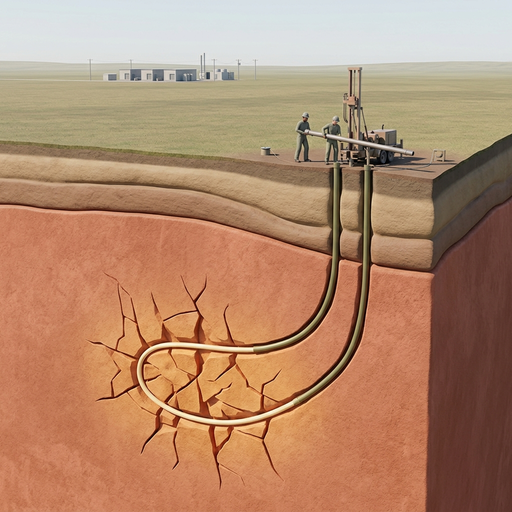
The idea behind enhanced geothermal systems — EGS, in the industry's shorthand — is disarmingly simple to state and ferociously hard to execute. Conventional geothermal is a gift of geology: nature provides hot rock, cracks full of water, and a path to the surface, and you stick a straw in. Enhanced geothermal is for everywhere nature did not bother: you drill two wells miles down into hot dry rock, you fracture the stone between them — creating, in effect, an artificial underground radiator of cracked hot granite — and you pump water down one well and bring it back up the other as steam hot enough to spin a turbine. The resource stops being a treasure hunt and becomes a construction project: anywhere the temperature gradient is favorable — and in much of the American West, the rock reaches steam-making temperatures at drillable depths — you can build a power plant where before there was only hot stone. The phrase the industry uses is that EGS turns geothermal from a resource play into a manufacturing play, and the distinction is the whole ballgame: resources run out and move around, but manufacturing scales, learns, and gets cheaper every time you do it.
The reason EGS is finally possible is the most unexpected technology transfer in the energy business: the shale revolution's toolkit. Everything that made enhanced geothermal a fantasy for fifty years — the drilling costs, the precision fracturing, the ability to steer a drill bit through miles of rock and know exactly where it is — is exactly what the American oil and gas industry spent the last two decades perfecting for fracking. Horizontal drilling that bends through miles of granite on purpose: invented for shale. Microseismic monitoring that maps fractures underground in real time: invented for shale. High-temperature drilling tools, diamond bits, mud systems that survive the heat: developed, debugged, and made cheap by the shale boom. The geothermal industry did not have to invent its tools. It inherited them from the industry it is theoretically trying to replace, along with the rigs, the crews, and the supply chains — which is why the companies leading the EGS charge are stuffed with oilfield veterans, and why the learning curve that took solar thirty years to climb might take geothermal ten. The ninety-nine million dollars from the Department of Energy is buying the proof of exactly that: twenty-one projects across the technology's remaining unknowns, and five field-scale demonstrations meant to show that the shale toolkit, pointed down instead of sideways, can manufacture power plants out of hot rock at commercial cost.
And the buyer waiting at the gate is the reason this is happening now rather than in ten years: the artificial-intelligence buildout this channel has been tracing all year. The data centers eating the grid need something the energy transition's two workhorses cannot provide — clean power that runs every hour of every day regardless of weather — and the list of technologies that can deliver it is brutally short: nuclear, hydro where it exists, gas with capture that barely exists, and geothermal. The hyperscalers — each one a hyperscaler, the industry's name for a cloud-computing giant whose data centers anchor the AI buildout — have figured this out and written the checks: purchase agreements for enhanced-geothermal power, direct investments in the leading EGS companies, and a technology-industry consensus, visible across two years of deal announcements, that the earth's battery is the missing piece of the AI grid. The economics rhyme with the politics: EGS plants are small, quiet, invisible from the road, and welcome in places that would never host a reactor or a wind farm, because the entire industrial plant is a few acres of pipes on the surface with a power station's worth of heat six miles down.
At My Audio Books dot A I, you can listen to this story and thousands of others that explore the hidden science and mechanics behind the headlines.
The strongest case for the geothermal decade — stated at full strength, because it might be right — starts with the resource math, which is not a projection but a survey: the technical potential of enhanced geothermal in the United States alone is measured in thousands of gigawatts, a figure so large that even the conservative versions of it dwarf the entire national grid's current capacity. It is clean, it is domestic, it is always on, and it needs no fuel, no storage, no transmission from distant deserts, and no weather. The learning curve is the strongest structural argument: the industry is standing on the shoulders of the most dramatic cost collapse in modern industrial history — shale drilling costs fell by an order of magnitude over two decades — and if even a fraction of that learning transfers, EGS goes from curiosity to workhorse on a timeline the energy transition desperately needs. The field tests now funded are the exact right experiment at the exact right scale: not lab work, not promises, but full-size plants drilling real wells into real rock, whose results will be measured in megawatts and dollars rather than press releases. And the strategic logic is impeccable: the country that invented the shale toolkit has more of it than anyone, and turning the oil industry's own weapons toward firm clean power is the kind of judo move energy transitions are supposed to be made of.
And the strongest case against — stated with the precision the geothermal veterans themselves insist on, because this technology has disappointed before — begins with the two words the industry does not like to say in public: induced seismicity. Cracking rock miles underground is, by definition, making small earthquakes on purpose, and the history of EGS includes the incident that nearly killed the field: the Basel project in Switzerland, shut down in two thousand and six after its fracturing triggered tremors that rattled a city. Modern microseismic monitoring has transformed that risk — the same tools that map the fractures can stop the pumps before the tremors grow — but the risk is managed, not eliminated, and one bad day at one field test could set the entire industry back a decade in public acceptance. The cost question is equally unsolved: drilling is still most of the cost of an EGS plant, and while the shale learning curve is real, geothermal wells are hotter, harder, and meaner on equipment than shale wells ever were — the tools inherit the tricks, not the prices, until the industry proves otherwise at scale. The resource has its own quiet catch: the best rock is in the West, the demand is in the East, and even always-on power needs wires to reach the data centers. And the deepest caution is the oldest one in energy: enhanced geothermal has been five years away for fifty years, through waves of funding and optimism that all ended the same way — and the people now promising the field tests will be different are, however good their tools, the latest in a long line of people who promised exactly that.
Three developments would disprove or confirm the geothermal decade in the years directly ahead, and each is measurable in public. First, the field tests' numbers: the five demonstrations now funded will produce cost-per-megawatt-hour figures that cannot be spun — if they land anywhere near the cost of gas-plus-carbon or new nuclear, the era has begun; if they land at the prices that killed the last five waves, the era is postponed again. Second, the seismic record: the industry's safety case now lives or dies on the monitoring data from the field tests themselves — a clean seismic record across thousands of fracturing events becomes the license to build anywhere, and a single Basel-scale incident becomes the argument that stops it. Third, the learning curve's slope: the industry's entire economics rest on drilling costs falling with each successive well the way shale's did — if the fifth well at each field test costs meaningfully less than the first, the manufacturing logic is real; if costs stay flat, geothermal remains a resource play wearing a manufacturing costume.
It is worth saying what this article has not claimed. It has not claimed enhanced geothermal is proven at commercial scale; the field tests exist precisely because it is not, and the article says so. It has not claimed the seismic risk is gone; it is managed, and the article presents Basel at full strength. It has not claimed geothermal can carry the grid alone; the resource math is enormous and the buildout will still take decades, and the article says that too. And it has not claimed the DOE funding is transformative by itself; ninety-nine million dollars is seed money for the proof, not the buildout. The claim here is narrower: the largest energy resource on Earth is, for the first time, reachable with tools that already exist, at a moment when the grid's biggest customer desperately needs exactly what it offers — and the test of that proposition is now funded, in the field, in public.
Which returns to the rock six miles down, and the strange reversal hiding inside the whole story. For two centuries, the energy industry dug into the earth looking for things to burn — coal, oil, gas — and the deeper it dug, the more it learned how to drill, fracture, and steer through stone. The earth's battery asks the industry to make one final use of everything it learned in the digging: not to take anything out of the rock, but to borrow its heat and leave the rock where it lies. The tools are the same. The crews are the same. The direction is down, as it always was. What changed is only the thing we're after — and the buyer waiting at the surface, counting the hours until the battery comes online.
At My Audio Books dot A I, you can create fiction, non-fiction, and turn your documents into audio, all stored in one place with a single subscription — plus get instant access to thousands of audiobooks and deep-dive investigations. Learn more today at My Audio Books dot A I.