The Druzhba Pipeline: Oil Transit, Supply Crises, and Europe’s Energy Dependence
Built to unite Soviet and European economies, the Druzhba oil pipeline became a source of strategic vulnerability as refineries grew dependent on its steady flow. Disruptions in 2007, 2019, and 2022 show that trade disputes, contamination, and sanctions can all halt supplies without a deliberate campaign of coercion—yet dependence still gives every actor along the route leverage and makes alternatives costly to build.
By MyAudioBooks.ai ·
Listen free: The Druzhba Pipeline: Oil Transit, Supply Crises, and Europe’s Energy Dependence
A pipeline named Friendship became one of the most contentious pieces of infrastructure on the European continent. In January two thousand seven, an argument over customs duties and transit fees abruptly halted the flow of crude oil toward refineries in Germany and Poland. Twelve years later, in April two thousand nineteen, millions of barrels of chemically poisoned crude quietly surged through the same network, corroding equipment and forcing an emergency shutdown across five nations. In August twenty twenty-two, an unsettled transit fee inside a European banking channel stopped pumping stations along the southern branch entirely. These crises revived a question that has shadowed the network since the height of the Cold War. Was the Friendship pipeline engineered from the beginning as an instrument of political coercion, or did decades of mutually profitable economic integration create strategic leverage entirely on its own?
At My Audio Books dot A I, you can create your own audiobooks from prompts, turn your documents into audio, all with one subscription, and store your items in your own personal library.
The physical origins of the system trace back to a diplomatic gathering in Prague. On December eighteenth, nineteen fifty-eight, the Council for Mutual Economic Assistance, known widely as Comecon, formally approved the construction of a transcontinental crude oil network. The objective was grounded in post-war industrial planning. European socialist states were transitioning their industrial bases from coal to petroleum to develop modern chemical industries, manufacture plastics and synthetic fertilizers, and fuel their expanding transportation sectors. The Soviet Union possessed expanding petroleum reserves and sought a dependable outlet to support allied economies across Central and Eastern Europe.
The name assigned to the project was Druzhba, the Russian word for Friendship, signaling socialist solidarity and planned economic integration. Construction began in nineteen sixty. The project operated as a shared undertaking among participating nations. Poland, Czechoslovakia, the German Democratic Republic, and Hungary each supplied machinery, steel pipe, specialized valves, and construction crews for the segments built across their respective territories. Deliveries reached partner states in stages, beginning with Czechoslovakia in nineteen sixty-two, Hungary and Poland in late nineteen sixty-three, and East Germany shortly after. By October nineteen sixty-four, the initial trunk system was fully commissioned.
To understand the political weight of this network, one must follow its geographic reach. A common historical misconception is that Druzhba was built specifically to transport crude from Western Siberia. In the late nineteen fifties and early nineteen sixties, the primary production base was anchored in the prolific Volga-Urals basin. Only later, as Soviet infrastructure expanded, were trunk connections built to incorporate major fields in Western Siberia, the Urals, and the Caspian basin. Druzhba was never a single pipeline from an isolated oilfield; it grew into an interconnected continental transport grid.
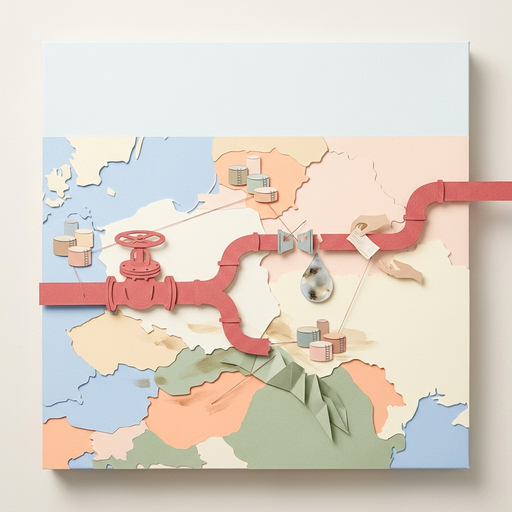
The network originates deep within the Russian pipeline system and travels west toward Belarus, arriving at the industrial junction of Mozyr. At Mozyr, the pipeline splits into two continental arteries. The northern branch crosses Belarus and central Poland, feeding the major Polish refinery at Płock before continuing directly into eastern Germany to supply massive refining complexes at Schwedt and Leuna. The southern branch crosses Ukraine, traverses the Carpathian Mountains, and reaches a distribution hub near Uzhhorod, where it divides to deliver crude into Slovakia, Hungary, and the Czech Republic.
Together, these branches form one of the longest and highest-capacity petroleum pipeline networks in existence. The International Association of Oil Transporters measures the core system at approximately five thousand five hundred kilometers, though counting regional loops, parallel pipes, and industrial spurs pushes the total network length considerably higher. In peak years, technical throughput reached roughly eighty million tonnes annually. In two thousand eighteen, the line carried approximately sixty-seven million tonnes, representing roughly one-quarter of all Russian crude exports that year.
For decades, direct overland delivery provided continuous, low-cost crude that insulated inland refineries from the volatility of maritime freight rates. Yet that same engineering efficiency created an inescapable upstream reality. A single pressure drop, valve adjustment, or contaminated batch thousands of kilometers away could alter the industrial output of multiple sovereign states at once.
Replacing a pipeline connection is fundamentally different from switching suppliers in a conventional consumer market. The primary obstacle is chemical. Petroleum refineries are not generic processing plants; they are bespoke chemical facilities calibrated to specific crude grades. Crude oil varies significantly in its density, measured by gravity, as well as its sulfur content, viscosity, and chemical composition.
Much of Central Europe's refining fleet was built specifically around Urals crude, an export blend characterized by medium density and relatively high sulfur content. If a refinery configured for Urals crude abruptly switches to a lighter, sweeter crude, or a heavier alternative, its operational yields shift immediately. Furnace temperatures must change, catalytic units can suffer rapid deactivation, and secondary conversion units like hydrocrackers may sit underutilized. Without substantial capital investments in new metallurgy, sulfur recovery plants, and blending facilities, switching feedstocks can permanently reduce the output of high-value transportation fuels like diesel.
The second obstacle is physical geography. A functioning pipeline is a continuous, pressurized hydraulic machine. It relies on an unbroken chain of mainline pumping stations, intermediate storage tank farms, quality-control laboratories, and custody-transfer metering facilities. Crude oil moves as an uninterrupted column through the steel pipe. Unlike maritime trade, where an importer can charter a different tanker from another ocean basin, a landlocked refinery connected to a dedicated pipe has no immediate physical alternative.
Coastal refineries in northern Germany or western Poland can access marine import terminals on the Baltic Sea. In contrast, inland facilities in eastern Germany, Slovakia, the Czech Republic, and Hungary are physically tethered to the overland routes that feed them. Rail transport and river barges can move marginal volumes, but they cannot match the continuous volume or low per-barrel cost of a large-diameter pipeline.
This engineering reality took on an entirely new character after nineteen ninety-one. When the Soviet Union dissolved, the single pipeline system suddenly crossed multiple newly independent nations. The physical asset did not move, but the legal, commercial, and political framework fractured overnight. Russia remained the principal upstream producer, while Belarus and Ukraine became essential transit nations, controlling the physical corridors through which crude reached European buyers.
Tariffs, customs arrangements, pumping fees, and maintenance responsibilities had to be negotiated across international borders. Dependence was no longer an internal planning calculation within Comecon; it became a series of sovereign bargaining relationships. Dependence exists whenever the cost of switching to an alternative is slow, expensive, or technically difficult. Coercion occurs when an upstream actor deliberately exploits that vulnerability to extract a political concession. Disentangling those two realities requires looking directly at moments when the oil stopped flowing.
The first major post-Soviet shock occurred in January two thousand seven. Following a bitter commercial disagreement over oil export duties and transit pricing, the Russian pipeline operator halted deliveries into the Druzhba system. Moscow accused Belarusian authorities of siphoning transit crude to cover disputed customs duties. Within hours, deliveries to refineries across Poland and Germany stopped without advance notice.
Downstream European customers found themselves cut off as collateral damage in an argument between Moscow and Minsk. The crisis was resolved in three days after intense bilateral negotiations over customs revenues, but the incident permanently altered European threat perceptions. It demonstrated that transit reliability was deeply vulnerable to commercial disputes in which downstream buyers had no direct voice. The shutdown was not a coordinated military or ideological assault on Western Europe; it was an aggressive pricing fight between two neighboring states that exposed the systemic risks of concentrated overland transit.
Twelve years later, an entirely different kind of breakdown occurred, driven not by geopolitics, but by industrial negligence and regulatory failure. In late April two thousand nineteen, laboratory technicians at the Mozyr refinery in Belarus discovered alarming levels of organic chlorides in the incoming crude. Organic chlorides are synthetic chemical compounds used in oilfields to dissolve heavy waxes and stimulate stubborn wells, but they must be stripped out before crude enters a commercial transport pipeline.
When heated in refinery atmospheric distillation towers, organic chlorides decompose into hydrochloric acid. That acid causes severe, rapid corrosion that can rupture furnace tubes, destroy overhead condensers, foul expensive catalysts, and create immediate risks of catastrophic fires or explosions. Standard industry operating thresholds permit roughly ten parts per million of organic chlorides. The crude entering Druzhba registered concentrations exceeding three hundred thirty parts per million.
The contamination was traced to an input hub near the Lopatino metering station in Russia's Samara region, where contaminated oil had been discharged from private storage into the main trunk line. European pipeline operators immediately sealed their intake valves to protect their facilities. Refineries with a combined processing capacity exceeding one point eight million barrels per day were suddenly paralyzed across Belarus, Poland, Germany, Ukraine, Slovakia, Hungary, and the Czech Republic.
The Oxford Institute for Energy Studies characterized the contamination as the most severe disruption in the pipeline's fifty-five-year commercial history. Russian federal investigators eventually arrested several individuals, uncovering a corrupt scheme to conceal the theft of crude oil by blending industrial waste back into the pipeline system.
It was an operational and governance disaster, not a calculated geopolitical strike. Clean crude began flowing progressively back into partner systems, reaching all destination states by June tenth, two thousand nineteen. Even so, cleaning millions of barrels of tainted crude from Polish storage and transit lines took until September. The disruption demonstrated that systemic vulnerability does not require hostile political intent; technical and regulatory breakdown inside a monopoly supplier can shut down a continent's fuel supply just as effectively.
The third mechanism emerged in the shadow of war. Following Russia's full-scale invasion of Ukraine in February twenty twenty-two, the European Union imposed sweeping sanctions on Russian crude oil imports. Crucially, the initial sanctions package deliberately exempted crude delivered via pipeline, specifically accommodating the acute technical and geographical constraints of landlocked states like Hungary, Slovakia, and the Czech Republic.
Then, in early August twenty twenty-two, transit through the southern branch of Druzhba suddenly stopped. This time, the physical pipeline was intact, crude supplies were plentiful, and no political decree had been issued to cut off supplies. The failure occurred inside the financial clearing system. Under European financial sanctions, a transit fee payment sent by Russia's pipeline operator to Ukraine's transit agency was rejected by a European intermediary bank.
Because the transit fee could not be processed, Ukrainian operators suspended transit pumping. The flow resumed within days only after national refining companies in Hungary and Slovakia directly paid the transit fees to the Ukrainian operator themselves. The incident revealed a modern reality: a functioning piece of physical infrastructure can be frozen simply because its financial clearing mechanisms run into the gears of international sanctions.
Comparing these three episodes clarifies an essential analytical distinction: dependence is a structural condition, whereas coercion is a deliberate choice. In two thousand seven, commercial bargaining over transit tariffs caused an accidental supply cutoff for downstream partners. In two thousand nineteen, criminal negligence and poor regulatory oversight produced a transnational industrial crisis. In August twenty twenty-two, compliance friction within the international banking sector halted pumping stations across the Carpathians. None of these individual disruptions fit the simplistic narrative of a producer turning an energy valve solely to force an ideological surrender.
Yet the structural leverage created by the steel in the ground remains entirely real. When a single pipeline supplies the lifeblood of an inland refinery, the supplier does not need to issue overt political threats for the vulnerability to shape national decisions. A government dependent on that line must weigh every foreign policy move, every sanctions package, and every regulatory dispute against the immediate prospect of industrial shutdown and fuel rationing at home.
Producer leverage, however, is not absolute; it is bounded by sharp economic realities. A pipeline is a fixed two-way relationship. While the buyer depends on the flow for energy, the seller depends on the flow for state revenue. Diverting millions of tonnes of crude away from a dedicated pipeline toward maritime markets requires spare tanker capacity, access to uncongested ports, and willing buyers. That often forces the producer to sell at steep discounts.
Furthermore, transit states control the geography through which the steel passes. Throughout the post-Soviet era, Ukraine and Belarus discovered that while they were vulnerable to upstream pressure, their territorial control over Europe's energy corridor gave them a powerful counterweight in negotiations with Moscow.
Ultimately, severe dependence forces customers to pay whatever cost is required to construct alternatives. Following the events of twenty twenty-two, northern branch recipients moved aggressively to cut their historical ties. Poland transitioned its Płock refinery to seaborne imports arriving at the port of Gdańsk. Germany severed Russian imports to Schwedt and Leuna, sourcing alternative crude via the German port of Rostock and international deliveries through Polish terminals. The northern route of Druzhba was effectively hollowed out by policy choice.
For landlocked nations on the southern branch, physical geography makes adaptation vastly more complex. Expanding the capacity of alternative pipelines, such as the Adria pipeline running north from the Croatian coast, requires capital expenditure, cross-border treaty negotiations, and physical upgrades to inland refineries. Diversification does not automatically eliminate vulnerability; it redistributes risk across new transit routes, port terminals, and commercial counterparties.
The Friendship pipeline began as an ambitious engineering solution to integrate industrial economies across thousands of kilometers. Decades later, it stands as an enduring case study in how physical infrastructure outlives the political world that created it. The next time an international headline warns of an energy cutoff, ask yourself the questions that untangle the drama: what precisely stopped, what failed inside the system, who held an alternative, and who was left bearing the cost?