The Common Swift Aloft: The Biology of Long-Distance Flight and Seasonal Migration
The common swift can spend roughly ten months away from its nest, crossing continents while feeding and drinking on the wing. Its extraordinary flight depends on efficient wings, steady supplies of airborne insects, favorable weather, and feathers renewed in flight—but scientists still cannot say exactly how it sleeps or whether it ever briefly lands. For all its freedom from the ground, the swift must return to a safe cavity to raise its young, making disappearing nest sites and declining insects threats to its aerial life.
By MyAudioBooks.ai ·
Listen free: The Common Swift Aloft: The Biology of Long-Distance Flight and Seasonal Migration
The common swift spends almost the entirety of its life in the air. Outside the brief window of the breeding season, this bird feeds, drinks, navigates continents, and is widely believed to sleep and mate without ever touching solid ground. That prolonged flight can last roughly ten consecutive months. Living aloft for most of a year sounds like an effortless biological triumph, but continuous flight demands an exacting physiological ledger. It requires solving the fundamental physical problems of energy, rest, and structural maintenance while moving through a fluid, unforgiving atmosphere.
At My Audio Books dot A I, you can create your own audiobooks from prompts, turn your documents into audio, all with one subscription, and store your items in your own personal library.
The common swift, known scientifically as Apus apus, is a small, soot-brown bird with long, scythe-like wings engineered for rapid, energy-efficient movement. Its breeding range covers large swaths of Europe and temperate Asia, while its non-breeding grounds stretch across the equatorial and southern zones of sub-Saharan Africa.
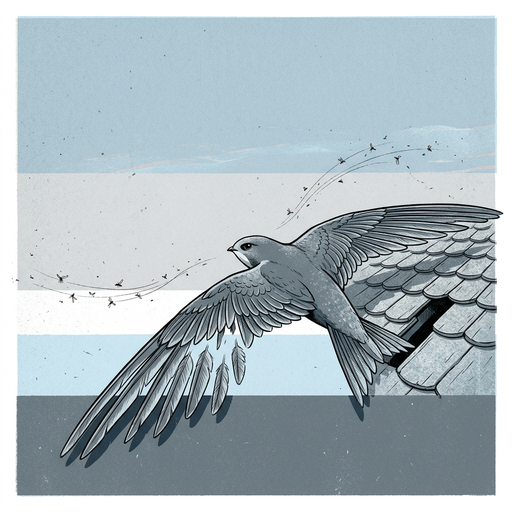
The annual cycle of the species is sharply divided into two distinct modes of existence. During the breeding months of late spring and early summer, swifts are tied to the earth. Midair reproduction is impossible: adults must incubate eggs, brood defenseless hatchlings, and shelter their young from predators and foul weather. For this phase, they depend entirely on dark, enclosed cavities located under the tiles of older houses, inside ventilation gaps of stone walls, or within craggy cliff fissures.
The famous ten-month claim applies strictly to the non-breeding season. Once the young fledge and disperse, adults leave their nesting cavities behind and move into an existence governed entirely by the atmosphere.
The exact duration of this airborne period varies considerably across populations and individuals. Latitude dictates when the brief summer bounty of insects begins and ends. Local storms can speed up or delay departure, while young non-breeders or adults whose nesting attempts failed early often head south weeks ahead of successful parents. No single calendar date or duration represents the species as a whole.
Measuring this prolonged aerial existence required new tracking technology. Researchers fitted returning swifts with tiny light-level geolocators, which record the exact timing of sunrise and sunset. By analyzing day length and solar noon, scientists can calculate daily geographical positions across thousands of kilometers. Because these loggers do not transmit their data, scientists must recapture the birds at their nesting cavities the following year to retrieve the records.
These light-level logs reveal broad migration paths and seasonal residency zones across Africa, though mathematical estimates of latitude become imprecise around the spring and autumn equinoxes. More fundamentally, an absence from a breeding colony is not identical to absolute, uninterrupted flight. Demonstrating that a bird left its nesting territory for ten months establishes that it did not return to its home cavity. It does not automatically prove that the swift never settled onto a high tree canopy or a remote rock face for a few minutes along the way. That distinction between geographic displacement and uninterrupted flight is where the deeper biological investigation begins.
The global movements of the common swift show that the species does not follow a single migratory template. Different breeding populations follow distinct flyways that match seasonal pulses of insect life across Africa.
Tracking studies on Swedish breeding populations revealed journeys that funnel birds directly into the humid equatorial forests and savannas of central Africa. In contrast, tracking work focused on an Italian breeding population showed that those birds traveled farther south, spending their non-breeding months primarily across Mozambique and neighboring parts of southeastern Africa.
In that Italian study, the tracked swifts departed their northern colonies between July seventh and July fourteenth, and returned between April twelfth and June fifth. Those dates describe the specific individuals sampled in that colony, rather than serving as an inflexible schedule for every swift across Europe.
A comprehensive study published in two thousand twenty uncovered a broader geographic architecture across European populations known as chain migration. Southern European breeders generally travel farther south to spend the non-breeding season in southern Africa, while northern European breeders settle in lower-latitude African regions farther to the north. This geographic leapfrogging spreads populations across different biomes, preventing hundreds of thousands of birds from descending on the exact same African food supplies at the same moment.
The eastern populations face an even more demanding geography. Between two thousand fourteen and two thousand eighteen, researchers tracked twenty-five swifts breeding at the Summer Palace near Beijing. Those birds completed an extraordinary round trip of approximately thirty thousand kilometers. They flew west across Inner Mongolia, cut across the arid plateaus of central Asia and the Arabian Peninsula, and crossed central Africa down to the dry scrublands of southwestern Africa before reversing the journey.
Their path is far from a straight line. The autumn journey exceeded the shortest theoretical flight path by approximately twenty-six percent, while the spring return exceeded it by roughly fifteen percent. The Beijing swifts do not choose their route based on Euclidean distance alone. They navigate along prevailing wind patterns and target regions where seasonal humidity creates temporary bursts of airborne arthropods, avoiding massive topographical barriers like the high Himalayas.
For European populations, the Sahara Desert presents a critical ecological crossing. Because swifts travel continuously aloft, they do not require terrestrial rest stops in the dunes. However, that aerial habit offers no protection if adverse winds or dust storms strike. Over thousands of square kilometers of arid sand, the air is largely barren of insect life. If a swift burns through its energetic reserves while battling headwinds across the desert, it cannot simply land and search for food on the ground. Crossing these barriers turns energy conservation from an aerodynamic advantage into a matter of survival.
To remain aloft for months, an animal must solve the daily problems of nutrition, hydration, rest, and reproduction entirely within moving air currents.
Feeding aloft is the engine that makes the entire life history of the common swift possible. Swifts prey on aeroplankton, an invisible drift composed of flying insects, wind-borne spiders, aphids, and midges swept up into the lower atmosphere. By patrolling the thermal boundaries above wetlands, canopy tops, and open fields, swifts harvest rich, localized concentrations of prey without ever touching a surface.
Hydration operates on similar principles. A significant portion of their water intake comes directly from the bodies of the insects they consume. When additional hydration is required, swifts glide low over calm freshwater lakes or wide rivers, touching the surface with their lower bill to scoop up water mid-flight. While this skimming behavior is regularly observed, the quantitative proportion of water derived from direct drinking compared to prey metabolism remains difficult to measure in wild populations.
Sustained flight introduces a far more difficult biological puzzle: the nature of sleep. Movement sensors can record flight altitude, acceleration, and wingbeat frequency, but they do not measure brain states. A detailed scientific review published in two thousand seventeen examined continuous flight tracking in both common swifts and Alpine swifts, concluding that existing tracking data do not prove whether these birds sleep during flight.
In other long-distance fliers, researchers have identified adaptive neurological mechanisms. Mallards resting on the edge of a flock, as well as frigatebirds performing multi-day oceanic journeys, can engage in asymmetric slow-wave sleep. In this state, one cerebral hemisphere enters slow-wave sleep while the other remains awake, keeping the corresponding eye open to scan for obstacles and maintain aerodynamic trim.
Frigatebirds also engage in short bouts of bilateral slow-wave sleep and even rapid-eye-movement sleep during soaring glides. These mechanisms offer plausible hypotheses for how swifts might manage rest aloft. Nevertheless, without direct electroencephalogram recordings measuring the electrical activity of a swift brain during extended migration, the duration, depth, and timing of sleep in Apus apus remain unresolved scientific questions.
Reproduction aloft carries similar complexities. Historical natural history records contain repeated descriptions of swifts performing rapid aerial chases, tumbling together through the sky in what appears to be courtship or attempted copulation. However, mating inside the dark shelter of the nesting cavity is thoroughly documented and routine. The evidence does not support an exclusively aerial mating life, nor does it establish how often high-speed airborne attempts lead to successful fertilization.
Remaining in the air for ten months is only viable if the energetic cost per kilometer is remarkably low. The body of the swift is shaped by aerodynamic optimization.
Its wings possess a high aspect ratio, meaning they are exceptionally long relative to their width. In fluid dynamics, this narrow wing geometry significantly suppresses the wingtip vortices that cause induced drag, allowing the bird to produce lift with minimal energy loss. The tapered, cigar-shaped body and flattened head further minimize parasite drag as air flows across the torso.
The swift relies on flap-gliding rather than relentless, continuous wingbeats. Powered flapping phases are regularly interspersed with long, descending glides, taking advantage of wind shears and warm rising air. Favorable winds can dramatically slash travel costs, but gliding is not energetically free. A gliding bird must continuously adjust flight feathers, modulate wing sweep, and stabilize its pitch against sudden turbulence, demanding active neuromuscular control.
When the bird flaps, its large pectoralis and supracoracoideus flight muscles demand an uninterrupted delivery of oxygen and fuel. Sustained flight relies almost entirely on aerobic lipid metabolism, burning fat stores accumulated before migration. While the broad mechanics of avian flight physiology are well understood, the specific seasonal cardiovascular and muscular adaptations of the common swift have not been mapped as exhaustively as those of species that can be easily studied in wind tunnels.
Weather dramatically alters the balance of this energetic budget. Headwinds can double or triple the power required to maintain a flight path, while violent rainstorms clear the sky of insects. Cold, wet air suppresses insect flight entirely, simultaneously cutting off the swift's caloric income and raising the energy required to maintain its internal body temperature.
Beyond fuel, continuous aerial life creates a severe mechanical maintenance problem: feather wear. Feathers are non-living structures composed of keratin. Over months of flight, they suffer constant abrasive wear from airborne dust particles, ultraviolet radiation, and the mechanical fatigue of millions of wing cycles. A frayed flight feather compromises lift and raises drag.
To solve this, swifts molt their primary flight feathers while airborne during the non-breeding season in Africa. Replacing flight feathers must be exquisitely slow and symmetrical, dropping and regrowing one or two feathers at a time so that the wing retains sufficient surface area for lift and maneuverability. Molt is a demanding metabolic investment that requires substantial protein synthesis, making feather renewal an active operational cost rather than a passive seasonal pause.
Other physiological costs remain largely unquantified. Navigating high-altitude winds exposes tissues to oxidative stress from prolonged aerobic exertion. The immune system may face complex trade-offs when resources are funneled into flight muscles rather than pathogen defense. Tracking can show where a bird travels and how fast it moves, but measuring these cellular and metabolic costs in a wild, free-flying bird remains one of modern biology's frontier challenges.
The extraordinary life of the common swift represents an evolutionary bargain. Every adaptation that liberates the bird from the ground simultaneously ties it more tightly to the atmosphere.
The advantages of this specialization are profound. By spending months aloft, swifts eliminate the threat of terrestrial ground predators that ambush roosting birds at night. They can exploit transient, highly dispersed insect swarms across hundreds of kilometers in a single afternoon. When drought or unseasonable cold impacts one valley, a swift can relocate to an entirely different watershed within hours.
Yet those same advantages create rigid ecological dependencies. Because the swift cannot effectively forage on the ground, scratch through leaf litter, or feed on seeds, its survival depends entirely on the continuous abundance of flying arthropods. If widespread pesticide use, habitat loss, or climate fluctuations suppress insect biomass, the swift has no alternative foraging strategy.
The chain migration pattern that distributes European swifts across Africa spreads population pressure, but it also locks distinct breeding groups into separate environmental vulnerabilities. If drought desiccates southeastern Africa, Italian swifts may face elevated mortality, while Swedish birds wintering thousands of kilometers to the northwest in central African forests remain unaffected.
The sharpest bottleneck in this entire annual cycle occurs not in the open sky, but at the nesting cavity. An animal that spends ten months traversing continents without touching the earth remains utterly bound to a physical crevice for two months each summer. In modern Eurasian cities, older buildings with exposed eaves, broken roof tiles, and accessible masonry gaps are systematically renovated and sealed for thermal insulation. Modern architectural design frequently eliminates nest sites, leaving populations with fewer places to lay their eggs, even where skies remain rich in insect prey.
The ten-month aerial life of Apus apus is not an effortless display of airborne mastery. It is a finely balanced ecological equation. The ability to cross oceans of air without landing requires high aspect ratio wings, an efficient metabolic engine, and precise, progressive feather replacement.
Fundamental questions about this life remain open: how often non-breeding birds might touch down during severe weather anomalies, how their brains regulate sleep while navigating nocturnal winds, and how annual energy expenditure is partitioned between calm transit and harsh barrier crossings.
The swift carving wide arcs above a summer rooftop belongs to two different worlds. Its independence from the earth is astonishing, but that freedom remains anchored to the abundance of insects, the mercy of the weather, and a secure crevice in which to raise the next generation. As you observe the sky in the days ahead, consider how even the most specialized creatures remain bound to the fragile systems beneath their wings.