The CIA Dart Gun: Cold War Toxins, Church Committee, and the Facts Behind the Myth
The CIA’s 1975 “heart attack gun” was a real Cold War prototype designed to fire toxin-laced darts, but its legend as an invisible, untraceable assassination weapon far exceeded the evidence. The Church Committee’s greater revelation was that the CIA had secretly retained lethal toxins for years after President Nixon ordered them destroyed, exposing how secrecy and weak oversight allowed prohibited capabilities to survive.
By MyAudioBooks.ai ·
Listen free: The CIA Dart Gun: Cold War Toxins, Church Committee, and the Facts Behind the Myth
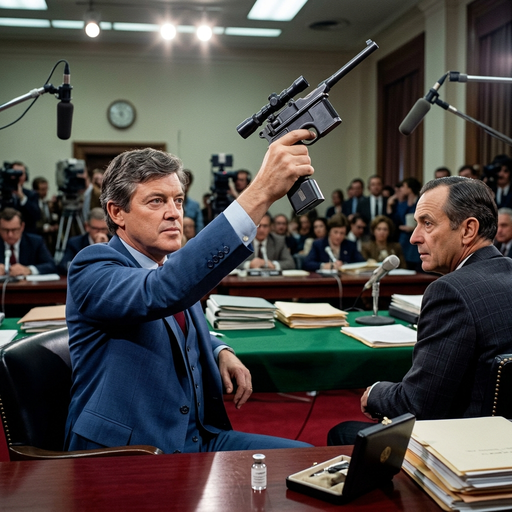
On September sixteenth, nineteen seventy-five, Senator Frank Church raised a dark, pistol-shaped weapon before a bank of television cameras and pointed it toward the ceiling of a Senate hearing room. Sitting across the witness table, Director of Central Intelligence William Colby confirmed its nature: a customized, battery-powered handgun engineered to launch a poison-tipped dart almost silently over a distance of one hundred meters.
Within days, headlines and popular lore christened the device the heart attack gun, claiming it could strike an unsuspecting target and induce an undetectable cardiac arrest without leaving a mark. The physical weapon was entirely real, entered into the official Senate record under bright television lights. Yet beneath the dramatic demonstration lay a far more complicated reality. Cold War laboratory engineering had collided with persistent folklore. The deeper scandal was not a miraculous murder weapon, but an intelligence agency that had quietly defied direct orders from the President of the United States.
At My Audio Books dot A I, you can create your own audiobooks from prompts, turn your documents into audio, all with one subscription, and store your items in your own personal library.
To understand how a poison dart gun arrived on a Senate witness table, we have to look back to the early years of the Cold War. In the early nineteen fifties, the Central Intelligence Agency established a close, highly compartmentalized working partnership with the United States Army Biological Laboratories at Fort Detrick, Maryland. Operating under the administrative cover of the Army's Special Operations Division, this joint venture took the cryptonym Project MKNAOMI.
While MKULTRA explored behavioral modification and psychoactive substances, MKNAOMI focused squarely on the material tools of biochemical warfare. The program had two primary objectives: maintaining an arsenal of lethal biological toxins and designing specialized, concealable dissemination systems that could incapacitate or kill targeted individuals during covert operations. Over two decades, Fort Detrick technicians experimented with an array of exotic materials, including food-poisoning toxins, paralytic venoms, anthrax, and chemical crop defoliants. Alongside these substances, technicians manufactured disguised delivery mechanisms: fountain pens that expelled toxic mists, aerosolized engine exhausts, and mechanical dart systems designed to puncture skin or clothing.
This technical work took place alongside high-level executive discussions regarding foreign interventions. During the nineteen fifties and early nineteen sixties, senior covert operations officials pursued schemes against several foreign leaders, including Patrice Lumumba in the Congo and Fidel Castro in Cuba. Historical records confirm that the agency developed lethal biological compounds intended for operations against Castro. However, the physical dart gun displayed years later emerged from a broad technical research program, rather than a single targeted plot.
The existence of this covert arsenal became untenable in late nineteen sixty-nine, when President Richard Nixon conducted a comprehensive review of the nation's chemical and biological defense posture. In November nineteen sixty-nine, Nixon formally renounced offensive biological weapons. He ordered the military to dismantle its stockpiles and restrict all future biological work strictly to defensive measures, such as vaccines and protective gear. Three months later, in February nineteen seventy, Nixon expanded that executive ban to encompass all toxins, whether produced through biological fermentation or synthetic chemical processes.
Under the terms of the presidential directive, the Department of Defense and the CIA received explicit instructions to destroy their toxic inventories. The Army systematically autoclaved and incinerated its massive bulk stocks of viral and bacterial agents at Fort Detrick. The covert laboratory programs appeared to be closed, their lethal compounds dismantled, and their research records transferred to archive repositories. In theory, the covert toxin capability had ceased to exist. In reality, a lethal reserve remained quietly intact, waiting to be uncovered.
Five years after the destruction order, American political life was shaken by revelations of intelligence overreach. Following the Watergate scandal, investigative reporting by Seymour Hersh in The New York Times exposed extensive domestic surveillance and covert operations. The revelations prompted immediate congressional action. In January nineteen seventy-five, the United States Senate voted eighty-two to four to establish the Select Committee to Study Governmental Operations with Respect to Intelligence Activities. The panel soon became known simply as the Church Committee, named after its chairman, Senator Frank Church of Idaho.
The committee launched the most expansive public investigation of the American intelligence apparatus ever undertaken. Over fifteen months, investigators conducted one hundred twenty-six full committee meetings and forty subcommittee hearings. They interviewed roughly eight hundred witnesses and examined more than one hundred ten thousand pages of declassified records.
When public televised hearings began on September sixteenth, nineteen seventy-five, the committee opened with an investigation into the unauthorized storage of toxic agents. Church called Director William Colby to testify about materials uncovered in agency facilities. Church asked whether the agency possessed devices specifically designed to deliver deadly toxins. Colby confirmed that it did, opening a wooden case to present the modified pistol.
Church picked up the gun, holding it aloft for the television cameras. As reporters recorded the moment, Colby outlined its technical specifications based on internal agency documentation. The device was built around the frame and slide of an ordinary Colt forty-five-caliber semiautomatic pistol. Technicians had heavily altered the weapon, installing a specialized barrel, an internal electric contact switch, and a telescopic sight mounted along the top. Instead of using gunpowder cartridges, the grip housed a small battery that powered an electric propulsion mechanism.
According to Colby's testimony, the firing mechanism launched an extremely small, thin dart, roughly the width of a human hair and approximately a quarter of an inch in length. Colby stated that the weapon operated almost without sound, producing no muzzle flash and no explosive report. He added that the system possessed an effective operational range of roughly one hundred meters.
The demonstration created an immediate sensation, but it also masked a critical distinction between hearing testimony and proven ballistic performance. The agency never test-fired the weapon in the hearing room. Nor did the committee conduct independent ballistics or accuracy trials. Assertions about the gun's absolute silence, its stability in flight, and its ability to propel a hair-thin dart across the length of a football field came directly from internal design claims. The hearing established that the agency had constructed an exotic dart gun. It did not prove how reliably that weapon could perform in the field.
The popular reputation of the weapon hinged not on its modified forty-five-caliber frame, but on the chemical payload it was designed to deliver: a compound called saxitoxin.
Saxitoxin is an extraordinarily potent non-protein neurotoxin naturally synthesized by certain species of marine dinoflagellates, microscopic algae that form the base of ocean food chains. When filter-feeding shellfish consume large blooms of these algae, commonly referred to as red tides, they accumulate the toxin in their tissues without being harmed. When humans ingest contaminated clams or mussels, the compound causes paralytic shellfish poisoning, a condition documented for centuries in coastal communities.
At the cellular level, saxitoxin acts as an exceptionally selective sodium channel blocker. To generate electrical impulses and communicate with muscle fibers, human nerve cells rely on the controlled flow of positively charged sodium ions through microscopic channels embedded in the cell membrane. Saxitoxin molecules bind tightly to the outer pore of these voltage-gated sodium channels, physically plugging the opening like a cork in a bottle.
This molecular blockage brings the transmission of electrical nerve signals to a sudden halt. As communication between the nervous system and peripheral muscles breaks down, the patient develops rapid numbness in the lips and fingers, followed by generalized flaccid muscle weakness and progressive paralysis. In severe, unmanaged poisoning, the paralysis strikes the diaphragm and the intercostal muscles that control the rib cage. The individual loses the mechanical ability to inhale, leading directly to asphyxiation and respiratory arrest. As oxygen levels in the blood plummet, the heart eventually stops beating from severe hypoxia.
This biological sequence is where the legend of the heart attack gun diverges from clinical toxicology. A fatal dose of saxitoxin causes death by respiratory paralysis, not by a primary myocardial infarction. A genuine heart attack occurs when a coronary artery becomes physically blocked by a blood clot or plaque rupture, starving the heart muscle itself of blood. Saxitoxin leaves the coronary arteries completely open, shutting down the mechanical act of breathing until the heart fails as a secondary consequence of suffocation.
In nineteen seventy-five, routine post-mortem toxicology panels did not screen for rare marine toxins. If an individual collapsed unexpectedly without obvious trauma, a local coroner might easily attribute the death to sudden cardiovascular collapse. That diagnostic gap created the theoretical possibility that an induced paralysis could be mistaken for a natural event.
Yet theoretical plausibility is not the same as forensic invisibility. In the decades following the hearings, popular retellings embellished the story. Rumors claimed the weapon fired a dart made of frozen water that melted inside the bloodstream, leaving no puncture and no residue. However, neither the Church Committee testimony nor declassified project files support this frozen dart narrative. The actual laboratory records describe metallic and composite micro-darts engineered to penetrate clothing and skin. Furthermore, while identifying trace quantities of saxitoxin was difficult for municipal coroners in the nineteen seventies, modern analytical chemistry can detect the compound at minute concentrations. A failure to detect a rare poison during a routine examination reflects the limits of standard tests, not permanent forensic invisibility.
The weapon documented at the hearing was a research prototype, an artifact of covert laboratory experimentation. The real legal crisis lay not in how the weapon had been used, but in what investigators discovered sitting in an unauthorized vault.
While the dramatic exhibit captured public attention, the hearing centered on an institutional crisis. The agency had retained an unauthorized stockpile of lethal biological agents in direct violation of a presidential order.
During the committee's staff investigation, researchers uncovered an agency document dating back to nineteen seventy, drafted shortly after President Nixon ordered the destruction of all toxin reserves. The memorandum discussed whether small quantities of select biological materials should be quietly preserved for research and contingency operations. Acting on this internal momentum, an agency scientist arranged to transfer a cache of refined toxins out of Fort Detrick. The material was moved into a storage vault at the Navy Bureau of Medicine and Surgery in Washington, District of Columbia.
When committee investigators inventoried this forgotten repository, they discovered approximately eleven grams of purified saxitoxin and eight milligrams of cobra venom. To put that quantity into context, committee staff cited toxicological estimates indicating that eleven grams of concentrated saxitoxin represented roughly ten thousand to twenty thousand lethal doses if administered directly.
Colby did not contest the presence of the toxins. Instead, his testimony framed the retention as an isolated breakdown in organizational discipline. Colby explained that a mid-level scientist within the agency's Technical Services Division had decided unilaterally to preserve the cache. That scientist reportedly believed that synthesizing high-purity toxins was an expensive, difficult achievement that should not be wasted. According to Colby, this decision occurred entirely without the knowledge or authorization of the Director of Central Intelligence or the White House.
The committee's final report rejected this individual rogue actor explanation as an adequate defense of the institution. Whether the stockpile was retained by deliberate organizational calculation or through the unchecked initiative of an individual technician, the presence of the toxins exposed an alarming absence of internal oversight. An intelligence agency operating within a constitutional democracy had preserved banned biological agents for five years after the Commander-in-Chief had ordered their total elimination.
The hearing demonstrated that the true danger exposed by the Church Committee was not simply the existence of specialized weaponry, but the failure of accountability. When secrecy shielded every decision, lethal materials could outlive the policies designed to destroy them, transforming a single laboratory artifact into a national symbol.
The image of Senator Frank Church gripping the modified pistol became one of the defining visual symbols of nineteen seventies political reform. The photograph circulated globally because it rendered the invisible, abstract world of covert operations immediately concrete. One physical object crystallized decades of hidden research, foreign intervention plots, and secret stockpiles.
Yet the iconic power of that image also created an intellectual hazard. It encouraged the public to conflate the proven existence of an unusual artifact with the unproven reality of every myth surrounding it. In the public imagination, a real, customized target pistol became proof that the CIA possessed a fleet of invisible assassination devices capable of striking down political figures without detection.
When we examine the historical outcomes, the Church Committee's real legacy was not the confiscation of exotic hardware, but the construction of a legal and legislative architecture to constrain intelligence operations. The immediate political shock of the hearings prompted the executive branch to alter its standards of conduct. In February nineteen seventy-six, President Gerald Ford signed Executive Order eleven thousand nine hundred five. The order established the first explicit presidential ban prohibiting American intelligence agencies from participating in political assassinations. That prohibition was reaffirmed and refined by President Jimmy Carter in nineteen seventy-eight and President Ronald Reagan in nineteen eighty-one, establishing a durable executive doctrine.
Simultaneously, the legislative branch moved to end decades of casual, informal intelligence monitoring. In May nineteen seventy-six, the United States Senate established the permanent Senate Select Committee on Intelligence, followed the next year by the creation of the House Permanent Select Committee on Intelligence. These standing committees replaced informal briefings with mandatory reporting requirements, legal budget oversight, and regular committee reviews of covert action findings. The era in which an agency could quietly maintain private caches of prohibited biological materials without legislative scrutiny was brought to a close.
Looking back across five decades, several historical questions remain permanently unresolved. Declassified records do not resolve whether agency units ever conducted field trials with similar dart technology abroad. Nor do they clarify how reliably a lightweight micro-dart could stabilize in outdoor wind conditions over real operational distances. In historical research, an absence of documentation does not prove successful concealment, just as it cannot guarantee that no other tests occurred. What the record provides is a clear boundary between established fact and persistent speculation.
As you reflect on this chapter of history, the enduring lesson lies in the discipline of separating evidence from legend. A physical artifact, real testimony about its intended engineering, the documented failure of executive command, and dramatic claims of unprovable assassinations represent entirely distinct historical propositions. By anchoring our understanding in the official record rather than popular mythology, we see the dart gun for what it truly was. It was not a supernatural tool of untraceable murder, but a warning of what happens when state power operates in the dark without meaningful restraint.
To examine the primary sources behind this investigation, you can read the complete transcripts and final reports of the Church Committee, preserved in the National Archives and congressional document repositories. If this analysis sharpened your perspective on the line between historical fact and popular legend, share it with someone who values verifiable history, and take time to explore the declassified record for yourself.