The Arecibo Telescope: Cosmic Discoveries, Planetary Radar, and a Hidden Structural Failure
Arecibo’s 1974 message is still traveling toward the stars, but the Puerto Rican telescope that sent it collapsed in 2020. Far more than a messenger to aliens, Arecibo helped confirm Einstein’s predictions, discover the first known exoplanets, and track potentially dangerous asteroids. Its fall, traced to hidden deterioration in its support cables, left a scientific and cultural loss that other observatories cannot fully replace.
By MyAudioBooks.ai ·
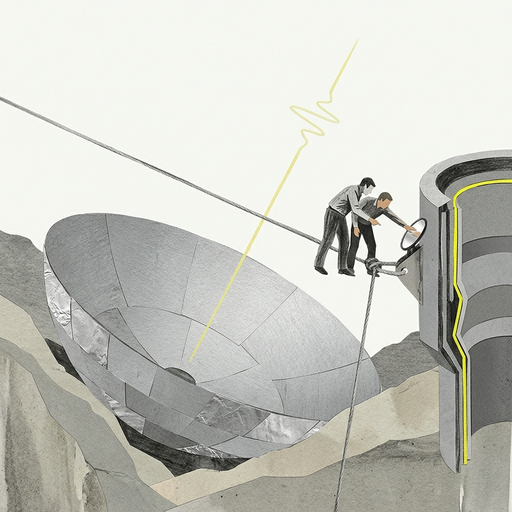
On November sixteenth, nineteen seventy-four, a radio telescope nestled in the limestone hills of northwestern Puerto Rico beamed an encoded portrait of humanity toward a dense star cluster twenty-five thousand light-years from Earth. That radio signal is still traveling across deep space, having crossed less than one-fifth of one percent of the vast distance to its target. The colossal machine that launched it is gone. On the morning of December first, two thousand twenty, the telescope's nine-hundred-ton instrument platform tore free from its support cables and plummeted into the aluminum reflector bowl below.
That catastrophic collapse ended nearly six decades of frontline scientific exploration. To understand what truly died in that valley, we have to look past the romantic myth of broadcasting to alien civilizations. We must examine how a daring piece of structural engineering transformed human understanding of gravity, revealed planets beyond our solar system, and shielded Earth from invisible hazards, before a microscopic material flaw brought it crashing down.
At My Audio Books dot A I, you can create your own audiobooks from prompts, turn your documents into audio, all with one subscription, and store your items in your own personal library.
Millions of years of tropical rain carved the dramatic limestone karst landscape of northwestern Puerto Rico, dissolving deep natural sinkholes across the terrain. By the late nineteen fifties, engineers and atmospheric physicists realized that one of these massive depressions south of the municipality of Arecibo offered an ideal natural cradle for an unprecedented scientific instrument.
Conventional radio observatories rely on motorized steel dishes that rotate on mechanical tracks. When an antenna spans hundreds of feet, the physical weight of structural steel becomes an insurmountable engineering obstacle. By laying the primary reflector directly into the contours of a natural limestone bowl, the designers allowed the bedrock of Puerto Rico to support the immense dead load of the structure.
When the observatory opened in November nineteen sixty-three, its reflector spanned three hundred five meters, or exactly one thousand feet. For more than fifty years, until the commissioning of China's FAST telescope in two thousand sixteen, Arecibo reigned as the largest single-dish radio telescope on Earth. In its final operational configuration, the dish comprised roughly forty thousand perforated aluminum panels suspended over the forested sinkhole.
A radio telescope does not listen for audible vibrations. It collects electromagnetic radiation at radio wavelengths, which arrive at Earth carrying minuscule amounts of energy from across the cosmos. Gathering enough radio photons to detect requires an exceptionally large collecting area, which gathers faint waves and focuses them onto specialized receivers.
Most steerable radio dishes are parabolic, reflecting parallel radio waves directly to a single focal point. If you fix a parabolic bowl permanently into the ground, however, you can only observe whichever celestial target happens to pass directly overhead. Arecibo solved this limitation by shaping its reflector as a sphere rather than a paraboloid.
A spherical surface reflects incoming radio waves along a focal line rather than a single focal point. This optical geometry allowed instruments suspended high above the bowl to intercept radio waves entering from different angles. Engineers suspended a triangular steel platform weighing nine hundred tons four hundred fifty feet in the air, hanging it from eighteen heavy steel cables anchored to three reinforced concrete towers.
A major upgrade in the nineteen nineties added a massive Gregorian dome beneath that platform, housing secondary and tertiary mirrors that eliminated spherical distortion. By steering receiver feeds along a curved track high above the dish, astronomers could direct the telescope's line of sight up to twenty degrees away from the vertical. As Earth rotated on its axis, celestial bodies drifted through that accessible window. Positioned at eighteen degrees north latitude, Arecibo enjoyed prime access to our solar system's planets, the equatorial Milky Way, and Earth's upper atmosphere. This position enabled two complementary disciplines: passively listening to natural cosmic emissions, and actively pinging our planetary neighborhood with high-power radar.
Much of Arecibo's historical reputation rested on its unmatched passive sensitivity. By gathering radio emissions across twenty acres of aluminum, the telescope could detect signals far too faint for smaller, steerable antennas to register. This extreme sensitivity made Arecibo the premier instrument for investigating pulsars.
Pulsars are rapidly spinning neutron stars, the collapsed cores left behind by cataclysmic supernova explosions. Packing more mass than our Sun into a dense sphere roughly twenty kilometers across, they generate immense magnetic fields that beam intense streams of radio waves into space. As these stellar remnants rotate hundreds of times per second, their radio beams sweep past Earth like cosmic lighthouses. Radio receivers record these sweeps as exceptionally regular pulses, providing astronomers with the most precise natural clocks in the universe.
In nineteen seventy-four, astronomers Russell Hulse and Joseph Taylor used Arecibo to discover the first known binary pulsar, cataloged as PSR B nineteen thirteen plus sixteen. The system consisted of a pulsar locked in an intimate, eight-hour gravitational orbit with an unseen companion neutron star. By measuring minute shifts in the arrival times of the radio pulses, Hulse and Taylor tracked the pair's orbital dynamics with exquisite precision.
Over years of systematic observation, they discovered that the two neutron stars were gradually spiraling inward, their mutual orbit shrinking by roughly three millimeters per revolution. Albert Einstein's general theory of relativity predicted that massive bodies accelerating through spacetime should radiate ripples known as gravitational waves, draining energy from their orbit.
The measured rate of orbital decay matched Einstein's mathematical predictions with startling accuracy. This marked the first indirect experimental proof of gravitational radiation, transforming theoretical physics and earning Hulse and Taylor the nineteen ninety-three Nobel Prize in Physics.
Eighteen years later, Arecibo broke new ground once again. In nineteen ninety-two, astronomers Aleksander Wolszczan and Dale Frail analyzed timing anomalies in radio emissions from another pulsar, designated PSR B twelve fifty-seven plus twelve. The minuscule irregularities in pulse arrival times revealed the subtle gravitational tugs of orbiting companions.
They had discovered the first confirmed planets ever detected beyond our solar system. The discovery proved that planetary systems could assemble or endure in the harsh radiation environments surrounding dead stars, fundamentally broadening the search for worlds across the galaxy years before optical telescopes detected planets orbiting Sun-like stars.
Beyond compact stars, Arecibo mapped diffuse reservoirs of neutral hydrogen gas throughout interstellar space using the classic twenty-one-centimeter spectral line. By tracking how this neutral gas rotated within distant galaxies, astronomers gathered foundational evidence for the gravitational influence of dark matter.
At the same time, the facility fulfilled a critical terrestrial mission as the National Astronomy and Ionosphere Center. By firing radio waves into the upper atmosphere, researchers analyzed how the ionosphere's plasma responded to solar flares, geomagnetic storms, and atmospheric tides, establishing vital insights into the space weather that surrounds our planet.
While most astronomical dishes function strictly as passive listeners, Arecibo possessed a second identity: it was an active radar transmitter capable of projecting megawatt-scale radio beams into deep space.
Planetary radar operates on a straightforward principle. The observatory directs a powerful, focused radio pulse toward a celestial body within our solar system and waits to capture the faint echo that bounces back to Earth. The round-trip travel time reveals the object's precise distance with sub-kilometer accuracy.
The Doppler frequency shift of the returning signal reveals its velocity and rotation, while minute variations across the echo allow computers to resolve surface roughness, identify impact craters, and construct complete three-dimensional models of targets millions of miles away.
This capability made Arecibo an indispensable pillar of planetary defense. Optical telescopes can track an asteroid's path across the night sky, but projecting that path decades into the future carries compounding positional uncertainties. A single radar observation from Arecibo could shrink those orbital error calculations by a factor of thousands, immediately clarifying whether a near-Earth object posed a genuine impact threat to our planet.
Radar measurements obey the inverse-fourth-power law. The outgoing beam weakens with the square of the distance traveling toward the target, and the returning echo weakens with the square of the distance traveling back to Earth. This steep physical constraint limits planetary radar to our immediate solar neighborhood. Arecibo could map the scorching surface of Venus through its perpetual cloud deck, detect deposits of water ice hidden within permanently shadowed craters at the lunar poles, and image asteroids cruising past Earth, but it could never hope to bounce a radar echo off another star system.
An interstellar message, however, operates under the simpler inverse-square law. It travels along a one-way trajectory, requiring only enough initial energy to be detected by a distant receiver. On November sixteenth, nineteen seventy-four, the observatory marked a major hardware upgrade by transmitting a deliberate digital signal toward Messier thirteen, a globular cluster containing hundreds of thousands of stars roughly twenty-five thousand light-years from Earth.
Devised by astronomer Frank Drake with contributions from Carl Sagan, the transmission consisted of exactly one thousand six hundred seventy-nine binary bits. That specific number is a semiprime, formed by multiplying the prime numbers twenty-three and seventy-three.
The mathematical structure served as an intentional puzzle for an intelligent recipient, hinting that the one-dimensional stream of ones and zeros should be unpacked into a two-dimensional grid measuring twenty-three characters wide by seventy-three characters tall.
When assembled correctly, the digital grid revealed a visual primer of human knowledge. It began with the basic numerals from one through ten in binary notation, followed by the atomic numbers of hydrogen, carbon, nitrogen, oxygen, and phosphorus, the fundamental chemical building blocks of terrestrial life. It continued with the molecular formulas for the sugars and bases that compose DNA, accompanied by a crude depiction of the double helix.
Beneath the biology, the message displayed a stylized stick figure of a human being flanked by figures indicating human height and the global population at the time. Finally, it showed a diagram of our solar system highlighting Earth, positioned directly above an outline of the Arecibo dish itself.
The nineteen seventy-four broadcast was a technological demonstration and a symbolic cultural artifact rather than a practical attempt to open a conversation. Because Messier thirteen lies twenty-five thousand light-years away, an exchange of messages would demand a waiting period of at least fifty thousand years. In fact, over the next twenty-five millennia, the targeted star cluster will have drifted out of the narrow beam's path.
The transmission illustrated humanity's technological maturity, but active transmissions remained an exceptional event. For the rest of its operating life, Arecibo's contribution to the search for extraterrestrial intelligence focused on passive listening, scanning celestial frequencies for artificial technosignatures while keeping its transmitters focused squarely on the worlds of our own solar system.
The structural collapse of Arecibo began quietly in the early morning hours of August tenth, two thousand twenty. At around three AM, an auxiliary support cable tore free from its socket anchor high atop Tower Four. The whipping cable crashed through the reflector bowl below, slicing a thirty-meter gash through the aluminum surface and damaging roughly two hundred fifty panels.
These auxiliary cables had been added during the nineteen nineties to help support the added weight of the Gregorian dome. Initial engineering assessments concluded that the damage, while severe, was repairable. Engineers developed stabilization plans and placed orders for replacement cables.
Three months later, on November sixth, a second cable failed on the very same tower. This time, it was not an auxiliary line, but one of the massive main support cables that had held the instrument platform aloft since the observatory opened in nineteen sixty-three. The cable parted in calm, benign weather, while carrying only about sixty percent of its rated minimum breaking capacity.
The failure of a primary cable fundamentally shifted the physics of the site. In a suspended network, the loss of one major tension element instantly redistributes heavy mechanical stress onto the surviving lines. High-resolution drone inspections revealed broken individual wire strands across other remaining cables. The structural margin of safety had completely evaporated.
Multiple independent engineering firms surveyed the site and reached a grim consensus: the remaining cables were unstable and unpredictable. Attempting to send repair crews up the towers or onto the platform would place human lives at catastrophic risk. On November nineteenth, two thousand twenty, the National Science Foundation announced that the historic telescope would be permanently decommissioned and safely dismantled.
The structure could not wait for controlled demolition. On the morning of December first, two thousand twenty, just before eight AM, the remaining support cables connecting Tower Four to the platform snapped in rapid succession. Deprived of its southern anchors, the nine-hundred-ton instrument platform swung violently through the air on its surviving lines, snapped the remaining cables, and plummeted four hundred fifty feet directly into the reflector dish.
The top portions of the reinforced concrete towers sheared off under the sudden shock load, sending debris tumbling down the hillsides. Because the facility had been evacuated weeks earlier, no one was injured.
In October two thousand twenty-four, the National Academies of Sciences, Engineering, and Medicine released their comprehensive forensic investigation into the collapse. The report pinpointed the root cause not on sudden external trauma, but on a hidden material mechanism known as accelerated zinc creep within the cable spelter sockets.
A spelter socket is a heavy steel termination used to anchor wire rope. The individual steel strands of a cable are unraveled, splayed inside a conical steel housing, and locked in place by pouring molten zinc around them, creating a solid composite wedge. Under normal conditions, zinc is a durable potting metal. However, zinc is inherently vulnerable to creep, a physical process where a metal gradually deforms and flows under sustained mechanical stress well below its tensile strength.
For nearly six decades, the cables supporting Arecibo held massive dead loads under continuous high tension in a tropical environment. Sustained mechanical stress combined with Puerto Rico's tropical heat and high humidity accelerated the slow deformation of the zinc inside the sealed sockets.
Over decades, the zinc gradually flowed, allowing the high-strength steel strands to slip incrementally until their mechanical grip failed. Because this degradation was sealed entirely inside solid steel sockets, it remained invisible to standard external visual inspections.
Environmental shocks accelerated this progressive degradation. Hurricane Maria had battered the island in September two thousand seventeen, subjecting the cables to violent peak wind oscillations. A sequence of significant earthquakes shook southwestern Puerto Rico in early two thousand twenty, followed by decades of ambient corrosion from coastal marine air.
Yet the primary structural failure was metallurgical and chronological: an aging socket design subjected to constant static tension, where internal zinc creep quietly undermined the integrity of the telescope's suspension system.
When the instrument platform shattered across the valley floor, it marked the end of a unique scientific capability. Arecibo had unified massive physical scale, high-power planetary radar, agile instrumentation, and a near-equatorial latitude into a single facility. No other observatory in the world duplicated that complete suite of tools.
Planetary radar sustained the most immediate blow. Following Arecibo's destruction, the task of radar-tracking near-Earth asteroids fell almost entirely to NASA's Goldstone Solar System Radar in California. While Goldstone remains a vital and highly capable system, it operates with lower transmitter power, features a smaller seventy-meter aperture, and must balance radar observations against heavy communications scheduling with interplanetary spacecraft.
The loss of Arecibo dramatically diminished global capacity to characterize the precise shapes, rotation dynamics, and trajectories of newly discovered near-Earth asteroids, weakening an essential planetary defense asset.
Radio astronomy has adapted by dispersing its scientific workload across existing and emerging facilities. China's Five-hundred-meter Aperture Spherical Telescope offers greater raw sensitivity for neutral hydrogen surveys and pulsar searches, though it cannot transmit radar signals. The Green Bank Telescope in West Virginia provides a massive, fully steerable collecting surface, while interferometric arrays like the Very Large Array in New Mexico and the MeerKAT array in South Africa combine multiple dishes to produce spatial imaging detail that single-dish telescopes cannot match.
Atmospheric science continues through orbital satellites and terrestrial lidar installations, and the search for extraterrestrial intelligence presses forward using digital signal processing across international telescope networks.
Yet for Puerto Rico, the loss was personal, cultural, and institutional. For fifty-seven years, Arecibo was an economic anchor in the island's northwestern hills, an internationally renowned center of excellence, and an inspiration for generations of Puerto Rican students and engineers. It proved that world-class astrophysics, Nobel-winning physics, and planetary defense could be anchored in the Caribbean. That cultural and human presence cannot simply be replaced by relocating data analysis to observatories elsewhere.
The collapse of the primary dish did not extinguish the campus itself. The surrounding facility remains active, housing the Angel Ramos Science and Visitor Center, educational laboratories, a twelve-meter training dish, and an atmospheric lidar system. Scientific institutions are actively debating the site's future, weighing proposals that range from expanding regional science, technology, engineering, and mathematics education to constructing a next-generation distributed array of smaller, coordinated dishes within the valley.
The fall of Arecibo stands as an enduring case study in the stewardship of scientific infrastructure. It revealed how catastrophic risks can mature quietly inside load-bearing components, hidden from view, and demonstrated that maintaining frontline scientific discovery demands continuous investment in foundational structural engineering.
The binary signal launched in nineteen seventy-four is still racing outward through the stars, carrying the mathematics, biology, and hopes of our species into the galactic plane. The machine that sent it has fallen silent, but the decades of knowledge gathered in that Puerto Rican sinkhole, from verifying Einstein's gravitational waves to shielding Earth from orbital hazards, permanently expanded humanity's view of the universe. As we build the next generation of scientific instruments to explore the cosmos, we are reminded that our boldest journeys into the stars depend on the humble stewardship of the engineering that anchors us here at home. Stay with us as we continue to investigate the discoveries, machines, and ideas that shape our world.