The Acoustic Kitty Project: Cold War Espionage and the Limits of Technical Ingenuity
Operation Acoustic Kitty was a real Cold War CIA effort to implant a cat with miniature listening equipment, hoping it could eavesdrop on outdoor Soviet meetings where conventional bugs could not reach. Though engineers achieved a remarkable bio-telemetry feat, the project collapsed because no amount of hardware could make a cat reliably behave like a spy—and the famous story of its death by taxi, like claims of its enormous cost, remains unverified folklore rather than documented fact.
By MyAudioBooks.ai ·
Listen free: The Acoustic Kitty Project: Cold War Espionage and the Limits of Technical Ingenuity
During the height of the Cold War, technical officers inside the Central Intelligence Agency pursued a project that sounded like science fiction. They attempted to transform an ordinary domestic cat into a covert listening device, complete with an implanted microphone, a battery, and an antenna wire threaded beneath its fur. For decades, popular lore has insisted that this bizarre creature met an immediate, tragic end, struck by a Washington taxicab moments after stepping onto the pavement for its very first trial. Yet when government evaluators finally declassified their internal project review, that fatal accident was nowhere to be found. The true record reveals an entirely different kind of failure. What unfolded was a costly collision between brilliant laboratory engineering and the stubborn realities of animal behavior. Understanding how years of specialist labor produced a functioning transmitter that proved completely useless in the field exposes the deepest vulnerabilities of Cold War intelligence thinking.
At My Audio Books dot A I, you can create your own audiobooks from prompts, turn your documents into audio, all with one subscription, and store your items in your own personal library.
In the early nineteen sixties, eavesdropping on an adversary in an enclosed room was a solved technical challenge, provided an operative could slip inside. Technicians could plant a wired microphone inside a baseboard, conceal a radio bug behind plaster, or intercept vibrations from an office window. Foreign intelligence officers, particularly Soviet handlers working abroad, understood these hazards perfectly. When sensitive instructions had to pass between handlers and their recruited agents, they avoided hotel suites, embassies, and private apartments. They stepped outdoors.
They chose open-air parks, quiet walking paths, and street corners. There, two people could sit side by side on a wooden bench, speak in hushed tones, and scan their surroundings for anyone lingering within earshot. For Western intelligence services, this outdoor tradecraft created an acute collection deficit. Parabolic microphones of the era were bulky, difficult to aim without drawing attention, and vulnerable to ambient traffic noise or wind. Planting a static microphone in a public park carried minimal value when targets moved unpredictably from one bench to another. Operatives needed a mobile, inconspicuous listening platform that could wander near an active target without raising alarm.
A domestic cat seemed to fit that profile. In virtually any city across the globe, a stray cat strolling across a lawn, dozing beneath a hedge, or pausing near a bench is completely unremarkable. If that animal could carry miniature audio hardware, an agency might finally breach the perimeter of outdoor conversations. This initiative, known informally as Acoustic Kitty, was one part of a much broader institutional push within the Directorate of Science and Technology, where officers placed immense faith in technical solutions.
During this same period, intelligence researchers explored using homing pigeons fitted with lightweight, automated cameras to photograph military installations, alongside experiments with other animals trained to assist in maritime reconnaissance. Official public accounts from the Central Intelligence Agency place the beginning of the cat project in nineteen sixty-four, though several investigative accounts suggest exploratory research began as early as nineteen sixty-one.
Whatever the exact starting date, the program remained deeply buried inside classified files until two thousand one, when the National Security Archive obtained a heavily redacted internal evaluation through a Freedom of Information Act request. That surviving document, titled simply Views on Trained Cats for Specialized Use, confirmed that the project was genuine. Yet the memorandum omitted engineering schematics, specific personnel rosters, and operational logs, creating a fragmented archival record that left plenty of room for sensational legend to take root.
The technical task confronting agency engineers involved merging biological tissue with electronic audio components. At its foundation, any clandestine audio transmitter requires four basic elements. It needs a sensor to capture sound waves, an amplifier to boost the signal, a radio transmitter powered by a battery, and an antenna to radiate the transmission to a nearby receiver. In the nineteen sixties, making these components small enough to hide on an animal without alerting a suspicious observer pushed contemporary manufacturing to its absolute threshold.
Retrospective accounts from intelligence historians and former personnel suggest that technicians settled on an invasive surgical approach. Instead of strapping an external harness to the animal, which any passerby would notice immediately, veterinary surgeons implanted the entire apparatus under the skin. Specialized descriptions place the audio pickup inside or adjacent to the cat's ear canal, allowing the natural shape of the feline ear to direct incoming sound toward the microphone.
A tiny transmitter and power supply were positioned within the body cavity, while an antenna wire was routed beneath the fur along the spinal column and down into the tail. Every gram of weight mattered. The batteries available at the time relied on chemical compositions that were relatively bulky and offered very brief operating windows, sometimes lasting only an hour or two before the charge ran out.
Engineering hardware inside a living body introduces complications that do not exist on a laboratory workbench. Living tissue conducts heat, fluids can corrode delicate solder joints, and biological immune systems naturally attack foreign objects. Early trials reportedly struggled with infection, tissue rejection, and physical discomfort that caused the animals to scratch at their incisions, dislodging internal connections.
Subsequent modifications required additional surgeries to stabilize the components and shield the circuitry from moisture. While later retellings suggest multiple animals underwent these complex procedures, the declassified evaluation maintains total silence on the exact number of subjects and the detailed sequence of surgical trials. What the record does demonstrate is that agency engineers managed to solve the acoustic challenge. They successfully built an implantable audio system that could capture human speech and broadcast it over a short radio frequency. In a laboratory setting, the hardware functioned as designed. Yet solving the physics of signal transmission addressed only half the equation.
A surveillance device is only as effective as its physical positioning. For a concealed microphone to pick up intelligible dialogue between two people trying not to be overheard, the carrier must remain within a narrow acoustic radius, generally no more than a few paces away. If the carrier wanders thirty feet down the path, the signal captures nothing but ambient street roar, rustling leaves, and passing traffic.
This spatial constraint created an insurmountable behavioral hurdle. Dogs had a long history of military conditioning, responding reliably to verbal cues and handler commands over substantial distances. Felines operate under an entirely different cognitive architecture. They are solitary hunters motivated by immediate territorial exploration, opportunism, and self-preservation. When researchers attempted to train their subjects to navigate toward specific individuals and remain stationary near their feet, the unpredictability of feline psychology asserted itself immediately.
Surviving documentation provides very few specifics regarding the training protocols employed during the project. It leaves open whether handlers relied on food rewards, auditory cues, or rudimentary remote stimulation to steer the animals toward an objective. Later accounts from individuals familiar with the work indicate that hunger continually derailed trials. An animal dispatched toward a simulated target would instantly abandon its trajectory if it caught the scent of food scraps or spotted an interesting insect.
City streets compound these behavioral distractions with sensory chaos. An outdoor operational theater is filled with barking dogs, roaring delivery trucks, changing weather, and curious pedestrians who might stoop to pet an approaching stray or chase it away. A human operative can assess these dynamic hazards and adapt in real time. A cat simply responds to its instincts, either bolting under a parked car or retreating into a storm drain.
Even if an animal successfully approached an outdoor bench, it had to remain in place for the duration of a conversation that could stretch for ten, twenty, or thirty minutes. The moment the carrier walked away to chase a shadow or settle into a sunny patch of grass, the intelligence stream died. The engineers had built a marvel of miniaturization, but they could not engineer the behavioral obedience required to place that hardware where it mattered.
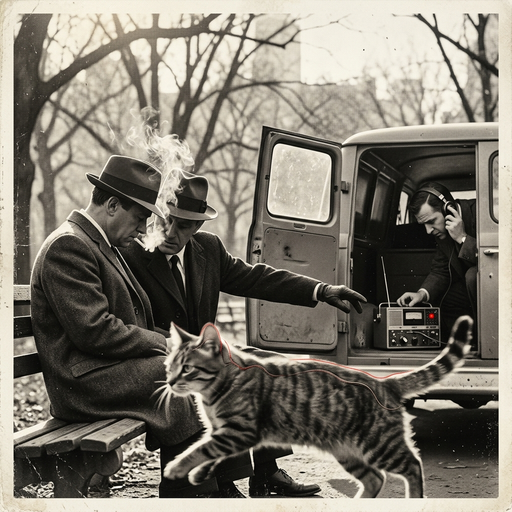
In the decades following the program's conclusion, an explosive anecdote came to dominate public memory. According to a narrative popularized in two thousand one by Victor Marchetti, a former executive assistant to the agency's deputy director, the project met a swift and gruesome end during a field demonstration in Washington. Marchetti recounted that handlers parked a surveillance van across the street from a Soviet compound on Wisconsin Avenue, opened the rear door, and released their surgically modified cat to eavesdrop on two men sitting on a park bench. Moments later, as the story went, a passing taxicab ran over the animal, extinguishing the mission on the spot.
This narrative has been repeated across dozens of books, television documentaries, and popular histories. It provides a neat, dark punchline: a multi-million-dollar scientific marvel destroyed in seconds by an ordinary piece of municipal traffic. Yet when researchers examine the primary documentary evidence, that dramatic scene dissolves.
The declassified nineteen sixty-seven evaluation memorandum contains no reference whatsoever to a taxicab, a busy roadway, Wisconsin Avenue, or an animal being killed in action. The absence of an event from an incomplete, redacted record does not definitively prove that an accident never occurred. However, it does mean the entire incident rests on uncorroborated retrospective testimony rather than contemporary agency documentation. Some former technical staff members have explicitly disputed the taxi account, asserting that the cat completed its initial outdoor tests, survived the project, and was eventually euthanized or adopted out after the hardware was safely removed.
A similar distortion surrounds the financial ledger. Popular articles routinely claim the project cost fifteen million or twenty million dollars. In the nineteen sixties, twenty million dollars represented an enormous sum, equivalent to hundreds of millions in contemporary purchasing power. Nothing in the declassified record substantiates that figure. The surviving memorandum provides no overall cost accounting or itemized budget breakdown.
While the agency certainly committed considerable funds to specialized surgical consultants, electronic prototyping, and training personnel over several years, assigning an exact twenty-million-dollar price tag transforms an educated guess into an artificial certainty. The folklore of the fatal taxi and the astronomical budget became popular because it turned a nuanced technical evaluation into an easy fable of bureaucratic absurdity. But the true institutional conclusion reached by the agency was far more measured, and far more instructive.
When the Central Intelligence Agency finally closed the project file in nineteen sixty-seven, the internal evaluation praised the researchers for achieving an extraordinary technical milestone. The evaluators recognized that the team had accomplished groundbreaking work in bio-telemetry, proving that audio hardware could be safely miniaturized, implanted within living tissue, and powered to transmit sound. Yet in the very next breath, the memorandum delivered a decisive administrative verdict: the system was fundamentally unsuitable for the specialized operational needs of the agency.
That clear distinction between an inventive demonstration and operational utility cuts to the core of Cold War intelligence culture. In the nineteen fifties and nineteen sixties, the pressures of geopolitical confrontation fostered an institutional environment where almost any technical concept could secure funding if it promised to solve the puzzle of ironclad denial. When human agents could not enter an area and fixed bugs could not reach a target, technical managers convinced themselves that biological carriers could bridge the divide.
This technological optimism created a profound blind spot. It treated a living, sentient animal as an empty chassis, assuming that the discipline of the laboratory could overwrite millions of years of evolutionary behavior. Alongside that conceptual flaw stands a serious ethical reality. The project subjected domestic animals to painful, invasive surgeries, prolonged confinement, and experimental conditioning entirely in secret, without the public oversight or ethical review boards that govern scientific research today. Because the archive remains heavily redacted, the public may never know how many animals were used, what levels of postoperative distress they endured, or how their lives ended.
Yet the ultimate termination of the project demonstrates something equally vital about institutional discipline. Technical managers recognized when an experimental concept had reached its outer boundary. Rather than continuing to pour resources into an unworkable platform, the agency accepted that laboratory ingenuity could not overcome the fundamental unpredictability of the natural world. The work quietly concluded, and technical officers redirected their focus toward electronic sensors, satellite reconnaissance, and automated systems that did not depend on the whims of an independent creature.
The enduring lesson of Acoustic Kitty is that a brilliant technical invention and a dependable operational tool are two completely different things. Whenever you encounter extraordinary claims about revolutionary technology, whether from historical archives or the frontiers of modern engineering, look past the initial demonstration. Ask the harder operational question: can it function reliably under the chaotic, uncontrolled conditions where it actually has to perform? If this investigation gave you a clearer understanding of the boundary between declassified facts and Cold War mythmaking, take a moment to reflect on which modern technical promises might be making the very same mistake today.