Tariff Tipping Point
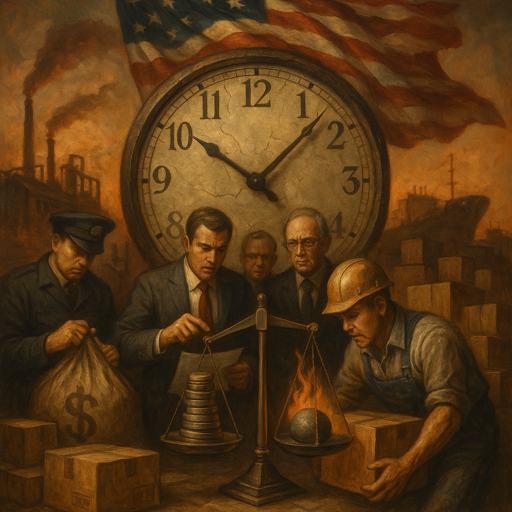
A proposed overhaul of U.S. tariff policy, with duties ranging from ten to one hundred forty-five percent on imported goods, has stakeholders from customs officers and economists to policymakers and factory workers racing against time to measure its impact. Drawing on historical parallels like Smoot-Hawley and the Tariff of Abominations, the story paints a vivid picture of a nation balancing short-term economic gains with long-term risks of inflation, supply-chain disruptions, and international retaliation, while grappling with whether tariffs can safeguard domestic prosperity without igniting global discord.
By MyAudioBooks.ai ·
This free listen has rotated out. The story remains available to read.
Astori Publishing Presents: Tariff Tipping Point Prologue Just before sunrise, the first container ship of the day eases into the Port of Los Angeles, its hull stacked with bright red boxes from Shenzhen and Busan. A gullas cry dissolves into the metallic thrum of gantry cranes, and Marisol Reyesacustoms badge clipped to a fluorescent vestaraises a handheld scanner to read the manifest. One line on her tablet matters more than any other: tariff status. If the schedule now moving through Congress becomes law, every television set sealed inside those containers will be taxed an extra ten percent the instant her stylus taps aclear.a A small gesture, yet worth millions before breakfast. Marisol thinks of the paperwork that will follow, of shoppers miles inland who will never know her name but will feel the ripple in next seasonas price tags. Two thousand five miles away, the Capitol dome is still lit against the indigo sky. Congressman Daniel Spencer, a third-term representative from an Ohio steel district, reviews talking points while the corridors are quiet enough to hear his footsteps echo. He plans to argue that a blanket tariff is not protectionism but triageaan emergency tourniquet on domestic industries hemorrhaging market share. In the folder under his arm lies a photograph of the shuttered blast furnace in Youngstown where his grandfather once forged rails; Spencer studies the soot-stained bricks, reminding himself why every percentage point on the draft schedule feels personal. At the same hour, in an upper floor of Princetonas economics building, Professor Lillian Greer nurses black coffee and types equations into a model blinking across two wide monitors. The simulation estimates what a ten-percent duty on nearly all imports might add to consumer inflation: roughly one full point in twelve months, unless the dollar strengthens or foreign suppliers absorb part of the hit. Greer knows models are abstractions, but she also knows how quickly numbers mutate into headlines, into mortgage-rate hikes, into real families trimming grocery lists. When the spreadsheet finishes processing, the projected rise in prices glows crimson. She snaps a photo with her phoneanot to publish yet, but so she can stare at the figure later and decide whether the risk is tolerable. Meanwhile, dawn has slipped past the International Date Line, and in Beijingas Ministry of Commerce, Vice Minister Liu Zhiyong steps into an office scented faintly of oolong and printer ink. A briefing packet awaits him: Washington may allow duties on some Chinese goods to soar as high as one hundred forty-five percent, a rate calibrated to erase any advantage Beijingas subsidies confer. Liu reads in silence, then draws a neat circle around the line forecasting retaliationaa reciprocal tariff on U.S. soybeans and jet engines. He recalls a proverb his grandmother recited during lean years: aWhen two tigers fight, one is maimed, the other slain.a The margin notes he drafts will shape whether China replies with litigation at the World Trade Organization or with its own swift surcharges. And far from boardrooms or chambers of state, Marcus Hayes laces steel-toed boots in an Ohio break-room that still smells of coolant and iron filings. His mill has recalled only half the workforce it furloughed during the last downturn, but rumors of a new tariff circulate like caffeine through the shift. If imported sheet metal costs more, orders could return; if retaliation throttles farm exports, his cousin who grows soybeans might suffer instead. Marcus wipes grime from the screen of his phone, refreshing the news feed for any hint of a vote on the Hill. Five individuals, bound by a policy not yet inked into law, already feel its gravity tugging at their routines. The customs officeras scan, the congressmanas speech, the economistas model, the vice ministeras annotation, the steelworkeras hopeathey frame the question that will thread through every dock, ledger, and dinner table in the months ahead: Can a tax collected at the border safeguard prosperity at home without igniting a price spiral or a diplomatic brawl abroad? Tariffs, strictly defined, are taxes on goods that cross a political boundary; but in practice they are pressure valves and tripwires, revenue engines and rallying cries. The United States wrote its first tariff into law on the Fourth of July, 1789, financing a fledgling government when income taxes did not exist. Two centuries later, the same instrument split the nation during the so-called Tariff of Abominations and deepened the Great Depression under Smoot-Hawley. History grants no easy verdictaonly evidence that a border tax rarely sits still. It migrates into wages, into grocery receipts, into the fine print of trade treaties. Now, as the sun climbs over Long Beach cranes and glints off the marble steps of the Capitol, a uniform ten-percent duty on almost every foreign goodaescalating to twenty-five percent on cars and a potential one hundred forty-five percent on select Chinese importsastands closer to enactment than any broad tariff in a generation. Proponents promise revived factories, leaner deficits, and leverage at the negotiating table. Critics warn of costlier essentials, retaliatory strikes, and snarled supply chains that modern logistics cannot easily reroute. Both camps reach for history; neither finds a perfect analogue. In the pause before committee hearings convene, before the first amended clause reshapes the numbers, the nation balances on a cusp as narrow as Marisol Reyesas stylus tip. The coming chapters will follow the money, the politics, and the precedent of tariffs old and new. For now, the port is waking, the screens in Princeton glow, and an unanswered question travels the Pacific on every steel container: Will this toll at the wateras edge serve as shield, as lever, or as fuse? End of Prologue Tariffs are taxes levied on goods crossing political boundaries, a concept as old as international trade itself. Imagine arriving at a national frontier, declaration form in hand, and being asked by an officer whether you are bringing anything to declare. This single question signals the presence of a tariffaa gate fee at a stadium, if you willawhere every ticket collected finances the arena inside. Economists often describe tariffs as taxes gathered at the wateras edge or the runwayas end because they operate at the point of entry. Yet, behind this straightforward definition lies a dual mission. Tariffs can act as a shield, raising the price of imported products and granting domestic firms breathing space from cheaper or heavily subsidized foreign competition. They can also serve as a lever in international negotiations; by adjusting tariff rates, governments try to induce trading partners to alter practices considered unfair or unbalanced. To understand tariffs, it's essential to grasp two key terms. A tariff, as mentioned, is a border tax on imports. A trade deficit occurs when the monetary value of a country's imports exceeds the value of its exports over a given period. Although deficits are not inherently good or bad, persistent gaps can become political flashpoints because they symbolize perceived economic leakageamoney leaving the country faster than it returns in sales abroad. For instance, the United States bought roughly nine hundred billion dollars more in goods from the world than it sold in twenty twenty-two, a sum larger than the entire economy of Switzerland. The history of tariffs in the United States dates back to the republic's infancy. Article I, Section Eight of the Constitution assigns Congress the power ato lay and collect taxes, duties, imposts and excises,a thereby establishing the legal foundation for tariff policy. Congress exercised this power promptly; on July Fourth, seventeen eighty-nine, it passed the very first federal revenue statute, a schedule of import duties designed to finance the fledgling government and nurture early manufacturing. According to Treasury records, customs houses collected more than ninety percent of federal income during the seventeen nineties, keeping the government solvent at a time when income taxes did not yet exist. A historical detour illustrates the charged nature of tariff debates. In eighteen twenty-eight, Congress approved what Southern critics branded the aTariff of Abominations,a pushing some duties above fifty percent. At Charleston Harbor, customs officers found themselves the targets of public rallies in which effigies of tariff supporters were paraded through the streets. Two years later, Vice President John C. Calhoun secretly penned the South Carolina Exposition, arguing that states could nullify federal lawsaa theory that nearly provoked armed conflict before a compromise tariff defused the crisis. This episode underscored an enduring reality: tariff rates are never mere arithmetic; they stir questions of federal authority, regional identity, and economic justice. Fast-forwarding a century, when President Herbert Hoover signed the Smoot-Hawley Act on June seventeenth, nineteen thirty, more than one thousand twenty-eight economists had already delivered a petition urging a veto. Within months, Canada, France, and over twenty other partners retaliated, and American farm exports tumbled by roughly two-thirds by nineteen thirty-two. The lesson landed hard. In nineteen forty-seven, determined to prevent a repeat, Washington joined twenty-two nations in crafting the General Agreement on Tariffs and Trade, inaugurating a slow but steady march toward lower global duties. The relevance of this history becomes clear when considering the tariff plan advanced by former President Donald Trump in two thousand twenty-five. The proposal would impose a uniform tariff of ten percent on nearly all imported goods entering the United States, with strategic carve-outs for partners covered by the United StatesaMexicoaCanada Agreement, thereby exempting many products arriving from Canada and Mexico. The policy layers additional tiers: imported automobiles could face duties of twenty-five percent, and a subset of Chinese goods might encounter rates as high as one hundred forty-five percentalevels chosen to counter what the proposal describes as unfair pricing and industrial subsidies abroad. Proponents of the two thousand twenty-five blueprint argue that higher border taxes will bolster domestic manufacturing, particularly in steel and automobiles, by pricing in what they portray as the external costs of foreign competition. They expect a slimmer trade deficit, pointing to the arithmetic that fewer cheap imports and potentially greater export leverage could narrow the gap between what Americans buy abroad and what they sell overseas. Supporters also forecast increased federal revenue, claiming that tariff collections could channel billions of dollars toward debt reduction or infrastructure investment. Furthermore, they frame the schedule as a potent bargaining chip, asserting that elevated rates on Chinese goods will strengthen Washingtonas hand when negotiating market access and intellectual-property protections. However, critics counter with concerns about the potential costs. Raising the price of imported inputs, they warn, will ripple through supply chains and emerge on store shelves as higher consumer prices. Foreign governments stung by high duties may retaliate in kind, jeopardizing exports from American farmers, aerospace firms, and technology companiesaa scenario that past experience suggests can materialize quickly. Retaliation aside, intricate production networks could seize up if key components become scarce or prohibitively expensive, eroding the competitiveness of precisely those industries the tariffs aim to protect. Historical precedent lends weight to the caution: policies similar to Smoot-Hawley precipitated job losses in export-dependent sectors and deepened an already fragile economic climate during the early nineteen thirties. The task for policymakers is to balance the promised benefits against the potential costs. On one hand, tariffs could safeguard jobs, reduce the trade deficit, and generate fresh federal revenue that could support workforce retraining or next-generation infrastructure. On the other hand, they risk higher retail prices, possible retaliation, supply-chain fragility, and broader diplomatic strain. Long-term implications deepen this balancing act. Countries facing steep duties often reconfigure supply routes, seek new markets, or double down on domestic production, altering global trade patterns in unpredictable ways. Such shifts can blunt the intended protective effect or, conversely, open unforeseen opportunities for firms nimble enough to adapt. Tariffs, in essence, are policy instruments with long memories. They collect money at ports and borders, but their resonance extends into factories, farms, and legislative chambers. The Constitution entrusted Congress with the authority to deploy these taxes; early lawmakers acted on that power in seventeen eighty-nine, inaugurating a national conversation that has never ceased. Each successive generation revisits the same core question: How can a border tax both shield domestic interests and leverage better terms abroad without provoking costs that outweigh its gains? The chapters that follow will explore how successive answers to this question have shaped, and continue to shape, the economic landscape of the United States. The narrative now turns to the moment when a proposal, first floated during rally stops in early twenty-twenty-three, crystallized into a detailed tariff blueprint for the calendar year twenty-twenty-five. To put this plan into perspective, consider that the last major overhaul of U.S. tariffs, the nineteen-thirty Smoot-Hawley Act, not only raised duties but also triggered a global trade contraction. The proposal includes a uniform border tax of ten percent that would apply to almost every imported product entering the United States, from children's shoes to industrial ball bearings. The schedule explicitly exempts goods qualifying under the United StatesaMexicoaCanada Agreement, thereby sparing Mexican avocados, Canadian aluminum, and thousands of other North American items from the levy. This design is notable because most modern tariffs have been targeted instruments, whereas this plan embraces breadth first, then layers strategic depth. Automobiles produced outside North America would face a higher rate of twenty-five percent, echoing earlier national-security investigations that urged special treatment for the car sector. At the summit of the hierarchy sits a country-specific clause: selected Chinese imports could confront duties of up to one hundred forty-five percent, a figure chosen to neutralize what the proposal describes as the afull valuea of subsidies embedded in those goods. For instance, if a Chinese-made solar panel is deemed to have received a subsidy worth thirty percent of its value, the U.S. could impose a duty of up to one hundred forty-five percent to offset that advantage. Proponents justify this architecture on three interlocking grounds. They argue that domestic manufacturers, particularly in steel mills and car plants, require immediate relief from foreign competition that they deem artificially cheap because of subsidies or lax labor standards abroad. They also claim that a blanket tariff, even at ten percent, would narrow the nationas trade deficit by trimming the volume of low-cost imports and by furnishing a credible threat that could be dialed upward or downward during negotiations. Furthermore, they anticipate a sizable inflow of new revenueatens of billions of dollars each year if trade volumes holdamoney that could be steered toward reducing the national debt or rebuilding highways and ports. The media response has been multifaceted. The New York-based daily press has foregrounded the pocketbook angle, with front-page stories warning that a charge on imported inputs could filter through supply chains and widen already elevated inflation gauges. Reporters cite grocery executives calculating mark-ups on citrus from Spain and electronics retailers estimating the cost of rerouting shipments away from Chinese assembly hubs. A Wall Street-published editorial board, more sympathetic to the tariff, nonetheless conceded that aprice visibilitya would increase and might reach what they termed aSmoot-Hawley optics,a a historical analogy designed to remind readers of the nineteen-thirty episode when duty hikes preceded a global trade contraction. Television producers have seized upon that same historical parallel, juxtaposing the flat ten-percent proposal with archival footage of nineteen-thirty grain elevators, and anchors often underscoring that consumer price indices in nineteen-thirty-one rose in spite of collapsing demand, underlining how tariffs can nudge costs upward even during slowdown periods. While United States media focus on household budgets, European and Asian outlets train their lenses on retaliation risk. The Financial Times has run headline columns speculating that Brussels might slap mirror duties on American bourbon and Harley-Davidson motorcycles, products previously caught in the crossfire during the twenty-eighteen steel dispute. In Beijing, the state-affiliated Global Times warns that a one hundred forty-five percent ceiling on Chinese exports could constitute, in their phrasing, aan act of economic warfare,a and hints at countermeasures targeting soybeans and commercial airplanes. Tokyo correspondents report that Japanese executives are calculating whether to shift additional assembly lines to Mexico, thereby exploiting the USMCA exemption, rather than absorb a twenty-five percent tariff on vehicles shipped directly from Yokohama. Domestic commentary is not monolithic. Large retailers and technology assemblers voice alarm, noting that tariffs are astickyaaonce embedded in pricing algorithms, they tend to linger, even if nominally temporary. Labor unions representing auto workers applaud the twenty-five percent clause, asserting that it restores aindustrial bargaining power.a Agricultural lobbies adopt a wait-and-see posture but lobby Congress for contingency aid should exports face retaliation. Academic analysts approach the plan with calibrated caution. Scholars concede that a ten-percent levy could raise headline inflation by up to one percentage point within a year, assuming full pass-through to consumers and no currency offset. A minority of economists add that, in theory, a stronger bargaining position might lead trade partners in the future to lower their own barriers, thereby offsetting some domestic price pressure. The consensus view remains that, absent coordinated diplomacy, higher border taxes elicit mirror responses abroad, shrinking overall trade volumes and with them, global growth. The supply-chain dimension merits special attention. Modern production intertwines metals mined in Australia, chips etched in Taiwan, and software coded in California, all converging in complex assemblies. An across-the-board ten-percent tariff raises the cost of each imported link. Firms can search for alternative suppliers, but switching is neither instantaneous nor free. Analysts estimate that it takes, on average, eighteen months to relocate a dependable parts supplier and another twelve months to certify quality to regulators. Advocates stress that price tags tell only part of the story. They remind audiences that the trade deficit reached roughly nine hundred billion dollars in goods in twenty-twenty-two and argue that allowing such a gap to widen indefinitely erodes the productive base of the economy. Tariff revenues likewise feature prominently in their calculus. Treasury projections claim that a ten-percent blanket duty could net upward of three hundred billion dollars over a decade, assuming no dramatic fall-off in import volumes. The sharpest divergence between boosters and skeptics concerns intangible leverage. Proponents assert that a tariff is not an end in itself but a negotiating wedge, citing the clause escalating rates to one hundred forty-five percent on Chinese goods as evidence of ready firepower. Skeptics retort that leverage must be credible on both sides; if the other party can endure higher duties longer than the United States electorate can tolerate elevated prices, the gambit may backfire. Some foreign commentators detect a silver lining. Journalists in Seoul note that Korean chipmakers could gain market share in advanced semiconductors if the U.S. levies push American buyers to seek non-Chinese alternatives. A Stockholm trade columnist adds that European steelmakers might benefit indirectly. Within Congress, deliberations reveal the same dichotomy echoed in the press. Lawmakers from manufacturing districts highlight potential job creation, while representatives from farm states caution against becoming collateral damage in retaliatory strikes. The proposalas sheer scale forces every participant to wrestle with the trade-offs inherent in tariff policy. Higher border taxes can foster domestic production but also magnify retail prices; they can encourage negotiation but equally provoke retaliation; they can replenish the treasury yet simultaneously dampen growth if trade volumes slump. For listeners seeking to track the debate, a helpful mental rubric is to ask three sequential questions each time a new headline breaks: What slice of imports is affected? Which constituency does the piece emphasize? Does the report treat tariffs as a static tax or a dynamic bargaining chip? In closing, tariffs operate simultaneously in the sphere of dollars and the arena of diplomacy. The twenty-twenty-five planas baseline rate of ten percent, its exemption for USMCA partners, the heightened twenty-five percent rate for automobiles, and the potential one hundred forty-five percent ceiling on Chinese imports together compose more than a schedule of duties; they form a strategic narrative about national resilience and international leverage. Whether the blueprint ultimately delivers more security than strain remains undecided. When proponents of the twenty-twenty-five tariff proposal make their case, they often begin with the jobs that Americans can see: men and women working in steel mills and automotive factories. They argue that cheap imports, often subsidized or produced under lax labor and environmental standards, undercut domestic industries that once supported entire communities. A blanket tariff of ten percent on nearly all imported goods, they claim, would give these industries a much-needed reprieve by narrowing the price gap between domestic and foreign products. To put this into perspective, the U.S. steel industry has faced significant challenges since the early 2000s, losing over 100,000 jobs between 2000 and 2016. The automotive sector is another key area of focus. Under the proposal, cars assembled outside North America would face a duty of twenty-five percent, significantly higher than the baseline ten percent rate. The U.S. automotive industry is a cornerstone of American manufacturing, with over 1.7 million jobs directly or indirectly related to the sector. Union officials argue that the higher tariff on automobiles would "level the playing field" for domestic workers who have negotiated middle-class contracts. Executives from domestic auto suppliers agree, noting that a higher tariff on finished vehicles reduces the incentive to shift assembly abroad and then ship the final product back to the U.S. For example, during the 2018 tariff disputes, some U.S. automakers reported increased investment in domestic production. Beyond steel and autos, proponents argue that tariffs can safeguard industrial employment more broadly. The U.S. lost roughly five million manufacturing jobs between two thousand and two thousand ten, a period that coincided with China's accession to the World Trade Organization and a surge in lower-priced imports. Advocates of the new duties argue that reversing even a portion of that decline justifies the policy's cost. To put this figure in perspective, the loss of five million manufacturing jobs represents a decline of over thirty percent in the sector's workforce during that decade. Supporters also highlight the trade deficit as a key motivation. The goods deficit alone reached roughly nine hundred billion dollars in twenty-twenty-two, a sum equivalent to about four percent of the U.S. GDP. By making foreign products more expensive and nudging consumption toward domestic alternatives, they predict that the gap will shrink, improving the "balance of payments." Another significant argument in favor of the tariff proposal is the potential revenue it could generate. Tariffs are collected by customs officers at the border, providing a source of revenue without the need for new domestic taxes. Internal projections circulated by supporters claim that a ten-percent blanket levy could raise over three hundred billion dollars during the coming decade, assuming import volumes remain steady. This amount is roughly equivalent to the annual budget of several major federal agencies combined. Proponents envision using part of this revenue for highway repairs, port dredging, or debt reduction. The proposal also aims to enhance U.S. leverage in international trade negotiations. The plan includes a clause that sets a ceiling of one hundred forty-five percent on selected Chinese imports, a rate calibrated to offset what the proposal describes as the "full value" of Beijing's subsidies. Backers argue that this high ceiling provides bargaining power, allowing Washington to dial down the duty if China scales back industrial subsidies or opens its markets more fully. The ongoing trade tensions between the U.S. and China underscore the relevance of this strategy. These motivations intersect with a broader public mood that has grown wary of unbounded globalization. Surveys in twenty-twenty-three found that a majority of respondents believed that global trade exposes the United States to excessive economic risk. The pandemic-era shortage of semiconductors, which forced auto plants to idle production lines, heightened this unease. Supporters argue that a baseline tariff would encourage firms to diversify suppliers or reshore production, thereby strengthening critical supply chains. Critics, however, counter that tariffs would lead to higher consumer prices, as companies pass on increased input costs. Economists warn that a ten-percent blanket tariff could add nearly one percentage point to consumer inflation within a year, assuming full pass-through and no offsetting currency movements. The steel tariff of two thousand eighteen offers a cautionary illustration: domestic steel prices climbed faster than world prices, inflating costs for downstream manufacturers. Retaliation is another concern. Governments whose exports face steep duties may respond with their own surcharges. During the twenty-eighteen dispute, Brussels targeted bourbon and motorcycles, while Beijing struck soybeans. Opponents of the new plan fear a similar pattern, magnified by the scale of the proposed duties. Agriculture groups caution that export bans or mirror tariffs could erase farm income gains achieved over the past decade. The complexity of modern supply chains complicates the calculus further. A tariff that raises the cost of even one component can reverberate across the assembly line. Relocating suppliers takes timeaon average, eighteen months, plus another year for regulatory certification. While companies can manage this transition, it demands capital and managerial bandwidth that smaller firms often lack. Supporters respond that such upheaval is necessary to build a more resilient system. By accelerating diversification, whether toward domestic mills or trusted allies under the United States-Mexico-Canada Agreement, tariffs can reduce dependence on far-flung inputs. The debate thus centers on weighing the immediate costs of higher border taxes against the longer-term benefits of industrial robustness and strategic leverage. It is a debate over time horizons as much as economics. Consumers feel price increases within weeks, while job creation or supply-chain realignment may take years to materialize. The psychology of fairness also plays a role, with strong bipartisan agreement that China's trading practices deserve a forceful response. The risk of a tit-for-tat spiral looms, however. If Beijing responds with surcharges on American aircraft or advanced farm equipment, the leverage Washington believes it wields could erode quickly. Historical examples, such as Smoot-Hawley in the nineteen thirties, serve as reminders that retaliation can arrive faster than adjustment. Despite these risks, supporters remain undeterred. They argue that the global trade architecture has shifted, with the pandemic and strategic rivalries already nudging corporations toward regionalization. Tariffs, they assert, simply accelerate this change. By taxing imports today, the government signals that the era of unqualified faith in just-in-time global sourcing is over. If successful, they predict a domestic industrial base better able to innovate, train workers, and meet national-security needs. The outcome will depend on variables still unwritten: currency movements, the negotiating stance of allies, technological breakthroughs, and the political patience of consumers. The motivations behind the tariff proposal remain clear: to use border taxes as a four-fold instrumentashield, revenue pump, deficit reducer, and diplomatic leverageared toward a public increasingly skeptical of long global supply chains. Well before economists had spreadsheet software, lawmakers were already learning that tariffs seldom stay confined to port ledgers. They seep into shop windows, payroll sheets, and diplomatic telegrams. Three United States statutesathe Civil-War-era Morrill Tariff, the Nineteen Thirty Smoot-Hawley Act, and the Nineteen Sixty-Two Trade Expansion Actaoffer a compact laboratory for observing how border taxes can raise prices, invite retaliation, or, when rates fall, expand export opportunity. Each episode also supplies a prism through which to view the proposed Twenty-Twenty-Five uniform tariff of ten percent on almost all imports, the twenty-five percent duty on foreign cars, and the ceiling of one hundred forty-five percent on selected Chinese goods. The Morrill Tariff, passed on March Second, Eighteen Sixty-One, just weeks before Fort Sumter, lifted the average duty on dutiable imports from roughly nineteen percent to about thirty-six percent. Lawmakers framed the measure as an emergency attempt to stabilize federal finances after a banking panic and to protect mills that supplied iron rails, canvas, and munitions. Within two years, the higher duties raised the domestic price of iron and finished textiles by well over ten percent, according to Treasury price indexes of the era. Import substitution did occuraPennsylvania furnaces expanded outputabut so did cost-push inflation, an outcome the public felt in staples such as nails and farm tools. The dual nature of tariffs highlighted in modern analysesathat they function both as a shield and as a leverawas already plain. Federal revenue climbed, yet households paid more. The Smoot-Hawley Tariff Act of June Seventeenth, Nineteen Thirty, demonstrated how quickly foreign partners can answer a tariff with one of their own. Average United States duties on dutiable goods jumped to nearly sixty percent, the highest peacetime level on record. Within twenty-four months, more than twenty-five trading partners, including Canada, France, and Mexico, introduced retaliatory surcharges or quotas. American farmers saw their exports plummet from about One Billion Three Hundred Million Dollars in Nineteen Twenty-Nine to less than Four Hundred Million Dollars in Nineteen Thirty-Two, a decline of roughly two-thirds. Every element of the modern risk ledgeraprice increases for inputs, retaliation abroad, and supply disruptionsawas present. Grain rotted in Midwestern elevators for lack of buyers, while foreign demand for United States machinery sagged once European tariffs stiffened. In contrast, the Trade Expansion Act, signed by President Kennedy on October Eleventh, Nineteen Sixty-Two, granted the executive branch authority to cut tariffs by as much as fifty percent, powe