Starliner and the Safety Case: NASA Risk Decisions From Launch to Crew Return
Boeing Starliner’s planned eight-day test flight became a 286-day mission for astronauts Barry Wilmore and Sunita Williams after thruster failures and helium leaks triggered an intensive investigation. Despite encouraging tests, NASA judged the unresolved propulsion risks too great for a crewed return, landing Starliner empty while the astronauts continued research and spacewalks aboard the International Space Station before returning safely on SpaceX Dragon in March 2025. Their journey underscores the value of backup spacecraft and a crucial safety principle: successful individual tests cannot substitute for understanding how a system will perform throughout a mission.
By MyAudioBooks.ai ·
Listen free: Starliner and the Safety Case: NASA Risk Decisions From Launch to Crew Return
On June fifth, twenty twenty-four, at Cape Canaveral Space Launch Complex forty-one in Florida, an Atlas Five rocket propelled Boeing’s Starliner capsule, named Calypso, into low Earth orbit. Aboard were NASA astronauts Barry Wilmore as commander and Sunita Williams as pilot. This was the Boeing Crew Flight Test, a developmental mission scheduled for approximately eight days to demonstrate that the new transportation system could carry astronauts to the International Space Station and return them home safely. As an uncertified developmental flight, its operational mandate centered on discovering flight-test limitations rather than executing routine orbital transport. Within twenty-four hours of liftoff, as Calypso approached the station, small maneuvering thrusters began dropping out of service. That unexpected behavior altered the flight plan, initiating a nine-month mission that fundamentally tested how NASA evaluates and manages flight-test risk.
At My Audio Books dot A I, you can create your own audiobooks from prompts, turn your documents into audio, all with one subscription, and store your items in your own personal library.
How does a flight-test program balance encouraging telemetry against unresolved hardware anomalies when astronaut safety is at stake? This continuous documentary follows that question across four distinct developments: an anomaly-plagued rendezvous in orbit, an intensive summer investigation across New Mexico vacuum chambers and orbital hot-fires, an agency decision to decouple the crew from their spacecraft, and a reconfigured commercial flight that transformed an eight-day trial into a two-hundred-eighty-six-day expedition.
On June sixth, twenty twenty-four, as Calypso closed within several hundred meters of the orbiting laboratory, five reaction-control thrusters unexpectedly dropped offline. While losing selected thrusters degraded control authority during close approach, Calypso's redundant thruster arrangements preserved adequate handling. Flight controllers and the crew managed the software dropouts, successfully recovering four of the affected engines, while Wilmore and Williams guided Calypso to a secure docking at the station’s Harmony module.
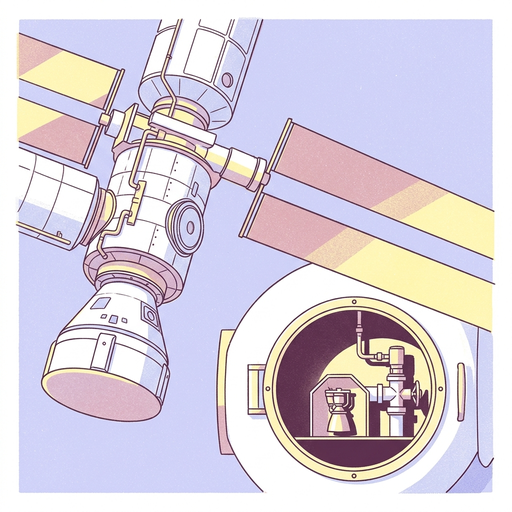
Once docked, engineering teams analyzed telemetry from the service module, uncovering two distinct hardware issues. A Boeing operational update on June tenth reported five small helium-manifold leaks and confirmed that one aft-facing reaction-control thruster remained deselected. A manifold is a distribution network of pipes and valves that channels pressurized gas throughout a spacecraft's propulsion system. A reaction-control thruster is a compact rocket engine producing roughly eighty-five pounds of thrust, firing in short pulses to adjust orientation and execute delicate maneuvers. Deselection occurs when flight software automatically commands an engine offline after sensing parameter limits, isolating the unit to safeguard the spacecraft while leaving the mechanical hardware intact. Several of the five helium leaks had emerged during ascent and early orbit operations before rendezvous.
Starliner relies on helium as a pressurant, an inert gas stored at high pressure to force liquid propellants into the combustion chambers without chemically reacting with the fuel or oxidizer. High-pressure helium lines pressurize the propellant tanks, driving fuel and oxidizer into the thrusters where they ignite on contact to steer the vehicle. Boeing confirmed that closing the manifold isolation valves during docked operations halted further gas loss from the storage tanks, but left the underlying seal degradation uninspected inside the sealed module. Contemporaneous flight telemetry established that the manifold leaks and the thruster dropouts were separate physical anomalies, showing no direct causal link between lost pressurant and degraded engine thrust.
Investigating these anomalies carried exceptional urgency because Starliner’s propulsion hardware resides entirely in its service module. Prior to atmospheric re-entry, the crew capsule separates from the service module, which burns up in the upper atmosphere. That operational sequence destroys the physical thrusters and valves, making orbital telemetry and ground replication the only methods to diagnose the failure. Docking had secured the crew inside the station, but it left the propulsion hardware exposed to space. How could engineers reproduce an intermittent in-flight failure on Earth before committing the crew to the return sequence?
Throughout June and July, engineers sought answers in orbit and on the ground. On June fifteenth, teams conducted a docked hot-fire test, gathering operational telemetry while Calypso remained attached to the station. To uncover the physical cause of the dropouts, NASA and Boeing initiated ground testing in early July at the White Sands Test Facility in New Mexico. This specialized rocket-engine test center is distinct from White Sands Space Harbor, the dry lakebed runway where the capsule was scheduled to land at the conclusion of the mission.
At the New Mexico facility, technicians mounted a representative reaction-control thruster inside a vacuum chamber. Testing began with baseline acceptance firings, followed by aggressive pulse profiles reproducing launch through docking, and concluding with sequences simulating undocking through deorbit. Repeated firings deposit significant thermal energy into the engine assembly. Firing frequency, limited cooling intervals, and the tightly enclosed service-module compartments known as doghouses cause local temperatures to climb rapidly. Engineers attempted to recreate the conditions under which flight thrusters lost thrust, inspect the physical components after firing, and assess whether temporarily recovered thrusters would continue operating during high-demand re-entry burns. A ground test article isolates specific mechanical failure modes, yet ground firings operate apart from the complex vibrational, orbital, and thermal interactions of the flight vehicle.
During hardware teardowns at White Sands, engineers observed physical deformation in a Teflon seal inside an oxidizer poppet valve. When exposed to elevated temperatures inside the thruster enclosure, the seal expanded, restricting the flow of oxidizer into the combustion chamber and reducing engine thrust. NASA publicly described this thermal deformation as a plausible mechanism relevant to the flight anomalies, though briefings emphasized that this finding represented an inference derived from ground teardowns, leaving open whether identical extrusion had occurred in each disabled flight unit.
Boeing also pointed to two encouraging operational measurements. On June tenth, Boeing engineers estimated that Calypso retained enough helium to support roughly seventy hours of free-flight maneuvering after undocking, compared to approximately seven hours required for a nominal end-of-mission return sequence. That projection established a substantial operational margin, defined as the surplus capability available beyond the baseline requirements of a planned flight sequence. Later, on July twenty-seventh, teams conducted an in-space docked hot-fire test across twenty-seven thrusters. Boeing reported that the tested thrusters operated between ninety-seven percent and one hundred two percent of their peak rated thrust, while the helium pressurization system remained stable throughout the test pulses.
Comparing these two metrics illustrates the difference between consumable supplies and mechanical reliability. The ten-to-one ratio between seventy available hours and seven required hours showed that helium leakage would not deplete the pressurant during a normal return. Meanwhile, the July single-pulse hot-fire proved that cooled thrusters could deliver rated power during brief, isolated bursts. Pressurant volume enables propellant flow only when supply valves remain open, and brief test pulses demonstrate baseline ignition without confirming that a thruster can endure the sustained thermal strain of a deorbit burn.
By late July, engineering teams had established three critical facts: an abundant helium supply margin, a plausible thermal mechanism in deformed valve seals observed during ground teardowns, and strong thrust delivery across brief single pulses in orbit. These findings demonstrated that the propulsion system could produce nominal thrust under isolated, short-duration firings, while leaving its endurance across dynamic, high-temperature flight phases uncharacterized. That gap between momentary performance and a verified safety case across all return scenarios defined the choice confronting agency leadership.
Before going further, try to say in one sentence why a thruster that fires successfully during a brief docked test might still fail during re-entry.
A brief test pulse confirms that propellant can ignite at a stable initial temperature, whereas re-entry demands dozens of sustained firings that trap heat inside the housing, swelling internal seals and choking propellant flow.
Both organizations possessed the same test data by early August, yet they arrived at opposing assessments of what that data proved. What engineering criteria would be required to justify placing Wilmore and Williams aboard Calypso for atmospheric re-entry?
On August twenty-fourth, twenty twenty-four, NASA leadership convened a formal review at the Johnson Space Center in Houston to determine how Starliner would return. NASA Administrator Bill Nelson, Commercial Crew Program manager Steve Stich, and Associate Administrator for Space Operations Ken Bowersox addressed the public following the review. The conclusion emerged as an agency-level judgment of acceptable flight risk, reached through systematic technical reviews rather than a unilateral decree or a single mathematical probability.
Boeing representatives maintained confidence that Starliner was capable of returning Wilmore and Williams safely, pointing to the July hot-fire performance, thruster redundancy, and large helium reserves. NASA leadership, however, concluded that the underlying physics of the thruster dropouts remained insufficiently understood. Without a verified predictive model explaining why the thrusters had degraded during rendezvous, NASA determined that the uncertainty in propulsion behavior was too great to accept for a crewed return. NASA required an uncompromising flight rationale, the formal engineering justification demonstrating through verified data and predictive modeling that a vehicle will operate safely across all credible flight conditions.
The governing principle of the review was that satisfactory performance during isolated ground and docked tests does not establish safe behavior across an entire crewed-return sequence. When a critical propulsion system displays unexplained anomalies in flight, demonstration under one set of conditions cannot serve as proof of reliability under higher thermal loads. The policy acknowledged that human spaceflight carries unavoidable hazards while establishing that known, unmodeled propulsion vulnerabilities require mitigation whenever viable alternatives exist.
Institutional memory played a significant, documented role in the decision-making process. NASA had previously lost the Space Shuttle Challenger on January twenty-eighth, nineteen eighty-six, and Columbia on February first, two thousand three, resulting in the deaths of fourteen astronauts. In both disasters, official investigations by the Rogers Commission and the Columbia Accident Investigation Board documented organizational cultures that normalized technical deviations and discounted dissenting engineering opinions. In his public remarks on August twenty-fourth, Administrator Bill Nelson directly referenced those losses, emphasizing that NASA’s safety culture required open discussion of dissent and a refusal to compromise safety standards when data did not support certainty.
Choosing an extended station stay avoided the uncharacterized risks of Starliner's propulsion system during re-entry, while introducing secondary challenges: prolonged exposure to orbital radiation and microgravity, heightened consumption of station consumables, and extensive revisions to commercial flight schedules. Agency leadership addressed these realities by mobilizing existing orbital and transportation assets into a structured contingency return plan.
On the evening of September sixth, twenty twenty-four, Calypso undocked autonomously from the space station. At twelve one AM Eastern Daylight Time on September seventh, corresponding to ten one PM Mountain Time on September sixth locally in New Mexico, the capsule landed smoothly under parachutes at White Sands Space Harbor. Its service module had separated and burned up during atmospheric re-entry as designed, leaving the thrusters and helium manifolds consumed by friction and unavailable for post-flight physical inspection.
The uncrewed landing achieved its planned objectives at White Sands Space Harbor. In flight-test engineering, a successful descent under specific atmospheric conditions demonstrates nominal performance during that single run, but leaves the broader physical uncertainty intact.
Popular accounts occasionally conflated the extended mission with prolonged confinement inside the capsule. In operational reality, Wilmore and Williams transferred into the spacious modules of the International Space Station on June sixth, treating Calypso as a docked vehicle before stepping into full-time roles as station expedition members. With Calypso safely on Earth and its two test pilots aboard the station, mission planners faced a complex logistical challenge. How could NASA convert a scheduled commercial crew rotation into a dedicated rescue pathway without disrupting long-term station operations?
NASA implemented the alternative return plan by restructuring the scheduled SpaceX Crew-Nine mission. On September twenty-eighth, twenty twenty-four, a Falcon Nine rocket launched the Crew Dragon spacecraft named Freedom from Cape Canaveral. A normal rotation carries four astronauts, but Crew-Nine launched with only two: NASA astronaut Nick Hague serving as mission commander and Roscosmos cosmonaut Aleksandr Gorbunov as mission specialist. To reserve two seats for Wilmore and Williams, NASA removed astronauts Zena Cardman and Stephanie Wilson from the flight assignment, establishing Hague as commander. This concrete personnel adjustment reflected the operational necessity of integrating the test pilots into the station rotation.
This logistical pivot demonstrated the strategic value of operational redundancy, the architectural practice of maintaining independent, parallel systems capable of fulfilling an essential function if the primary vehicle falters. The Commercial Crew Program had deliberately contracted two independent commercial providers, Boeing and SpaceX, so that an issue with one vehicle would not sever American access to the station. Implementing that redundancy, however, required significant hardware adaptation. Because Boeing and SpaceX developed proprietary life-support interfaces, the astronauts' Boeing launch suits were physically incompatible with Dragon umbilical lines, prompting ground teams to manifest custom SpaceX suits, molded seat liners, and revised emergency evacuation procedures.
Before Crew-Nine arrived, leadership of the orbiting outpost shifted. On September twenty-second, twenty twenty-four, Russian cosmonaut Oleg Kononenko formally handed over command of the International Space Station to Sunita Williams, making her commander of Expedition seventy-two.
Wilmore and Williams were fully incorporated into the station complement, serving across Expeditions seventy-one and seventy-two. Rather than waiting idly, they undertook demanding research, maintenance, and operational schedules. NASA updates documented their work maintaining life-support systems, conducting scientific experiments, and performing major spacewalks outside the complex. On January sixteenth, twenty twenty-five, Williams and Nick Hague completed a spacewalk lasting six hours. On January thirtieth, Williams and Wilmore ventured outside together for five hours twenty-six minutes, removing a degraded radio-frequency communications assembly and collecting surface samples from the exterior hull to investigate microbial survival in space.
Following the January thirtieth spacewalk, NASA recorded Sunita Williams at sixty-two hours six minutes across nine career excursions. That total surpassed Peggy Whitson's mark for cumulative spacewalking time by a woman. The achievement represents an aggregate career total compiled across multiple missions, standing apart from single-mission durations and from the overall human spacewalking record held by Anatoly Solovyev.
Dragon Freedom remained docked as part of the station’s nominal rotation rather than immediately returning the crew. The departure schedule depended on the arrival of Crew-Ten to relieve Expedition seventy-two. Crew-Ten launched on March fourteenth, twenty twenty-five, and docked on March sixteenth, enabling a formal handover. On March eighteenth, twenty twenty-five, Wilmore, Williams, Hague, and Gorbunov departed aboard Freedom. At five fifty-seven PM Eastern Daylight Time, the spacecraft splashed down in the Gulf of Mexico off the Florida coast near Tallahassee. Recovery teams secured the capsule and assisted the astronauts. NASA recorded two hundred eighty-six days in space for Wilmore and Williams, while Hague and Gorbunov concluded a flight of one hundred seventy-one days.
The successful recovery of the astronauts rested on a resilient operational architecture: an adaptable orbital station, an overhauled flight manifest, and an independent alternate spacecraft. While Starliner did not achieve its primary objective of completing a crewed round trip, contingency planning brought the crew home safely. What does the entire sequence establish about evidence, uncertainty, and the limits of judging a developmental flight test as a simple success or failure?
The mission that began on June fifth, twenty twenty-four, with an Atlas Five launch ultimately unfolded across three distinct trajectories: an eight-day test flight altered by thruster anomalies, an uncrewed return that brought Calypso home to New Mexico in September, and a two-hundred-eighty-six-day expedition that ended when Wilmore and Williams splashed down aboard Freedom on March eighteenth, twenty twenty-five. Their return honors documented endurance and professional skill without needing exaggerated drama. Starliner did not complete its intended crewed round trip, yet the space station and an alternate commercial spacecraft ensured the astronauts returned safely. The engineering lesson is that successful individual tests do not constitute a complete safety case when operating conditions change. What verified evidence will be required to demonstrate that Starliner's propulsion system is fully understood before astronauts board the spacecraft again?