Soviet Spy Trawlers: How Listening Ships Shadowed NATO Fleets During the Cold War
During the Cold War, Soviet intelligence ships disguised by their trawler-like hulls shadowed NATO fleets, recording radio traffic, radar signatures, and tactical routines that distant sensors could miss. NATO answered with radio silence and counter-surveillance, but could not simply expel the watchers from international waters. Their power lay not in stolen battle plans or legendary hidden gadgets, but in decades of accumulated knowledge—a mission that survives on modern intelligence ships.
By MyAudioBooks.ai ·
Listen free: Soviet Spy Trawlers: How Listening Ships Shadowed NATO Fleets During the Cold War
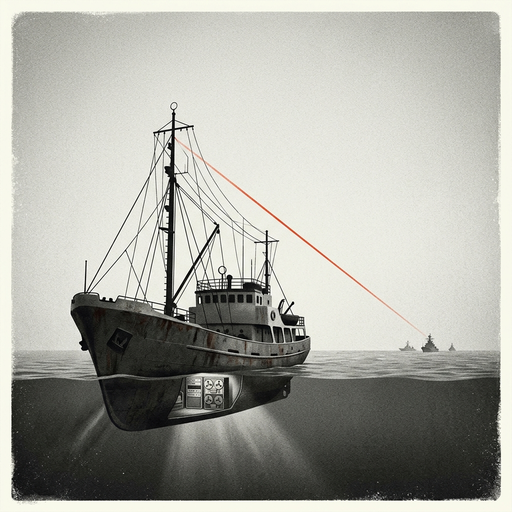
In the middle of the North Atlantic, a carrier strike group maneuvers across the grey swells. Guided-missile cruisers, destroyers, and thirty-thousand-ton assault ships rehearse the tactical patterns of an open-ocean war. Yet riding their perimeter, keeping pace just beyond the formation, is an unglamorous vessel with high bulwarks, rusted sheerlines, and the unmistakable silhouette of a commercial fishing trawler. It tows no nets. Its crew pays little attention to the schools of cod or herring beneath the keel. Instead, deckhands and technical specialists watch the warships, adjusting wire antennas that stretch from the masthead to the stern. The fleet possesses enough firepower to level a coastal city, but in peacetime on the high seas, it cannot simply order the vessel to disappear. What could an ordinary-looking hull actually learn from shadowing a naval exercise? What technical systems were humming behind its bolted bulkheads, and why did monitoring a fishing boat become one of the most persistent operational contests of the twentieth century?
At My Audio Books dot A I, you can create your own audiobooks from prompts, turn your documents into audio, all with one subscription, and store your items in your own personal library.
After the Second World War, the Soviet Union faced a Western maritime alliance capable of projecting carrier air wings and amphibious forces across vast oceanic distances. In the nineteen fifties and nineteen sixties, as the Soviet Navy shifted from coastal defense toward forward presence in foreign waters, understanding Western fleet doctrine became an urgent requirement.
Building an offshore listening network from scratch was expensive and technologically demanding. Early maritime surveillance efforts relied on practical improvisations. Rather than commissioning fleets of costly warships, Soviet authorities adapted existing civilian platforms: commercial deep-sea fishing trawlers, salvage tugs, and small freighters.
Western naval intelligence services observed these vessels operating along shipping routes and designated them with the operational hull classification AGI, standing for Auxiliary General Intelligence. The three-letter label was entirely a Western creation. It did not reflect a single unified Soviet ship class or standard public terminology in Moscow. Instead, it served as a convenient shorthand for any foreign auxiliary operating primarily as an offshore signals intercept platform.
Popular accounts soon reduced these vessels to a single archetype: the spy trawler. That label obscured essential distinctions. An ordinary commercial fishing vessel was not identical to a retired trawler acquired by the Soviet Navy, retrofitted with specialized hardware, and crewed by naval intelligence personnel. Nor were converted trawlers identical to purpose-built intelligence collection ships or commercial cargo conversions.
Treating every Soviet fishing boat as an active surveillance platform overstates the documented record. The vast majority of the Soviet fishing fleet performed routine commercial work, even if individual vessels occasionally reported opportunistic maritime sightings. The true surveillance core consisted of dedicated conversions and specialized naval units.
Moreover, these surface collectors did not operate in isolation. By the late nineteen sixties and nineteen seventies, they formed one layer of an expanding surveillance architecture. That network included shore-based listening stations, long-range maritime patrol aircraft, reconnaissance submarines, and orbital surveillance satellites.
Yet shore stations could not follow a fleet over the horizon, and satellites in low Earth orbit passed overhead only intermittently. To understand a NATO exercise, proximity was indispensable. During large-scale maneuvers, Western navies practiced coordinated air strikes, submarine hunting, and distributed communications. Observing these rehearsals at close range revealed operational habits that distant sensors could never capture.
This operational need raises a fundamental question. Why take a fishing boat into a nuclear confrontation, and how does a vessel built for hauling nets become an intelligence platform?
The choice of a trawler hull was guided by cold maritime practicality. Deep-sea fishing vessels were engineered to operate in the brutal weather of the Barents Sea, the North Atlantic, and the Norwegian Sea. They offered heavy displacement relative to their length, exceptional stability in heavy seas, and large fuel capacities that translated into weeks or months of unreplenished endurance.
They were also economical to acquire and operate compared to specialized warships. An ordinary naval frigate required expensive propulsion machinery, weapons magazines, and high-maintenance combat systems. A converted trawler required only a durable diesel engine and a seaworthy hull.
Inside, the transformation was extensive. Spaces once designated for fish holds, ice bunkers, and processing machinery were cleared out. Shipyards installed internal compartmentation to create secure workspaces, radio receiver rooms, and quarters for intelligence specialists.
Electronics of the era generated considerable heat and consumed significant electrical current. Shipyards had to install auxiliary diesel generators to power banks of vacuum tubes, cooling fans, and sensitive receivers. Specialized ventilation and air conditioning systems prevented humidity and salt air from corroding internal circuitry.
Above deck, the profile changed in telltale ways. Heavy masts were re-rigged with high-frequency whip antennas, long-wire arrays, and rotatable direction-finding loops. Conical radomes and directional dishes were fitted wherever deck space allowed. While some antennas stood out prominently, others blended into the standard rigging of commercial masts.
A persistent Cold War legend suggested that these vessels hid secret sensors, sonar arrays, or torpedoes inside their fishing nets. Historical records and technical analyses do not support claims of sensors routinely concealed within fishing gear. The collection hardware was installed inside the ship, operating through antennas mounted above the deck line.
Because of these modifications, civilian appearance was rarely a deceptive disguise. A fishing boat riding low in the water without processing gear, trailing unusual wire arrays, and drifting beside an aircraft carrier did not fool anyone on a warship bridge. Western crews recognized them immediately.
Over time, the fleet evolved. Early conversions utilized classes such as the Okean, Lentra, and Bologoe types. By the nineteen seventies, the Soviet Navy introduced specialized classes derived from trawler designs, such as the Alpinist class. Later, they deployed large, purpose-built intelligence ships like the Balzam class, which displaced roughly five thousand metric tons. The fishing hull had proven the concept, but the mission was outgrowing the converted civilian frame.
To understand why an intelligence ship accepted the discomfort of shadowing warships, one must look at what it was collecting. The primary mission was signals intelligence, broadly divided into communications intelligence and electronic intelligence.
Communications intelligence focused on the spoken and transmitted words of the fleet, along with the operational metadata surrounding them. Intercepting a transmission did not always mean reading the message. NATO relied on robust mechanical and electronic encryption systems that prevented real-time decipherment.
Yet encrypted messages still broadcast valuable information. Specialists on the collector logged frequencies, signal strength, call signs, and transmission schedules. A sudden surge in message traffic between an admiral's flagship and escorting destroyers often telegraphed an impending maneuver or an air launch minutes before it occurred. By mapping who spoke to whom and how often, analysts assembled the organizational structure of the fleet.
Electronic intelligence, by contrast, focused on non-communication emissions, primarily radar and navigational beacons. Every naval radar operates with specific technical parameters: pulse repetition frequency, beam width, operating frequency, and scan rates.
When an air-search radar swept across an intelligence vessel, automated receivers and magnetic tape recorders preserved the emission. Back ashore, technical analysts dissected the recording to determine the radar's power limits, blind spots, and operating modes. Once Soviet naval intelligence understood the electronic signature of a specific radar system, engineers could design electronic jammers to blind it. In turn, missile guidance systems could be programmed to home in on those emissions.
Visual surveillance complemented electronic collection. Photographers on deck recorded modifications to warship antennas, new weapon mounts, deck-handling procedures, and the time required to launch an air wing.
Proximity was the deciding factor. High-frequency and very-high-frequency tactical radios operate primarily by line of sight. Their signals curve poorly around the surface of the Earth. A shore station hundreds of miles away, or an aircraft flying a brief sweep, could never capture the low-power tactical chatter passing between ships in a tight formation. The collector had to be physically present, riding the same swells, to intercept fleeting, low-power emissions.
Surveillance was never an all-seeing crystal ball. Fleeting transmissions could be missed, and tight emission controls could silence a fleet entirely. Yet repeated observation across strategic choke points—the Greenland-Iceland-United Kingdom gap, the Strait of Gibraltar, the Sicilian Channel, and Pacific transit corridors—gradually turned isolated data points into a comprehensive operational picture. Gathering that data, however, required entering a delicate, high-stakes tactical game.
Living in close proximity created an intense operational dynamic. A collector had to stay near enough to intercept weak signals, but sailing within a warship's formation brought constant risk. NATO commanders, for their part, faced the challenge of protecting operational security without turning peacetime surveillance into armed confrontation.
The primary Western defense was emission control, known as EMCON. When commanders detected a collector shadowing their perimeter, they instituted strict radio and radar silence. Ships communicated using directional signal lamps, sound-powered telephones, or secure line-of-sight infrared beams. Tactical radars were shut down, and exercises were run on secondary frequencies or deferred until the vessel drifted away. The collector could record only what the fleet exposed.
NATO forces also turned surveillance back on the watcher. Maritime patrol aircraft flew low overhead to photograph antenna arrays, while escort destroyers maneuvered close to record the collector's radar emissions.
At close quarters, the interaction occasionally escalated into physical friction. Cold War naval accounts mention aggressive ship handling: destroyers crossing an intelligence ship's bow to throw massive wakes, intentional near-collisions, and claims of tangled communications cables. While these incidents occurred, they reflected tactical tension rather than a formal, sanctioned policy of physical harassment.
The legal status of these encounters was defined by the international law of the sea. Beyond territorial waters, international law guarantees freedom of navigation on the high seas. A naval vessel, regardless of its mission or civilian appearance, cannot be legally boarded or expelled simply because it is listening. As long as the collector complied with international collision regulations, NATO warships had no legal authority to force it away.
Shooting at an unarmed collector, or attempting to seize it, would have constituted an act of war. Furthermore, aggressively maneuvering to push a collector away often telegraphed to Soviet intelligence that the operation underway was of exceptional importance.
The practice of using commercial hulls for intelligence was not unique to Moscow. During the nineteen sixties, the United States Navy operated converted light cargo vessels, designated as Auxiliary General Environmental Research ships, or AGER. The capture of the USS Pueblo by North Korea in nineteen sixty-eight demonstrated both the universal utility of commercial hulls and the extreme vulnerabilities that accompanied them.
In the final balance, what did these converted trawlers actually accomplish? They did not steal master war plans from flag officers' desks, nor did they possess the technical ability to crack every layer of Western naval encryption.
Their real value lay in patient, cumulative aggregation. Over decades of observation, Soviet intelligence built detailed technical profiles of nearly every class of NATO warship, radar system, and operational procedure. They learned how quickly an American aircraft carrier could launch its strike packages, what frequencies British frigates used to coordinate anti-submarine sweeps, and how allied task groups responded to sudden course changes.
In a crisis, that accumulated knowledge would have dictated electronic warfare tactics, target prioritization, and missile flight paths. Knowing the precise pulse rate of an adversary's radar transforms an invisible beam into an exploitable target.
At the same time, these vessels served a psychological purpose. Their constant vigil at the perimeter of exercises was a visible reminder that Western naval power was never operating unobserved. Yet close shadowing also introduced persistent risks of miscalculation, collision, and unintended escalation in times of diplomatic tension.
Following the dissolution of the Soviet Union in nineteen ninety-one, the vast fleet of converted trawlers shrank dramatically. Many older hulls were scrapped or retired as economic crisis gripped the new Russian Federation. Yet the mission itself survived. The Russian Navy continued operating specialized intelligence collection vessels, shifting increasingly away from converted civilian hulls toward sophisticated, purpose-built platforms.
Today, orbital satellites, automated underwater sensors, and long-range unmanned aerial vehicles handle much of the work once done by maritime collectors. Yet surface intelligence ships remain active across the world's oceans. Their persistence demonstrates that high-altitude sensors cannot fully replace a physical listening post floating on the surface of the water.
Separating historical reality from popular folklore leaves a clear picture. The mission did not rely on phantom sensors hidden in fishing gear or universal civilian conspiracies. Instead, it was an organized naval program: dedicated hulls, disciplined crews, and sensitive receivers quietly recording the electromagnetic pulse of an opposing fleet.
When an ordinary-looking vessel appears on the horizon beside a military exercise, its significance is not measured in naval guns or missile tubes. It is measured in the quiet accumulation of radio waves, radar pulses, and procedural habits.
The next time a commercial trawler or research vessel makes headlines for lingering near a multinational naval drill, three questions can help cut through the noise. What specific emissions can a surface platform intercept that satellites miss? What tactical presence does its position project? And how much of the story is verifiable intelligence gathering rather than maritime legend?