Solar Storms and Modern Infrastructure: Power Grids, Satellites, and Resilience
In 1859, a solar storm disrupted telegraphs so dramatically that some operators could send messages with their batteries disconnected; in 1989, another storm blacked out Quebec in under ninety seconds. Today, power grids, satellites, navigation, and communications face different vulnerabilities, but their risks depend on location, infrastructure, and the storm itself. The danger is real, yet forecasting, engineering, and preparation make worldwide technological collapse far from inevitable.
By MyAudioBooks.ai ·
Listen free: Solar Storms and Modern Infrastructure: Power Grids, Satellites, and Resilience
In the late summer of eighteen fifty-nine, telegraph operators across North America and Europe watched their equipment turn erratic. Sparks jumped from switchboards, operators received painful electrical shocks, and telegraph paper scorched from spontaneous electrical arcs. Then came the strangest report in early electrical history: operators on several lines disconnected their heavy batteries entirely and discovered they could continue transmitting messages, powered solely by an unbidden electrical current surging through the ground.
That disturbance, known as the Carrington Event, remains our historical benchmark for an extreme geomagnetic storm. In the nineteenth century, it struck a sparse network of iron and copper wires strung between wooden poles. Today, human civilization rests on continents of high-voltage transmission lines, thousands of orbital satellites, and synchronized global digital networks. That stark contrast raises the central question of modern space weather: when an eruption of that magnitude meets an electrified society, what actually breaks, what holds, and what can we do about it?
At My Audio Books dot A I, you can create your own audiobooks from prompts, turn your documents into audio, all with one subscription, and store your items in your own personal library.
On the morning of September first, eighteen fifty-nine, English astronomer Richard Carrington stood in his private observatory, projecting an image of the Sun onto a shaded screen. As he tracked an unusually complex cluster of dark sunspots, two intensely bright patches of white light suddenly materialized within the group. Carrington hurried to find a witness, while across London, another observer named Richard Hodgson independently reported the exact same flash. They had documented one of the earliest recorded optical sightings of a major solar flare.
The Carrington Event was not a single, isolated instant. The Sun had been expelling magnetic activity for days, producing repeated disturbances from late August into early September. At the exact moment the white-light flare occurred, delicate magnetometers at Kew Observatory in London recorded a sharp, brief deflection in Earth’s magnetic field. This phenomenon, known as a magnetic crochet, provided an early clue connecting solar activity to terrestrial magnetism decades before scientists understood the solar wind or interplanetary plasma.
Within hours, auroras lit up the night sky across extraordinary latitudes. Observers witnessed brilliant green and crimson displays across the Caribbean, Central America, Hawaii, and northern Australia. In the Rocky Mountains, the glow was so intense that gold miners woke up in the middle of the night and began preparing breakfast, convinced dawn had arrived.
Beneath those skies, long grounded telegraph circuits acted as involuntary antennas, accumulating voltages generated across thousands of kilometers of terrain. These reports confirm the sheer geographic scale of the disturbance, yet they remain qualitative historical observations rather than calibrated engineering data.
No spacecraft were stationed in orbit to record the density, speed, or magnetic orientation of the incoming solar plasma. Scientists today must reconstruct the storm’s physical parameters from handwritten nineteenth-century magnetograms, instruments that often swung completely off their scales during the peak disturbance. Furthermore, nineteenth-century telegraph circuits carried simple direct current over earth-return paths, bearing little resemblance to modern three-phase alternating current grids or solid-state electronics. The Carrington Event demonstrates the Sun’s raw capacity to disturb electrical systems, but it serves as a historical benchmark rather than an off-the-shelf blueprint for modern damage.
Understanding the danger of space weather requires separating two solar phenomena that often occur together but behave very differently. The first is a solar flare. A flare is an abrupt eruption of intense electromagnetic radiation traveling at the speed of light. It covers the distance to Earth in approximately eight minutes, ionizing the upper atmosphere and disturbing high-frequency radio signals on the planet’s sunlit side.
The second phenomenon is a coronal mass ejection. Rather than pure radiation, this is an immense eruption of magnetized plasma, billions of tons of superheated electrons and protons launched from the Sun’s outer atmosphere. This material travels far slower than light, taking anywhere from fifteen hours to several days to cross the gulf between the Sun and Earth.
When that magnetized plasma cloud collides with Earth, it meets the magnetosphere, the protective magnetic bubble carved out by our planet’s intrinsic magnetic field. If the magnetic field embedded within the arriving plasma points strongly southward, it links directly with Earth’s northward-pointing field through a physical process called magnetic reconnection.
This physical link allows vast amounts of solar wind energy to enter the magnetosphere. That energy accelerates charged particles into the upper atmosphere, driving massive electrical currents circulating hundreds of kilometers above us, including the intense auroral electrojets.
As these high-altitude currents fluctuate rapidly, they create dynamic magnetic fields at the surface of the Earth. Through the law of induction, any changing magnetic field drives an electric field through the ground below. Regional geology dictates the strength of that field: deep, electrically resistive rock, like ancient granite formations, cannot easily disperse the charge. Instead, the electric field pushes current upward into any long, man-made conductor with multiple grounding points.
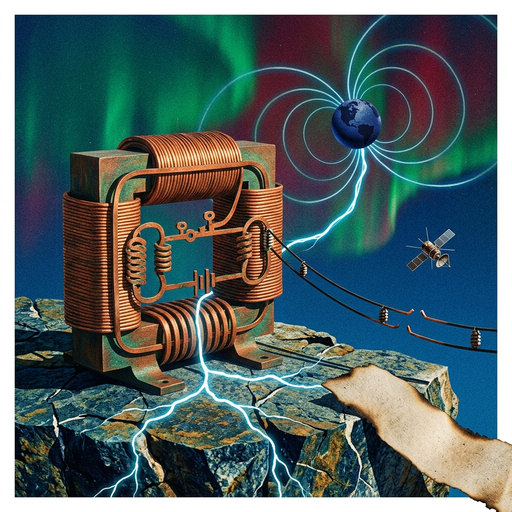
High-voltage power lines are tailor-made for this process. Because large power transformers connect directly to ground for safety and system stability, geomagnetically induced currents enter the substation neutrals. These currents fluctuate at frequencies far below one hertz, behaving essentially like slowly varying direct current entering an alternating current network.
Alternating current transformers cannot handle sustained direct current. Even modest levels push the transformer’s magnetic iron core into saturation during half of every alternating current cycle. This saturation forces magnetic flux out of the core into surrounding structural steel, generating extreme internal heating, distorting the smooth alternating voltage into unwanted harmonics, and causing the transformer to consume massive amounts of voltage-supporting reactive power.
This physical process differs fundamentally from an ordinary short circuit. The hazard is not simply that a line melts or a fuse blows; rather, the sudden distortion and loss of voltage stability can trigger automated protection systems, knocking critical components offline and destabilizing the wider network long before equipment burns out.
On March thirteenth, nineteen eighty-nine, this theoretical physical mechanism produced a major real-world power failure. A severe geomagnetic storm struck Earth, driving intense electric fields into the ground across eastern North America.
The province of Quebec was uniquely exposed. Hydro-Québec operated an advanced transmission system that carried hydroelectric energy from massive generating complexes around James Bay south to Montreal and Quebec City over seven-hundred-thirty-five-kilovolt transmission lines spanning nearly one thousand kilometers. The entire network sat atop the Canadian Shield, an immense formation of resistive Precambrian bedrock that forced induced currents out of the rock and directly into the grounded transmission grid.
Shortly after two o’clock in the morning, geomagnetically induced currents saturated transformers across the network. The resulting electrical distortion caused voltage asymmetry of roughly fifteen percent on the seven-hundred-thirty-five-kilovolt system.
Complex voltage-stabilizing devices known as static compensators began misinterpreting these severe harmonics as internal equipment faults. One by one, their protective relays tripped them offline to preserve the hardware. Stripped of dynamic voltage support, the balance of the grid collapsed. Five major transmission lines from James Bay tripped out of service in rapid succession, dropping approximately nine thousand four hundred fifty megawatts of generation within seconds.
The entire provincial grid collapsed in less than ninety seconds. Across Quebec, roughly six million people lost electricity in the middle of a sub-freezing winter night. The outage lasted approximately nine hours for most customers, requiring careful, manual restoration by system engineers.
Quebec was the storm’s most prominent blackout, but it was not an isolated event. South of the Canadian border, the same disturbance caused severe voltage sags and damaged equipment in the United States, including internal thermal failure in a large step-up transformer at the Salem Nuclear Generating Station in New Jersey.
The primary engineering lesson from nineteen eighty-nine is that a power grid can collapse from voltage instability and cascading relay trips without first suffering widespread physical destruction. The Quebec blackout demonstrated how rapidly modern protection systems can cascade when faced with severe geomagnetic distortion, providing an operational case study rather than a scaled model of an uncertain worst-case event.
Modern society depends on tightly coupled infrastructure, making it vital to distinguish between demonstrated physical vulnerabilities and speculative scenarios. In electrical transmission, the most serious lasting concern involves extra-high-voltage transformers. These machines are custom-engineered, weigh hundreds of tons, and require specialized manufacturing facilities with build times extending past a year. If a storm were to destroy dozens of these transformers simultaneously through extreme overheating, replacing them would take considerable time.
Yet vulnerability across power networks remains highly uneven. High-latitude regions face strong auroral electrojets, but local geology, line orientation, network topology, grounding configurations, and real-time power transfers dictate how much current enters any individual transformer. Geography alone does not define failure.
Above the atmosphere, satellites encounter distinct environmental hazards. Spacecraft do not experience geomagnetically induced currents from the ground; instead, they face energetic solar particles and intense radiation. Solar protons can penetrate shielding to cause single-event upsets in microprocessors, while accumulated electrons can build static charges inside satellite insulation that discharge in damaging internal arcs.
Simultaneously, solar radiation heats the thermosphere, causing Earth’s upper atmosphere to expand outward. This expansion increases aerodynamic drag on low-Earth orbit satellites, causing their orbits to decay rapidly unless onboard propulsion compensates, creating major operational challenges for tracking and collision avoidance.
Satellite navigation and timing services face functional degradation even when spacecraft remain completely healthy. Turbulent solar storms stir up irregularities in the ionosphere, causing radio signals to delay or fluctuate rapidly, an effect known as scintillation. Ground receivers can struggle to maintain lock, disrupting precision navigation and satellite-based timing signals that support cellular networks, financial trading systems, and pipeline controls.
Communications networks display mixed vulnerabilities. High-frequency radio used for transoceanic aviation and marine communications experiences severe absorption during storms, forcing aircraft on polar routes to divert south.
In contrast, modern internet traffic travels primarily through fiber-optic cables, which carry light and are entirely immune to geomagnetic induction. Long-distance terrestrial and transoceanic fiber links do require copper conductors to carry electrical power to underwater signal repeaters every fifty to one hundred kilometers. While deep ocean water dampens electric fields, transoceanic cables still accumulate potential differences across their span, presenting engineering questions that remain under active study.
The primary systemic threat to digital infrastructure is not that microchips will burn out from induced currents. Communications facilities, data centers, and internet exchange points reside in grounded physical buildings. The true hazard lies in cascading dependencies. If the bulk power grid experiences an extended blackout, data facilities must rely on emergency generators. When backup fuel supplies, transport networks, and municipal water for cooling systems are disrupted, digital services fail because the electrical foundation beneath them has faltered.
Unlike earthquakes, space weather offers advance warning, though forecasting precision encounters hard physical limits. Solar coronagraphs and orbital telescopes detect the launch of a coronal mass ejection almost immediately, allowing forecasters to estimate its speed, trajectory, and arrival time within a window of a few hours. That provides grid operators with fifteen to forty-eight hours of strategic notice.
The decisive variable, however, remains hidden until the storm is on Earth’s doorstep. The severity of geomagnetic coupling depends on the north-south orientation of the magnetic field embedded inside the arriving plasma. If that field points north, it deflects smoothly off Earth’s magnetic field with modest consequences; if it points south, severe induction follows.
Currently, monitoring satellites stationed at Lagrange point one, roughly one point five million kilometers upstream from Earth, can only measure that magnetic orientation as the plasma sweeps past them. At typical storm speeds, that yields thirty to sixty minutes of definitive tactical warning before ground induction begins.
Even with limited warning times, operators are far better equipped than in nineteen eighty-nine. Following the Quebec blackout, Hydro-Québec invested heavily in system hardening, installing series capacitors to block direct current, reprogramming protective relays, adding harmonic filters, and designing real-time geomagnetic monitoring tools.
Across the globe, space-weather alerts now trigger documented operational procedures. Utilities postpone planned line maintenance, reconfigure networks to avoid single points of failure, reduce power flows along long transmission corridors, and bring additional generation online to provide reactive power reserves.
Estimating how frequently extreme events occur remains an active scientific problem. Figures suggesting that a Carrington-scale storm occurs once every one hundred to five hundred years represent statistical models fitted to sparse historical records rather than an impending countdown.
Studies of carbon-fourteen spikes preserved in ancient tree rings reveal evidence of extreme solar-particle events in the distant past, including an event around seven hundred seventy-four of the Common Era. Yet these radionuclide spikes measure intense fluxes of solar protons hitting the atmosphere, a mechanism distinct from the geomagnetic ground induction driven by coronal mass ejections. A historical particle event does not automatically establish an equivalent power grid catastrophe.
Long-term continental grid failure remains an acknowledged tail risk, but it is not the default outcome of every severe solar storm. The reality lies between panic and complacency: major geomagnetic storms are inevitable physical realities, but operational coordination, engineering improvements, and strategic mitigation sit squarely between a solar eruption and a societal breakdown.
History proves that the Sun has the power to disturb human technology. Yet human systems are not passive targets. Following the lessons of eighteen fifty-nine and nineteen eighty-nine, engineers have spent decades learning the physics of space weather and transforming vulnerability into resilience. When confronted with claims that an inevitable solar storm will switch off modern society, the responsible approach is to evaluate three practical factors: which system is exposed, in which geographic region, and backed by what specific engineering evidence.
If this investigation helped you separate the physical realities of space weather from alarmist headlines, consider sharing it with someone who values evidence-based science. What parts of our modern infrastructure do you think require the most attention as we prepare for future storms?