Rosalie’s Christmas Orders
Burned-out pastry chef Dominic Corso returns to Providence to close his late sister’s bakery, only to stake his savings on keeping its debt-strapped kitchen running through Christmas. When his controlling approach wrecks a major catering order and exposes the conditions attached to his past offers of help, he must choose between a secure hotel job and a smaller, uncertain future in which funding the bakery no longer means commanding it. He stays, accepts the staff’s authority over their work, and earns a place at their table—even as grief, debt, and the possibility of failure remain.
By MyAudioBooks.ai ·
Listen free: Rosalie’s Christmas Orders
I had one hand under the last table when Astrid told me to move my suitcase.
“Flour comes through there, Dominic.”
The table rocked whenever I took my weight off it. I pressed a folded piece of cardboard beneath the short leg and tried again. At seven ten that Tuesday morning, she had already asked me twice.
“That’s better,” I said.
“Your suitcase.”
I stood, caught the handle, and pulled it out of the narrow passage between the counter and the kitchen. Astrid went through carrying a tub of dough against her apron. She knew me from my earlier visits to Rosalie, before the seven years when I stopped coming. She gave me no welcome I had to answer.
It was December first, two thousand and twenty-six. I was forty-one, a pastry chef back in Providence for my older sister’s funeral, which was over, and her affairs, which weren’t. Corso’s stood near Federal Hill, where I still knew the streets better than I knew where she kept anything. I had been outside professional kitchens for six months. I called it a career break when someone asked.
I parked the suitcase beneath a chair and followed Astrid.
She set the tub on the shared bench. Beyond her, the oven baker was turning loaves with a peel. A younger man at washing knocked dough out of a bowl with a scraper. The mixer ran close enough to the bench that a person opening its guard narrowed the route to the oven.
“Where do you want me?” I asked.
“Wash your hands first.”
I washed, found a clean apron, and reached for the dough. Astrid put a scale in front of me.
“Same weight. Fold the sides under. Keep the seam down.”
“I remember how to make a roll.”
“Then these should go quickly.”
They did. The dough had good strength, and my hands found the movement before I had finished resenting the instruction. Across the bench, Astrid checked the first two, then left me with the rest.
I had come to count what could be used, finish what had been promised, and close the bakery without leaving spoiled food or unpaid people behind. The lawyer had already arranged my authority to keep the estate business trading temporarily. That made me responsible for decisions during the winding down. It didn’t make the bakery mine.
Rosalie had kept taking orders. The four people still working here were filling them: bread for the counter, cakes and pastry for customers who had paid or expected to pay at pickup. There were also larger orders for people serving food somewhere else. Those outside orders used the same mixer and oven as everything sold through the front. The daily counter brought in money throughout the day. Until I understood both sides, I had no useful closing date.
“Dominic, plates,” someone called.
The woman at the counter had two customers waiting and a hot sandwich balanced on a spatula. I opened a cupboard and found cake boxes.
“Other side,” she said.
I tried the next door.
“Under me. Here.”
I went around her, found the plates, and passed one across.
“Joanne Costa,” she said. “I do the counter. You’re standing on my foot.”
I moved. She slid the sandwich onto the plate and carried it to a man sitting near the window. By the time she returned, the younger man had come through with a stack of clean bowls.
“Eddie, leave me two,” she told him.
He separated them without stopping. “The shallow ones?”
“Please.”
I went back to shaping rolls. The oven baker drew out a tray, checked the bottoms, and set it down with a dry metal scrape.
“Frank Bellini,” Astrid said, catching my attempt to place him. “You met.”
“At the funeral,” Frank said. “We had other things to discuss.”
I nodded. I remembered his hand on my upper arm beside the church door. I hadn’t remembered his name.
The flour supplier arrived while I was finishing the last row. Eddie reached for the delivery trolley, but the supplier kept his hand on its handle.
“Before we bring anything in,” he said, “I need to speak to whoever’s authorizing payment.”
Astrid wiped her hands. “Dominic is.”
I gave him my full name. He knew Rosalie’s surname. He wanted to know whether I could pay for the delivery.
“What’s outstanding?” I asked.
“Forty thousand dollars.”
I pressed the last roll too hard. It flattened under my palm.
“Forty fucking thousand?”
The supplier waited.
I turned to Astrid. “You knew about this?”
“I knew he was waiting for money.”
“Forty thousand?”
“She told me she was arranging it.”
Joanne came to the kitchen end of the passage. “She told me we needed a good Christmas. She never gave me that amount.”
Frank stayed beside the oven. “Wages came. Flour came. We knew she was behind.”
“You could have asked.”
“I did,” Astrid said.
The supplier pulled the trolley back enough to let Eddie pass.
“I can’t extend more credit,” he said. “New stock is paid on delivery. What you owe already is a separate conversation.”
“I don’t owe it personally.”
“I understand that. I’m asking what the business can pay.”
His calm made my voice sound worse. I took off the apron and folded it, badly, while I counted what I had available.
Thirty thousand dollars remained in the fund that had let me leave my last job without immediately taking another. Six months had already taught me how quickly a person could use up a supposedly sensible reserve. I wanted enough left to choose where I went next.
“When’s payroll?” I asked.
Astrid told me. Five thousand dollars would cover the next pay, including the hours already worked. Three thousand would buy the ingredients needed to keep going for now. Neither sum touched the old flour debt.
Joanne went back to the counter when the bell sounded. A woman wanted two loaves and the pastries she had ordered. I heard the card terminal finish, then Joanne asked whether she needed a bag.
I took out my phone.
“I’m putting in eight thousand,” I said. “Five held for payroll. Three for ingredients. We get through the Christmas orders, then decide what can stop.”
Astrid rested both hands on the bench. “How many hours are you buying ingredients for?”
“The hours we need.”
“The hours we’re paying for,” she said. “Those have to match.”
I opened the bank app and made the advance while the supplier waited. Twenty-two thousand remained before my own living costs. I showed him that money had reached the business account, then put the phone away.
“Cash on delivery,” I said. “And six thousand toward the old balance by December twenty-eighth.”
“From Christmas trading?”
“Yes.”
He rubbed a thumb along the trolley handle. “Six thousand. December twenty-eighth. New purchases paid separately.”
“I heard you.”
“I need you to agree.”
“I agree.”
I paid for the delivery from the ingredient money. He let Eddie take the trolley.
Joanne returned with an empty bread basket. “The counter money still has to pay for tomorrow’s work. You can’t put everything we take toward him.”
“I know the difference between sales and spare cash.”
“Then leave enough for tomorrow.”
Astrid began counting trays on her fingers. “We have accepted orders through Christmas Eve. We have bread every morning. Frank’s oven hours are already full on the busy days.”
“I’ll work.”
“Doing what?”
“Pastry. Whatever takes pressure off.”
She shifted the scale toward an empty part of the bench. “Start by fixing that roll.”
I picked up the flattened dough and folded it again. I had sent Rosalie checks before. She had never cashed them. The first had come with conditions, and I had never told her those conditions were withdrawn when I sent the later ones. Standing at her bench, I wanted the simpler account: I had offered help, and she had refused it.
“Christmas,” I said. “That’s what I’m committing to.”
Astrid waited until the seam held beneath my thumb, then put the roll with the others.
By Tuesday, December eighth, I knew where the plates lived and which part of the passage stayed clear when the flour came. I had paid for ingredients as they arrived, worked the agreed shifts beside the staff, and gone away at night with dough beneath the edges of my nails. Nobody had mistaken the advance for money that would last.
That morning I changed the mixing order.
Astrid usually made the almond biscuit dough first, then the sweet yeast dough for the breakfast rolls. The butter sat out while she dealt with the mixer, and the biscuits spread more than they needed to. I put the sweet dough in first and kept the biscuit butter cold until I needed it.
“You’re starting those now?” she asked.
“They can rise while I do these. Less standing around.”
She had both arms beneath a slab of dough she was moving onto the bench. “Ask Frank where they go.”
“I’ll handle the oven.”
The biscuits came out even, with clean edges. I broke one after it cooled enough to hold. It snapped instead of bending.
“That’s better,” I said, offering her half.
She tasted it. “Less spread.”
“And less trimming.”
She put the remainder down and went back to her work.
The rolls rose quickly in the warm kitchen. I glazed the tops, opened the oven, and loaded the trays into the space I could see.
Frank came around the bench with the proofed bread.
“What’s in there?”
“Sweet rolls. Short bake.”
“Whose short bake?”
I pushed the door shut. “They’ll be out before—”
“Before the bread that’s ready now?”
I turned toward his trolley. The loaves had expanded to the edges of their baskets.
“They can hold a few minutes.”
“Have you tested that with this dough?”
Astrid stopped cutting. “That was the bread slot.”
I checked the oven. The rolls had begun to swell, their glaze turning dull. Waiting would spoil the bread. Pulling them would spoil the rolls.
“Fuck.”
Frank stood with his hands on the trolley.
I took out the trays. The movement let the half-set dough sag. One roll tore where it had stuck to its neighbor.
“Put your bread in,” I told him.
He went past me with the peel. I carried the rolls to the bench, where they occupied the space Astrid needed for cutting.
“Where are those going?” she asked.
I lifted the first tray again.
Eddie brought the waste bin closer, then waited for me to finish the decision myself. I tipped the rolls in. They landed with a soft, heavy sound that made the whole morning’s work seem worse.
“Ingredients and time,” Astrid said.
“I’ll cover them.”
“The time has gone.”
“I know. I fucked it up.”
She studied my face, then took the empty tray. “Keep the sweet dough where it was. Keep the biscuit butter cold.”
I wanted to explain that the method had worked. The bin was beside my leg. I washed the glaze off my hands instead.
Later, I found Astrid pressing biscuit dough into individual little bars, then trimming each one to the same length. A row of offcuts waited beside her.
“Why separate molds?” I asked.
“That’s how we’ve sold them.”
“Same shape if we press a slab and cut it.”
“The edges won’t match.”
I put a small piece between two straight guides, rolled it, and cut three bars. She set one beside hers. The difference was smaller than the piece she had trimmed off.
“How much do you throw away?” I asked.
“We reuse some.”
“How many times?”
She pushed the offcuts together with her scraper, then broke off a dry edge. “Get the larger tray.”
We pressed the next batch as a slab. It took less time, and she cut the bars herself. She kept the first row back for comparison rather than announcing that I had been right.
Near lunch, I moved the biscuit trays toward the packing surface.
Joanne stopped me with a stack of plates against her hip.
“I need that clear.”
“They’re just cooling.”
“I’m making sandwiches there.”
“We could do fewer sandwiches on production days.”
“Which of these people do I tell?”
Two men stood at the counter, one still wearing work gloves. A woman behind them was taking off her coat. Joanne put down the plates, took a loaf from Frank’s cooling rack, and cut it.
I carried the trays back.
She assembled the first sandwiches while I fetched the bowls she asked for. The men bought coffee as well. The woman ordered lunch and chose biscuits to take with her. Another customer came for bread and stayed to eat.
“They buy what else is here,” Joanne said when I returned for the knife. “And they pay today.”
“I can see that.”
“Good. I need mustard.”
I found it without opening the wrong cupboard.
On Friday, December eleventh, Eddie slid a bowl back toward me at washing.
“That one’s yours.”
A hard band of dough had dried around its rim. I had stacked it beneath two others while I cleared my bench, telling myself I would soak it before I left.
“I’ll get it.”
“I can do it.”
“You’ve got enough.”
He moved aside. I filled the bowl with hot water, worked the scraper beneath the crust, and felt it jar through my wrist. Eddie kept washing the smaller things.
The others were still finishing their paid work. Frank brushed crumbs from the oven mouth. Astrid wrapped dough for the next morning, and Joanne counted what remained in the display before cleaning it.
“You can leave that to soak,” Eddie said.
“And find you doing it when I come back?”
“Usually how soaking ends up.”
I stayed until the dough came free, washed the bowl, and wiped the patch of bench I had dusted with flour. Eddie inspected it without making a show of inspecting it.
“Thank you,” he said.
The phone rang at the counter while I was putting the bowl away. Joanne had wet hands, so I answered.
The woman wanted pastry for a catered event on Saturday, December nineteenth. She needed six hundred individual pieces, half fruit tartlets and half filled cream puffs, packed for her to take away.
“Pickup at twelve thirty in the afternoon,” she said. “Everything has to go with me then.”
I rested the phone against my shoulder and pulled a scrap of paper toward me.
“Yes. We can do that.”
Joanne dried her hands.
The buyer asked about the price. Four thousand dollars for the full order, two thousand paid as a deposit. I repeated the selection and the pickup, then took the payment through the counter terminal.
It cleared. The buyer thanked me and ended the call.
“How many?” Joanne asked.
“Six hundred.”
Astrid lifted her head from the dough she was wrapping. “For when?”
I told them.
Frank set down his brush. “What are we leaving out?”
“We’ll work around it.”
“What does it go around?”
I described the shells we could bake ahead and the filling we could finish Saturday. As I spoke, I could see the completed trays: uniform fruit, clean borders, the puffs filled neatly and packed before the buyer arrived. I had made much larger orders in hotel kitchens.
Astrid pointed at the bench. “Shells here. Bread there. Where am I rolling?”
“We sequence it.”
“You accepted before you had a sequence.”
“I’ve accepted the deposit. Two thousand dollars.”
“Which we spend making a four-thousand-dollar order,” Joanne said. “That’s not two thousand left over.”
“I understand.”
“I need lunch prep on Saturday. Not a corner you give me after everything’s filled.”
“You’ll have space.”
“Put it in before you give the space away.”
I wrote Saturday at the top of a clean production sheet and began dividing the work.
Frank came to my shoulder. “I leave at one that afternoon.”
“Pickup is twelve thirty.”
“I leave at one. Those are two different things.”
“I’ve got it.”
“And I want fewer shifts after Christmas. I told Rosalie. I’m telling you now.”
He waited until I added his finish beside his name.
Eddie had returned to washing. “I’m done at three.”
“Right.”
“Paid until three. I’ll get through what I can.”
“We may need to finish packing.”
He turned off the tap. “Then we need to pack before three. I’m not staying after my paid time to catch up.”
The politeness had gone from his voice without the volume changing.
“Nobody asked you to work for nothing,” I said.
“I’m saying it now.”
I wrote his finish too.
Astrid took the sheet and read the quantities. “You want these fillings done Friday?”
“Yes. Shells ready. Saturday is assembly and the last bake.”
“Along with bread, counter pastry, and lunch.”
“We’re not starting from zero.”
She gave the sheet back. I took that for more agreement than it contained.
While I was clearing my things, my phone lit with a message from a former hotel colleague. We had been talking since November about a pastry position. He had worked with me when I still liked the speed of a full kitchen and had enough staff to keep it clean.
He wanted to know whether January fourth remained possible.
I typed that I was still interested.
“Something else?” Frank asked.
“A job conversation.”
“Here?”
“Hotel. Out of town.”
“January?”
“Nothing settled.”
The position had a salary, a proper pastry kitchen, and my name above a department again. I could imagine walking into it without somebody asking me where Rosalie had put the plates. I left the conversation open on my phone while I finished writing Saturday’s work.
By Friday, December eighteenth, the sheet had been handled enough that the corner curled beneath Astrid’s wrist.
She held it down at the production bench beside the oven passage. I stood opposite her, trying to move Saturday’s assembly earlier without moving the bread or Joanne’s lunch preparation. The afternoon counter was thinning, but every trip through the passage still required someone else to turn sideways.
“These puffs have to cool before they’re filled,” Astrid said.
“I know.”
“Where?”
“Packing surface.”
“Where the tartlets will be.”
“We pack those first.”
“With who?”
“Eddie.”
“Who’s finishing the filling and washing the bowls?”
I took the pen and drew it toward me without making a mark.
Frank was by the oven, shutting down the work he could finish that afternoon. Eddie had a bowl and a cloth at washing. Joanne was on the counter side of the passage, checking that nothing for tomorrow’s lunch had been pushed out of reach.
“If I start the tarts,” I said, “you can take the puffs.”
“And the morning dough?”
“I’ll come back to it.”
Astrid tapped the sheet. “That’s three things you’ve come back to.”
I wanted another bench. I wanted a second oven and the hotel crew I kept using in my head. Corso’s had what stood around us.
Eddie dried his fingers, put two in his mouth, and produced a short, piercing whistle.
“How do you do that?” I asked.
“Fold your tongue back. Fingers hold it.”
I tried. A stream of air escaped around my knuckles.
“Less mouth open,” Eddie said. “You’re letting it out the sides.”
“Useful equipment, my mouth.”
“Try again.”
I adjusted my fingers and blew. Nothing but breath.
Joanne set down the container she was carrying. “Here.”
She put two fingers beneath her tongue and whistled so loudly that I took my hand away from my face. Astrid laughed, a full laugh that interrupted her attempt to say something.
“All right,” I said. “You’ve established the standard.”
Eddie rinsed his fingers and picked up the bowl again. I pulled the waiting sheet back between Astrid and me.
“The assembly has to begin here,” I said, touching the first space after the bread.
My phone vibrated beside the pen. The hotel colleague had sent the confirmation we had been discussing: a January fourth start, with an answer required by noon on December twenty-first.
I read it twice.
Astrid waited. “Are you taking that?”
“It’s a message.”
“Are we finishing this?”
I picked up the phone. The salary was there in the confirmation, along with the responsibilities and the start date. Nothing in the offer required me to find money for a dead woman’s flour.
“We need to talk about January,” I said.
Joanne moved to the end of the passage. “Are we opening in January?”
“If the Christmas trading supports it. A smaller operation. More outside orders, fewer counter hours.”
Astrid took her hand off the sheet. “What outside orders?”
“We’d build them. Regular business. Wholesale, not just one event at a time.”
“At what prices?”
“I’d set prices that cover the work.”
“And when do they pay?” Joanne asked.
“We’d set terms.”
“My customers pay while they’re standing here.”
“Your customers need the counter staffed all day. Production stops every time somebody needs a sandwich.”
“I make the sandwiches.”
“And the space, the bread, the washing. All of it is work.”
“Yes,” she said. “It is.”
I put the pen down. “We can’t carry the present staffing for a counter that size. We’d need fewer people, not just a different display.”
Eddie stopped turning the bowl beneath the tap.
“Which people?” Frank asked.
“I haven’t assigned anything.”
“You’ve assigned fewer.”
“A January plan has to pay. That’s the point.”
Joanne’s face changed at the word plan. She brought a hand to the edge of the counter, then let it fall.
“I need to know whether you’re asking me to change the prices or telling me I won’t have a counter.”
“Those aren’t the only choices.”
“Then give me the other one.”
I described shorter hours, a reduced selection, bread sold alongside pickups for outside customers. I spoke quickly, putting the pieces in place before anyone could remove one. With less retail preparation, I said, we could consolidate production. We could use the last table for packing during the busy part of the morning.
“Where do the people eating lunch go?” Joanne asked.
“We’d serve fewer lunches.”
“How many fewer?”
“We’d work that out.”
“Before or after you tell them?”
Astrid turned the Saturday sheet toward herself. “January isn’t sequenced either.”
“I’m trying to keep the place open.”
“Tomorrow first.”
“We need enough money to have a January.”
“We need an order we can make tomorrow.”
Frank shut the oven door. The latch clicked over, and he kept his hand on it.
“Does this plan have me leaving at one?” he asked.
“Yes.”
“Fewer shifts later?”
“I heard you the first time.”
“Then use it.”
Eddie turned the tap down. “And three for me. The paid finish stays three.”
“It stays three,” I said.
Astrid moved her finger along the sheet, naming work rather than people. “Bread. Counter pastry. Tart shells checked and finished. Puffs baked and cooled. Both filled. Fruit cut. Everything packed. Lunch prepared. Washing kept moving.”
“We’ve already done some of that.”
“And I’ve allowed for it. Six hundred catering pieces still leave us more assembly than the bench and the hours can take.”
“I’ll do the assembly.”
“Where do I work while you do it?”
I shifted the sheet toward the empty end of the bench.
“That space has dough on it tomorrow,” she said.
I brought my hand back.
“Call the buyer,” Astrid said. “Reduce it while she can still do something.”
“The event is tomorrow.”
“That’s why you call now.”
“I gave my word.”
“So did I. To the bread orders.”
Joanne spoke from the counter side. “And I have lunches people asked for before you took this.”
The phone stayed warm in my hand. I could see the hotel message without turning the screen toward anyone. My colleague needed a yes or no. Here, every answer made another question.
“I’ve put my money into this,” I said.
Astrid’s jaw tightened. “I know.”
“I’m not asking you to cover the loss.”
“You’re asking me to be responsible for the output.”
“You’re head baker.”
“Then I need to decide the order of the work.”
“You do.”
“Until you move it.”
I opened my mouth, and she put her finger on the sheet.
“Last week you put pastry in the bread slot. Today you want Eddie on packing while I’m waiting for clean bowls. If I set a sequence, can you change it?”
“If something needs changing.”
“Then you own the sequence. You own what fails.”
“That’s a hell of a way to run a kitchen.”
“It’s the kitchen you’re running.”
Frank remained beside the oven. Joanne kept the counter side of the passage clear. At washing, Eddie worked the cloth around the inside of another bowl, slower now.
I wanted Astrid to acknowledge that I could still make good things, that I had taken a loss without putting it on her, that I had stayed to scrape my own dough out of a bowl. Instead she waited for an answer about tomorrow.
“We keep the full order,” I said. “The counter work stays too. I’ll make the production fit.”
“With whose sequence?”
The phone showed five forty PM. I held the hotel confirmation open in my right hand, with Astrid opposite me and the pen beside the waiting sheet.
With my left hand, I laid the unchanged Saturday production sheet flat.
“Then you’re directing it,” Astrid said. “I’ll do the work you give me. I won’t promise the result.”
She left the sheet beneath my hand and took the wrapped dough to its place for the night. Frank turned back to the oven. From washing came the scrape of Eddie’s cloth against a bowl.
“Seven tomorrow,” I said.
“We know,” Joanne said. “We still have to finish tonight.”
I closed the hotel message and put the phone in my pocket. We worked the rest of the paid closing shift. I checked the tart shells we had baked ahead, separating the broken ones from those we could use. Astrid finished the fillings. Eddie washed what we emptied, and Joanne cleared the counter without giving away her preparation space for the morning.
I wanted to carry on after they left. There were things another hour could improve, provided I ignored everything that needed doing after those things. I covered the shells and put them away.
We left at six thirty in the evening. The walk to my rented room took ten minutes. I ate standing beside the small sink, set an alarm, and lay down with my hands resting outside the blanket. Each time I woke, I tried another sequence for the oven. I slept between them.
At six forty-five the next morning, I unlocked Corso’s and turned on the work lights. By seven, Frank had his hands in the bread dough and I was trimming tart shells at the bench. Astrid weighed the morning pastry beside me. Eddie started at washing while Joanne brought out what she needed for lunch.
“Leave that end clear,” Joanne said.
“I have.”
“For the whole morning.”
I shifted my cutting board toward me. She set down two containers and went to open the counter.
The first hour went well enough to support every bad decision I had made. The shells held their shape. The cream had set properly overnight. I could pipe cleanly and quickly, and a tray of finished tartlets made the unfinished work seem smaller.
Then I needed the fruit cut. Eddie needed the sink I was using to rinse it. Astrid needed the bench occupied by my next trays, and Frank needed a clear route to the oven.
“Lift your elbow,” he said.
I moved. His peel passed close enough for me to feel the heat along my forearm. I put a tray on the packing surface, then brought another behind it. Joanne came through for bread and stopped.
“I can’t turn with a plate there.”
“I’ll move it.”
“Where?”
I carried it back to the bench. Astrid held a tub against her hip until I found enough room to set it down.
By half past nine, we had tartlets waiting for fruit, puffs waiting to bake, and bread waiting to come out. Nothing had broken. Nobody had been late. We had simply reached the part of my plan that required two people to stand in the same place.
I squeezed a last row of puffs onto a tray and carried it toward the oven.
“Those go after the small loaves,” Astrid said.
“They’re only—”
“The small loaves go now.”
Frank already had them ready. I could have opened the oven and made him wait. My hand reached the latch before I brought it back.
“All right. Where can these stand?”
Astrid cleared a narrow space. “Here. Keep the passage open.”
I set them down. Joanne came for a knife, found her preparation area clear, and started cutting sandwiches. Frank loaded the small loaves. They came out in time to cool before the customers who had ordered them arrived.
At the counter, Joanne handed over bread, took payment, and returned to the sandwiches. Nobody had stayed late or hurried a bake. One batch had gone where it belonged. My puffs still waited.
By eleven, the first ones were cooling, but the trays occupied the surface where I needed to pack. I filled tartlets in groups, carried them forward, then carried the empty trays back through the same passage. Eddie washed the bowls we needed again before he could catch up with everything else.
“Can you box those?” I asked him.
“After these.”
“I need them boxed now.”
Astrid spoke without lifting her hands from the dough. “I need those bowls now.”
I took the boxes myself.
As pickup approached, we had one hundred fifty finished pieces packed and ready. Three quarters of the order still existed as separate tasks. I had stopped counting minutes and begun counting movements: lift, fill, place, close. Each one seemed too small to explain the amount left.
Joanne had people waiting for lunch. I heard a chair drag, then the bread knife working through a crust.
“Joanne, I need you on fruit,” I called. “Eddie, leave washing and bring the boxes over.”
Joanne kept cutting. “I’ve got lunches.”
“They can wait five minutes.”
“They’ve already waited.”
“Eddie can carry plates after. Just give me five fucking minutes.”
Astrid put down her scraper. “Which work am I stopping?”
“None of yours.”
“You’ve just taken the person washing my bowls.”
“I can’t fill and pack six hundred pieces with one pair of hands.”
“You couldn’t yesterday either,” Astrid said.
I pulled the Saturday sheet toward me, although every quantity on it had become useless.
“I’m moving two people for five minutes.”
“Then you’re directing again,” Astrid said. “Tell me what you want stopped.”
The counter bell sounded. Joanne called that she would be right there. I heard a woman ask for the catering order, then Joanne’s answer.
“Dominic. Your twelve thirty pickup.”
I went through the passage with cream on the cuff of my sleeve. The buyer stood beside the counter with her car keys in her hand. Joanne had moved the finished boxes within reach.
“Is the rest coming out?” the woman asked.
I set my hand on the nearest box. “We have one hundred fifty ready.”
She waited.
“That’s what’s finished.”
“I ordered six hundred.”
“Yes.”
“I paid you for six hundred.”
“You paid the deposit. I’ll refund what—”
“I know what I paid.” She put her keys down. “Can you supply the order or can’t you?”
Behind me, an oven latch snapped shut. Joanne reached around us for two plates.
“No,” I said. “I can’t supply the full order.”
The woman took out her phone. “Find out exactly what you’re giving me. I have to call someone.”
I went back only as far as the kitchen end of the passage.
“We need to stop the catering work,” I said.
Astrid nodded. “And finish the work we can sell today.”
“All those shells. All that cream.”
“Some will keep. Some won’t.”
I wanted her to show me another way. I wanted the person who had predicted this to produce an answer beyond being right.
“If Rosalie had taken the fucking help when I offered it, we wouldn’t have ended up here.”
Joanne stopped with the plates in her hands. “Keep your voice down. She can hear you.”
Astrid stayed opposite me. “What did you offer Rosalie?”
“Money. I sent it. More than once.”
“What did you ask her to do?”
I pressed the sheet flat again. A spot of cream spread under my thumb.
“Change the way she ran the place.”
“Which changes?” Astrid asked.
I could hear the buyer speaking into her phone. She said our name, then said there had been a problem.
“Close the counter,” I said. “Let Frank and Joanne go. I would control expenditure until the business was stable.”
Frank drew the bread out of the oven and set it down before he answered. “Both of us.”
“Yes.”
Joanne carried the plates past me. “I’m serving these.”
I moved aside. When she came back, I was still standing with the sheet under my hand.
“The later checks didn’t say that,” I said.
“Did you tell her the conditions had changed?” Astrid asked.
“I didn’t put conditions in with them.”
“Did you tell her?”
“No.”
“Rosalie told me cashing one would let you take over,” Astrid said. “That’s what she said to me. I told her we needed the money.”
“She could have fucking called.”
“I told her to ask you,” Joanne said. “I said, find out whether he still means it. She said she knew what you meant.”
“She didn’t know.”
“Then neither of you checked.”
I dragged the heel of my hand over the cream on my sleeve and worked it farther into the cloth.
“I thought another check would tell her.”
Frank moved a tray clear of the oven mouth. “She could have put her prices up. She could have told us how far behind she was.”
Astrid turned toward him. “I asked her.”
“I know you did. I’m saying she chose what to tell us.”
Joanne picked up the bread knife again. “And I’m not using this lunch rush to decide which of you cared about the shop more. Tell me what I can promise the people standing out there.”
I had never asked Rosalie what she needed. I had told her what I could fund, then kept sending money she would have had to take from the same man, with the same demand left between us.
At the counter, the buyer ended her call.
“Dominic,” she said. “I have to go.”
Astrid stepped closer, keeping her voice low. “I can direct what’s left today. You handle her and the counter problems. Then I need you at washing.”
“I’m a pastry chef.”
“I need someone at washing.”
I lifted my hand off the sheet. “All right.”
“And when I say there isn’t room for something, you can’t put it back in through Eddie or Joanne.”
I wanted to qualify it. Emergencies, exceptions, decisions I would still have to make. The buyer tapped her keys against the counter.
“Your production answer holds,” I said. “If we can’t afford it, we stop it. I don’t move people around you.”
Astrid picked up her scraper. “Then leave those trays. Go.”
I went to the buyer and opened the boxes so she could see what she was taking. Seventy-five tartlets. Seventy-five cream puffs.
“One thousand dollars’ worth,” I said. “I’ll return one thousand dollars of your deposit now. You owe nothing further.”
“Your price on the pieces stays the same?”
“Yes.”
“I’m paying someone else at short notice to cover what you haven’t made,” she said. “I understand.”
“No, I don’t think you do.”
I kept my hand off the boxes while she checked them.
“I accepted work we couldn’t finish. I’m sorry.”
She closed the last lid. “Make the refund.”
I used the same counter payment system through which we had taken the deposit. She stood beside me until the refund of one thousand dollars was confirmed on the original card payment.
“The unpaid two thousand is canceled,” I said. “Don’t send me a credit for next time. There won’t be a next time.”
“I won’t.”
I carried the boxes to the counter edge for her. She took them in two trips, refusing my offer to bring them farther. Joanne kept serving while the door opened and closed.
Three thousand dollars of anticipated sales had gone. The hours and ingredients were already spent.
When I returned to the kitchen, Astrid had Eddie putting away what could safely be kept. Frank was finishing his last bake. I checked the time. We had less than fifteen minutes before he left.
“I need five minutes,” I said.
“While we work.”
“Then wash,” Astrid said.
I took off my sticky apron, found another, and went to the sink.
“Wages already earned stay reserved,” I said. “So do the holiday hours we’ve agreed. Before anything extra goes to the old flour debt.”
Joanne came back for a loaf. “Including hours you later wish you hadn’t booked.”
“Including those.”
“I’ll need to see what’s available for ingredients,” Astrid said.
“You will.”
I dried my hands and opened the bank app. I moved another seven thousand dollars from my own account into the business, recording the contribution separately from the counter receipts.
“That’s fifteen thousand of mine altogether,” I said.
Nobody thanked me. Eddie handed me a bowl. On the money I had begun with, I had fifteen thousand left before rent, food, and the rest of living. I put the phone on the dry end of the bench.
“There’s a hotel job,” I said. “January fourth. I have to answer by Monday at noon.”
Frank turned from the oven. “The one you were talking about.”
“Yes. I’m turning it down.”
Astrid’s hands paused over the dough. “You don’t have to tell us that.”
“You need to know I’m not setting up January and leaving you to run it.”
“Staying here doesn’t give you the oven,” she said.
“I know what I just agreed.”
She waited until I had put the bowl under the water.
“I’d like a trial,” I said. “January fourth through February twenty-six. Not the wholesale plan I described yesterday. Something we can actually make and sell. You can say no.”
“Who sets the production?” Astrid asked.
“You. Within the money we agree is available.”
“And if I say an order won’t fit?”
“I turn it down.”
Joanne rested the bread against her apron. “I want a say in the prices. Counter prices. Not a number you give me after you’ve decided which lunches disappear.”
“Yes.”
“And I decide what we can promise someone for today. I’m not asking the kitchen for six things every time a customer wants one.”
“Within what Astrid has ready,” I said.
“Obviously.”
Frank checked his last loaves. “Three mornings after Christmas. Monday, Wednesday, Friday. Finish at one.”
“Three mornings.”
Astrid nodded once. She said nothing about how she would handle the other days.
“Seven to three,” Eddie said. “Monday through Friday for January. If you want something different, ask before the week starts.”
“No standing Saturdays,” I said.
“No standing Saturdays. Christmas is what we already agreed,” Eddie said.
I rinsed the bowl and set it down.
“We’ll all know what’s coming in and what’s due,” I said. “And we review it in February. If it doesn’t support the wages and purchases, we stop.”
“I’ll try that,” Astrid said. “I’m not promising February works.”
“I’m asking you to try.”
Joanne went back to the counter without offering anything warmer. Eddie turned the next pan beneath the tap. Frank put down the oven brush, washed his hands, and took off his apron.
“One,” he said.
I had another tray ready to bake. With him gone, Astrid would have to leave her bench to handle it. She saw me checking the tray.
“Cover it,” she said. “That’s tomorrow’s now.”
Frank passed through the gap beside me and left. I covered the tray.
For a while, I kept turning toward the oven to ask him things. Each time, his place was empty. Astrid moved between the bench and the oven while I washed. Joanne stopped taking hot lunch orders when the prepared food ran out. A man who had waited for a sandwich put his coat back on when she told him there would be no more that afternoon.
I followed him to the counter.
“We’ve finished hot food for today,” I said. “We have bread and the biscuits in the display.”
“I came for lunch.”
“I know. I’m sorry.”
He left without buying either.
At washing, the catering trays had hardened at the edges. I soaked them, scraped them, and changed the water. My lower back hurt when I bent. I could still have filled a puff faster than anyone else in the building. There were no puffs left that needed me more than the sink did.
At three, Eddie dried his hands.
“I’ve put the clean bowls away. Those two pans are soaking.”
“I’ve got them.”
“See you Monday.”
He left with his coat zipped and his hands empty. I stayed at washing. Joanne and Astrid had booked time until four, and they used it to close the counter and put away the work Astrid had kept. We left the rest unmade.
On Monday, December twenty-first, I called my former hotel colleague before opening.
“I can’t take January fourth,” I said.
“Do you need another week?”
“No. I’m declining.”
He paused. I could hear someone speaking at his end, then a door closing.
“I need to fill it, Dom.”
“I know.”
“We had a good conversation. I thought you wanted back in.”
“I did.”
He let that stand. “All right. I’ll move on.”
After we ended the call, I stood at the counter with my phone in my hand. Then Joanne asked me to bring out the bread, and I put the phone away.
On December twenty-second, she raised the sandwich prices we had worked through together. Two regular customers complained. One bought only bread. Joanne wanted to keep a slow-selling pastry for the people who asked for it; Astrid said the preparation took too much of the morning.
“How many did we sell yesterday?” I asked.
“Three,” Joanne said.
We dropped it. She told the next person who asked rather than sending them back to argue with Astrid.
The outside orders got smaller. I stopped accepting discounted trays whose price had never covered the paid work, and I refused additions to the Christmas Eve pickups. One caller told me Rosalie would have managed.
“I can’t promise it,” I said.
I hated how much of the day that answer stayed with me.
On December twenty-fourth, we made fewer kinds of bread and finished the orders we had accepted. The shifts ended at their paid times. There were customers we disappointed and food we sold without having to move another person’s work to produce it.
The counter receipts mattered. So did the seven thousand dollars I had added. Together they let us buy current ingredients, hold the wages aside, and still make the payment I had promised.
On December twenty-eighth, the flour supplier kept his hand on the trolley until I had paid for the new delivery.
“New stock first,” he said.
“I know.”
I paid for that separately, then sent six thousand dollars against the old balance while he stood beside the counter.
“Thirty-four thousand remaining,” he said after checking.
“Yes.”
“What happens next?”
“One thousand on January twenty-ninth. Monthly after that, if the trading supports it. We’re reviewing the business on February twenty-six.”
He rubbed his thumb along the trolley handle. “I’ll take the thousand on January twenty-ninth. We talk again at the review. New flour stays paid on delivery.”
“Agreed.”
He let Eddie take the trolley. There was no further concession to ask for, and I had none to offer.
By January fourth, the trial had become ordinary paid work. Corso’s still belonged to the estate, and we were still trading under the temporary authority already in place. Nothing about our arrangement settled the estate or promised the staff ownership.
Astrid set production against the ingredient and wage money we agreed was available. Joanne worked with me on counter prices and decided what could be promised immediately. Frank came on his three mornings. Eddie knew his five days and his finish. I handled payments, customers, and the work Astrid assigned me.
I still saw changes I wanted to make. Some were useful. When I asked whether we could cut a biscuit batch differently, Astrid tried it and kept it. When I asked for another tray of rolls late in the morning, she said no. I had already reached for the flour. I put it back.
On Monday, January eleventh, two thousand twenty-seven, I carried the last lunch plates from the counter to washing. We had served a modest number of lunches and sold most of the bread. A few pieces remained in the display. No one was waiting.
The hotel kitchen would have been starting its second week with someone else in charge. I knew the sort of work he would be doing. I missed the salary, the staff, and the clean distinction between going to work and putting my own money into it.
Thirty-four thousand dollars still waited at the flour supplier. January twenty-ninth was coming. February twenty-six was farther away, but not far enough to let us stop counting.
I dried a plate and found myself composing a complaint for Rosalie about the way she had arranged the cupboards. I reached for my phone before I remembered. I left it in my pocket.
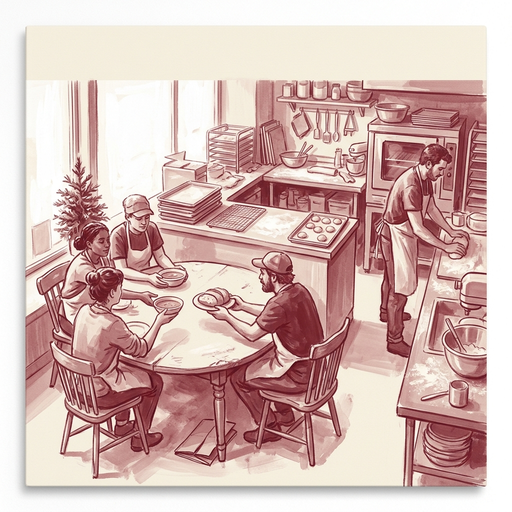
Astrid carried a bowl of soup to the scarred last table beside the passage. Frank was already sitting there, coat over his chair, with Joanne opposite him. Eddie brought the bread and sat. I had stopped trying to find storage space where they were eating.
“Why aren’t we doing the rolls first on Wednesday?” I asked Astrid.
“Because Frank’s bread needs—”
“We could put—”
I stopped. She kept her hand on the back of the empty chair.
“Go on,” I said.
“His bread needs the longer rise. If he starts that first, I can finish the rolls while it’s resting. The bench clears before Joanne starts.”
I counted the movements without changing any of them.
“All right,” I said.
Astrid sat. I brought a chair from the next table and put it at the end, clear of the passage.
“Are you eating?” Joanne asked.
“Yes.”
“Then take this before it gets cold.”
I sat and accepted the bowl. Eddie held out the bread, and I took a piece and passed the plate to Frank without getting up.