Pando’s Aspen Forest: The Science of One Clone’s Size, Age, and Survival
Pando looks like a forest, but its more than 47,000 aspen trunks belong to one sprawling clone. Its immense mass is estimated and its age remains uncertain; the more urgent question is whether it can survive as deer, elk, and cattle eat the young shoots needed to replace its aging trees. Fences have shown that Pando can regenerate, but lasting recovery will require protecting new growth without relying on barriers forever.
By MyAudioBooks.ai ·
Listen free: Pando’s Aspen Forest: The Science of One Clone’s Size, Age, and Survival
In Utah's Fishlake National Forest, more than forty-seven thousand quaking aspen trunks rise from the soil, rustle in the mountain wind, and draw life from a single massive root system. Together, they form Pando, an organism celebrated as the heaviest living thing on Earth and perhaps one of the oldest. Yet both of those famous titles depend on mathematical models, biological definitions, and scientific estimates that remain open to debate. What makes an entire forest a single living individual, and how much of Pando's legend survives careful scrutiny?
At My Audio Books dot A I, you can create your own audiobooks from prompts, turn your documents into audio, all with one subscription, and store your items in your own personal library.
Pando is a male quaking aspen clone, scientifically classified as Populus tremuloides, covering roughly one hundred six acres, or about forty-three hectares, on the Fish Lake plateau in south-central Utah. To understand how thousands of separate trees can belong to one organism, botanists separate the concept of the individual into two distinct biological units: the genet and the ramet. The genet is the overarching genetic individual, originating from a single ancestral seed that germinated in the soil long ago. The ramets are the individual tree-like trunks that rise toward the sun. Pando is the genet, while its tens of thousands of white-barked trunks are ramets.
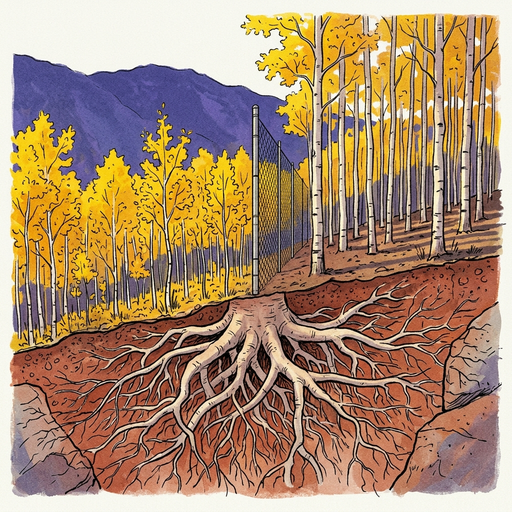
This architecture works because quaking aspens reproduce through a process known as root suckering. While aspens can flower, pollinate, and produce viable seeds, they expand across landscapes through vegetative growth. Specialized buds along shallow lateral roots send vertical shoots up through the leaf litter. These shoots develop into fully formed trunks, sharing sap, water, and carbohydrates with the parent system. Because these stems emerge directly from existing root tissue rather than sexual reproduction, they carry the genetic identity of the parent clone forward.
This reproductive strategy separates the lifespan of a single trunk from the lifespan of the entire organism. An individual aspen trunk grows, reaches maturity, weathers fungal rot, and typically dies within one to two centuries. The underground root system outlives those individual trunks, continually generating new shoots to replace the stems that fall.
In the nineteen seventies, researchers first identified Pando as a massive clone by studying its visible traits. Across the entire one hundred six acres, the trees leaf out at the exact same moment in spring, display the identical shade of golden yellow in autumn, and produce exclusively male flowers. Decades later, molecular sampling confirmed what those physical markers suggested. Genetic profiling across the stand verified that the vast majority of the grove shares a single clonal origin.
Shared genetic identity, however, does not mean every cell in the grove contains an absolutely identical sequence. As cells divide over generations, harmless somatic mutations accumulate along different branches of the root system, creating subtle genetic variations across the clone. Similarly, while large portions of the colony remain physically linked underground, researchers have not mapped an unbroken, living root bridge between every single trunk. Natural decay, physical disturbances, and fungal infections can sever connecting roots over time without erasing the shared heritage of the clone. Demonstrating that Pando is one genetic individual explains how it entered the record books, but it also creates a complex problem: how do you weigh and date an organism that looks like an entire forest?
The figures that earned Pando its worldwide fame are staggering: roughly one hundred six acres, more than forty-seven thousand individual trunks, and an estimated total mass of roughly thirteen million pounds, or about five point nine million kilograms. Those numbers make Pando an icon of terrestrial biology, but they are calculated estimates rather than direct measurements. Nobody has excavated Pando or placed the organism on a physical scale.
Researchers calculate Pando's mass using allometric modeling. Forest scientists measure the height, trunk diameter, and wood density of sample stems across the stand, using those dimensions to calculate the average above-ground volume of wood. They multiply those averages by the estimated stem count, and then add mathematical projections for the subterranean root system. Subterranean biomass is notoriously difficult to measure without destructive excavation, meaning small adjustments in the assumed ratio of roots to shoots can shift the total estimate by hundreds of tons.
Establishing the exact physical boundary of the clone adds another layer of complexity. An aspen grove does not carry a clean visual border. Adjacent aspen clones, originating from completely different seeds, often grow directly up against Pando or mingle along its edges. Determining which stems belong to Pando and which belong to neighboring clones requires systematic DNA sampling along the perimeter. Without genetic testing across every boundary tree, calculating the clone's precise acreage and total stem count carries inherent uncertainty.
Size also changes depending on which physical dimension you measure. In eastern Oregon, a single humongous fungus belonging to the species Armillaria ostoyae occupies more than two thousand acres of soil, covering an area twenty times larger than Pando. In the shallow waters of the Mediterranean Sea, a clonal seagrass meadow of Posidonia oceanica stretches across tens of miles of seabed. Both organisms cover vastly more ground than Pando. Yet because fungal mycelium and marine grasses possess far lower physical density than dense hardwood, neither matches Pando's estimated mass. Pando holds a defensible place among the heaviest documented living organisms on the planet, but its title belongs to bulk rather than area.
When foresters extract core samples from the oldest standing trunks in Pando, the growth rings tell a consistent story. Most of the mature trunks are between one hundred ten and one hundred fifty years old. Aspen wood is soft and prone to internal rot, which prevents individual trunks from standing for millennia. Counting tree rings dates the current generation of stems, but it reveals nothing about when the original seed sprouted.
Because individual aspen stems decay completely, Pando contains no single continuous tree-ring record reaching back to its origins. A giant sequoia or a Great Basin bristlecone pine preserves thousands of years of growth inside an unbroken cylinder of living wood. Clonal organisms operate differently. The original seedling dies, the first generation of roots eventually decomposes, and the lineage persists through continuous regeneration. Determining the age of the lineage, the length of time it has occupied this Utah hillside, and the age of any specific living root are three separate scientific questions.
For decades, official land management accounts cautiously described Pando as hundreds or perhaps thousands of years old. In twenty twenty-four, geneticists applied a somatic mutation clock to the clone, analyzing whole-genome sequences from leaf and root samples across the grove. By mapping the small copying errors that accumulate each time plant cells divide, researchers attempted to calculate the elapsed time since the original seed germinated. One early version of the preprint estimated an age between roughly sixteen thousand and eighty thousand years, while a revised version reported a range between roughly twelve thousand and thirty-seven thousand years. Because these figures emerged in preliminary preprints that had not yet completed peer review, scientists treat them as working hypotheses rather than confirmed birthdays.
Molecular clocks rely on fundamental assumptions about how steadily somatic mutations accumulate over centuries. Mutation rates can fluctuate depending on soil chemistry, ultraviolet radiation, and periods of rapid vegetative growth alternating with long droughts. Environmental records from lake sediments near Fish Lake confirm that aspen pollen has been present in the basin for tens of thousands of years, proving the species survived the last glacial maximum in the region. However, ancient pollen in lake mud demonstrates that aspens lived in the watershed, not that this specific clone was the one producing it.
The concept of the oldest living organism depends entirely on how an organism is defined. A bristlecone pine that has stood for five thousand years represents an unbroken physical structure of living tissue. Pando represents an ancient genetic lineage that has renewed its physical form across generations. Pando is undeniably older than the trees standing within it, but its exact beginning remains an open scientific question.
Beneath Pando's golden canopy lies an immediate ecological crisis. To a traveler driving through Fishlake National Forest, the grove appears vast and vibrant. But forest ecologists monitoring the stand over recent decades noticed a dangerous pattern: the grove was dominated almost entirely by old, dying stems, with virtually no young saplings surviving to replace them.
Quaking aspens rely on continuous replacement. As mature stems reach the end of their natural lifespan, the root system sends up thousands of tender young suckers to claim the sunlight. However, these young shoots are preferred forage for Rocky Mountain elk, mule deer, and domestic cattle permitted to graze on public lands. In an ecosystem where natural apex predators like wolves and grizzly bears have long been displaced, herbivore populations feed heavily on the new growth. Browsers consume the terminal buds year after year, clipping the shoots down before they can grow beyond reach.
This browsing pressure creates an aging forest on borrowed time. While the upper canopy remains intact, the grove develops a severe demographic imbalance. Without young stems graduating into mature trees, the canopy thins, reducing the photosynthetic energy sent down to nourish the root system. Fire suppression over the past century has compounded the problem by allowing competing conifers to encroach, while regional droughts, boring beetles, and fungal cankers add continuous stress to aging trunks. Controlled fire can stimulate a surge of new suckers, but without protection from herbivores, those young shoots are simply consumed more rapidly.
In nineteen ninety-three, the United States Forest Service initiated the Aspen Regeneration Project to reverse this decline. Land managers installed heavy-duty wildlife fences roughly eight feet tall to block deer, elk, and livestock. Historical reports describe varying fencing footprints over time, with some institutional accounts noting that roughly half the clone was enclosed, while others cited approximately eighty-four acres, reflecting different stages of management.
The practical goal of these fences is straightforward: protect young stems until they grow roughly six feet, or two meters, tall. At that height, their terminal growing tips sit safely above the reach of browsing deer and cattle. Restoration studies tracking these exclosures confirmed a stark difference. Inside the fences, dense thickets of young aspen surged upward, successfully re-establishing a secondary canopy. Outside the fences, browsing pressure eliminated nearly all new growth, leaving the forest floor barren.
Within the protected enclosures, researchers tested active management treatments, including felling dying mature trees, clearing competing shrubs, and applying controlled burns. They compared these against passive protection, where the stand was simply fenced and left alone. Both approaches triggered robust regeneration. Statistical analyses showed no significant performance difference among the cutting, burning, or clearing treatments. The evidence established that the primary barrier to Pando's survival was not an inability to produce shoots, but the continuous consumption of those shoots by herbivores.
Yet fencing is an emergency intervention rather than a permanent solution. Tall wire barriers require constant maintenance against falling timber and heavy winter snowpacks, and they divide wildlife migration routes across the mountain. More fundamentally, fences protect shoots from browsing, but they cannot shield root systems from rising temperatures or prolonged drought. Pando has proven it can regenerate when browsing pressure is lifted, but protected plots do not yet represent a self-sustaining ecosystem.
The scientific evidence surrounding Pando clarifies the reality behind the legend. Molecular testing confirms that Pando is a legitimate biological individual: a single male clone spanning one hundred six acres. Its estimated mass of thirteen million pounds secures its place among the most massive living systems on Earth, even if nature resists simple, tidy world-record rankings. At the same time, its exact age remains unresolved, floating between the verified century-old rings of its trunks and the vast, unconfirmed timelines suggested by provisional genetic clocks.
Pando forces a fundamental reconsideration of how long an organism can endure. In solitary trees and animals, life is a single continuous journey that concludes when the physical body fails. In a clonal organism, life is a relay race. No single trunk is designed for permanence. The survival of the organism depends entirely on the vitality of the subterranean network and its capacity to transfer resources from dying stems to emerging shoots. Longevity is not wood that refuses to rot, but an unbroken continuity of cellular renewal.
Lasting recovery for Pando cannot be measured by the temporary survival of its oldest trees or a short-term burst of suckers behind a fence. A genuinely healthy aspen grove requires a balanced demographic pyramid: fresh suckers, robust saplings, mature canopy trees, and decomposing logs coexisting across the hillside. The long-term challenge for land managers is finding a workable balance between herbivore populations, domestic grazing, and forest habitat so that Pando can replace its canopy without permanent wire barriers.
Important questions remain unanswered. Scientists are still studying how wild ungulates and domestic livestock divide the browsing impact. They are also examining how vulnerable the deep root system is to multi-year droughts, and whether young stems inside fences today can withstand future climate extremes. Pando demonstrates that an entire mountainside can belong to one continuous life, and that preserving an ancient giant ultimately means safeguarding its youngest growth.
If this look into Pando changed the way you think about what an organism can be, sit with the question of what other natural systems defy our conventional definitions. There is much more to uncover about how the living world functions, and we look forward to exploring those questions with you next time.