Oregon’s Giant Honey Fungus: The Evidence for Its Size and Role in Forest Ecology
Beneath Oregon’s Malheur National Forest, a single honey fungus spans roughly 3.7 square miles, killing trees and recycling their wood into nutrients that reshape the forest. Genetic evidence confirms its extraordinary reach, but estimates of its age and mass—and its claim to be the world’s largest organism—depend on how scientists define and measure an individual. Its story also challenges romantic myths about underground fungal networks, revealing a hidden world driven as much by competition and decay as by partnership.
By MyAudioBooks.ai ·
Listen free: Oregon’s Giant Honey Fungus: The Evidence for Its Size and Role in Forest Ecology
Beneath nearly four square miles of eastern Oregon’s Malheur National Forest lies an organism that challenges our basic understanding of what an individual living creature can be. It belongs to the species Armillaria ostoyae, a honey fungus whose underground network carries an estimated mass of several thousand tons and a projected age exceeding two thousand years. Popular accounts routinely describe it as the largest living organism on Earth. That superlative immediately raises a deeper biological puzzle: largest by what specific measurement, one single organism by what definition, and what scientific evidence actually supports either claim?
At My Audio Books dot A I, you can create your own audiobooks from prompts, turn your documents into audio, all with one subscription, and store your items in your own personal library.
In the Strawberry Mountain range near Reynolds Creek and Clear Creek, roughly eleven miles east of Prairie City, Oregon, the forest appears undisturbed from above. Decades ago, patches of dying conifer trees first drew the attention of foresters. White firs, Douglas-firs, and ponderosa pines showed yellowing needles, thinning crowns, and sudden mortality across widening clearings. When researchers dug into the topsoil and pulled back the bark of dead trees, they found thick, cream-colored mats of fungal tissue pressed against the sapwood, cutting off the trees’ vascular flow.
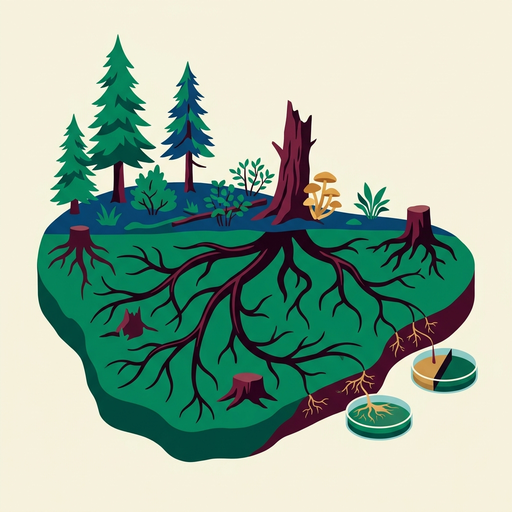
In autumn, clusters of golden honey mushrooms sprout near the bases of infected trunks. To an observer, those mushrooms look like individual organisms scattered across the landscape. In fungal biology, a mushroom is merely a temporary reproductive structure, functioning much like fruit on a tree. The mushroom produces and releases millions of microscopic spores into the wind, but the primary living body remains hidden beneath the forest floor.
That subterranean body consists of hyphae, microscopic branching filaments with cell walls reinforced by chitin. When millions of hyphae interlace through soil, leaf litter, and tree roots, they form an expansive network called a mycelium. Fungi cannot produce energy through photosynthesis. They feed by absorbing nutrients from their surroundings, secreting digestive enzymes directly into soil and wood, and absorbing the dissolved organic compounds.
Armillaria possesses a specialized mechanism for navigating between food sources. The fungus aggregates its hyphae into tough, dark, cord-like strands known as rhizomorphs. Resembling black shoestrings, these cords feature an outer protective sheath and an internal core capable of transporting water and nutrients across barren mineral soil. Rhizomorphs allow the fungus to cross hostile gaps between trees, hunting for new root systems.
This diffuse growth pattern creates a fundamental biological question. In biology, a genetic individual originating from a single sexual mating event and expanding through vegetative cloning is called a genet. A genet may occupy hundreds of separate roots, stumps, and fallen logs across square miles without maintaining an unbroken physical connection. Foresters identified Armillaria in separate drainage basins across eastern Oregon. They could not immediately tell whether they were observing thousands of distinct fungal individuals, or a single massive genet slowly colonizing the forest.
To determine whether the dying trees shared one attacker, United States Forest Service scientists conducted an extensive sampling study across the Malheur National Forest. Researchers collected and analyzed root samples from one hundred twelve diseased trees across thousands of acres. By pairing fungal cultures in laboratory dishes and examining vegetative compatibility alongside molecular markers, scientists tested whether samples from distant groves were genetically identical clones or distinct genetic individuals.
When two fungal isolates from different genets meet on an agar plate, their hyphae typically form a dark, antagonistic boundary line, rejecting each other as non-self. When two isolates belong to the exact same genet, their mycelia fuse seamlessly into a single continuous culture. Through these pairing tests and subsequent genetic analyses, researchers assigned sixty-one of those sampled trees to a single fungal individual. What appeared on the surface as isolated pockets of forest decline was actually one immense clonal entity.
The Forest Service mapped several distinct Armillaria genets across the study area, ranging from small patches of roughly fifty acres to an expansive individual designated as Genet D. Genet D spanned approximately two thousand three hundred eighty-five acres, which equals about three point seven square miles. That mapped footprint is equivalent to roughly sixteen hundred American football fields placed side by side.
Earlier scientific accounts had mapped the same individual at approximately two thousand two hundred acres, or three point five square miles. These differing figures do not represent separate discoveries of competing giants, but rather refined mapping boundaries as researchers sampled additional perimeters and integrated geographic information system data.
Mapping an organism across three point seven square miles raises an immediate question about what that boundary line represents. The reported boundary is an outer perimeter inferred from sampled trees, dead wood, and disease margins. It does not describe an unbroken, solid underground slab of fungal tissue. Beneath the forest floor, the fungus exists as a discontinuous network, threading densely through infected root systems and decaying stumps, while being sparse or absent in patches of unoccupied mineral soil.
Calculating the mass of such a distributed organism requires mathematical modeling rather than a direct scale. The Forest Service estimated the biomass of Genet D to fall somewhere between seven thousand five hundred sixty-seven tons and thirty-five thousand tons. Scientists derived that estimate by extrapolating from smaller, closely measured Armillaria colonies found in Michigan. Researchers could not excavate nearly four square miles of protected national forest to weigh every root and rhizomorph. That massive range reflects substantial uncertainty about the exact volume of fungal tissue occupying the subterranean landscape.
The age of the Oregon giant is similarly derived from growth models. Researchers measured the average radial expansion rate of Armillaria rhizomorphs through soil, which typically ranges between two and a half to three feet per year under local conditions. Based on that rate, an organism covering two thousand three hundred eighty-five acres would require at least two thousand four hundred years to reach its current extent. Some estimates place its potential age closer to eight thousand years.
Genetic continuity does not imply that any individual cell has lived for millennia. Fungal mycelium constantly grows forward at its expanding margins while dying back and decomposing in exhausted territory behind it. Changing precipitation, severe wildfires, and shifts in tree species over centuries introduce uneven growth pulses.
These distinctions clarify the colony’s famous status. Genet D holds the established scientific record as the largest known individual fungus by mapped land area. Its upper biomass projection of thirty-five thousand tons makes it a formidable contender alongside Utah’s Pando aspen clone for the heaviest known living organism. Yet it is not the oldest living creature; clonal sea grasses and creosote ring colonies boast estimated lineages spanning ten thousand years or more. Whether Genet D qualifies as the single largest organism ultimately depends on whether one defines an organism by its outer mapped geographic boundary, its total dry weight, or a requirement for continuous physical tissue.
Understanding how Genet D achieved this scale requires examining its dual ecological roles. In conventional ecology, organisms are often placed into rigid categories: either a destructive parasite or a beneficial recycler. Armillaria ostoyae challenges that division by functioning simultaneously as a virulent root pathogen and an indispensable wood decomposer.
The infection begins when fungal rhizomorphs grow through soil and encounter the roots of a susceptible tree, particularly true firs or stressed Douglas-firs. The fungus can also enter through physical wounds caused by soil movement or burrowing insects. Once inside, hyphae colonize the cambium, the fragile layer of dividing cells between the inner bark and the wood. By spreading circumferential mycelial mats under the bark, the fungus girdles the tree, severing the vascular pipelines that transport water upward from the roots and sugars downward from the canopy. Within a few growing seasons, the host tree suffocates and dies.
Once the host tree is dead, Armillaria does not abandon the timber. The fungus shifts into a saprotrophic lifestyle, living off the dead wood it helped kill. Wood is structurally durable because its plant cell walls are fortified with cellulose, hemicellulose, and lignin, a complex polymer that resists ordinary microbial decay. Armillaria secretes an aggressive suite of extracellular enzymes, including peroxidases and cellulases, capable of unraveling lignin and cleaving cellulose into simple sugars.
This enzymatic breakdown drives the forest’s nutrient cycle. As Armillaria decomposes massive root systems and heartwood, it transforms stubborn carbon chains into soluble organic matter, microbial biomass, and essential mineral ions like nitrogen and phosphorus, returning them to the forest soil. Fungal cellular respiration also releases carbon back into the atmosphere as carbon dioxide.
A portion of that carbon remains locked within fungal tissue and soil humus for decades, while another portion circulates back into the canopy. The balance between retention and atmospheric release fluctuates with soil temperature, moisture levels, and oxygen availability.
On a landscape scale, this tree-killing activity creates forest canopy gaps. When a pocket of mature trees dies, sunlight floods down to a forest floor that had been shaded for decades. Soil temperatures rise, snow melts at different rates, and dormant seeds germinate. Shrub layers expand, providing forage for ungulates and nesting habitat for songbirds, while dead standing snags offer roosting hollows for woodpeckers, owls, and small mammals. Rather than acting as a simple agent of destruction, the fungus serves as an ecological engineer, breaking down old stands to create a patchwork of diverse habitats. Its immense size is the direct outcome of millennia of continuous, incremental expansion through an ever-changing forest mosaic.
The discovery of massive underground fungi has fueled popular fascination with subterranean networks. Over the past three decades, that fascination crystallized around the concept of a wood wide web, a narrative suggesting that forest trees exist in a cooperative community linked by fungal threads. To understand what is happening under the forest floor, we must carefully distinguish the pathogenic role of Armillaria from the mutualistic relationships formed by mycorrhizal fungi.
Armillaria invades and destroys host tissue to extract resources. In contrast, mycorrhizal fungi form cooperative associations with tree roots. The plant provides the fungus with carbon-rich sugars produced through photosynthesis. In exchange, the mycorrhizal fungus utilizes its microscopic hyphal network to explore tiny soil pores, absorbing water, phosphorus, and nitrogen and transferring those essential resources back to the plant. This mutualism is fundamental to temperate forest survival, particularly in nutrient-poor or drought-prone soils.
When a single mycorrhizal fungal individual colonizes root tips of multiple adjacent trees, it forms what scientists term a common mycorrhizal network. The popular narrative expanded this physical reality into an extraordinary ecological claim. Popular accounts frequently assert that mature canopy trees act as mother trees. In this view, they use common fungal networks to intentionally nurse their own offspring, routing carbon to struggling saplings and broadcasting warning signals about insect attacks.
Rigorous field experiments over recent years have challenged the strength of those sweeping claims. In twenty twenty-three, forest ecologists Justine Karst, Melanie Jones, and Jason Hoeksema published a comprehensive review examining twenty-six published studies that evaluated common mycorrhizal networks in forests. Their analysis uncovered a substantial gap between popular storytelling and empirical evidence.
The review found that while mycorrhizal fungi physically connect some trees, those networks do not necessarily explain observed resource movements. In controlled experiments testing whether seedling performance improves when connected to a common network, the evidence showed an equal balance of neutral, positive, and negative outcomes. In many cases, seedlings linked to networks grew no better, or grew worse due to direct competition for soil nutrients from mature trees and the fungi themselves.
The researchers found no published, peer-reviewed field study establishing that mature trees preferentially transfer resources or defense signals to their own kin through common mycorrhizal networks. While labeled isotope tracers have proven that carbon and other chemical compounds can move between plants underground, identifying a moving molecule does not identify the specific pathway it traveled.
Substances can move through bulk soil moisture, through direct root-to-root contact where roots fuse together, or by leaching from one plant and being passively absorbed by another. Measuring a physical transfer does not prove a net ecological benefit to the recipient, nor does it prove that the donor tree is intentionally managing its neighbors. Fungal networks are dynamic, resource-driven arenas governed by competition and survival, not conscious, cooperative welfare programs.
Bringing the scientific evidence together reveals a portrait of the Oregon giant that is grounded in measurement rather than romantic myth. Genet D is firmly supported as a single biological individual by reproducible culture pairings and DNA sampling across miles of national forest. Yet that genetic unity does not mean a continuous, unbroken carpet of living cells throbbing beneath every square inch of the landscape.
The lesson of Genet D parallels the lesson of the network debate. In both cases, popular imagination tends to run ahead of empirical data. A shared genetic marker across miles does not prove complete physical integration, just as the subterranean movement of carbon does not prove an intentional delivery system.
Fungi occupy three foundational niches within forest ecology. Saprotrophic decomposers recycle dead plant tissue and prevent forests from suffocating under their own debris. Pathogens thin overcrowded stands, create structural gaps, and open resources for succession. Mycorrhizal mutualists trade minerals for sugars in root partnerships. Armillaria ostoyae embodies the first two roles within a single genome, showing how pathology and decomposition work together over centuries to renew forest ecosystems.
Scientific confidence varies across these topics. We have high confidence in the genetic identity and the outer three point seven square mile boundary of Genet D. We have well-established biochemical explanations for how its enzymes degrade cellulose and lignin. In contrast, we have wider margins of error regarding its total biomass, its exact age, and the degree of physiological connection maintained between distant root tips.
These uncertainties become urgent as western forests face changing environmental baselines. Rising summer temperatures, extended regional droughts, and shifts in wildfire severity place immense stress on conifer stands. Will drought-stressed trees become significantly more vulnerable to Armillaria infection, accelerating widespread root mortality? Or will prolonged soil drying and extreme heat waves constrain the fungus’s underground expansion? Understanding how this subterranean giant interacts with host trees is critical for predicting future carbon storage in western forests.
When walking across a forested hillside in the Strawberry Mountains, the physical presence of the world’s largest organism remains almost entirely invisible. Only during a brief window each autumn do small, honey-colored mushrooms emerge along the bases of decaying trees. That delicate mushroom is merely the receipt, not the transaction. The true transaction is happening continuously beneath the forest floor, where thousands of tons of ancient fungal threads quietly consume dead wood, fell towering conifers, and shape the living architecture of the forest.
The next time you walk across a forest floor, consider how much of life remains unmapped beneath the surface, and what truly defines a single living individual. If this exploration shifted your perspective on the fungal world, share this journey with another curious mind, and keep questioning the hidden systems operating beneath our feet.