Operation Fish: Britain’s Secret Gold Convoys and the Finance of Survival
As Britain faced invasion in 1940, Operation Fish secretly moved immense stores of gold and foreign securities across U-boat-infested seas to Canada, preserving the purchasing power needed to buy weapons and sustain the war. Though legends overstate that Britain emptied every vault or achieved an uncontested record, the operation was a remarkable Anglo-Canadian feat of logistics that safeguarded Allied resistance when Britain stood alone.
By MyAudioBooks.ai ·
Listen free: Operation Fish: Britain’s Secret Gold Convoys and the Finance of Survival
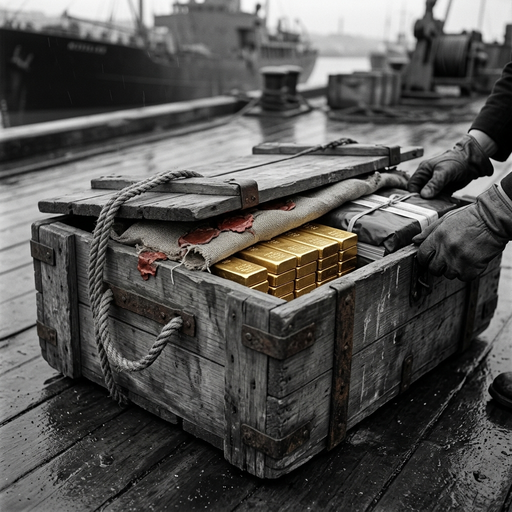
In June nineteen forty, as French defenses collapsed and German divisions reached the English Channel, Britain confronted the imminent reality of national defeat. Deep beneath the streets of London inside the Bank of England, and across rain-swept dockyards in Scotland, small teams of trusted officials and sailors began hauling heavy wooden crates into waiting warships. On shipping manifests and exterior stencils, the cargo carried a deliberately mundane label: fish. Inside those crates lay hundreds of tonnes of refined gold bullion and vast bundles of foreign securities, sent across waters prowled by German submarines.
This covert transatlantic operation became known to history as Operation Fish. In the decades following the war, popular accounts transformed the mission into legend, claiming that Britain evacuated its entire national gold reserve in the single largest physical transfer of wealth in human history. Examining what actually crossed the North Atlantic reveals how modern states wage war through financial mobilization. It also requires testing whether London truly emptied its vaults, and whether the documented records support that famous superlative.
At My Audio Books dot A I, you can create your own audiobooks from prompts, turn your documents into audio, all with one subscription, and store your items in your own personal library.
Wartime survival depends as much on industrial supply chains as on battlefield courage. When Britain declared war in September nineteen thirty-nine, its domestic industrial base was wholly incapable of meeting the material demands of total war. The factories of the United Kingdom could not produce the necessary volume of frontline aircraft, merchant shipping, munitions, machine tools, copper, petroleum, and grain. To wage modern combat against an industrial powerhouse, Britain had to buy those supplies abroad, primarily from producers across North America.
Procuring those essential materials ran directly into formidable legal and financial barriers. The United States government, determined to avoid being drawn into another foreign conflict, operated under the Neutrality Act of nineteen thirty-nine. That law established a rigid cash-and-carry framework. Belligerent governments were strictly forbidden from purchasing American war materiel on commercial credit or issuing sovereign bonds on Wall Street. Furthermore, American suppliers could not accept British pounds sterling as payment. Sterling was a domestic currency that could not settle American accounts unless backed by foreign exchange.
To buy aircraft and oil, Britain needed recognized international settlement assets. Those assets took two primary forms: refined gold bullion and marketable foreign securities. Marketable securities were stocks, bonds, and debentures issued by North American corporations or governments and held by British investors. Under emergency wartime regulations, the British Treasury ordered citizens and corporations to register and surrender these foreign assets. The government could then liquidate those securities on stock exchanges in Montreal and New York, generating the United States and Canadian dollars required to pay North American suppliers.
During the opening eight months of the conflict, known as the Phoney War, transferring reserves across the ocean represented a deliberate, orderly financial measure. The British Treasury and the Bank of England understood that physical reserves had to be positioned near North American markets to settle contracts swiftly and fund industrial retooling. Then, in May nineteen forty, the Western Front ruptured. German armored columns tore through the Ardennes, overwhelmed the Low Countries, and forced France into armistice within six weeks.
The military catastrophe fundamentally altered the strategic calculus. Britain suddenly stood isolated, facing the imminent threat of an amphibious cross-Channel invasion. Assets stored in the underground vaults of Threadneedle Street in London were no longer merely distant from American suppliers. They were exposed to aerial destruction and direct enemy capture. If German armies landed on British soil and seized the central bank, Britain's international credit would evaporate overnight.
Winston Churchill's newly established coalition government recognized that national survival demanded immediate action. What had begun as a routine financial pipeline escalated into a strategic evacuation. Working in absolute secrecy, the Bank of England established direct channels with the Bank of Canada, turning central banking into an urgent logistical operation. The movement of British wealth across the Atlantic was not a panicked, single-day evacuation. It was an escalating logistical campaign that began well before the fall of France.
The maritime pipeline that carried these assets overseas unfolded across several distinct stages between late nineteen thirty-nine and the summer of nineteen forty. Long before the collapse of Allied armies in Western Europe, the Royal Navy had already begun ferrying gold across the Atlantic to establish operating reserves in North America. In the autumn of nineteen thirty-nine and the early months of nineteen forty, British cruisers, including Emerald, Southampton, and Glasgow, quietly transported over one hundred tonnes of gold bullion to Canada.
These early naval missions carried formal operational codenames. In October nineteen thirty-nine, an undertaking designated as Fish One dispatched the battleship Resolution across the North Atlantic with a cargo of sovereign bullion. Seven months later, as the Battle of France approached its climax, the British Admiralty launched Fish Two. On the thirtieth of May, nineteen forty, the battleship Revenge slipped out of the Firth of Clyde. The warship carried bullion valued at roughly forty million pounds, packed into more than two thousand cases, and arrived safely in Halifax on the seventh of June.
Bank of England accounting records reveal that by the end of May nineteen forty, cumulative shipments of gold across the Atlantic had already reached roughly two hundred million pounds. This substantial figure demonstrates that wealth was flowing steadily west across the ocean aboard both frontline warships and fast converted passenger liners. Rather than an isolated flight from danger, the operation represented an established maritime corridor that could be expanded rapidly when the military situation deteriorated.
That rapid expansion arrived in late June nineteen forty. With France signing an armistice on the twenty-second of June, the British Cabinet authorized unprecedented shipments. On the twenty-fourth of June, the cruiser Emerald was loaded at the Scottish port of Greenock with a colossal mixed cargo. Naval ratings and dockworkers stowed two thousand two hundred twenty-nine wooden bullion boxes, each containing four gold bars, alongside nearly five hundred boxes of negotiable securities. In total, Emerald departed with assets valued at approximately one hundred thirty million pounds.
The largest single movement departed less than two weeks later. On the fifth of July, nineteen forty, a convoy of five heavily laden vessels sailed from the Clyde. The convoy included converted ocean liners carrying thousands of crates of gold and negotiable paper assets. Historical records indicate that this single July convoy carried wealth valued at approximately one point seven billion United States dollars at nineteen forty exchange rates.
To shield this fortune from German surface raiders and submarines, the Admiralty assigned a formidable escort force, including the battleship Revenge, cruisers, and a protective screen of destroyers. While popular histories often compress these distinct voyages into a single dramatic story, official manifests show variations in cargo counts and valuations between individual sailings. Between the autumn of nineteen thirty-nine and the summer of nineteen forty, Britain executed a continuous, heavily guarded naval transfer of physical wealth across thousands of miles of ocean.
Moving tens of thousands of individual assets under wartime conditions created extraordinary logistical complications. Gold is one of the densest materials on earth. A standard wooden bullion crate containing four gold bars weighed more than one hundred thirty pounds, requiring two men to lift. In the holds of warships, thousands of these dense boxes could not simply be stacked haphazardly. Improperly distributed weight could severely compromise a warship's center of gravity and handling characteristics in rough seas. Naval engineers calculated load distributions with extreme precision, securing the crates against heavy rolling.
The negotiable securities presented an entirely different challenge. Equity certificates, sovereign bonds, and corporate paper assets were lightweight but extraordinarily voluminous. They occupied hundreds of large packing cases that required rigorous protection from moisture and seawater. A single damp cargo hold could ruin millions of pounds of legal documentation.
To prevent dockworkers, rail staff, and casual observers from deducing what was being moved, handlers stenciled the wooden crates with common commercial markings, routinely identifying the contents simply as fish. This deception proved highly effective at discouraging curiosity on the docks. But operational secrecy provided no physical shield against the principal danger: the German submarine fleet.
The North Atlantic in nineteen forty was an active battleground. German submarines prowled the western approaches to the British Isles, hunting Allied shipping lanes. Cruisers and converted liners carrying the wealth sailed under total blackout conditions, enforcing strict radio silence and carving erratic zig-zag courses at top speed. A single torpedo could send dozens of tonnes of national reserves to the ocean floor, dealing a catastrophic blow to British liquidity.
Despite the persistent danger, every vessel assigned to the operation completed the journey without loss. When the ships entered the fortified harbor of Halifax, Nova Scotia, the second phase of the operation began. Officials from the Bank of Canada boarded the vessels to examine the wax seals, cross-reference manifests, and oversee the unloading process under armed supervision.
On the Halifax docks, Canadian National Express freight cars were assembled into heavily guarded trains. Hundreds of armed officers from the Royal Canadian Mounted Police and Canadian military personnel formed tight cordons around the rail yards. The bullion and document cases were loaded into sealed, armored train cars, which then rolled westward through the night across the Canadian landscape under constant armed escort.
The assets were divided by category and routed to two separate destinations. Gold bullion and coin traveled to Ottawa, where armed guards transferred the crates into the reinforced underground vaults of the Bank of Canada on Wellington Street. Completed only a few years earlier, these subterranean vaults were built with thick reinforced concrete and advanced security systems, providing a repository far beyond the range of European bombers.
The paper securities took an alternate route to Montreal, arriving at the Sun Life Building on Dominion Square. At the time, the Sun Life Building was the largest corporate office structure in the British Commonwealth, featuring three subterranean basement levels excavated deep into solid bedrock. Behind locked steel gates and guarded by round-the-clock security, hundreds of vetted clerks worked in absolute secrecy, cataloging, checking dividend coupons, and registering millions of foreign shares and bonds.
By the end of the summer of nineteen forty, Canadian institutional records confirm that roughly one thousand five hundred tonnes of gold bullion and coin had accumulated in Ottawa. Those reserves rested safely in the Bank of Canada vaults. Meanwhile, the Sun Life basements in Montreal housed hundreds of millions of pounds in marketable foreign paper. The entire physical chain had functioned with total discretion, remaining largely concealed from public knowledge for decades.
The sheer scale of Operation Fish inevitably gave rise to grand historical assertions. In popular retrospectives, two primary claims appear repeatedly. The first claims that Britain evacuated its entire national gold reserve to Canada. The second asserts that the operation represented the largest physical movement of wealth in human history. Evaluating these claims against documented archival records reveals important distinctions between historical reality and popular legend.
The first major complication lies in how asset values were recorded. Many popular narratives quote aggregate figures, such as the one point seven billion United States dollars attributed to the July fifth convoy, as though that total represented pure gold bullion. In reality, that valuation was a combined tally in which paper securities formed the vast majority of the monetary value. Paper certificates represent legal claims on corporate and government equity, whereas bullion is physical commodity wealth. Blending the two into a single number creates an impression of gold tonnage far larger than what actually crossed the sea.
Furthermore, published estimates of the total gold shipped to Canada vary considerably across different historical sources. Some institutional accounts cite gold transfers totaling roughly four hundred seventy million pounds sterling, while other wartime narrative histories place the cumulative figure as high as six hundred thirty-seven million pounds. These discrepancies stem from varying accounting periods, fluctuating wartime exchange rates, and differing definitions of which naval sailings should be included in the total.
The physical benchmark of roughly one thousand five hundred tonnes of bullion stored in Ottawa provides definitive proof of an immense evacuation. However, storing that volume in Canada does not prove that the Bank of England emptied its vaults down to the bare stone. Educational summaries from the Bank of Canada Museum refer to Churchill's plan to move the country's entire reserve. Yet Bank of England archival histories do not confirm that every single gold bar left British shores. Britain maintained distributed reserves in South Africa, Australia, and India, and retained domestic bullion for immediate currency stabilization and operational emergencies. The assertion that Britain completely stripped its domestic vaults remains an exaggeration unsupported by the surviving ledgers.
An even more critical distinction involves legal ownership. Much of the gold shipped to Canada was not the sovereign property of the British state. Under the Bank of England's Owned Gold Scheme, foreign institutions and non-residents were permitted to lodge gold in London for secure transit to North America. As Nazi armies overran continental Europe in nineteen thirty-nine and nineteen forty, the central banks of Belgium, the Netherlands, Poland, and Norway evacuated portions of their national reserves to Britain. When British warships sailed for Halifax, significant quantities of the gold in their holds were being transported in custody for foreign governments. Conflating all transported gold with British national wealth misinterprets the legal nature of the cargo.
Finally, the title of the largest physical movement of wealth in history encounters serious historical and economic limitations. Declaring an absolute world record requires consistent standards of comparison across different centuries and currencies. Should negotiable securities be valued at nominal face value or their market value during a wartime firesale? Should historical movements be measured in physical metric weight, domestic purchasing power, or as a percentage of global economic output?
Modern commentaries frequently convert the nineteen forty shipments into contemporary estimates ranging from thirty billion to several hundred billion dollars. These modern conversions vary wildly depending on whether researchers index against consumer inflation, historical gold prices, or relative national output. Operation Fish certainly stands among the largest movements on record. Other colossal transfers took place in the same era, including the evacuation of French national reserves to Africa and massive central bank consolidations in the United States. Without standard definitions, claiming an uncontested, universal world title remains an unproven assertion. The documented evidence confirms an extraordinary logistical achievement, but the absolute superlatives do not withstand rigorous scrutiny.
Moving hundreds of tonnes of bullion and crates of paper securities across an ocean did not generate new wealth for the British war effort. What it achieved was the preservation of international purchasing power and physical security. For Britain in the summer of nineteen forty, the strategic value of Operation Fish lay in keeping the state financially solvent at the exact moment its defenses were pushed to the brink.
Holding those liquid reserves in Ottawa and Montreal allowed the British Purchasing Commission in New York to continue executing vital procurement contracts. Throughout nineteen forty and into early nineteen forty-one, British agents signed orders for thousands of military aircraft, artillery pieces, naval vessels, and essential industrial chemicals. Before the United States Congress passed the Lend-Lease Act in March nineteen forty-one, American legal statutes prohibited the delivery of weapons without immediate payment. Britain required liquid securities to sell on North American exchanges and gold bullion to settle balances. Without them, dollar supplies would have dried up before the end of nineteen forty, abruptly severing the industrial supply line that kept Allied forces armed.
Beyond commercial liquidity, the transfer functioned as ultimate strategic insurance for the British Empire. If German forces had succeeded in crossing the English Channel, the British government intended to withdraw across the Atlantic. The Royal Navy and the merchant fleet planned to continue the war from Canada. The wealth secured in the vaults of Ottawa and the basements of Montreal ensured that Britain's capacity to finance armed resistance would endure even if the home islands were overrun.
This vast undertaking was an inherently bilateral achievement. Canada was not simply a secure vault, but an indispensable operational partner in Allied survival. Canadian dockworkers unloaded the warships, Canadian railway personnel coordinated secure transit across thousands of miles of track, Canadian Mounties guarded the shipments, and Canadian bank officials managed the assets under wartime conditions. The successful coordination between London, Ottawa, and Montreal established an operational model for Allied financial cooperation that sustained the war effort long after the threat of invasion receded.
Examining the documentary record puts the operation into clear perspective. The documented scale of Operation Fish was immense: hundreds of tonnes of refined gold and vast portfolios of foreign securities successfully crossed a hostile ocean under continuous wartime danger. Yet the grandest myths surrounding the operation require careful qualification. Surviving records do not show that Britain emptied every domestic vault, that every bar of gold belonged to the British Treasury, or that the operation holds an uncontested global record for all time.
The true significance of Operation Fish requires no embellishment. It remains a masterclass in strategic logistics. The operation proved that national survival in modern war depends just as heavily on the ability to deploy financial capital as it does on military firepower in the field.
The ordinary label marked fish shielded the financial lifeblood of a nation during its darkest hour. If this investigation into Britain's secret wartime finance shifted your perspective on how global conflicts are sustained, consider how often national survival rests on the quiet movement of balance sheets. Stay with us as we continue to explore the hidden logistics and untold records that shaped modern history.