Nouadhibou Bay’s Stranded Ships: How Fishing Economics and Coastal Geography Shaped a Graveyard
Nouadhibou Bay is both a vital Mauritanian port and a resting place for derelict ships, accumulated as aging fishing fleets, costly disposal, sheltered shallows, and weak enforcement made abandonment easier than removal. The wrecks threaten navigation and fishing and pose environmental risks, though cleanup has cleared some of the worst hazards. Its famous “world’s largest ship graveyard” label remains unverified: estimates count different areas and cannot establish how many vessels remain today.
By MyAudioBooks.ai ·
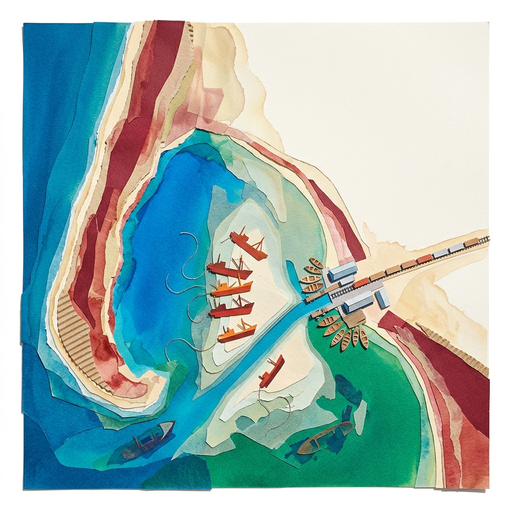
A narrow finger of desert extends into the Atlantic Ocean along the northern coast of Mauritania, sheltering one of the most vital maritime crossroads in West Africa. Modern freezer trawlers share this water with traditional wooden fishing boats and massive bulk carriers that carry iron ore hauled from deep within the Sahara. Yet over the past four decades, this working harbor became internationally famous for hundreds of vessels that no longer move at all.
Rusting trawlers, tugboats, and cargo hulls rest upright in the mud or lie rolled on their sides across the tidal shallows. Widely circulated accounts describe Nouadhibou Bay as the world's largest ship graveyard, often depicting it as an abandoned wasteland under the Saharan sun. When you examine the historical and maritime record, however, that simple narrative begins to unravel. Different official and scientific reports disagree sharply on how many hulls actually exist, where the boundaries of the graveyard lie, and whether the site holds any verified global title. Understanding this bay means untangling a practical puzzle: how an indispensable commercial port became home to hundreds of derelict vessels, and why walking away from a ship was so often the easiest path available.
At My Audio Books dot A I, you can create your own audiobooks from prompts, turn your documents into audio, all with one subscription, and store your items in your own personal library.
The Bay of Nouadhibou is sheltered from the heavy swells of the open Atlantic by the long ridge of the Ras Nouadhibou peninsula. This geological barrier creates one of the few naturally protected anchorages along thousands of miles of West African desert coastline. It is not an isolated dumping ground. The bay sits directly alongside the city of Nouadhibou, Mauritania's second-largest urban center and the undisputed hub of its marine economy.
Here, specialized desert freight trains unload iron ore from the inland mines of Zouérat onto deep-water bulk carriers. Meanwhile, cold-storage facilities, packaging plants, and local docks handle fisheries that supply food and livelihoods to thousands of households. The very geography that makes this harbor indispensable for regional trade also helps explain why disabled ships remain trapped here. The bay breaks the power of ocean breakers, but it is lined with wide sandbars, shallow flats, and low-energy tidal margins. When a vessel loses engine power or snaps its mooring line, ocean currents do not drag it into the abyss. Instead, the hull drifts toward the shallows and rests softly on the sand.
Abandonment in this environment carries a precise operational definition. It does not mean a ship was targeted by weapons, torpedoed, or sunk as a deliberate tourist spectacle. In maritime practice, abandonment describes an owner or operator walking away from a vessel without completing responsible maintenance, removal, or salvage. The hulls resting in Nouadhibou arrived through fundamentally different circumstances. Some captains deliberately ran their ships onto soft shoals to prevent them from foundering inside active navigation channels after taking on water. Others broke free from their anchors during seasonal gales and grounded by sheer accident. Some suffered catastrophic mechanical breakdowns, slowly filled through unserviced seals while swinging at anchor, and settled quietly into the silt. Many others were simply tied up and deserted once their operating companies exhausted their financial reserves.
Because these vessels accumulated across multiple decades and settled into different marine zones, measuring the scale of the graveyard has produced wildly contradictory numbers. In two thousand eleven, a French-language technical report documented approximately two hundred wrecks scattered across the harbor and nearshore shallows, noting that the overwhelming majority were commercial fishing vessels. At the same time, popular secondary accounts routinely report more than three hundred ships. An environmental desk study from an independent research university took a broader view, surveying not just the inner bay, but also the commercial port and an outer anchorage known as Buoy Two. That study estimated approximately five hundred eighty sunken or stranded vessels.
These figures diverge because each survey measured a different reality. A corroded trawler visible above the waterline at low tide is obvious from the beach. A completely submerged steel hull resting ten meters down is invisible from shore, yet it presents an identical hazard to navigation. Some historical counts focused solely on commercial fishing boats, while others included barges, small tugs, and cargo craft. None of these figures represents a permanent census of what remains today, and none proves that Nouadhibou holds an undisputed global title. The label of the world's largest ship graveyard remains a dramatic popular phrase rather than a verified international ranking.
Wrecks have rested along this desert coast for more than a century. Local accounts frequently cite the French naval cruiser Chasseloup-Laubat, positioned in the bay during the nineteen twenties as an anchored water station and storage hulk, as an early landmark. For decades after, however, shipwrecks were infrequent, isolated occurrences resulting from ordinary maritime misfortune. The rapid accumulation that turned the bay into a dense concentration of rusting steel did not begin until the nineteen eighties.
A documented turning point occurred around nineteen eighty-four, during a major structural reform of Mauritania's commercial fishing sector. The national government sought to capture a larger share of the enormous wealth generated in its territorial waters, which sit inside one of the richest ocean upwelling zones on earth. To reduce dependence on foreign-flagged factory fleets, authorities adopted policies designed to stimulate local ownership, establish domestic fishing companies, and mandate national landing requirements.
This policy shift prompted domestic entrepreneurs and newly formed companies to acquire commercial tonnage rapidly. Many of these new entrants lacked extensive maritime experience, established maintenance infrastructure, or access to deep financial reserves. Unable to afford the steep price tag of newly built ships, they turned to the international secondhand market. They purchased aging, retired trawlers built between approximately nineteen fifty-five and nineteen eighty, many of them cast off by European fishing fleets modernizing their own operations. These older vessels carried low initial purchase prices, but they arrived with severe mechanical liabilities.
Operating an ocean trawler is a capital-intensive enterprise governed by brutal operating margins. Decades of continuous operation in saltwater degrade diesel engines, weaken electrical wiring, and thin steel plates through chronic corrosion. By the late nineteen eighties and early nineteen nineties, new Mauritanian operators were confronted with escalating fuel costs, erratic export prices, and costly mechanical breakdowns. When specialized refrigeration systems failed or crankshafts cracked, the owners faced repair bills that often surpassed the commercial value of the ship itself.
In the maritime world, an iron ship can remain physically afloat long after it becomes economically dead. An owner might tow an inoperable trawler into Nouadhibou Bay with the intention of securing financing or sourcing spare parts from abroad. While the ship sits idle at anchor, costs continue to mount. Port fees, watchman salaries, and anchorage dues accumulate daily. If the owner exhausts their capital, repairing the vessel becomes impossible.
At that stage, lawful disposal represents another severe financial hurdle. Scrapping a ship responsibly requires towing the hull to an authorized shipbreaking yard, draining fuel, cleaning hazardous residues, stripping insulation, and cutting the steel under strict environmental and labor standards. When the cost of towing and dismantling exceeds the market value of the recovered scrap metal, lawful disposal becomes a net financial liability.
In an ideal legal system, maritime authorities compel vessel owners to clear their property or draw upon compulsory salvage insurance. In global shipping, however, ownership can easily be obscured behind offshore registrations, foreign flags of convenience, layered holding companies, and unpaid mortgages. When a venture collapsed, corporate entities dissolved, leaving behind a multi-hundred-ton hull in the bay.
Some secondary accounts assert that corruption played a central role, alleging that port officials accepted bribes to look the other way while vessels were intentionally grounded or cut loose. However, these claims are not substantiated by court judgments, published audit reports, or official government inquiries in the public record. What the evidence confirms is a systemic administrative gap: a regulatory apparatus that lacked the tracking databases, mandatory financial bonding, and enforcement budgets required to hold elusive owners legally and financially accountable.
Allowing hundreds of decaying vessels to linger in a confined coastal bay produces immediate economic and environmental consequences. The primary and most pressing hazard is physical obstruction. Nouadhibou is not a remote lagoon. It is an active commercial gateway where massive bulk carriers navigate narrow channels to load Saharan iron ore, and where hundreds of artisanal fishing crews launch wooden boats every day.
Derelict ships do not stay anchored indefinitely. As hulls corrode and mooring chains weaken under the strain of heavy desert winds, abandoned vessels regularly slip their anchors during storms. Uncontrolled hulks drift across established shipping channels, run aground on sandbars needed for maneuvering, or smash into operating docks. In a busy harbor, a partially submerged steel trawler acts as an uncharted artificial reef, capable of ripping open the hull of an incoming merchant vessel that deviates even slightly from the fairway.
Beyond physical hazards to navigation, abandoned vessels introduce diverse chemical contaminants into the marine environment. A retired fishing trawler is essentially a floating reservoir of industrial materials. Even after commercial gear is stripped, double-bottom fuel tanks often retain heavy residual bunker oil, engine sumps hold lubricants, steering mechanisms contain hydraulic fluid, and electrical rooms house corrosive lead-acid batteries. Ships built during the nineteen sixties and nineteen seventies also carry extensive asbestos insulation wrapped around steam lines. They contain toxic lead-based priming paints, along with organotin or copper antifouling compounds designed to poison marine growth on the hull.
The actual environmental threat varies greatly depending on the condition and history of each vessel. An empty steel barge that was grounded decades ago and picked clean by local salvagers presents a very different ecological profile than a fully laden freezer trawler that foundered suddenly with sealed fuel tanks. As seawater corrodes iron bulkheads over decades, sealed compartments inevitably fail. Petroleum products leach toward the surface, generating persistent slicks that wash across shallow intertidal mudflats and nearshore nursery zones.
Here, rigorous analysis requires acknowledging clear evidentiary limits. While the hazardous materials inside these vessels are well understood, scientific institutions have not published a comprehensive chemical baseline measuring heavy metal or hydrocarbon concentrations throughout the sediments of Nouadhibou Bay. There are no definitive epidemiological studies tracking long-term health outcomes among local residents or port workers. Likewise, no audited historical ledger records the total volume of spilled contaminants.
Some accounts argue that the wrecks offer an ecological upside by functioning as artificial reefs. It is true that submerged steel surfaces offer attachment points for algae, barnacles, and mollusks, which in turn draw small fish seeking shelter from predators. Artisanal fishers frequently operate in the vicinity of grounded wrecks precisely because marine organisms congregate around these structures.
Marine scientists emphasize, however, that localized fish attraction should never be mistaken for a thriving, balanced ecosystem. Drawing marine populations toward deteriorating hulls coated in toxic biocides and leaking fuel residues does not produce a documented net environmental benefit. At the same time, jagged, submerged metal wreckage constantly snags and tears the nets of local fishers, transforming traditional fishing grounds into hazardous underwater debris fields.
The emergence of Nouadhibou's ship graveyard was not caused by a single deliberate master plan or an isolated administrative failure. It was the predictable outcome of five interacting conditions. The port saw an influx of aging secondhand vessels, run by economically vulnerable operators facing disposal costs that far exceeded scrap value. At the same time, a naturally sheltered bay prevented wrecks from washing out to sea, while local institutions lacked the regulatory capacity to enforce financial liability.
Whenever a private owner walked away from an unprofitable trawler, they made a rational calculation that transferred private disposal expenses onto the public ledger. The financial costs did not vanish. They were borne by the port authority forced to pilot commercial cargo around dangerous hazards, by artisanal fishers losing expensive gear, and by the coastal ecosystem absorbing toxic residues. The graveyard took shape vessel by vessel, anchor by anchor, over four decades of unmanaged industrial transition.
This dynamic stands in stark contrast to other famous maritime concentrations around the world, such as Mallows Bay on the Potomac River in the United States. Mallows Bay was the result of a deliberate, highly centralized government effort. Following the First World War, nearly two hundred surplus wooden steamships built for the emergency merchant fleet were concentrated into a single cove, systematically stripped, burned, and abandoned during an organized salvage operation. It was a focused, finite disposal campaign. Nouadhibou, conversely, was an open-ended process of decentralized commercial attrition, driven by private bankruptcies across multiple decades and legal jurisdictions.
Popular commentary frequently portrays Nouadhibou as a permanent, forgotten wasteland where derelict ships remain forever frozen in the sand. The historical record shows that this picture is incomplete. The two thousand eleven technical assessments coincided with major clearance operations coordinated by Mauritanian maritime authorities, supported by international technical and financial assistance from the European Union.
Specialized marine salvage contractors deployed heavy crane vessels, industrial divers, and cutting equipment directly into the bay. These teams methodically tackled the most hazardous derelicts, refloating, breaking apart, and removing dozens of vessels that actively obstructed deep-water channels, shipping fairways, and the mineral export terminal. The operation successfully restored clear navigational access to the commercial docks and vital ore berths.
Yet removing navigational obstructions from an active shipping lane is not the same as clearing an entire coastal geography. While deep-water hazards threatening international merchant traffic were prioritized for removal, dozens of older hulls sitting high on shallow sandbars and intertidal mudflats were left in place. In those shallow, low-energy zones, the enormous expense of heavy marine salvage yielded no measurable benefit to port commerce, leaving them to slow atmospheric and tidal corrosion.
Photographs of rusted hulls stranded in the desert surf continue to circulate, reinforcing the myth of an untouched graveyard. But those photographs capture specific moments in time, not the complete, evolving reality of the bay. Historical estimates from past decades cannot tell us precisely how many vessels rest in these waters today, nor can they collapse the vital distinction between accidental shipwrecks and deliberate desertion.
Understanding Nouadhibou Bay requires looking past sensational titles to investigate the economic pressures, legal frameworks, and coastal geography that allow derelict ships to accumulate. Whenever a dramatic number or global superlative is applied to a distant place, the real inquiry begins by asking what was measured, who conducted the count, and what practical forces made walking away the easiest choice.