Nauru’s Phosphate Boom: Why Mineral Income Failed to Build Lasting Wealth
Nauru’s phosphate deposits brought colonial exploitation, then extraordinary wealth after independence—but mining consumed the island’s interior as it filled the treasury. When the deposits dwindled and risky investments failed, Nauru was left with debt, damaged land, and few ways to earn a living; its struggle to rebuild shows why a resource windfall is not the same as lasting wealth.
By MyAudioBooks.ai ·
Listen free: Nauru’s Phosphate Boom: Why Mineral Income Failed to Build Lasting Wealth
During the nineteen seventies, a tiny island nation in the central Pacific became, by several standard economic measures, one of the wealthiest places on Earth. Its citizens paid no direct taxes. Public healthcare and education were provided entirely by the government, and luxury goods arrived by ship and plane to an isolated community of fewer than eight thousand people. Yet within a single generation, that extraordinary prosperity dissolved into severe financial distress. The island was left burdened with deep debt, an empty treasury, and an interior reduced to an unlivable forest of bare limestone pinnacles. The source of that sudden fortune was ancient seabird guano, transformed over thousands of years into rich phosphate rock. The story of what followed exposes the sharp, often misunderstood difference between earning high temporary income and building durable national wealth.
At My Audio Books dot A I, you can create your own audiobooks from prompts, turn your documents into audio, all with one subscription, and store your items in your own personal library.
Nauru is an isolated, oval-shaped raised-coral island sitting just forty-two kilometers south of the equator, encompassing only twenty-one square kilometers of total land area. For centuries before industrial mining arrived, traditional Nauruan society sustained itself on a narrow coastal belt fringed by coconut palms, pandanus trees, and rich reef fisheries. Behind that fertile rim, the land rises steeply to a central plateau known locally as Topside, which stands roughly sixty meters above sea level and covers four-fifths of the island.
Beneath the lush vegetation of that inland plateau lay an extraordinary geological deposit. Over countless millennia, deep accumulations of seabird droppings reacted with the underlying coralline limestone and seasonal rainwater. The resulting deposit became high-grade tricalcium phosphate, remarkably low in contaminants and exceptionally rich in elemental phosphorus.
Phosphorus is an indispensable plant nutrient required for cellular energy transfer and root development. Across the agricultural regions of the industrialized world, intensive farming was rapidly depleting natural soil fertility, creating an insatiable overseas demand for chemical fertilizers. Nauru possessed one of the purest and most concentrated deposits on the planet, locked right in the surface crust of its central plateau. This single geological accident set the course for more than a century of outside intervention and dramatic environmental transformation.
Commercial extraction began around nineteen hundred, during the period of German colonial rule over the Marshall Islands protectorate, after British prospectors confirmed the mineral value of Nauruan rock. The Anglo-German Pacific Phosphate Company launched industrial operations, shipping boatloads of untreated rock to agricultural markets overseas.
The political control of that extraction shifted decisively after the First World War. In nineteen nineteen, the League of Nations placed Nauru under a joint mandate held by Britain, Australia, and New Zealand, with Australia assuming day-to-day administrative authority. Under the Nauru Island Agreement of nineteen nineteen, the three governments created the British Phosphate Commissioners, an enterprise structured to manage the extraction and distribution of the island's deposits. Rights to the mineral were allocated by treaty: forty-two percent to the United Kingdom, forty-two percent to Australia, and sixteen percent to New Zealand.
The Commissioners began mining operations in nineteen twenty-two. They operated not as a competitive commercial firm seeking maximum market profit, but as a strategic supply mechanism designed to deliver low-cost fertilizer directly to domestic farmers in the administering nations. Throughout decades of imperial oversight, phosphate was sold to Australian and New Zealand pastoral industries at prices kept near extraction costs. While agricultural economies across the British Empire expanded using inexpensive fertilizer, Nauruan landowners received only modest, fraction-of-a-cent royalties per ton.
The actual work of extraction relied heavily on imported contract labor, particularly indentured workers from southern China and neighboring Pacific archipelagos, organized under a rigid racial and employment hierarchy. Nauruans held no legal authority over production volumes, export pricing, or the long-term physical destruction of their island.
During the Second World War, Japanese forces occupied the island, subjecting the population to severe hardship. More than one thousand two hundred Nauruans were deported to Chuuk Atoll as forced laborers, where nearly five hundred perished. Following the war, United Nations trusteeship returned administrative power to the same three governments, again under Australian operational control. Decades of persistent political organizing by Nauruan leaders culminated on January thirty-first, nineteen sixty-eight, when Nauru declared its sovereignty. Independence granted the newly established republic ownership of the mining assets and full legal control over the remaining deposits.
With sovereignty secured, the government of Nauru took direct control of extraction through the state-owned Nauru Phosphate Corporation, coinciding with a sharp rise in world commodity prices. During the nineteen seventies and early nineteen eighties, global fertilizer prices jumped dramatically, delivering an unprecedented flood of cash to the young micro-state.
Five specific conditions powered this extraordinary windfall. The deposits contained remarkably high phosphate concentrations. Extraction required surface strip mining rather than complex underground shafts. Overseas agricultural demand remained robust. The mining apparatus was managed directly by the state. And the resident population numbered only a few thousand people.
When economists calculated gross domestic product per person by dividing hundreds of millions of dollars in annual mineral exports by the tiny domestic population, the resulting ratio exceeded that of nearly every major industrialized nation. International headlines quickly labeled Nauru the richest country per person on Earth.
That headline figure, however, masked an essential economic reality. Gross domestic product measures the value of goods and services produced within a single calendar year. It is an income flow, not an accounting of durable accumulated wealth. In Nauru, that revenue derived from the rapid consumption of a non-renewable geological asset. Every dollar of phosphate exported represented the permanent removal of irreplaceable national land.
The financial windfall also flowed through distinct channels. Individual landowning families received direct royalty checks and lease payments, while the national treasury absorbed the bulk of export earnings. The state eliminated income taxes and created expansive public payrolls that employed a majority of the workforce. It built modern administrative infrastructure and provided universal public services, including fully subsidized electricity, housing, water, and overseas medical referrals.
Private consumption surged alongside public spending, marked by high vehicle imports, modern appliances, and extensive foreign travel. Yet this brisk economic activity remained fundamentally organized around collecting and distributing the proceeds of a finite natural deposit. High annual income flowed through households and the public purse without establishing sustainable, export-earning domestic industries to take over when the diggers finished their work.
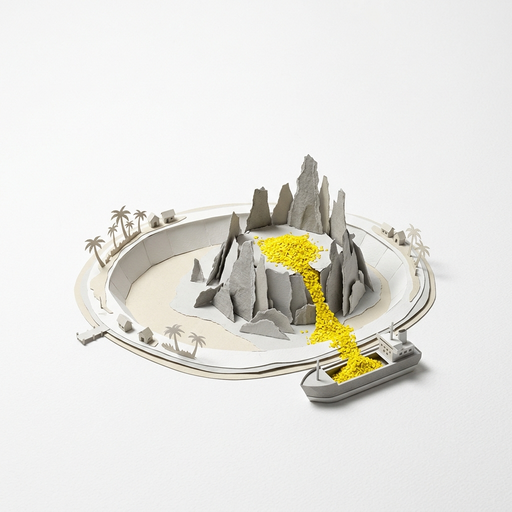
As extraction accelerated, the physical landscape paid the price. The mining process stripped away all vegetation, topsoil, and subsoil to scoop out the phosphate packed tightly between ancient coral formations. When the draglines and excavators finished, they left behind an uninhabitable moonscape of bare, razor-sharp limestone pinnacles rising up to ten meters high. Across four-fifths of the island, the interior plateau became a scorched, jagged expanse of exposed rock, incapable of supporting agriculture, commercial development, or human settlement.
Recognizing that the mineral deposits would eventually run out, the post-independence government created the Nauru Phosphate Royalties Trust, alongside related statutory investment vehicles. The core strategy was clear: convert a depleting physical asset into an enduring portfolio of international capital. This fund was meant to generate dependable dividends for future generations, long after the last ton of rock left the harbor.
The success of that strategy required disciplined capital preservation, professional risk management, and rigorous public oversight. Over several decades, the trust accumulated substantial assets, purchasing high-rise commercial office buildings in Melbourne, luxury resorts in Hawaii, properties across the Pacific, and high-profile real estate developments in London. The state also financed a national airline, Air Nauru, operating a fleet of commercial jets across vast, sparsely populated Pacific routes that consistently ran severe operating deficits.
As the twentieth century drew to a close, the financial foundation cracked from both sides. First, the easily accessible, highest-grade phosphate reserves on Topside approached exhaustion, causing export volumes and government royalties to plummet. Second, many overseas investments underperformed or collapsed under the weight of heavy borrowing, speculative ventures, high management fees, and inadequate administrative controls. Properties were heavily mortgaged to service ongoing sovereign debts and sustain domestic budget commitments.
When global commodity prices fluctuated and international creditors demanded repayment, Nauru found itself holding illiquid, heavily encumbered foreign assets rather than a defensive cushion of liquid capital. The sovereign trust had not been insulated from institutional pressures and domestic spending demands. Depletion of the physical resource intersected with the unraveling of the financial portfolio, plunging the republic into a severe fiscal crisis marked by power blackouts, banking collapses, and sharp contractions in public services.
The exhaustion of primary phosphate mining left Nauru facing severe physical constraints. With Topside transformed into an inaccessible labyrinth of limestone pillars, the entire population remained compressed onto the thin coastal rim. This narrow corridor contains the island's homes, schools, hospital, airport, and administrative offices, leaving virtually no room for suburban expansion or new infrastructure.
That spatial compression carried serious consequences for everyday life and public health. Stripping the interior destroyed the island's traditional agroforestry, which historically yielded breadfruit, mangoes, and native fruits. The country became almost entirely reliant on imported, highly processed shelf-stable foods rich in refined sugars, salt, and saturated fats. Combined with sedentary lifestyle shifts from public-sector employment, this dietary transition contributed to exceptionally high rates of type two diabetes, cardiovascular disease, and related metabolic illnesses. In turn, these conditions placed chronic burdens on the healthcare system.
Recovering the damaged interior emerged as a central national objective. In nineteen ninety-seven, the government adopted the National Environmental Management Strategy and National Environmental Action Plan, laying the groundwork for systematic land rehabilitation. Yet repairing the plateau requires immense financial and engineering resources. Crews must knock down millions of hard limestone pinnacles, crush the rock into usable gravel, import or generate organic soil, and carefully reintroduce native vegetation. The practical goal of these programs is not restoring an untouched pre-colonial forest, but creating functional, level land that can support housing, renewable energy, and industrial development.
Regaining that elevated ground is also vital for long-term climate survival. Sitting barely a few meters above sea level, the crowded coastal fringe faces severe erosion, saltwater intrusion into shallow freshwater lenses, and extreme storm surges linked to global climate shifts. Moving essential infrastructure, water reserves, and residential neighborhoods onto the raised interior provides the only realistic defense against oceanic exposure.
In the search for post-boom revenue, Nauru engaged in secondary mining, scraping deeper residual phosphate pockets left behind by earlier operations, and began sponsoring exploratory deep-sea mineral ventures in international Pacific waters. During the twenty-tens, the country also became the host for Australia's offshore regional processing center for asylum seekers. The arrangement injected critical foreign currency, public revenue, and service jobs into the domestic economy.
Yet international monitors, including the United Nations High Commissioner for Refugees and human rights bodies, documented profound humanitarian concerns within the detention facilities. They cited intense tropical heat, overcrowding, medical shortages, and systemic psychological distress among detainees. The processing center episode demonstrated how an economically vulnerable micro-state, facing the loss of its primary natural income, can find its fiscal survival tied to controversial external policy priorities.
Nauru's twentieth-century trajectory illustrates the vital distinction between an economy that processes high cash flows and an economy anchored by enduring capital. Earning hundreds of millions of dollars from a mineral windfall did not prevent profound financial and ecological distress when the physical resource diminished and the institutional assets proved fragile. The core challenge of resource-led development is not merely how to extract and distribute mineral revenues while they last. It is how to convert finite physical deposits into resilient infrastructure, usable land, and protected capital that support a society indefinitely.
Whenever you hear that a nation is extraordinarily rich because of what lies beneath its soil, take a closer look at the balance sheet. Consider what is actually being measured, where the revenue flows, what legal rules protect the principal, and what physical ground will remain for the next generation when the extraction stops.