Missing Apollo Moon Rocks: Diplomatic Gifts, Custody Gaps, and the Search for Lost Displays
In 1998, undercover agents caught a businessman trying to sell a Moon rock gifted to Honduras for five million dollars. His case exposes a larger mystery: decades after Apollo, many lunar goodwill gifts are unaccounted for, often because records failed rather than thieves struck. Proving what these fragments are—and who owns them—depends on preserving the chain of custody that connects each piece of the Moon to its place in human history.
By MyAudioBooks.ai ·
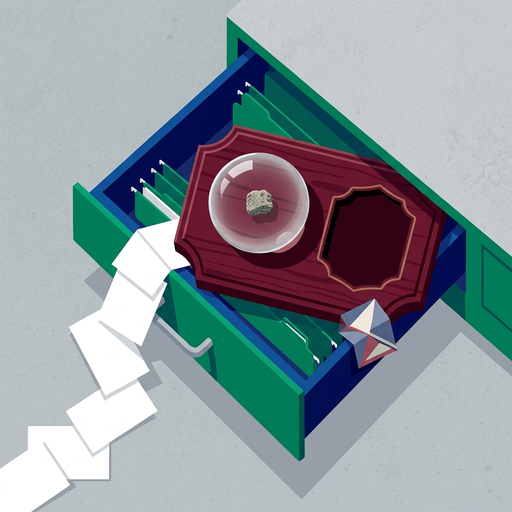
In nineteen ninety-eight, an American businessman arranged a private meeting in Miami to sell a piece of another world. The asking price was five million dollars. The object was an acrylic sphere encasing fragments of lunar rock, and the prospective buyers were undercover federal agents. That sting exposed a quiet, global reality. In the decades following the Apollo landings, hundreds of authentic presentation displays containing lunar material slipped away from public custody. Tracking where those pieces went reveals the delicate boundary between a priceless scientific sample, a forgotten diplomatic gift, and an object on the international black market.
At My Audio Books dot A I, you can create your own audiobooks from prompts, turn your documents into audio, all with one subscription, and store your items in your own personal library.
Between nineteen sixty-nine and nineteen seventy-two, six crewed Apollo missions touched down on the lunar surface. Astronauts on Apollo eleven, twelve, fourteen, fifteen, sixteen, and seventeen gathered approximately eight hundred forty-two pounds of lunar rocks, core tubes, pebbles, and surface soil. That material represented the most hazardous, technically demanding scientific collection effort in human history. Yet from the moment those transfer containers opened inside the Lunar Receiving Laboratory in Houston, the material split into two fundamentally different custody systems.
The vast majority of the samples entered NASA's scientific curation program. Under this framework, researchers across the globe could apply to analyze lunar material, but the space agency maintained permanent legal ownership and strict curatorial control. Every research loan required environmental controls, specialized vaults, precise accounting, and a legal obligation to return any unconsumed fragments.
Presentation displays followed an entirely separate route. Seeking to share the achievement as an act of international goodwill, the administration of President Richard Nixon directed NASA to package small fragments of lunar material into commemorative plaques. Two major distributions took place: the first after Apollo eleven in nineteen sixty-nine, and the second following Apollo seventeen in nineteen seventy-three, the final crewed lunar mission.
These goodwill displays combined geological specimens with political symbolism. Apollo eleven displays featured tiny particles of lunar soil encased in a clear acrylic sphere, mounted to a wooden plaque alongside the flag of the recipient nation or American state that had traveled aboard the spacecraft. Apollo seventeen displays carried a solid specimen chipped from a single, documented lunar rock catalogued as sample seven zero zero one seven. That parent rock, a basalt gathered in the Taurus-Littrow valley, was divided so that recipient nations and territories typically received fragments weighing about one and a half grams.
The decisive distinction lay in the transfer of title. When the United States government presented a goodwill plaque to a foreign head of state or an American governor, the object became an outright diplomatic gift. It ceased to be United States government property. NASA retained no supervisory oversight, no audit rights, and no authority to recall the display. Once the formal ceremonies concluded and the photographic flashes faded, the long-term survival of each gift rested entirely upon the institutional habits of the recipient.
That transfer of ownership also separated these specimens from other extraterrestrial rocks. Lunar meteorites, which are fragments blasted off the Moon by asteroid impacts that eventually land on Earth naturally, can be legally owned and traded on the private market. Terrestrial rocks can easily be misidentified or deliberately sold as counterfeit lunar material. Yet authentic Apollo material carries a distinct status: gathered directly by human hands, distributed through sovereign handovers, and governed by property laws that depend on continuous documentation.
In December two thousand eleven, NASA's Office of Inspector General released an audit that triggered international headlines by reporting that five hundred seventeen space samples were missing or stolen. The resulting coverage suggested that hundreds of historic Moon rocks had vanished from public museums overnight. In reality, that audit examined a completely different institutional problem.
The inspector general audited NASA's internal scientific research network, rather than the diplomatic gifts presented to world leaders. The five hundred seventeen unaccounted-for items included cosmic dust particles, meteorite fragments, and research loans granted to universities and private laboratories over several decades. Researchers had moved to new institutions, laboratories had closed, and specimens had been misplaced in storage cabinets without formal notification to NASA curators. The audit exposed genuine administrative weaknesses within the scientific custody system, but it was never a census of the world's missing goodwill displays.
Determining how many diplomatic Moon rocks actually survive requires consulting historical registers that frequently conflict. Different inventories establish different baselines depending on how they categorize territories, administrative bodies, and presentation phases. One widely cited historical count tracks three hundred seventy presentation displays across both Apollo programs, comprising two hundred seventy gifts to foreign nations and one hundred gifts to American states and territories. Another authoritative ledger counts three hundred seventy-nine displays in total.
The common reference to one hundred thirty-five recipients belongs specifically to the international distribution following Apollo eleven, which matched the roster of recognized foreign nations invited to receive commemorative gifts at the time. By the time Apollo seventeen returned, that international list had expanded, creating a different set of presentations. Recipient countries, physical presentation plaques, and individual mineral fragments represent three separate units of counting that casual accounts often conflate.
Decades after the presentations, independent researchers attempting to verify the whereabouts of these displays discovered wide inventory gaps. One historical survey identified one hundred fifty-nine international goodwill displays that could not be located. A separate detailed audit counted one hundred sixty international displays and twenty-four American state displays missing, reaching a combined total of one hundred eighty-four unlocated plaques out of three hundred seventy. Another comprehensive investigation placed the missing count at one hundred sixty-nine out of three hundred seventy-nine.
These figures describe snapshot audits rather than permanent losses. In archival research, an unlocated listing represents an evidentiary gap rather than confirmed criminal theft. It encompasses specimens resting in secure government vaults that lack public catalogues, records misplaced during bureaucratic reorganizations, and items quietly stored away by former officials who treated them as personal mementos. Determining whether an object was stolen, destroyed, or simply forgotten requires examining how institutional memory breaks down.
Physical objects in public custody survive only as long as the records attached to them remain unbroken. Most unlocated lunar displays slipped away through the ordinary friction of institutional custody, rather than daring museum heists.
When a national leader or state governor accepted a goodwill display, the plaque entered an executive environment rather than a dedicated archival repository. A plaque might sit on a prime minister's desk for several years, move to a ceremonial display cabinet, and then, following an election, be packed into an administrative transfer box bound for a state library, a historical society, or a government warehouse. If a receiving clerk logged the crate as political correspondence rather than space heritage, the physical connection to the object dissolved on paper.
Building renovations, departmental relocations, and informal loans created constant opportunities for loss. An agency director might lend a display to a regional school, a library, or a civic hall without formal loan agreements. When that official retired, the institutional knowledge of the loan vanished with them. Decades later, curators auditing the central collection could find no trace of the specimen, while the facility holding the object might assume it was merely a commemorative replica.
Political instability created far more severe disruptions. During military coups, civil conflicts, and regime collapses, government headquarters and presidential palaces were frequently ransacked or abandoned. Across multiple continents, sovereign administrations fell and archives were burned or scattered. In several recorded cases, presentation displays held in presidential compounds disappeared during periods of civil unrest, their historical value obscured by immediate political chaos.
The case of Alaska illustrates how routine administrative movement can obscure an authentic lunar artifact. Alaska received goodwill displays from both Apollo missions. In the early nineteen seventies, the Apollo eleven plaque was held by the Alaska State Museum, which later made it available for temporary regional display. During that period, documentation broke down, and the specimen ceased to appear in official property inventories. For decades, researchers assumed the piece was gone. In reality, the documented gap in custody did not prove a black-market transaction; it demonstrated how easily a physical object slips out of sight when accession ledgers are incomplete.
Historical accounts have identified eighteen missing Apollo eleven state displays and nine missing Apollo seventeen state displays across the United States. Yet when targeted archival searches were initiated, several of these missing specimens turned up in uncatalogued storage lockers, basement vaults, and the personal effects of retired officials who had preserved them without realizing their public status. The gap between an administrative inventory and physical reality is where most Moon rocks disappear.
Whenever an alleged piece of Apollo material surfaces in private hands, investigators face two distinct questions: whether the material is genuinely from the Moon, and whether the seller holds legal title to it. Establishing the physical nature of the object requires geological testing; establishing legal ownership requires documentary provenance.
Geological analysis can determine whether a mineral sample originated on the Moon. Lunar rocks possess unmistakable geochemical signatures, including distinctive ratios of oxygen isotopes, an absence of water within the crystal structure, and specific concentrations of iron and titanium that differ sharply from terrestrial geology. Yet laboratory testing has limits. Lunar chemistry can verify that a rock came from the Moon, but it cannot differentiate an Apollo sample gathered by astronauts from a lunar meteorite that fell to Earth through natural processes. Nor can chemistry alone prove whether a fragment was chipped from sample seven zero zero one seven or belongs to a specific nation's goodwill plaque.
Documentary provenance provides the indispensable chain of evidence. It traces the specimen from the lunar surface to the mission manifest, through the NASA curation laboratory, into the presentation mount, and across every institutional handover that followed. A handsome presentation plaque and a plausible historical narrative do not establish ownership. Similarly, an exorbitant asking price reflects only a seller's financial ambition, not a lawful right to sell public heritage.
These dual standards guided Operation Lunar Eclipse in nineteen ninety-eight. The joint investigation was initiated by Joseph Gutheinz, a senior special agent with the NASA Office of Inspector General, alongside Bob Cregger of the United States Postal Inspection Service, with operational cooperation from United States Customs. Recognizing that illegal markets for Apollo artifacts were growing, the agents placed an undercover newspaper advertisement seeking authentic lunar material.
A Florida businessman named Alan Rosen responded to the inquiry. Rosen held an authentic Apollo seventeen presentation display containing a fragment of sample seven zero zero one seven, which had originally been presented by the United States to the people of Honduras. Rosen had acquired the display from a Honduran military officer for fifty thousand dollars and imported the item into the United States in nineteen ninety-five. Convinced that the piece could be legally liquidated on the private collector market, Rosen offered the display to the undercover agents for five million dollars.
The undercover team arranged a meeting at a hotel in Miami. When Rosen presented the acrylic sphere and commemorative plaque for inspection, federal agents seized the object. The seizure initiated an extended legal battle over civil forfeiture, sovereign property rights, and customs regulations. While the specimen was physically secure, confirming its specific identity required tracing its documented history back to the original gift presented to the Honduran government.
Court rulings affirmed that the Apollo seventeen display remained the sovereign property of Honduras, gifted to its people and unlawfully removed from public custody. The specimen was officially repatriated, bringing an end to years of illicit private transit. Today, that Apollo seventeen fragment is housed in the Chiminike interactive education center in Tegucigalpa, protected as national heritage. The recovery proved that an illicit transaction could be halted, but it also underscored how vulnerable these objects remain once they enter private trade.
Operation Lunar Eclipse was a triumph of interagency investigation and forensic authentication, yet recovering a single specimen resolved one illicit transaction while leaving the wider challenge of unrecorded collections unaddressed. A successful undercover sting addresses the consequence of a black market, but it cannot reconstruct the missing custody records of hundreds of other distributed gifts.
The underlying vulnerability was institutional. When the Apollo presentations were planned, lunar material was treated as the ultimate diplomatic currency, an extraordinary emblem of human achievement presented to heads of state, foreign ministries, embassies, universities, and state capitols. Yet once delivered, these extraordinary objects were absorbed into ordinary property systems with wildly uneven record-keeping practices. While NASA maintained an ultra-clean, high-security curatorial repository in Houston for its scientific core, the goodwill gifts were left to navigate the unpredictable currents of international diplomacy, political change, and local bureaucracy.
Even within NASA's domestic sphere, absolute custody proved elusive. The hundreds of unaccounted-for research samples identified in the two thousand eleven inspector general audit demonstrated that specialized scientific institutions also experience administrative lapses. Physical custody relies on continuous administrative vigilance. Without periodic audits and physical verification, records deteriorate across sovereign ministries and specialized space agencies alike.
Mineralogy can confirm the physical reality of an object, but only documentation preserves its historical identity. If an authentic piece of lunar basalt is recovered without records, its connection to Apollo, a specific landing site, or a sovereign nation remains unprovable. Conversely, when researchers systematically reconstruct paper archives, unlocated objects frequently emerge from forgotten institutional corners without the need for federal warrants or legal seizures.
These presentation displays occupy a unique position at the intersection of planetary science and human history. They are tangible relics of the moments when human beings walked across another world, transformed into gifts designed to bridge political divides on Earth. When one of these displays disappears, the loss is not simply a financial figure or a property dispute; it is an erosion of shared public heritage.
Significant questions remain open. Many unaccounted-for displays likely survive quietly in regional archives, waiting for a curator to cross-reference an old register. Others were permanently lost during civil conflicts, while some remain hidden in private collections. Resolving those questions depends far less on black-market stings than on transparent public inventories, rigorous museum cataloguing, and an enduring commitment to track what was entrusted to public care.
Apollo brought pieces of another celestial body home to Earth, but ceremonies and speeches could never guarantee their preservation. Whenever an authentic lunar fragment emerges, the decisive question is never just whether the stone came from the Moon, but who protected it across the decades, how it changed hands, and whether its history can still be proved. If this account changed how you view the artifacts of space exploration, consider looking into the public collections in your own region, and asking what extraordinary pieces of history might be resting uncatalogued in their vaults.