Michelangelo’s Sistine Ceiling: The Engineering, Labor, and Patronage Behind the Frescoes
From 1508 to 1512, Michelangelo transformed an unwanted commission from Pope Julius II into the Sistine Chapel ceiling, overcoming engineering challenges, unforgiving fresco deadlines, physical strain, and interrupted payments. Through inventive scaffolding, coordinated workshop labor, and an evolving vision—from the crowded Flood to the monumental Creation of Adam—he turned the practical constraints of the job into artistic breakthroughs. Unveiled in 1512, the ceiling redefined monumental painting, revealing an achievement forged as much through disciplined work and adaptation as through extraordinary imagination.
By MyAudioBooks.ai ·
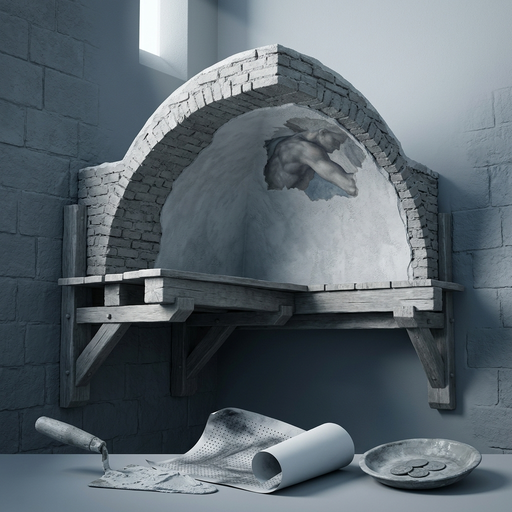
In the late spring of fifteen hundred and eight, Michelangelo Buonarroti faced an architectural problem that threatened to ruin his reputation. High above the stone pavement of the Vatican’s primary ceremonial chapel, an expanse of curved brick and masonry arched roughly twenty metres over the floor. The hall could not be shut down like a typical building site. Papal masses, diplomatic receptions, and official conclaves had to proceed below while tons of timber, plaster, and wet pigment moved across the upper air. The patron who demanded this work was Pope Julius the Second, a ruler whose military ambition matched his desire to reshape Rome. Michelangelo, who had established his fame by carving colossal marble in Florence and Rome, insisted repeatedly that he was a sculptor rather than a painter. Yet the ceiling belonged to him, and the physics of the assignment were unforgiving. Wet lime plaster sets within hours, giving the painter a strictly limited window to finish each section before the surface locks out the brush. Making that brief window usable across thousands of square feet required an immense apparatus of scaffolding, materials, wages, and coordinated physical labour.
At My Audio Books dot A I, you can create your own audiobooks from prompts, turn your documents into audio, all with one subscription, and store your items in your own personal library.
How does a reluctant sculptor, working under an impatient pope, transform an unmanageable architectural assignment into a landmark of monumental painting? The answer lies in the material conditions of the job itself: first, the engineering of the scaffold and the expansion of the initial contract; second, the chemistry of wet plaster and the physical toll of daily execution; third, the financial crises that forced changes in scale; and finally, the unveiling that redefined Renaissance painting.
When Pope Julius summoned Michelangelo to decorate the chapel vault in May of fifteen hundred and eight, Michelangelo was already committed to an immense project for the same patron. Three years earlier, in fifteen hundred and five, Julius had commissioned him to build a colossal, freestanding marble tomb intended for Saint Peter’s Basilica. Michelangelo had spent eight months in the quarries of Carrara selecting marble blocks, only to find the pope’s attention and treasury redirected toward rebuilding the basilica itself under the architect Donato Bramante and financing military campaigns in northern Italy. To Michelangelo, the ceiling commission arrived as an unwelcome distraction from his true calling as a marble sculptor, and an assignment fraught with professional danger.
Patronage in the papal court operated as an ongoing negotiation over resources, artistic freedom, and status between a powerful sovereign and an independent artisan. Popes used monumental commissions to project spiritual authority and familial prestige, while artists used them to secure financial stability and artistic autonomy.
The initial scheme discussed for the ceiling was modest compared to what stands there today. According to Michelangelo’s later letters and the early biographical accounts written by Ascanio Condivi in fifteen fifty-three and Giorgio Vasari in fifteen fifty and fifteen sixty-eight, the pope’s advisers originally proposed painting figures of the Twelve Apostles in the triangular supports along the edges, with the wide central vault filled by geometric decorative patterns. Michelangelo argued that such a design would look poor and conventional. Julius granted him permission to expand the narrative program, though no single master contract survives that records the complete theological plan in advance. Surviving sketches demonstrate that the iconography evolved through trial, consultation with papal theologians, and practical calculation of what could be seen from the pavement below.
The early biographies by Vasari and Condivi remain indispensable historical records, yet both authors wrote decades after the events to burnish Michelangelo’s legacy. Vasari claimed that rival artists, jealous of Michelangelo’s standing, deliberately urged the pope to assign him the fresco in the hope that he would fail publicly in a medium he had not mastered. Documentary evidence does not corroborate this conspiracy. Michelangelo brought substantial preparation to the project. He had trained as an adolescent in the busy Florentine workshop of Domenico Ghirlandaio, one of the most proficient fresco masters of the fifteenth century, and he had recently painted the celebrated Doni Tondo in tempera. His reluctance stemmed from his sculptural commitments and the sheer logistical misery of the site rather than technical ignorance.
Before any paint could touch the vault, Michelangelo had to solve the engineering problem of physical access. The chapel ceiling is a barrel vault flattened along its crown, punctuated by triangular spandrels above the arched windows. Bramante had initially proposed a scaffold suspended by ropes through holes drilled into the masonry of the vault. Michelangelo rejected this idea immediately, pointing out that puncturing the ceiling would leave holes that could never be properly repaired or painted over. Instead, Michelangelo designed a stepped wooden platform supported by heavy timber brackets anchored into putlog holes cut into the chapel walls just above the window cornices.
This bridge-like truss structure spanned the width of the chapel without requiring vertical timber posts that would clutter the ceremonial floor beneath. The platform moved forward in stages along the length of the chapel as work progressed, carrying the artist and his materials within arm’s reach of the curving plaster. A popular misconception claims that Michelangelo spent four continuous years lying flat on his back upon this platform. Modern architectural reconstructions of the scaffold show that the working platform sat close enough to the vault to allow him to work standing upright, leaning backward, or crouching according to the curve of the architecture. He worked with his arms elevated and his neck craned upward for hours, but it was an upright and dynamic posture rather than continuous horizontal confinement.
Once the wooden platform brought the vault within reach, the primary obstacle shifted from the timber below to the chemistry above: how much painting could be completed before freshly laid plaster set permanently into stone.
Painting on a vault twenty metres in the air followed a strict industrial sequence. Long before plaster was mixed, the composition had to be finalized on paper. Michelangelo created detailed preparatory life studies in chalk and ink, which were scaled up into full-sized working drawings called cartoons. The lines of these cartoons were then transferred to the wall, either by puncturing the paper along the contours and dusting charcoal powder through the holes, or by using a metal stylus to press the drawn lines directly into the damp plaster surface.
The method Michelangelo used for the ceiling was buon fresco, the technique of painting water-borne earth pigments onto fresh, damp lime plaster so that the colours bond chemically into the curing stone. Slaked lime, which is calcium hydroxide, absorbs carbon dioxide from the surrounding air as it dries, transforming into calcium carbonate, which is chemically identical to limestone. This chemical reaction locks the pigment crystals permanently inside the rock surface. The resulting bond makes buon fresco exceptionally durable, but it eliminates any leisure in execution. The artist cannot pause, erase, or allow the surface to dry before completing the painted area.
To manage this deadline, the surface was divided into sections called a giornata, which translates as a day's work and represents the patch of fresh plaster sized precisely for what a painter could complete in one working period. Each morning, plasterers applied a thin finishing coat of damp lime mortar, known as the intonaco, over a rough base coat, covering only the specific figure or background segment planned for that day. The boundaries of these sections followed the contours of limbs, drapery folds, or architectural mouldings so that the joints between successive applications of mortar remained inconspicuous from the floor.
The visible joints preserved across the Sistine ceiling provide undeniable physical evidence that the composition was executed as a series of timed tasks. Once the plaster hardened, the chemical window slammed shut. The surface stopped absorbing water, and fresh paint could no longer bind into the masonry by buon fresco. If an artist made a serious error or ran out of daylight, the setting plaster had to be chipped away with a cold chisel and a fresh batch laid down the following morning.
Technical execution proved fragile almost immediately. During the winter of fifteen hundred and eight into fifteen hundred and nine, as Michelangelo began painting the first narrative scenes near the chapel entrance, early accounts report that moisture seeped through the plaster, causing white crystalline deposits of salt, known as efflorescence, to erupt across the wet paint. Condivi and Vasari both recount that Michelangelo went to Julius in despair, claiming that the medium had betrayed him. The Florentine architect Giuliano da Sangallo examined the failure and discovered that the local Roman lime mortar, mixed with volcanic pozzolana sand, retained far too much moisture under humid chapel conditions. Sangallo showed Michelangelo how to alter the proportions of slaked lime and sand to create a mortar that cured cleanly without throwing off efflorescence. Historical analysis confirms that early passages required significant corrective scraping and replastering before reliable progress could resume.
This technical complexity required a functioning workshop. Romantic tradition often portrays Michelangelo working in absolute isolation, locking the chapel doors to bar every assistant. The physical demands of fresco made complete solitude impossible. Preparing the heavy lime plaster, hauling barrels of water and sand up the scaffolding, grinding raw mineral pigments, and transferring full-scale cartoons demanded continuous physical labour. Michelangelo recruited an experienced team of Florentine painters and plasterers, including his friends Giuliano Bugiardini, Francesco Granacci, and Aristotile da Sangallo.
The biographical record indicates that Michelangelo soon found their execution unsatisfactory. He disliked their conventional fifteenth-century brushwork and dismissed several assistants from the painted surface, choosing to execute the actual figures with his own hand. While he dismissed fellow painters from executing the final figures, he retained a dedicated support crew. Masons, pigment grinders, and platform handlers remained at work behind him throughout the four-year project, ensuring that every daily patch of plaster was mixed and laid to his precise specifications.
The bodily cost of this continuous labour appears vividly in a comic, agonized poem Michelangelo drafted around fifteen hundred and nine, addressed to his friend Giovanni da Pistoia. In the margins of the manuscript, he sketched a grotesque cartoon of himself standing stiffly on the scaffold, arm raised overhead, paintbrush dripping wet pigment onto his face. In the verses, he described his belly pressing against his chin, his beard pointing toward the sky, his spine folded backward, and his chest growing a goiter-like strain from the constant overhead posture. He noted that paint rained continuously down upon his skin, turning his face into an accidental mosaic, while his eyesight suffered from constantly focusing upward at extreme foreshortened angles.
The poem operated as self-deprecating satire while registering the genuine bodily strain of the assignment. Painting hundreds of figures overhead in freezing winter draughts and oppressive summer heat tested the limits of human endurance.
Before going further, try to explain to yourself in one sentence why a fresco project cannot simply pause when money runs out and resume months later without structural consequences.
A fresco working unit demands that plasterers, cartoon preparers, scaffold builders, and the painter converge simultaneously at the exact moment the lime is mixed and receptive. If cash flow interrupts the supply of timber, sand, pigments, and wages, the entire production line stops, leaving unpainted plaster edges to cure and harden into dead boundaries that require difficult structural cuts when work resumes.
On the seventh of September, fifteen ten, Michelangelo wrote a pointed letter to his father in Florence that strips away the romantic mythology of the project and exposes its mechanics as a job. In the letter, Michelangelo stated that he was awaiting five hundred ducats that the pope owed him for completed work, and that he needed an equivalent sum of five hundred ducats merely to move the scaffolding to the second half of the vault and purchase the materials required to continue. Julius the Second had left Rome for Bologna to conduct a military campaign against French forces, leaving his treasury officials behind and the artist stranded without liquid capital.
This letter illustrates how cash flow directly governed physical access. Michelangelo requested these funds to cover immediate operational costs, as moving the massive wooden platform across the chapel clerestory required carpenters, riggers, and new timbers, all of which had to be paid in hard currency. Surviving financial records reveal substantial gaps between project authorizations and actual disbursements. Early sources report conflicting figures for the total financial agreement. Vasari mentions an authorized sum of fifteen thousand ducats, while Condivi records that Michelangelo received approximately three thousand ducats for his labour and expenses. These conflicting numbers reflect different accounting categories: the total budget authorized by the papal chamber versus the net payments made to Michelangelo after subtracting the costs of materials, timber, and assistant wages. When papal disbursements ceased, construction on the scaffold stopped, and the production of daily plaster units ground to a halt.
Between the late summer of fifteen ten and the summer of fifteen eleven, the scaffold was dismantled from the eastern half of the chapel and re-erected over the western half. This shift exposed the first completed portion of the ceiling to the papal court, offering the first opportunity for observers to inspect the work from the stone floor below.
The visible contrast between the early and late sections of the ceiling reveals a dramatic evolution in artistic scale and economy. Near the entrance of the chapel, in the early scene depicting the Flood, Michelangelo crowded more than sixty small figures across the composition. The figures are arranged in narrative pockets: refugees scrambling up a rocky hill, survivors huddling beneath a makeshift tent, and frightened crowds storming the floating ark. From the floor twenty metres below, this multiplicity of small figures is difficult to decipher. The narrative appears dense and fragmented.
By the time Michelangelo began painting the western half of the vault, after the scaffold was moved, his compositional strategy changed completely. In the Creation of Adam, painted on the second half of the ceiling, the crowded landscapes and multi-figure clusters disappear. Two monumental figures dominate an open expanse of painted sky. God rushes forward supported by angels within a billowing mantle, while Adam reclines upon a barren earth, extending his arm with an unforgettable gesture of longing. The figures are massive, their musculature is bold and legible from the floor, and the dramatic tension is concentrated into the narrow gap between their touching fingertips.
This shift toward larger figures directly answered the visual demands of the chapel interior. While biblical chronology begins with the Creation and moves toward the Flood, Michelangelo painted the ceiling in reverse chronological order, starting at the chapel entrance and working toward the altar. As he gained experience with how his painted forms registered across the immense vertical space of the building, he eliminated secondary detail, enlarged the proportions of his figures, and increased the breadth of his brushwork.
Technical examination also clarifies the boundary of the buon fresco method. While the vast majority of the ceiling was executed directly into wet lime, Michelangelo also made selective use of a secco painting, the method of applying pigment mixed with an organic adhesive, such as egg yolk or animal glue, onto plaster that has already dried. A secco details were used primarily for small corrections, gilded ornaments on thrones and architectural cornices, and certain dark shadows that could not be achieved during the damp working window.
Because a secco pigment rests upon the cured stone rather than bonding within its crystalline structure, these passages are far more vulnerable to moisture, cleaning, and environmental decay over time. Modern conservation campaigns confirmed that Michelangelo worked almost entirely in pure buon fresco, relying on wet plaster for his core expressive power while using a secco strictly as a secondary tool of refinement.
By the summer of fifteen twelve, with the second half of the vault nearing completion, the project approached its ceremonial deadline.
On the evening of the thirty-first of October, fifteen twelve, the eve of All Saints’ Day, the Sistine Chapel opened for solemn papal vespers. The scaffolding had been completely dismantled, the dust cleared from the floor, and the entire ceiling exposed to the view of the papal court. Julius the Second celebrated the feast of All Saints the following morning, the first of November, beneath an expanse of painting that altered the course of Western art.
The completed work united three hundred and forty-three individual figures within a fictitious marble architectural framework. Running down the spine of the vault are nine central panels illustrating the book of Genesis, divided into three thematic groups: the Creation of the World, the Creation and Fall of Humanity, and the Story of Noah. Flanking these central narrative panels are twelve colossal seated figures: seven Hebrew prophets and five pagan sibyls, ancient prophetesses who were understood in Renaissance Christian theology to have foretold the coming of Christ to the Gentile world. At the corners of the narrative panels recline twenty athletic nude male figures, known as the ignudi, whose precise theological symbolism remains a subject of modern scholarly debate. In the triangular spandrels and arched lunettes above the windows, occupying the dark margins of the vault, sit the quiet, shadowed generations of the Ancestors of Christ.
The artistic impact of the ceiling can be understood by comparing two distinct visual registers. Consider the difference between the colossal prophets and the humble ancestral family groups. The seated prophets, such as Jonah, Jeremiah, and the Libyan Sibyl, are defined by powerful bodily torsion, the dramatic twisting movement of the shoulders in the opposite direction to the hips. Jonah leans back into space with foreshortened thighs, gazing straight up toward the heavens, his massive body appearing to push back against the physical curvature of the masonry.
Below them, tucked inside the window lunettes, the ancestors of Christ occupy an intimate, earthbound register. Here there are no heroic postures or divine encounters. Instead, Michelangelo painted weary mothers nursing infants, fathers slumped forward in exhaustion, and quiet families huddled together in travel. Executed rapidly with broad, fluid strokes of thin paint, these figures reveal Michelangelo’s capacity for domestic observation alongside public monumentality.
The consequences for sixteenth-century art were immediate and profound. Michelangelo had treated the human body not as a static decorative ornament, but as an expressive instrument capable of bearing immense weight, tension, and emotional thought. The muscular anatomy, unexpected foreshortening, and spatial compression visible on the ceiling provided a visual vocabulary that later sixteenth-century painters studied and transformed, fueling the stylistic developments of Mannerism. Artists like Rosso Fiorentino, Pontormo, and the young Raphael absorbed the physical energy of the Sistine vault, recognizing that monumental painting had been radically redefined.
The Sistine ceiling stands as the deliberate conversion of a complex, heavily constrained job into an unprecedented artistic statement. Through the discipline of the daily plaster patch, the engineering of the scaffolding, the management of workshop labor, and continuous negotiations over cash and authority, Michelangelo expanded what paint on plaster could achieve.
The next time you encounter a reproduction of the Sistine ceiling, look past the familiarity of the images and observe three practical traces of the job. First, compare the crowded composition of the Flood near the entrance with the monumental economy of the Creation of Adam to see how Michelangelo adapted his scale to the height of the room. Second, contrast the dramatic bodily twist of the monumental prophets with the quiet, everyday posture of the ancestral families painted in the lunettes below. Finally, study high-resolution detail images of the surface to locate the faint, jagged seams of individual giornate, remembering that every line marks the boundary of a single day’s race against setting lime plaster. The surviving records leave open how much of this achievement was driven by artistic ambition and how much was forced by practical necessity, but the ceiling itself endures as proof of what happens when exceptional invention meets the uncompromising limits of a job.