Matchgirls of Bow: The Eighteen Eighty-Eight Strike and the Fight Against White Phosphorus
In 1888, 1,400 women and girls at Bryant and May’s London match factory struck against starvation wages, punitive fines, and white-phosphorus fumes that could rot away their jawbones, winning concessions and building a pioneering women’s union. Their victory helped ignite Britain’s New Unionism and shattered assumptions that unskilled women could not organize—though the poison itself remained legal until a broader campaign, scientific advances, and international action finally banned white-phosphorus matches two decades later.
By MyAudioBooks.ai ·
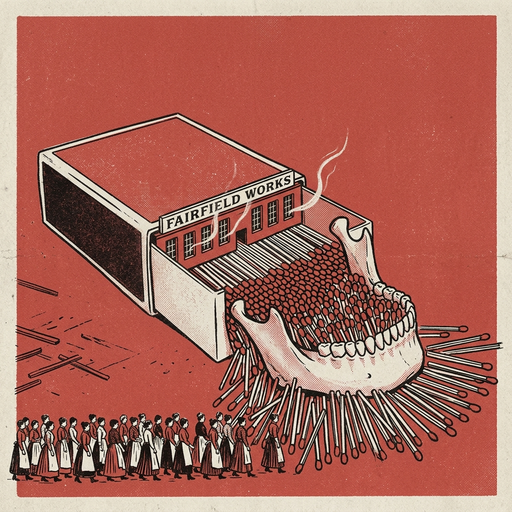
In late nineteenth-century Britain, an ordinary wooden match was an indispensable household convenience, struck millions of times a day to light parlor grates, gas lamps, and kitchen stoves. Inside that everyday object lay white phosphorus, an active chemical capable of igniting on almost any rough surface. Yet it was potent enough to destroy the facial bones of the people who handled it. In July eighteen eighty-eight, hundreds of women and teenage girls walked out of the largest match factory in London, halted production, and forced their employers to yield within two weeks. Their defiance transformed modern labor organizing, but it left behind an enduring question. Did their famous victory actually change British labor law, or did the legal ban on that dangerous poison belong to an entirely different struggle?
At My Audio Books dot A I, you can create your own audiobooks from prompts, turn your documents into audio, all with one subscription, and store your items in your own personal library.
The epicenter of Britain's match trade stood in Bow, an industrial district in London's East End. There, the firm of Bryant and May operated the Fairfield Works, a sprawling complex that turned out millions of friction matches every working day. Mass-producing these cheap fire-sticks required hundreds of manual workers, drawn almost entirely from the surrounding working-class neighborhoods. Local women and teenage girls dominated the packaging and dipping rooms, standing for hours at long benches as they sorted, boxed, and dipped wooden splints into chemical paste.
The name most often applied to this workforce, the matchgirls, suggested adolescent youth. Yet the factory floor brought together children as young as twelve alongside adult women supporting entire households. For these families, factory employment provided vital income, but it tied domestic survival to some of the most dangerous conditions in Victorian industry.
The root of that danger was white phosphorus. Manufacturers favored white phosphorus because it ignited readily at low temperatures and sparked reliably across almost any friction surface. Safer alternatives existed, including red phosphorus, which was used in safety matches that ignited only against a prepared chemical strip on the box. Yet consumer preference and commercial cost kept white phosphorus dominant. Buyers demanded strike-anywhere matches, and British manufacturers continued to feed that demand.
Making these matches meant constant chemical exposure. In the dipping rooms, workers plunged bundles of wooden splints into heated troughs of phosphorus paste, releasing continuous chemical vapors. In the boxing departments, workers packed dried match heads into containers at breakneck speed, frequently inhaling fumes or triggering accidental flare-ups on the tables. Because factory ventilation remained primitive, these vapors hung in the enclosed rooms day after day.
The workers who breathed those fumes occupied a marginal position in Victorian society. Mainstream trade unions focused almost exclusively on skilled male craftsmen, viewing unskilled women and young girls as transient and unorganizable. Without formal representation in Parliament or backing from established labor institutions, the Bow workforce faced the hazards of the factory floor in complete isolation.
Those hazards were already well documented. Decades before the eighteen eighties, medical authorities across Europe had identified a severe, specific occupational disease directly caused by phosphorus vapors. That established pathology set up an inevitable collision between workplace conditions and human bodies.
The occupational illness linked to white phosphorus was known colloquially as phossy jaw, and medically as phosphorus necrosis of the jaw. The condition developed as phosphorus vapors entered the body, typically through decayed teeth or inflamed gums, and attacked the bone tissue of the lower or upper jaw.
Physicians first recorded the disease in continental Europe during the eighteen thirties and eighteen forties, and detailed medical reports circulated through British journals by the middle of the nineteenth century. The disease followed an agonizing progression. It began with persistent toothaches and swelling of the gums. As the infection took hold, abscesses formed along the jawline, leaking foul-smelling discharge through the gums and the skin of the face.
The underlying bone steadily died. Deprived of blood flow, the dead bone separated from living tissue, forming loose fragments that had to be expelled or surgically removed. In severe cases, surgeons excised entire sections of the human jaw to prevent the infection from spreading into the brain or bloodstream. Survivors suffered permanent facial disfigurement, severe speech impairment, and chronic digestive failure from the inability to chew solid food. In the worst instances, systemic infection proved fatal.
This disease fell heavily on the industrial poor. Wealthier consumers enjoyed the convenience of cheap friction matches, while the bodily cost remained concentrated among the factory workers who produced them. Historical records leave the exact frequency of phossy jaw within Bryant and May's own workforce during the eighteen eighties uncertain. Employers frequently concealed cases and dismissed symptomatic workers before their conditions reached hospital registries. Yet the occupational danger itself was indisputable.
Alongside bodily peril, the workers faced severe financial discipline. Match workers earned low piece-rate wages, often bringing home only four to eight shillings a week for long shifts that stretched from dawn until dusk. From these meager earnings, factory managers subtracted an aggressive system of fines and deductions.
Supervisors penalized workers for minor infractions, including talking on the line, leaving workbench areas untidy, dropping matches, or arriving a few minutes late. Additional deductions were taken for the brushes, glue, and sandpaper required to complete their work. These deductions directly reduced take-home pay, turning internal factory rules into immediate household hardship. A single deducted shilling could wipe out a day's food for an entire family.
The dispute grew out of the compounding weight of bodily hazard, subsistence pay, and an authoritarian disciplinary system, bringing financial hardship and physical risk together into a single crisis.
The standoff broke into the open in June eighteen eighty-eight, when outside reformers began publicizing factory conditions. Annie Besant, a prominent social reformer, journalist, and member of the Fabian Society, published a blistering exposé detailing the wages, fines, and health hazards inside Bryant and May. Her reporting brought the reality of Bow into middle-class drawing rooms, sparking public outrage against a company whose directors cultivated reputations as generous philanthropists.
Bryant and May management responded aggressively. Factory managers demanded that workers sign printed loyalty declarations denying the published allegations and affirming their satisfaction with workplace conditions. The workers refused. When management retaliated by dismissing a worker suspected of speaking to outsiders, the confrontation crossed an irreversible threshold. While surviving accounts offer slightly different details regarding the exact sequence of individual dismissals, the collective response was immediate.
On July fifth, eighteen eighty-eight, the workers walked out. Within days, roughly fourteen hundred women and girls abandoned their benches, shutting down production across the complex. The sudden withdrawal of labor stunned company directors who had assumed that poor, unorganized women would never risk their livelihoods.
Outside allies quickly rallied to assist the strikers. Annie Besant and fellow socialist organizer Herbert Burrows helped the women coordinate their meetings, formed a strike committee, and established a strike fund that distributed financial relief to destitute families. Public sympathy grew as striking workers marched through London to the Houses of Parliament, bringing their physical presence and moral claims straight to the center of British political life.
The pressure operated on two distinct fronts. Inside the factory, empty workshops cost the company money every day production remained frozen. Outside, newspaper coverage and boycott threats inflicted severe reputational damage on Bryant and May's shareholders. Within two weeks, management capitulated.
On July seventeenth, eighteen eighty-eight, the company entered negotiations with the strike committee and agreed to substantial concessions. Bryant and May agreed to abolish deductions for materials and end punitive fines. They promised to take back all striking workers without retaliation, and to provide a separate dining room so workers would not have to eat meals amid toxic phosphorus dust.
The victory expanded beyond the settlement table into lasting organization. Following the strike, the workers formed the Union of Women Match Makers, which soon became the largest trade union of women in the United Kingdom. Their success proved that collective action could win tangible concessions even in an industry with no prior history of unionization.
Yet that historic victory carried a profound limit. The settlement abolished unfair fines and improved dining facilities, yet white phosphorus remained in active use on the factory floor. The very chemical that caused phossy jaw remained in production, revealing a sharp divide between settling an industrial dispute and ending an occupational poison.
The persistence of white phosphorus after the strike directly challenges the popular belief that the eighteen eighty-eight walkout outlawed the poison. The legal eradication of white phosphorus took another twenty years of scientific investigation, political debate, and diplomatic negotiation.
The first major parliamentary division concerning factory regulations and phosphorus matches took place in nineteen hundred, twelve years after the workers marched out of Bow. During that debate, lawmakers considered whether administrative rules and improved ventilation could control the hazard, or whether the chemical itself required direct state prohibition. Factory inspectors documented that voluntary industry guidelines failed to stop new cases of bone necrosis. Companies routinely concealed illnesses or dismissed affected workers before health officials could record them.
The definitive legal change arrived only with the passage of the White Phosphorus Matches Prohibition Act of nineteen hundred eight, two decades after the matchgirls won their strike. This statute went far beyond regulating working hours or shop floor ventilation. It explicitly prohibited the manufacture, sale, and importation of matches made with white phosphorus throughout the United Kingdom.
The statute took effect through phased stages, allowing manufacturers time to clear existing inventories and convert machinery before full prohibition arrived around nineteen hundred ten.
This long delay reflected several converging factors. Banning the substance required developing commercially viable alternatives. French chemists Henri Sévène and Emile Cahen patented a safe friction match using phosphorus sesquisulfide in the late eighteen nineties. That breakthrough gave manufacturers a workable substitute that ignited on friction surfaces without releasing toxic fumes. Bryant and May adopted this safer compound around nineteen hundred, driven by sustained press exposure and the threat of boycotts.
At the same time, international diplomacy played an indispensable role. British manufacturers had long argued that a domestic ban would simply open the home market to cheap, dangerous matches imported from abroad. That commercial stalemate broke only after the nineteen hundred six Berne Convention, an international treaty in which several European nations agreed to ban the manufacture and import of white phosphorus matches simultaneously.
The eighteen eighty-eight strike was essential in breaking public silence and exposing industrial exploitation to the nation. Yet the eventual statutory ban was the result of a broader historical movement, shaped by medical reporting, factory inspection scandals, technological innovation, and international trade treaties.
The lasting significance of the eighteen eighty-eight strike lies in the transformation of modern trade unionism. Prior to the walkout, the British labor establishment operated under the assumption that low-wage, unskilled workers, especially women and young people, were impossible to organize. Conventional union leaders believed that workers living near subsistence lacked the financial leverage to sustain a work stoppage.
The women and girls of Bow dismantled that assumption in fourteen days. Their disciplined withdrawal of labor demonstrated that unorganized workers could coordinate strategy, articulate clear demands, and win public solidarity. Their success acted as an immediate spark for New Unionism, a transformative wave of labor organizing that swept Britain over the following years. It inspired dockers, gasworkers, and other unskilled laborers to form mass industrial unions.
Important historical questions about the strike remain subject to ongoing research. Because the company kept inconsistent employment records, historians still debate the precise proportion of workers who were under eighteen years old during the walkout. Similarly, the degree to which factory managers adhered to every concession in the months following the agreement remains difficult to verify across every department. Nor can historians assign an exact mathematical weight to how much the eighteen eighty-eight strike contributed to the nineteen hundred eight legislation compared to later diplomatic treaties and chemical patents.
What remains clear is that the workers established a model of collective representation that outlived their immediate dispute. By forming their own union, they proved that collective power was not the exclusive privilege of skilled craftsmen. They demonstrated that the people who perform the most dangerous work possess the capacity to challenge the terms of their employment.
The industrial victory of eighteen eighty-eight transformed labor history, while the legal elimination of white phosphorus demanded another two decades of sustained agitation. Every strike-anywhere match that lit an ordinary Victorian home carried an invisible cost paid in human health, until the workers who made them refused to carry that cost alone.
When you look at how everyday consumer goods enter your daily life, the quiet compromises embedded in modern manufacturing become hard to ignore. Beneath the convenience of the products we take for granted, the question is always who bears the hidden physical cost, and what becomes possible when those workers decide to act together.